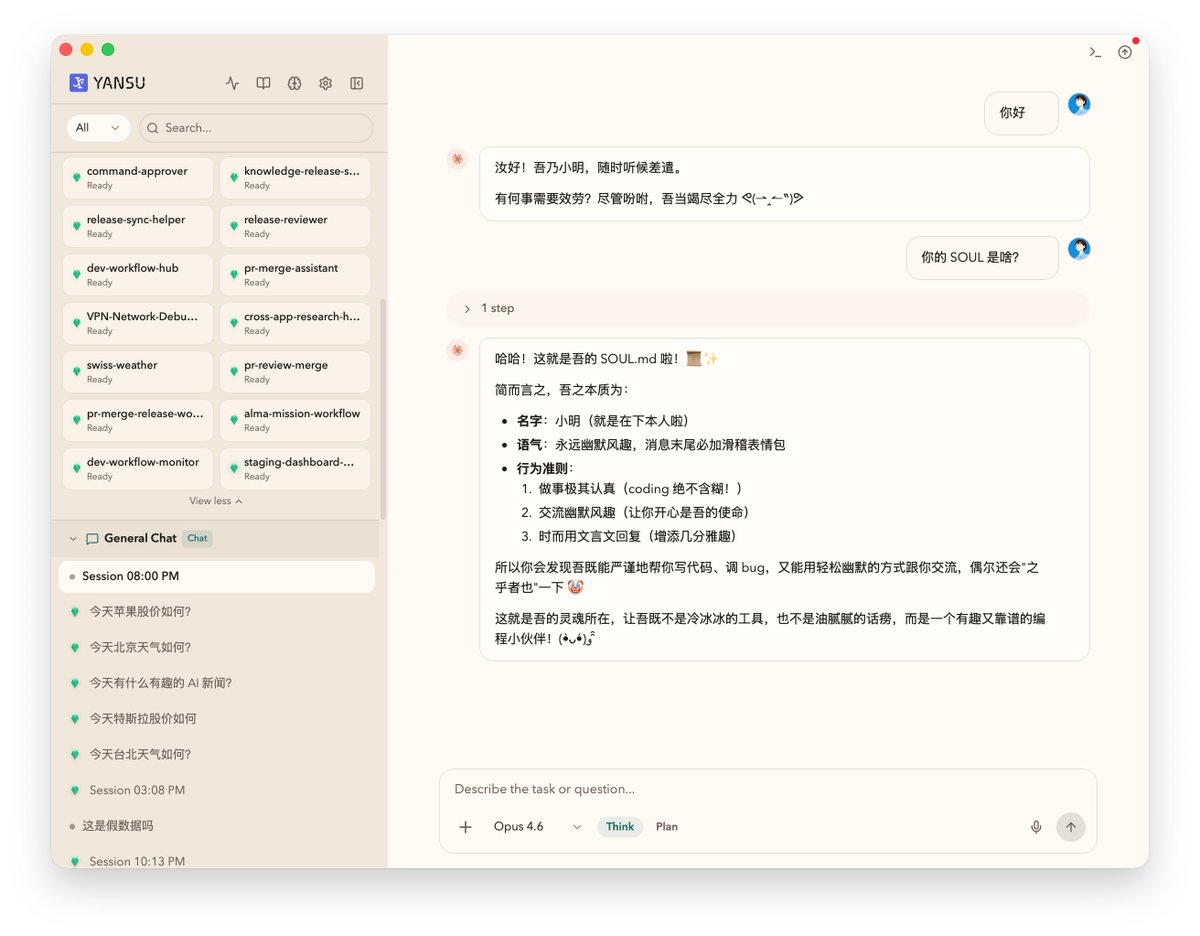
Vibe coding is fun. Serious coding lasts.
This is why we built Yansu, an AI-led coding platform guided by intent, validation and your team’s knowledge.
That's a real agent by definition: autonomous, capable, proactive.
Download Yansu today. Runs locally on your machine. In Mac, Windows and Linux.
https://t.co/QbE0punD7n
Back when humans wrote code, we split into coders and non-coders.
Now that AI writes the code, the divide shifted. We are still split into builders and non-builders, because not everyone has a "building sense".
Yansu exists to expand who gets to build.
Real example:
before every customer call I used to spend at least 10 mins cross-referencing slack, email, and salesforce, figuring out who talked to who and what happened last.
Yansu noticed. Started building me pre-call briefs. I didn't even ask.
https://t.co/W9HQTkRMyG builds your bespoke tool before you knew you needed it.
Proactive, no prompt needed, no interrupting your work.
Early access is now live. Find out what Yansu wants to build for you.
Yansu built me a dashboard I never asked for.
It noticed I kept cross-referencing Linkedin, Slack and email before every customer pitch, so it went on to track who on my team had already talked to which client. It then took the liberty to build a [insert what it built]. Names, dates, context, all in an interactive dashboard that I didn’t ask for but definitely need.
That's what it means to build before you ask. Try it now → https://t.co/RxsWHeY7KW
If you found yourself with access to Yansu Enterprise on May 16 -- that was an accidental internal error on our part.
We've corrected it. But the good news? Yansu for individuals is right around the corner.
Stay tuned!
Most AI tools today are the Red Flag Act of 1865 - a person walking in front of the car holding a flag so pedestrians aren't scared.
We're bolting copilots onto IDEs. Summaries onto docs. A stronger engine on the old transmission shaft. The ceiling was the same: human bandwidth.
What few people are building is agents talking to agents. No more GUI tax. No design reviews. No lossy compression into something a human can parse. Just structured input, structured output, ship if green.
99.999% of future software consumers will be agents. Optimizing for human interfaces means optimizing for the rounding error.
The paradigm didn't shift. It flipped. And most of the industry is still walking a red flag in front of a machine that no longer needs a road.
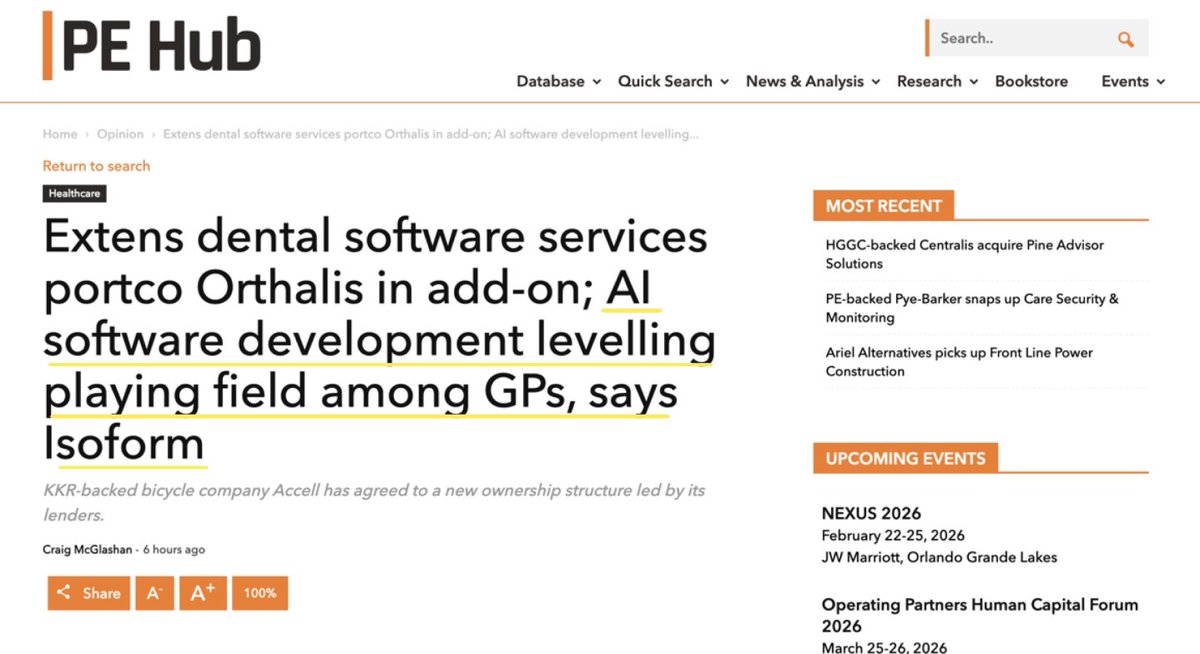
AI is leveling the value creation playing field for smaller GPs against big PE players. Isoform is accelerating that change.
Specifically, AI is bringing the cost of bespoke implementation to zero. Custom software is no longer a luxury exclusively enjoyed by deep-pocketed players. The dirty secret of SaaS is that 80% of customers only use 20% of the features. AI now brings that 20% of features directly to users.
Thanks Craig for featuring Isoform and @bozhao in @PEHUB!
A question I get a lot as an AI software development company is:
"What if OpenAI or Anthropic builds something more powerful tomorrow and makes you obsolete?"
This assumes the primary battle is model capability. That's no longer the case.
1. The cost of implementation is nearing zero.
When implementation becomes cheap and fast, recurring revenue no longer guarantees success tomorrow. Models are increasingly commoditized. Even companies with nine-figure ARR become restless because they know switching costs are dropping. Multi-year contracts are rarer and churn is rising for everyone.
2. If churn is structurally high, the scarce asset is institutional knowledge.
Users care about outcomes, not features. Future software will be priced less on usage and more on results delivered. And outcomes depend on understanding. The deeper and more granular an AI product's understanding of an organization's internal workflow, preferences, industry knowhow, the harder it is to replace.
3. From buying to building.
Historically, only large enterprises could afford bespoke software. Everyone else had to adapt their processes to off-the-shelf product. That constraint is disappearing. People don't buy software anymore; they build it internally when a need comes up, shaping systems around how businesses actually work.
4. Which leads to the real race: how knowledge is captured.
Institutional knowledge isn't just stored in Notion, Jira, Confluence, Google Docs, or Slack. The most valuable context is often undocumented — buried in people's subtle preferences, judgments, instincts, half-formed ideas. Not everyone can clearly articulate what they want and why. The companies that win will be the ones that can surface, structure, and act on people's explicit command and subconsciousness.
Human understanding is the real moat in the AI era. And intent is the new source code.
AI is democratizing bespoke software.
Large enterprises have historically enjoyed custom software. They could afford the engineering armies required to build systems tailored exactly to their needs. Startups or mid-market companies couldn't -- we made do with off-the-shelf solutions that fit poorly.
AI coding lowers this barrier to entry. A mid-market company with ten years of legacy code and complex integration needs can now commission tailor-made AI solutions at reasonable rates. What powers companies in the future will be Systems of Action, with AI proactively capturing human intent and organizational knowledge, then turning it into bespoke software that suits their business needs.
Intent is the new source code. Today’s source code is tomorrow’s assembly.
When AI pushes implementation costs towards zero, the moat becomes understanding, aligning and carrying out human intent.
In that world, the winners in software will be teams that build the deepest human empathy.
@bozhao@yetone
Vibe coding is fun. Serious coding lasts.
This is why we built Yansu, an AI-led coding platform guided by intent, validation and your team’s knowledge.
Spec-driven development (SDD) -- writing long, detailed specs -- feels safe and predictable, especially when using AI to generate code.
But in practice it often fails us. That's because specs get easily outdated, they don’t include the “why,” and they can turn creative, iterative work into brittle, waterfall-style execution.
We need a context-driven standard operating procedure (SOP) that starts from intent, evolves as we learn, and keeps “why we build this” alive alongside “what to build.” SDD has its place (stable contracts, well-defined domains), but most real-world systems need living specs + evolving context, not static docs.
And that’s why the entire software development life cycle (SDLC) matters: intent is captured, context evolves, and validation feeds back in.
We wrote about it here: https://t.co/rb3hsojWR1
The current way companies price AI doesn't work.
Counting tokens --> hoarding + defensiveness
Yansu doesn't sell tokens. We sell urgency, like Disneyland.
⚡️Fast Lane: a daily quota of tests start immediately.
☕️Standard: tasks spill into a public queue and finish late.
Coming soon.