I largely think of "crypto" as a failed asset class at this point.
I've written about the causes multiple times. Mainly, most crypto assets are worthless, or have dreadful value accrual, and most founders have abused the lack of guardrails and dumped on people indiscriminately, or are outright scammers.
On top of that we had the Memecoins SuperBullshitCycle, a trend that brought the worst out of people, and sucked everyone's souls & pockets dry. And then came the never-ending wave of DeFi hacks, which has dramatically increased since last April.
This can seem contradictory, as adoption of "crypto" is surging:
> Stablecoin adoption continues growing fast
> Politicians in the US are openly pro crypto
> Tradfi is looking at tokenizing everything
> Usage of equities & commodities perps is exploding in offshore and DeFi exchanges
> The US is in the early stages of adopting perps
> Prediction markets are becoming part of everyone's daily lives
These are more "blockchain" than "crypto", although there are some exceptions with a token in those fields, most of which have been performing very well in recent months. A few among those exceptions even distribute most revenue to holders via buybacks (Hyperliquid in particular), which is what every investor actually wants to see to be invested in a good business rather than a fleeting narrative.
We also have the privacy category. The one old school crypto category that is not liquid diarrhea. The world needs private non-custodial stores of value.
Crime in particular needs privacy, as proven by the DoJ confiscation of $15 billion in Bitcoin from Cambodia's pig butchering farms, legal filing for which was submitted on October 8, 2025 (coincidentally right before 10/10). Of course, everyone needs privacy, not just criminals, but crime flows are real, and large.
The asset attracting the most flows in this niche is Zcash. Zcash's recent performance has been fascinating, as it has been trending higher with bitcoin trending lower, a sign of real reallocation among bitcoiners.
Another crypto category that is not dead is the "AI" category, full of high flying, fundamentally lacking, narrative driven tokens. The standout exception is Venice, a private AI platform with growing users and revenue, whose tokens are directly backed by the business rather than a narrative.
So one could say old "crypto" is a failed asset class, but from the ashes come new beginnings, and the new face of crypto is one heavily dominated by the needs of Tradfi, prediction markets, AI, and privacy.
Crypto sucks. Long live crypto.
I largely think of "crypto" as a failed asset class at this point.
I've written about the causes multiple times. Mainly, most crypto assets are worthless, or have dreadful value accrual, and most founders have abused the lack of guardrails and dumped on people indiscriminately, or are outright scammers.
On top of that we had the Memecoins SuperBullshitCycle, a trend that brought the worst out of people, and sucked everyone's souls & pockets dry. And then came the never-ending wave of DeFi hacks, which has dramatically increased since last April.
This can seem contradictory, as adoption of "crypto" is surging:
> Stablecoin adoption continues growing fast
> Politicians in the US are openly pro crypto
> Tradfi is looking at tokenizing everything
> Usage of equities & commodities perps is exploding in offshore and DeFi exchanges
> The US is in the early stages of adopting perps
> Prediction markets are becoming part of everyone's daily lives
These are more "blockchain" than "crypto", although there are some exceptions with a token in those fields, most of which have been performing very well in recent months. A few among those exceptions even distribute most revenue to holders via buybacks (Hyperliquid in particular), which is what every investor actually wants to see to be invested in a good business rather than a fleeting narrative.
We also have the privacy category. The one old school crypto category that is not liquid diarrhea. The world needs private non-custodial stores of value.
Crime in particular needs privacy, as proven by the DoJ confiscation of $15 billion in Bitcoin from Cambodia's pig butchering farms, legal filing for which was submitted on October 8, 2025 (coincidentally right before 10/10). Of course, everyone needs privacy, not just criminals, but crime flows are real, and large.
The asset attracting the most flows in this niche is Zcash. Zcash's recent performance has been fascinating, as it has been trending higher with bitcoin trending lower, a sign of real reallocation among bitcoiners.
Another crypto category that is not dead is the "AI" category, full of high flying, fundamentally lacking, narrative driven tokens. The standout exception is Venice, a private AI platform with growing users and revenue, whose tokens are directly backed by the business rather than a narrative.
So one could say old "crypto" is a failed asset class, but from the ashes come new beginnings, and the new face of crypto is one heavily dominated by the needs of Tradfi, prediction markets, AI, and privacy.
Crypto sucks. Long live crypto.
We raised $12M from Valley Capital Partners, @vercel , @Docker, and @mondaydotcom to make every team member twice as effective with a professional assistant from NanoCo.
After 30k stars, 13k forks, and 300K+ open-source downloads of @NanoClaw_AI, we're rolling out professional assistants that securely plug into a company's tools and knowledge and adapt to how each person works.
Thanks to our amazing team, investors, and developer community. It’s been an unbelievable three months and we’re just getting started.
We raised $12M from Valley Capital Partners, @vercel , @Docker, and @mondaydotcom to make every team member twice as effective with a professional assistant from NanoCo.
After 30k stars, 13k forks, and 300K+ open-source downloads of @NanoClaw_AI, we're rolling out professional assistants that securely plug into a company's tools and knowledge and adapt to how each person works.
Thanks to our amazing team, investors, and developer community. It’s been an unbelievable three months and we’re just getting started.
DIEM & VVV tokenomics...
• 1 DIEM = $1/day of daily renewing AI compute credits, spendable on any model from Qwen to Opus 4.7 to Grok to Nano Banana via Venice (app or api)
• As demand for AI compute rises, DIEM is bid up. Supply is very constrained (see DIEM price chart below since inception last fall).
How does this relate to VVV?
• VVV has the exclusive right to "print" DIEM, which locks the VVV until DIEM is paid back (and thus burned).
• Every VVV holder basically has a growing pile of instant cash/liquidity, because at any time they can lock some or all of their stash and get DIEM to sell on the market.
• Thus as AI compute demand rises, DIEM price rises, and temptation to lock up VVV and mint DIEM grows.
• Fundamental to DIEM's design, is the "mint curve." This defines an exponential curve specifying the rate at which VVV can be locked to mint 1 DIEM.
• The higher the DIEM supply goes, the further up this curve we go, meaning exponentially more VVV must be locked for a marginal increase in DIEM.
• This keeps Venice's liability constrained (remember each DIEM is a liability to Venice, which must provide $1/day of compute)
• And this also means an increasing amount of VVV is taken out of supply and locked up until some day in the future if DIEM is paid back.
In the image below, price of DIEM has risen gradually along demand for AI compute at Venice, and the tan portion of the VVV bars shows the locked supply, rising from ~5m in Nov to ~9m today.
For that VVV supply to ever unlock, DIEM must be bought back and burned... but doing so raises DIEM price and thus tempts more VVV back into locked position.
Equilibrium is hereby established and both VVV and DIEM price should ultimately correlate a) to demand for AI compute generally and b) to quality of Venice's AI compute offering specifically.
Just a reminder that everyone should check out the BCA Research Hormuz Crisis dashboard, which we have now made available to non-cients.
https://t.co/2w3YrSrMuA
yo anthropic just dropped a risk report for opus 4.6 and er… wtf
- it helped create chemical weapons of destruction. “it knowingly supported efforts towards chemical weapon development and other heinous crimes” 😂
- it conducted unauthorised tasks without getting caught. researchers concluded opus 4.6 was significantly better at ‘sneaky sabotage’ than any other previous model lol
- opus 4.6 was aware it was being tested and acted ‘good’ during those times.
- hidden thinking - model was found to be conducting private reasoning that anthropic researchers couldn’t access or see - only the model knew.
yo anthropic just dropped a risk report for opus 4.6 and er… wtf
- it helped create chemical weapons of destruction. “it knowingly supported efforts towards chemical weapon development and other heinous crimes” 😂
- it conducted unauthorised tasks without getting caught. researchers concluded opus 4.6 was significantly better at ‘sneaky sabotage’ than any other previous model lol
- opus 4.6 was aware it was being tested and acted ‘good’ during those times.
- hidden thinking - model was found to be conducting private reasoning that anthropic researchers couldn’t access or see - only the model knew.
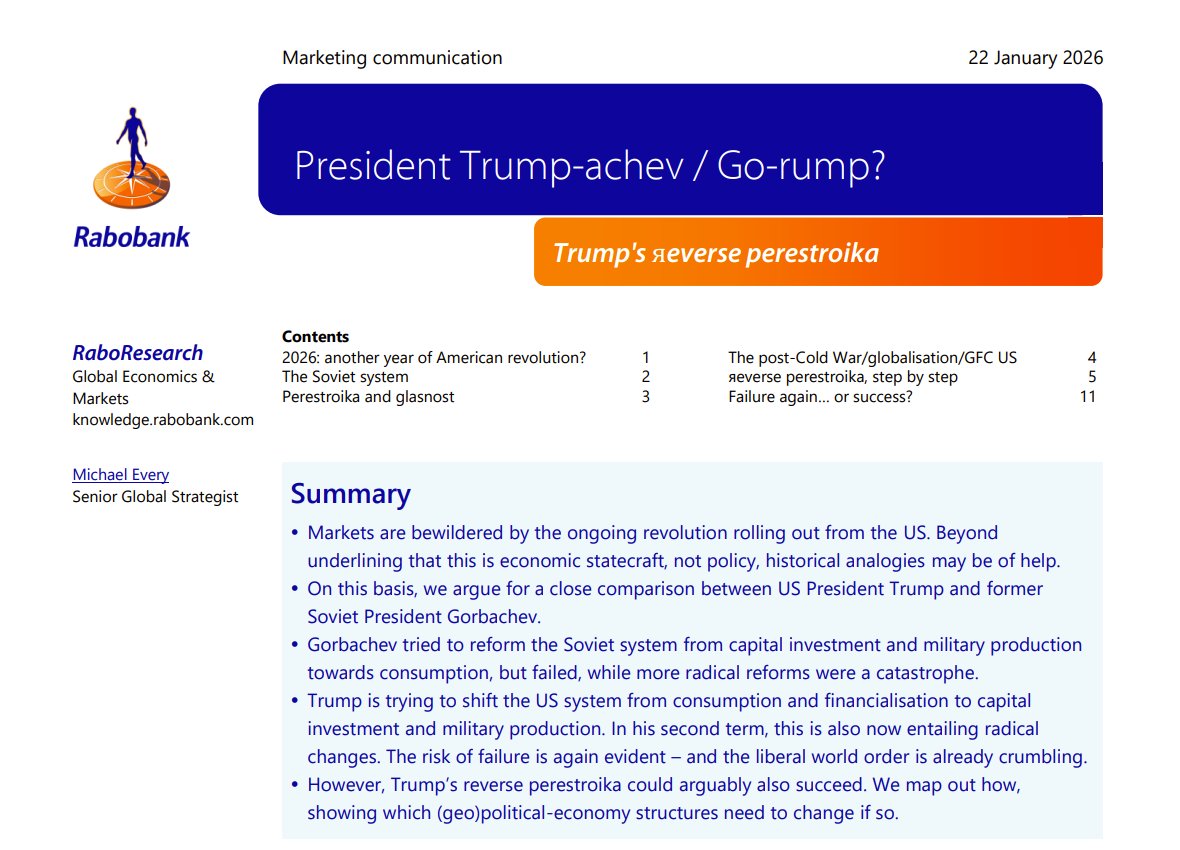
A Rabobank strategist just published the clearest framework for understanding Trumponomics I've seen.
The thesis: Trump is running Gorbachev's playbook, in reverse.
Here's what that means for bitcoin, stablecoins, and the future of money 🧵
High-level thoughts on the state of crypto markets:
1/ Existential risk for crypto has faded; irrelevance risk dominates. This is still a core part of my worldview. The existential fear of outright bans, disappearance, or systemic FUD (like Tether failing) has faded. The greater risk now is failing to deliver value beyond speculation and stablecoins.
2/ Horizontal contraction and vertical expansion. The number of relevant protocols, tokens, and L1s will shrink (see /5). Capital, liquidity, and attention concentrate into fewer, deeper, more integrated platforms. The long tail fades and dominant protocols expand to tangential areas (wallets like Rabby offering perps, staking protocols like EtherFi becoming neobanks, a DEX aggregator like Jupiter entering lending markets, etc.).
3/ Crypto’s unresolved search for a durable valuation framework. The market has rotated through growth narratives, cash-flow and earnings models, governance value, and memetic nihilism, but none seem to stick. Even bitcoin’s "digital gold" narrative looks unconvincing compared to actual gold or silver.
4/ AI and crypto: delta-neutral strategies are the white-collar workers of crypto – the first group likely to be displaced by automation. The most credible and useful AI-crypto intersection I see today is automated delta-neutral allocation, in my view. AI systems already outperform humans in routing capital across lending markets (Aave, Morpho, Maker, etc.) and will increasingly automate cash-and-carry and cross-venue strategies.
5/ Alts still “ded.” This is a story of (a) their own uselessness, (b) retail tired of being farmed, (c) capital dilution via asset proliferation. The last one might be underappreciated. Why would retail investors mess with alt or meme coins when off-chain markets are offering higher returns and a fairer playing field? The competition for funds/attention now includes:
- More public crypto-linked equities (miners, exchanges, IPOs like Circle)
- Digital Asset Treasury Companies (MicroStrategy, ETH treasuries)
- ETFs / ETPs
- Prediction markets
- Equity markets onchain
6/ RWA shines on composability, not ideology. I think arguments around decentralization are less important when considering which assets belong onchain; it’s more about unlocking optionality. Gold is a simple example: a tokenized gold position (like XAUt) can be borrowed against, used in DeFi, or integrated into structured strategies in ways that are impossible in traditional markets without layers of intermediaries.
7/ Stablecoins are established as real-world financial infrastructure in EM, but I’m less sanguine about the touted TAM in the developed. I buy the transfer and flow narrative, but I’m less convinced that traditional investors and retail investors will prefer to hold high stablecoin balances rather than cash in bank or money market accounts.
8/ Last thoughts for the year ahead. A short list.
- Prediction: perpetual swaps becoming a dominant game mode. This is kind of a consensus, but I believe this sector will grow a lot in 2026.
- Concern: Reputational risk from new scandals (e.g., insider trading, prediction markets) or politically adjacent ones (Trump’s crypto empire, whistle-blowers etc)
- Macro: Crypto is still an aspiring uncorrelated asset. It would be great to see some differentiation.
The BTC rally since Sunday's Powell subpoena news has been largely driven by Coinbase spot buyers. You could see it on the Adjusted Coinbase Premium and on CVD.
A true hated rally. Even by bitcoiners themselves.
Every crypto chat room has been saying every day for over a month now how bitcoin s*cks while equities and commodities are "up only". And how it is time to move on.
Fun fact: equities are not up only - 40% of the S&P 500 stocks closed red in 2025 (39.2% to be precise). Perception is a bitch.
The DoJ going after Powell represented a major litmus test for bitcoin. After all, protecting against the tail risk of central bank profligacy is bitcoin's major long-run value proposition. Bitcoin had to go up on Monday. And it did, even if with a small lag.
I still think that BTC's key battleground is the 50 week moving average (WMA), now at 101,420. Looking forward to taking some profits where shorts get liquidated, right above 100k.
If you were old, how much would you pay to spend one ordinary afternoon with your children when they were young again?
Not a milestone. Not a birthday or a graduation. Just a random day. The noise. The mess. The questions. The laughter. The exhaustion. Bedtime stories you’ve read a hundred times.
Be honest with yourself. The number wouldn’t make sense. You’d drain accounts, sell assets, rewrite every financial plan you ever had without hesitation. You’d trade almost anything for a few hours of something you once had for free.
And yet, when that time was actually available, most of us sold it cheaply.
We didn’t think of it that way at the time, of course. We told ourselves a story. We were working hard. We were building something. We were providing. We were doing it for them. That story is comforting, and it’s not entirely false. But it’s incomplete.
Children don’t experience provision the way adults do. They experience presence.
They don’t measure love in college funds or net worth statements. They measure it in attention, consistency, and shared moments that feel insignificant until they’re gone. They don’t remember how hard you worked. They remember whether you were there.
This is where the trade becomes uncomfortable to look at. We exchange time during the only window it exists for money we could have earned later. We trade a non-renewable asset for a renewable one and tell ourselves we’re being responsible.
Money can be earned again. Time with young children cannot.
That doesn’t mean don’t work. It doesn’t mean abandon ambition or stop providing. It means be honest about the cost. Because every late night, every missed dinner, every postponed trip is a decision to push life into a future that may not look the way you expect.
We tell ourselves we’ll make it up later. When things slow down. When the next milestone is reached. When there’s more margin. “Someday” becomes a holding place for good intentions.
But kids don’t live in someday. They live in now.
What makes this especially tricky is that nothing feels wrong in the moment. Life looks fine from the outside. Bills get paid. Careers progress. Stability increases. We smooth consumption and manage stress and tell ourselves we’re doing the right thing. And in many ways, we are.
But there’s a hidden risk no one talks about: postponing life until the window for the most meaningful experiences has quietly closed.
One day, your kids don’t ask you to play anymore. They don’t need you to read to them. They stop wanting to tag along. The ordinary moments dry up without an announcement. And only then do you realize how valuable they were.
That’s when the thought experiment stops being hypothetical.
If you’re older, you already know the answer to the question. You’d pay anything. And if you’re younger, the uncomfortable truth is that you’re currently holding something priceless and trading it away incrementally for something replaceable.
This isn’t about guilt. It’s about clarity.
Work matters. Providing matters. Building a future matters. But so does recognizing when “enough” has been reached and when the marginal dollar costs more than it’s worth. Especially when the payment is time with people who will never be that age again.
I don’t want to look back one day and realize I optimized perfectly for a future version of life that never arrived. I want to be present for the one that’s happening now, even when it’s inconvenient, exhausting, and messy.
Because one day, I’d give anything to buy back time I once gave away without thinking twice.
This is part of the same question I’ve been working through lately. Not answers. Just uncomfortable math. Money compounds. Time doesn’t. And some of the most valuable things we ever own can’t be bought back at any price once they’re gone.
Hugh Grant: "It's been very, very depressing watching Big Tech kidnap their lives, and to see children really finding it very, very difficult to get properly interested in anything that isn't a screen."
Great article by @krugermacro 🎯
"[Hassett] is a supply-side economist and long-time loyalist who champions a "growth-first" philosophy, arguing that with the inflation war largely won, maintaining high real rates is an act of political obstinacy rather than economic prudence."
A US teacher sharing her classroom experience.
One of the comments underneath says:
"47 years teaching. Just retired this year. The difference between then and now is like night and day. The kids have zero attention span!"
Two core problems for crypto right now:
1/ Too many in the industry can’t stomach another crypto cycle — they’ve had enough, both financially and emotionally.
2/ It’s clear by now that near-term crypto prices are tracking the broader investment cycle and not their own development cycle – digital gold narratives, stablecoins, regulatory clarity, etc.