i'm obsessed with AI DIY projects.
my favorite one right now is this broccoli farmer in hokkaido, japan using Codex to run his 100-hectare farm
this guy never studied agriculture, never inherited land, started out as a civil servant.
but he wanted his farm to run better, and instead of paying an engineering firm he couldn't afford, he just built the tools himself.
here's what he's built on his own:
> remote control of his greenhouse vents from a chat app, wired up with an esp32 board, a motor driver, and cloudflare workers
> a bot that checks each greenhouse's temperature and opens the vents when it gets too hot
> satellite crop-health data laid over a map of his own fields
> an airtable base linking his plots, tasks, materials, and sensors
> wiring diagrams of his electrical panels, generated from a photo
stuff like this used to be locked behind machinery and engineers only the big agribusinesses could pay for.
but this legend just breezed past all of it with a laptop and Codex lol
Introducing Magenta RealTime 2, a new open model musicians can play as an instrument!
Run low-latency, live music synthesis natively on your MacBook using MIDI, text, and audio. 🎶
We love seeing Google’s open model ecosystem grow!
Pothole detection in real time using @ultralytics YOLO26 🕳️
Identify potholes accurately from images or video to support road maintenance, safety monitoring, and smart city infrastructure workflows.
More info👇
#AI#SmartCities#Ultralytics
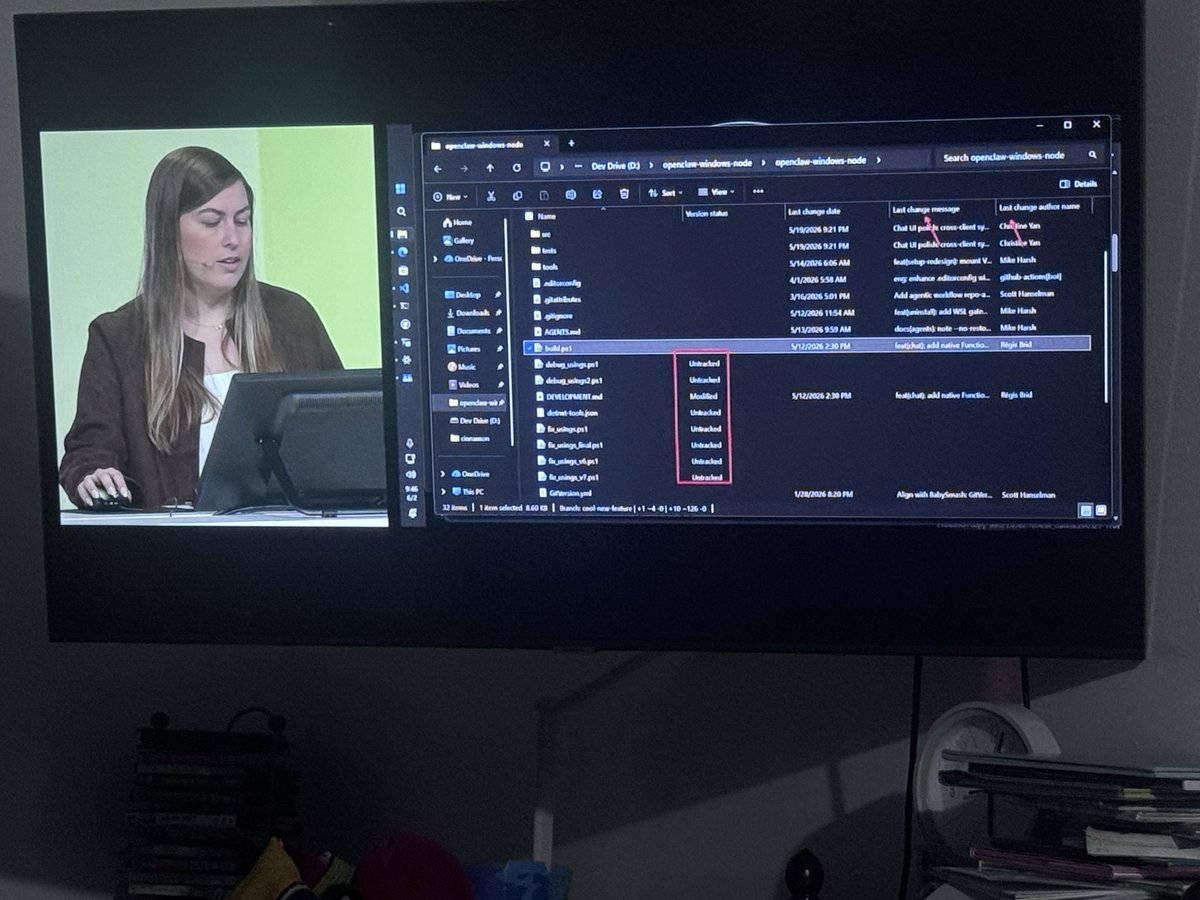
Watching #msbuild like it’s the evening news.
Digging “git aware” file system experience.
Since I’m working across windows & macs these days, I wonder if I can get that experience in Finder too.
Just a few more days until #MSBuild -
GitHub Copilot in Visual Studio: Agents That Debug, Profile & Test
Enterprise C#, .NET devs: this one’s for you.
👉 Set your reminder: https://t.co/l8dtwDIaxB
Today, we share a breakthrough on the planar unit distance problem, a famous open question first posed by Paul Erdős in 1946.
For nearly 80 years, mathematicians believed the best possible solutions looked roughly like square grids.
An OpenAI model has now disproved that belief, discovering an entirely new family of constructions that performs better.
This marks the first time AI has autonomously solved a prominent open problem central to a field of mathematics.
2nd week in a row, we had an issue with codebase I have 0 familiarity with. But I have been living with the product for a year.
Figuring out the issue, and delivering a fix in hours rather than days is exhilarating.
Auto-building the resulting kb from the chat is vibes too.
@nikitabier Earlier today, I saw a tweet and thread that was translated from Japanese. Felt natural, I understood the idioms and it felt like a world opening up to me. I’m not American but carry that story. Keep up the good work.
We’ve spent a lot of time on the framework underneath Codex, so it can move quickly on routine work while stopping for review when the risk changes.
Here’s how we use sandboxing, approvals, network policy, and telemetry to run Codex safely @OpenAI:
https://t.co/SXsYDARw40
it just occurred to me that many people don't know the Digital Library of the Caribbean exists, but you really all should have it bookmarked! it has millions of papers, periodicals, transcripts and entire books from all over the region available for free:
https://t.co/KCHA6Rk0gy
POV: claude traveled 6 months into the future and told you exactly how your next move failed.
it's called a premortem.
daniel kahneman (nobel prize-winning psychologist behind "thinking fast and slow") called it his single most valuable decision-making technique.
google, goldman sachs, and procter & gamble all use it before major launches.
here's the problem it solves.
when you ask claude "is this a good plan?" it finds all the reasons to say yes.
that's what it was trained to do. so you walk away feeling confident.
you execute, and spend weeks / months building on top of that plan.
then it blows up.
and you realize the problem was obvious in hindsight, you just never stress-tested it because claude told you it was solid.
a premortem fixes this by flipping the frame.
instead of asking "what could go wrong?" you tell claude "it's 6 months from now and this is already dead. tell me how it died."
that shift turns off claude's optimism because there's nothing to be optimistic about. the premise already says it failed.
so claude stops looking for reasons your plan will work and starts explaining how it fell apart.
claude comes back with every way your plan could die, each one with a full failure story and the early warning signs to watch for.
then a synthesis pulls it all together:
> which failure is most likely
> which failure is most dangerous
> the single biggest hidden assumption you're making (often the most valuable part)
> a revised version of your plan with the gaps closed
you say "premortem this" and give it your plan. the skill handles the rest.
Congratulations to the Government of Trinidad & Tobago,@OfficialMPAAITT & @iGovTT on the launch of #VerifyTT — its national Verifiable Credentials platform, already live & reaching thousands of graduates! Thank you to @LetsCoDevelop & #INJI for bringing this platform to life.
The Centre for Digital Public Infrastructure - CDPI had previously reported that the VerifyTT project by Trinidad & Tobago marks the “first-ever implementation of DPI-as-a-Packaged Solution (DaaS)”. 📲🌐
👉 https://t.co/esI7yUeaQw
@iGovTT