🚀 #ACE — Buy Watchlist
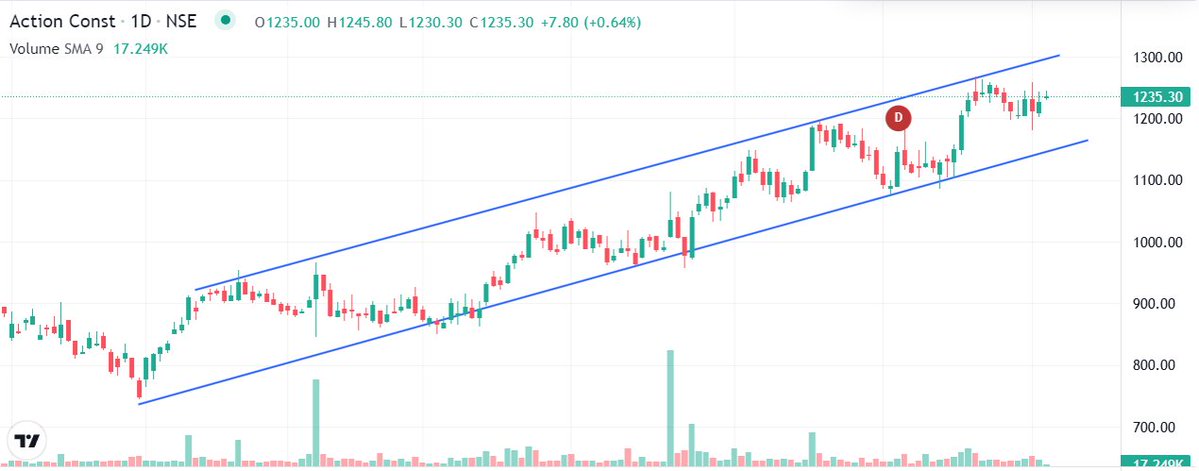
The stock price is trading within an ascending channel and is rebounding toward the upper channel boundary. 📈
Current Market Price (CMP): ₹1,235
🔥 Resistance: ₹1,245 – ₹1,280 (Upper channel boundary / Recent high)
🎯 Target (TGT): ₹1,300 → ₹1,350
💡 Ideal Buy-on-Dip Range: ₹1,200 – ₹1,215
🛡️ Support/Stop-Loss (SL) Range: ₹1,160 – ₹1,130 (Lower channel boundary)
📊 The ascending channel pattern remains intact; a close above ₹1,280 will trigger the next leg of the rally.
📦 9-day Simple Moving Average (SMA) of volume is 17.2K — current volume is relatively subdued compared to previous spikes; a breakout should be accompanied by increased volume.
#ACE #Nifty #NSE #IndianStockMarket #DalalStreet #IndianMarkets
The Sensex rose 472.77 points (0.66%) to close at 72,382.47, while the Nifty gained 133.80 points (0.60%) to end at 22,555.75. Overall market breadth was weak, with approximately 1,991 stocks advancing, 2,297 declining, and 216 remaining unchanged.
Top gainers on the Nifty included Tata Motors Passenger Vehicles, ITC, Bajaj Finance, Shriram Finance, and NTPC; top losers included HCL Technologies, Max Healthcare, HDFC Bank, Asian Paints, and Apollo Hospitals.
All sectoral indices closed higher, with the exception of the pharmaceutical sector; the Consumer Durables, FMCG, Media, Infrastructure, Oil & Gas, PSU Bank, Telecom, and Real Estate sectors posted gains ranging from 0.5% to 2%.
Both the Nifty Midcap and Smallcap indices rose by 0.5%.
Looking ahead, the 22,400–22,380 zone is expected to provide immediate support. A drop below this level could trigger selling pressure, pushing the index down to 22,220—a level coinciding with the October 1 low. On the upside, the 22,700–22,720 zone is likely to act as immediate resistance. A sustained breakout above this range could spark a rally targeting 22,850. However, the overall trend remains weak pending sustained buying momentum.
Today marks the birth anniversary of Mahatma Gandhi and the International Day of Non-Violence. 🕊️
Through his philosophy of non-violence and his simple way of life, Gandhi championed India’s struggle for independence and profoundly shaped the global understanding of peace. 🙏
In today’s era of constant conflict, restraint and honesty remain the most challenging—yet most powerful—starting points.
May we temper our impulses with understanding and root peace firmly in our daily lives.
#GandhiJayanti #InternationalDayOfNonViolence
Amid mixed global market signals, the Sensex fell 570.59 points (0.79%) to close at 71,909.70, while the Nifty dropped 198.50 points (0.88%) to 22,421.95. Market breadth was negative, with approximately 1,306 stocks advancing, 2,916 declining, and 191 remaining unchanged.
Among sectoral indices, the IT index rose 2% and the Telecom index gained 0.5%. Conversely, the Auto, Media, FMCG, Infrastructure, Metal, Consumer Durables, and Realty sectors fell by 2–3%, while the Energy, Pharma, PSU Bank, and Oil & Gas sectors all declined by more than 1%.
The Nifty Midcap index fell 1.1%, and the Smallcap index dropped nearly 1%.
Market sentiment was influenced by several factors. Rising bond yields and heightened inflation concerns fueled expectations of a potential rate hike by the Reserve Bank of India in October, raising fears regarding economic growth.
Foreign selling persisted; reports indicate that Foreign Institutional Investors (FIIs) sold Indian equities worth approximately ₹440 billion in September. Additionally, a large pipeline of upcoming initial public offerings (IPOs) has been absorbing liquidity from the secondary market.
The market faced persistent selling pressure at higher levels throughout the week. A long bearish candle formed on the weekly chart. On the daily chart, the price continued to record lower highs and lower lows, signaling a downtrend. Although the Nifty experienced a sharp decline during the day, it staged a minor recovery in the final hour of trading.
From a technical perspective, the Nifty remains below its 20-day and 50-day moving averages. The Relative Strength Index (RSI) fell further below 25, indicating bearish sentiment, while the Moving Average Convergence Divergence (MACD) continued to slope downwards below the zero line. A rising Average Directional Index (ADX) suggests the bearish trend remains strong. Consequently, the current bearish structure remains intact. The market is showing short-term weakness but is oversold; therefore, a rebound from current levels cannot be ruled out. On the downside, the 22,200/71,300 range serves as a key support zone, while 22,500/72,200 acts as immediate resistance. A break above 22,500/72,200 could extend the rebound to the 22,700–22,800/73,000–73,200 range. Conversely, a drop below 22,200/71,300 could intensify selling pressure and push the market down to the 22,000–21,950/71,000–70,700 range.
Influenced by mixed signals from global markets, Indian stock markets opened lower on October 1, with the Nifty index hovering around the 22,550 mark. As of 9:35 AM IST, the Sensex had fallen 156.85 points (0.22%) to 72,323.44, while the Nifty dropped 75.70 points (0.33%) to 22,544.75. In terms of overall market breadth, 1,117 stocks advanced, 1,994 declined, and 169 remained unchanged.
With the exception of the IT and private banking sectors, all sectoral indices traded lower; the auto sector fell 2%, while the media and infrastructure sectors each declined by 1%. Both the Nifty Midcap and Nifty Smallcap indices fell by 0.5%.
Foreign investors have continued to offload holdings over the past two trading sessions, with total sales reaching ₹201.28 billion. This selling pressure may persist as the US 10-year Treasury yield climbs further to 5.3%. A notable paradox exists in foreign investor activity: while they have been reducing their equity holdings via stock exchanges, they continue to invest through the primary market and purchase mid-cap and small-cap stocks that command higher valuations. In September, foreign investors sold shares worth ₹455.36 billion through exchanges but invested ₹96.76 billion via the primary market. Rising US Treasury yields and expectations of further weakness in Indian large-cap stocks may explain this seemingly contradictory behavior.
This appears to be merely a period of short-term market volatility. Market conditions are expected to improve once crude oil prices retreat—a prospect supported by the recent drop in Brent crude prices below $98 per barrel.
Investors can utilize this period of market weakness to accumulate quality stocks—particularly large-caps in growth-oriented sectors—as these stocks currently offer an attractive risk-reward ratio.
Affected by the mixed sentiment in the global market, the Indian stock index opened lower on October 1, with the Nifty index near 22,550 points.
India's Mumbai Sensex index fell 66.44 points, or 0.09%, to 72,413.85 points; India's Nifty index fell 39.60 points, or 0.18%, to 22,580.85 points. About 942 stocks advanced, 1,551 stocks declined, and 145 stocks were unchanged.
Indian stock indices closed flat, with the Nifty index settling at 22,620 points.
At the close, the Sensex fell 48.78 points (0.07%) to 72,480.29, while the Nifty dropped 95.75 points (0.42%) to 22,620.45. Approximately 2,051 stocks advanced, 2,135 declined, and 187 remained unchanged.
Top gainers on the Nifty included ICICI Bank, Kotak Mahindra Bank, Interglobe Aviation, Wipro, and Tech Mahindra, while top losers included Max Healthcare, Apollo Hospitals, SBI Life Insurance, Eternal, and ONGC.
Among sectoral indices, the Metal and Pharma sectors fell by more than 1%, whereas Public Sector Banks, Private Banks, Real Estate, and Media sectors rose by 1–2%.
The Nifty Midcap index closed flat, while the Smallcap index rose 0.2%.
The rally lost momentum due to profit-taking at high levels, followed by a rebound in oil prices. Elevated global bond yields remain a key headwind, limiting the scope for sustained risk-taking.
Amid heightened macroeconomic uncertainty, investors have gravitated toward stocks with relatively attractive valuations and a higher margin of safety; consequently, large-cap stocks—particularly in the banking and IT sectors—have gained upward momentum.
Overall market sentiment remains cautious; investors continue to monitor crude oil price trends, bond yields, inflation expectations, and potential implications for global monetary policy.
As a result, market participants are likely to remain selective until the macroeconomic outlook becomes clearer, favoring companies with strong fundamentals and robust profitability.
🚀 #M&M
— Buy Watchlist
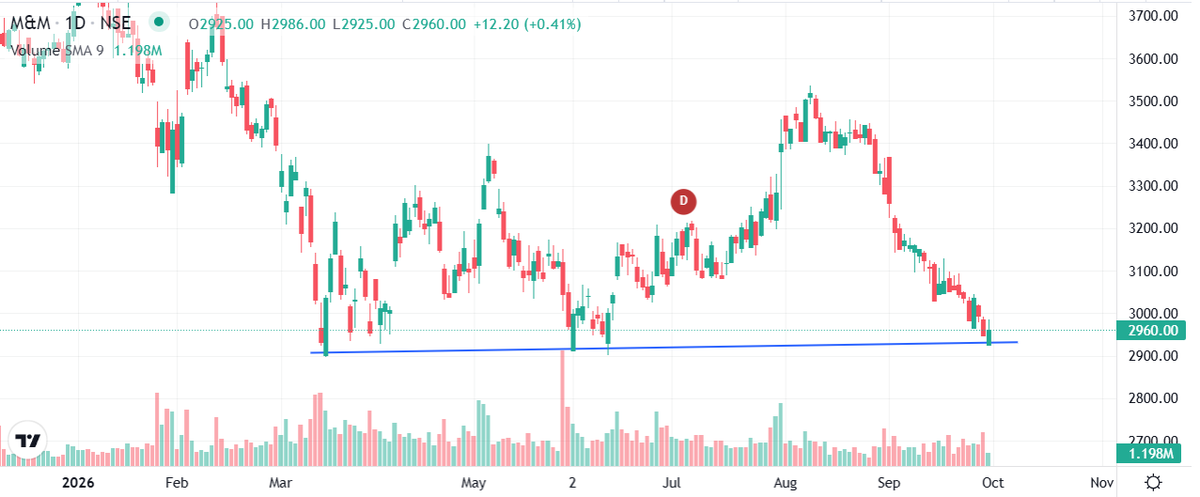
The stock rebounded after touching an upward-sloping support line around ₹2,925. This level previously served as a key demand zone between March and June. 📈
Current Market Price (CMP): ₹2,960
🔥 Resistance Levels: ₹3,050 – ₹3,150
🎯 Target Price (TGT): ₹3,200 → ₹3,350
💡 Ideal Buy Zone (on pullback): ₹2,925 – ₹2,945
🛡️ Support/Stop-Loss (SL) Zone: ₹2,880 – ₹2,850
📊 Holding this lower support level helps maintain a bullish "higher low" pattern.
📦 The 9-day Simple Moving Average (SMA) for volume is 1.2 million shares; volume during the rebound was average, but a significant surge in volume is needed to trigger the next leg of the rally.
#M&M #Nifty #NSE #IndianStockMarket #DalalStreet #AutoStocks #IndianMarket
Following recent heavy selling pressure, the Nifty index may attempt to rebound to the immediate resistance level of 22,800 before challenging the key 23,000 mark. Momentum indicators suggest a easing of selling pressure, and lower oil prices may provide some support. However, given the weak overall market structure, the sustainability of any rebound remains crucial. Immediate support lies in the 22,550–22,500 range. Meanwhile, the Bank Nifty index may extend the previous day's rebound, moving toward the key resistance zone of 55,000–55,300. Nevertheless, the overall trend remains bearish, with Tuesday's low of 53,785 likely acting as immediate support.
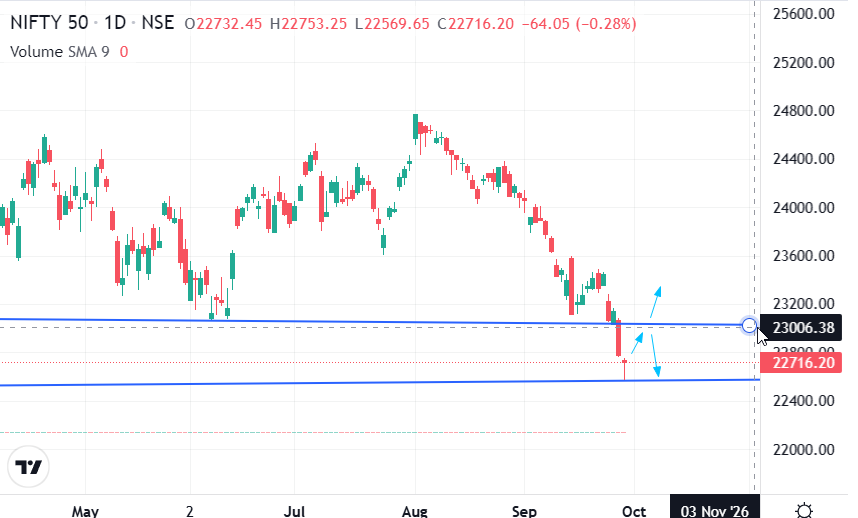
The index closed 6.65% lower in September, extending the correction that began in August. Although market sentiment remains cautious following the sharp decline, the Nifty index is currently approaching a critical long-term support zone. Given the risk-reward profile at current levels, traders are advised to avoid aggressive short positions and instead closely monitor the market for signs of stabilization.
From a technical perspective, the 22,500–22,200 range remains a key support zone, while 22,800–23,000 serves as the immediate resistance zone. A sustained breakout above 23,000 could strengthen the rebound momentum and trigger a more robust rally in the short term.
Key Resistance Levels: 22,800, 23,000
Key Support Levels: 22,500, 22,200
The Nifty index is expected to open flat near the 22,700 mark. Market sentiment remains cautious given the recent weakness; immediate support lies in the 22,500–22,550 range, while resistance is situated between 22,900 and 23,000.
The short-term trend remains weak, and any rebound towards the 22,900–23,000 zone is likely to face selling pressure. A drop below 22,500 could trigger a further decline; conversely, if the support zone holds, the market may enter a period of consolidation.
On the positive side, I would only consider adopting a more bullish strategy if the Nifty index manages to sustain itself above 23,050. This could signal a reversal of the short-term trend and pave the way for further gains. Until then, upward moves are likely to encounter selling pressure, so market participants should closely monitor price action around these key levels.
India's benchmark stock indices closed lower for the second consecutive session, with the Nifty hovering near the 22,700 mark. At the close, the Sensex fell 242.65 points (0.33%) to 72,529.07, while the Nifty dropped 64.05 points (0.28%) to 22,716.20. Market breadth was negative, with 1,871 stocks advancing, 2,321 declining, and 164 remaining unchanged.
The market remained under pressure on the monthly contract expiry day, extending the recent pullback trend. Benchmark indices opened weak and stayed subdued for most of the session; they briefly approached six-month lows before staging a modest recovery.
Sectorally, selling pressure was widespread; real estate, IT, and auto sectors led the decline, while metals and pharmaceuticals bucked the trend to close higher. The broader market also faced selling pressure, with both mid-cap and small-cap indices falling by approximately 1%.
Global factors continued to weigh on the market, including elevated crude oil prices, firm US 10-year Treasury yields, and a weakening rupee driven by sustained foreign capital outflows. However, oversold conditions and expiry-related trading activity prompted a rebound from intraday lows, limiting the overall decline.
From a technical perspective, the Nifty tested a key long-term support level—the 200-week simple moving average (200-WSMA) near 22,600—and successfully held it; the next critical support level lies near 22,400. After a sharp intraday drop, the market found support around the 22,570/72,000 levels and recovered some of the ground lost earlier in the session. A "Doji" pattern has formed on the daily chart, while intraday charts continue to show signs of weakness, suggesting a risk of further decline from current levels. We believe the short-term market trend remains weak, although the possibility of a quick intraday rebound cannot be ruled out. For intraday traders, the 22,600/72,200 level serves as a key support zone; a break below this area could extend the pullback to the 22,850–23,000/73,000–73,500 range. On the downside, should the market fall below 22,600/72,200, selling pressure could intensify, potentially pushing the market down to the 22,500–22,400/72,000–71,700 levels.
While most sectors remain under significant pressure, the pharmaceutical sector has demonstrated notable resilience; in contrast, the IT and FMCG sectors face a risk of further weakening. Given current market conditions, we maintain a cautious stance and advise monitoring key index levels closely for further directional signals.
Weighed down by weak global markets, Indian stock indices opened lower on September 29, with the Nifty index slipping below the 22,800 mark.
The Mumbai Sensex fell 236.06 points (0.32%) to 72,535.66, while the Nifty dropped 68.15 points (0.30%) to 22,712.10. Market breadth was mixed, with approximately 920 stocks advancing, 864 declining, and 174 remaining unchanged. Among Nifty constituents, Dr Reddy's Labs, Cipla, HCL Tech, NTPC, and Tata Consumer led the gains, whereas Tata Motors PV, Bajaj Finance, Tata Steel, HDFC Bank, and ICICI Bank were the top losers.
Given the persistent selling pressure and the breach of key support levels, we advise caution; while the indices may rebound from oversold territory, the sustainability of such a rally remains uncertain. The Nifty 50 needs to hold the 22,750 support level (near Monday's low) to have a chance of advancing toward 23,000; a decisive break below this level could see the index slide toward 22,500. Meanwhile, if the Bank Nifty fails to hold the 54,400 mark (near Monday's low), a further decline to the 54,000–53,800 range cannot be ruled out; conversely, if it manages to sustain above 54,400, it could make a push toward 55,000.
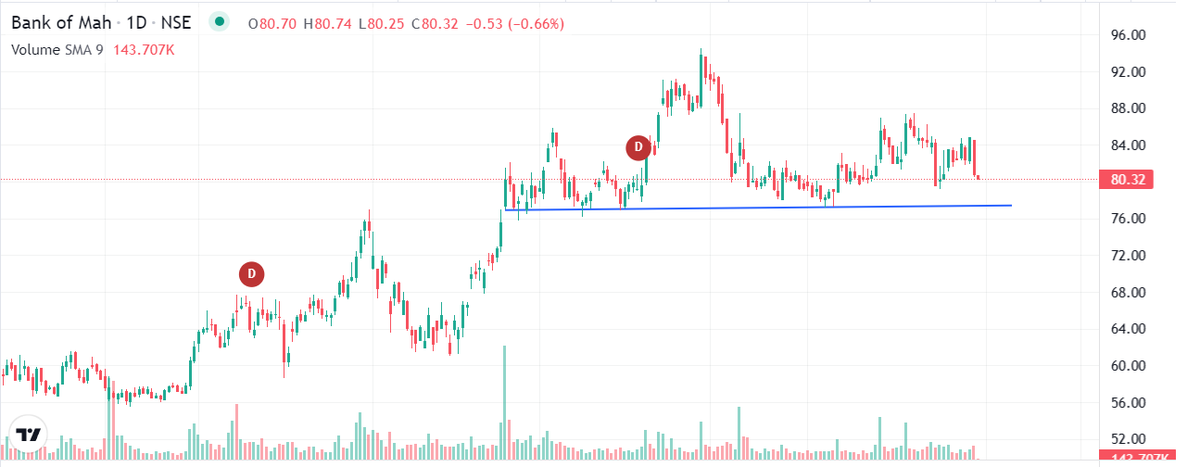
🚀 #MAHABANK — Buy Watchlist
The stock price is holding above the marked support level and consolidating within the ₹77–₹88 range. 📈
Current Market Price (CMP): ₹80.3
🔥 Resistance: ₹84 – ₹88 (followed by the swing high near ₹94)
🎯 Target (TGT): ₹88 → ₹94
💡 Ideal Buy-on-Dip Zone: ₹77.5 – ₹80
🛡️ Support/Stop Loss (SL) Zone: ₹76 – ₹74
📊 Range support remains solid; a close above ₹88 will trigger the next leg of the rally.
📦 9-day Simple Moving Average (SMA) of volume is 144K — volume is currently subdued; a breakout requires a surge in volume.
#MAHABANK #Nifty #NSE #IndianStockMarket #DalalStreet #PSUBanks #IndianMarkets
If the index falls below the 22,700 mark, selling pressure could intensify, potentially dragging the index toward 22,400—a key support level situated near the trend line connecting major lows from the past two years and the 200-week moving average.
From a technical perspective, the Nifty index has immediate support in the 22,650–22,700 range. Rupak De, a senior technical analyst at LKP Securities, stated that a drop below this range could deepen the short-term pullback.
Global Market Dynamics
As of 11:51 a.m. Tokyo time, S&P 500 futures were down 0.2%.
Nikkei 225 futures (OSE) fell 0.4%.
Japan's Topix index dropped 1.5%.
Australia's S&P/ASX 200 index rose 0.1%.
Hong Kong's Hang Seng Index fell 0.6%.
The Shanghai Composite Index declined 0.1%.
Euro Stoxx 50 futures rose 0.4%.
The Nifty index is expected to open flat near the 22,780 mark—close to yesterday's low. With today marking the expiry of the Nifty monthly contracts, market volatility is likely to remain high, potentially leading to sharp intraday price swings.
Immediate support lies in the 22,650–22,750 range, while the 22,900–23,050 zone serves as a key resistance area. The market remains weak following recent declines; sentiment is likely to stay cautious unless the Nifty can reclaim the 22,900–23,050 zone.
Any rebound toward the resistance level may face selling pressure, whereas a drop below 22,650 could trigger further weakness. Conversely, if the 22,650–22,750 support zone holds, a rally driven by short-covering cannot be ruled out.
Given the monthly contract expiry, traders should anticipate heightened volatility and look for opportunities based on price action near these key levels, rather than blindly chasing erratic and disorderly market movements.
The Nifty index is expected to open flat near the 22,780 mark—close to yesterday's low. With today marking the expiry of the Nifty monthly contracts, market volatility is likely to remain high, potentially leading to sharp intraday price swings.
Immediate support lies in the 22,650–22,750 range, while the 22,900–23,050 zone serves as a key resistance area. The market remains weak following recent declines; sentiment is likely to stay cautious unless the Nifty can reclaim the 22,900–23,050 zone.
Any rebound toward the resistance level may face selling pressure, whereas a drop below 22,650 could trigger further weakness. Conversely, if the 22,650–22,750 support zone holds, a rally driven by short-covering cannot be ruled out.
Given the monthly contract expiry, traders should anticipate heightened volatility and look for opportunities based on price action near these key levels, rather than blindly chasing erratic and disorderly market movements.
From a technical perspective, the market opened lower and broke below the 23,000/73,500 level, triggering intensified selling pressure. Furthermore, bearish candlestick patterns on the daily chart and a series of lower lows on the intraday chart suggest the market may weaken further from current levels.
We anticipate continued weakness in the short term. However, given the current oversold conditions, we expect a rapid rebound from these levels. For intraday traders, the key level of 22,800/72,800 warrants close attention; a break below this level could extend the bearish trend, with support located in the 22,650–22,550/72,500–72,000 range. On the upside, a break above 22,800/72,800 could drive a rebound toward the 23,000–23,050/73,200–73,500 range.
The market showed overall weakness in yesterday's trading; the Indian BSE Sensex fell 1,124.02 points (1.52%) to close at 72,771.72, while the Nifty index dropped 360.25 points (1.56%) to close at 22,780.25. Market breadth saw approximately 1,214 stocks advancing, 2,905 declining, and 166 remaining unchanged.
Among Nifty constituents, top losers included Jio Financial, Tata Motors, Tata Consumer Products, Adani Enterprises, and Adani Ports, while top gainers included Dr. Reddy's Labs and Infosys.
All sectoral indices closed lower; the PSU Bank index fell 3% and the Telecom index dropped 2%, while indices for the Energy, Infrastructure, FMCG, Real Estate, Private Bank, Metal, and Oil & Gas sectors all declined by more than 1%.
The Nifty Midcap index fell 1.7%, and the Smallcap index dropped 1.8%.
The market showed overall weakness in yesterday's trading; the Indian BSE Sensex fell 1,124.02 points (1.52%) to close at 72,771.72, while the Nifty index dropped 360.25 points (1.56%) to close at 22,780.25. Market breadth saw approximately 1,214 stocks advancing, 2,905 declining, and 166 remaining unchanged.
Among Nifty constituents, top losers included Jio Financial, Tata Motors, Tata Consumer Products, Adani Enterprises, and Adani Ports, while top gainers included Dr. Reddy's Labs and Infosys.
All sectoral indices closed lower; the PSU Bank index fell 3% and the Telecom index dropped 2%, while indices for the Energy, Infrastructure, FMCG, Real Estate, Private Bank, Metal, and Oil & Gas sectors all declined by more than 1%.
The Nifty Midcap index fell 1.7%, and the Smallcap index dropped 1.8%.
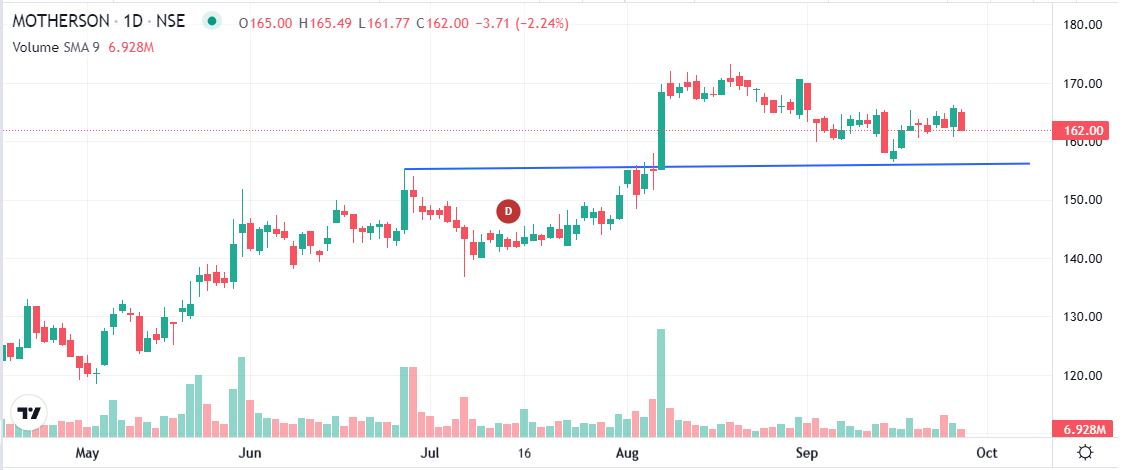
🚀 #MOTHERSON — Buy Watchlist
The stock has maintained a solid trend since breaking out above the level marked on the chart in August. After hitting a swing high of ₹172, the price is currently pulling back toward the breakout line. 📈
Current Market Price (CMP): ₹162
🔥 Resistance: ₹166 – ₹172 (Recent swing high)
🎯 Target (TGT): ₹175 → ₹185
💡 Ideal Buy-on-Dip Zone: ₹158 – ₹160
🛡️ Support/Stop Loss (SL) Zone: ₹155 – ₹152
📊 Price holding above the key July-August level (now acting as support)
📦 9-day Volume SMA: 6.93 million shares — Volume has moderated from the breakout surge; watch for a pickup in volume during the next leg of the move
#MOTHERSON #Nifty #NSE #IndianStockMarket #DalalStreet #IndianMarkets
The GIFT Nifty indicates a lower opening for the market, driven by renewed US-Iran tensions that have pushed up crude oil prices and dampened global risk appetite. Rising global bond yields, a strengthening US dollar, and persistent selling by foreign institutional investors are also likely to remain significant headwinds for Indian domestic equities.
As of approximately 8:30 AM, the GIFT Nifty stood at 23,115, down 74 points (0.32%). This follows a rebound in the Nifty 50 index during the previous trading session, where it closed at 23,140.50.
Crude oil prices are likely to remain a key focus for the Indian market; Brent crude prices climbed back above $106 per barrel after US President Donald Trump rejected Iran's proposal to resolve the conflict and reopen the Strait of Hormuz.
Asian markets opened cautiously this week, with US stock futures trading lower; investors are also closely monitoring upcoming US employment and inflation data, which could influence market expectations regarding the Federal Reserve's interest rate trajectory.