The correlation bounds of Chattopadhyay, Hatami, Lee, Lovett, Tal and Viola yield a proof that Almost-ParityP = BP.ParityP, from which you can get a simpler proof of Toda's theorem.
Details: https://t.co/wEJu4fDIIA
Sept 4 (Friday of Labor Day weekend): FLT formalization announced by Anthropic
Sept 7/8: Tristan+Levent -> OpenAI announce Navier-Stokes
But somehow amidst all the commotion, we all seemed to have missed the following (!!!).
Sept 6: Lech Mazur claims an AI-generated proof that a positive proportion of numbers go back to 1 under Collatz!! And it's Lean-formalized. I went through the Lean (or rather, had my AI do it) and I think it's right. Now I'm trying to make sense of the math (doesn't look like anything is too hard, just a lot of arguments, building on top of Terry's earlier work).
Naoufal El Jaouhari, an Applied Maths Engineer based in Paris, wrote to me a few days ago that he'd gotten his AI to formalize the same proof for 3x-1 building on Mazur, which led me to look at Mazur.
Now I'm working on a "digestion" of all of this. Weird wild stuff!!
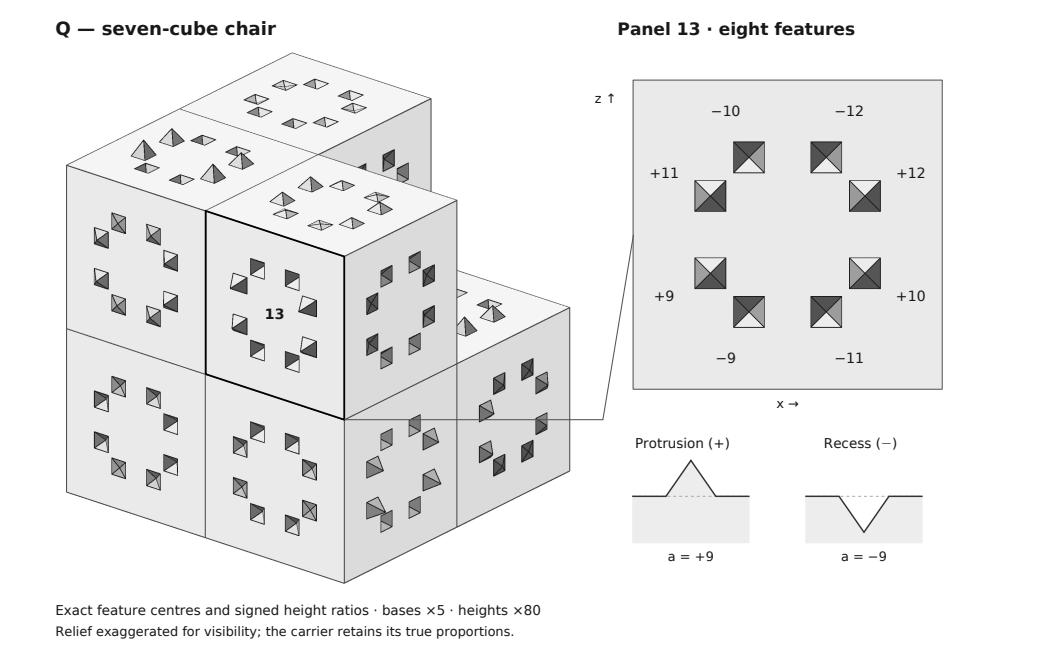
Breaking math news: The first-ever 3D Einstein tile, an object that tiles space in a never-repeating pattern, has been found by independent researcher Ioannis Tsiokos using GPT Astra. Resembles a chair. Mathematicians have de-slopped the proof. @kkakaes: https://t.co/KOMjtwluoH
zeta(5) has very likely been proven irrational by Aabir Fauzan! He has posted a preprint on Zenodo, likely due to not having an endorsement to arXiv. Naturally I had Astra study the argument, and it fully vouches for its correctness.
It is interesting to see how one of the oldest fields of computer science, formal verification, which started in 1960s, is being "rediscovered" by the new hotter domains.
And each time I can clearly see the ignorance and arrogance of the new comers. A few years back, it was blockchain. Now it is the AI.
And the same pattern, each time:
"it will be correct because we will formally verify it"
"what's your trust base"
"what do you mean? We use Lean"
"do you even have a formal semantics of the language?"
"what do you mean? we use Lean"
Garbage (formal semantics) in, garbage (formal verification) out. Lean will only guarantee that your code does what the formal semantics says.
Strongly recommend @rv_inc 's blog to learn more about FV and how to do it correctly: https://t.co/9f4JgR2cPT
The Ultimate Top 500 Open Problems in Mathematics
https://t.co/ArIV77LJ9r
Weeks of work by 4 LLM families (GPT 6, Fable 5.1, GLM-5.3, DeepSeek V4 Pro). 34,890 pairwise judgments across 1,227 candidate problems. They ran repeated discovery rounds, source checks, deduplication, and clarification of exact problem statements. Models compared problems using source-backed descriptions without seeing the existing rankings or other models' judgments.
The comparisons considered the significance of a resolution, centrality to the field, connections across disciplines, scholarly and public recognition, and potential scientific or practical impact. Results were statistically combined and checked for ranking uncertainty and sensitivity to individual model families. Includes theoretical computer science, and mathematical physics.
The list includes plain-language explanations, sources, notes on what remains open, and links to related research where available.
Where the targets of recent AI results would rank if they were still open:
#21 — Smooth-forced Navier–Stokes breakdown (Fefferman C).
#32 — Unforced three-dimensional Euler blowup.
#92 — The Jacobian conjecture in general dimension.
#167 — Whether every group is sofic.
#211 — The planar unit-distance conjecture.
Note that the recently announced Navier–Stokes result concerns flow driven by a smooth external force. #4 entry is unforced three-dimensional Navier–Stokes global regularity (Fefferman's statement A), which remains open. Showing that a forced flow can develop a singularity does not settle whether singularities can arise without external forcing.
I vividly remember Avi Wigderson teaching NIZKs at HUJI in the early 2000s. He motivated it by a story: suppose you prove the Riemann hypothesis but fears others will steal the credit once you send them your manuscript. How can you convince the world you have a proof without revealing it?
At the time, we all felt this was an extremely convoluted use case for an extremely impractical scheme. It’s wild how far things have come
AI disruption in research will not be evenly distributed.
Theory-heavy fields like cryptography, blockchain, and information theory are exposed earlier because much of the work is abstract, computational, and machine-verifiable.
AI has made proof generation cheap, which raises the premium on the foundations that determine whether a proof is trustworthy.
And >20 years of work have gone into our K Framework to enable rigorous definition of code's behavior - the trusted foundation on which proofs can rest.
It's a bad idea.
If you dictate scientists just what to work on, you will get a low return on investment. The current science funding schemes ALREADY have this problem: pour money into some specific program, see scientists produce something that fits into the program to get the money --> topic is overcrowded with incremental and nonsense research that mostly leads nowhere.
It's inefficient for the same reason planned economies are inefficient.
Scientists need MORE freedom to do what they want, not less.
https://t.co/ccKpGqZzTa
Some thoughts on AI and Theory.
1. To a first approximation, theoretical computer science has been organized around a few major open questions. Much of our work has been motivated by developing approaches to answer these questions.
2. Such “problem-motivated” work has often led to theory-building focused on identifying a general principle that unifies a class of theorems. But much of that theory-building also involved proving new, difficult theorems.
3. Thus, while it’s true that problem-solving was strongly correlated with building understanding, drawing connections, and eventually developing general theories, it would be disingenuous not to admit that our community, perhaps disproportionately in retrospect, focused on and celebrated problem-solving. This was not arbitrary, and was quite defensible. Being able to make progress on central technical questions usually correlated with taste, creativity, persistence, and depth of understanding. Much of our reward structure therefore implicitly relied on the fact that producing an important proof was good evidence that someone possessed these harder-to-observe qualities.
4. It seems likely that we will soon have AI tools available to us that can prove many such theorems in a short time. The cost of obtaining proofs for well-posed mathematical questions will likely fall dramatically. The “scarce” intellectual work will likely shift both upstream: to questions, models and theories, definitions, and conjectures, and downstream: to interpretation, synthesis, explanation, and theory-building.
5. But as long as we believe in humans being meaningfully in charge of our collective decisions and fate, building human understanding of our science (and of science more generally) will remain an essential goal. I plan to expand on this important aspect soon.
6. Historically, finding a solution to an important problem and understanding its significance, implications, and connections were entangled. Finding a proof usually required researchers to discover the right concepts along the way. A dramatic reduction in the time and effort required to prove theorems could break that coupling. We could end up with many more true statements and proofs without a commensurate increase in understanding.
Converting an abundance of proofs into human understanding may become one of the central challenges of our field.
7. As a result, I expect the high-level goals of theoretical computer scientists to change. In fact, the advent of powerful theorem provers might help us construct new theories and explore new models far more easily and rapidly, and significantly expand the domains where our models and theories apply. In that sense, the space for theoretical work may significantly expand rather than contract.
8. There’s a high human cost to the disruption that we are likely heading into. Many in our field, and in mathematical communities more broadly, are coming to terms with it. The range of opinions and reactions among mathematicians and theoretical computer scientists is a natural part of this evolution in our thinking as we collectively work through it.
Some concrete efforts (including one at @SimonsInstitute) are already underway to think through the immediate scientific and institutional questions arising during this transition.
Just got this incredible news from UCLA Math Circle.
Two high school students, Aayush Bathija and Prince Rohatgi, working with postdoc Daniel Soskin through the UCLA Math Circle, have solved a problem that Fields Medalist June Huh had previously worked on without solving.
The paper was heavily AI-assisted.
Whatever your view on AI in mathematics, enabling high school students to push the frontier of mathematical research is something worth celebrating.
https://t.co/RfvxWXdAeZ
The Ramanujan Journal is honored to publish one of the final papers by the late Prof. Florian Luca (1969-2026), whose unexpected passing in July was a great loss to the math community.
We are proud to share this contribution to his enduring legacy: https://t.co/ue5cZZddCw
Am teaching grad complexity theory at CMU; about 1/3 of the lectures will be new (vs. last time), 'modern' results. Videos are going onto https://t.co/tEmg9UTHop which will later also feature student videos.
We did Williams (/Cook-Mertz/Shalunov) TIME(t) in SPACE(~√t) today.
If you think vibe coding makes computer science fundamentals irrelevant, this study points the other way.
Vibe coding still rewards computer-science knowledge: it was a stronger predictor than writing skill.
Researchers tested 100 university students on 3 no-code app-building tasks where they could only talk to the AI and inspect the result, never the source code.
Both skills mattered, but CS knowledge was the stronger signal.
CS achievement correlated 0.39 with vibe-coding performance, compared with 0.29 for writing.
When both were considered together, CS added about 2x as much unique predictive value as writing.
Writing still helped because stronger writers tended to produce clearer, better-organized prompts, and better prompts were linked to better apps.
– arxiv. org/abs/2603.14133
Title: "Computer Science Achievement and Writing Skills Predict Vibe Coding Proficiency"







![pickover's tweet photo. The Fibonacci sequence is encoded in the number 1/89. [math] https://t.co/leizmCyxwM https://t.co/BFiN0xV93p](https://pbs.twimg.com/media/HSMcWcbWcAA2k82.png)


