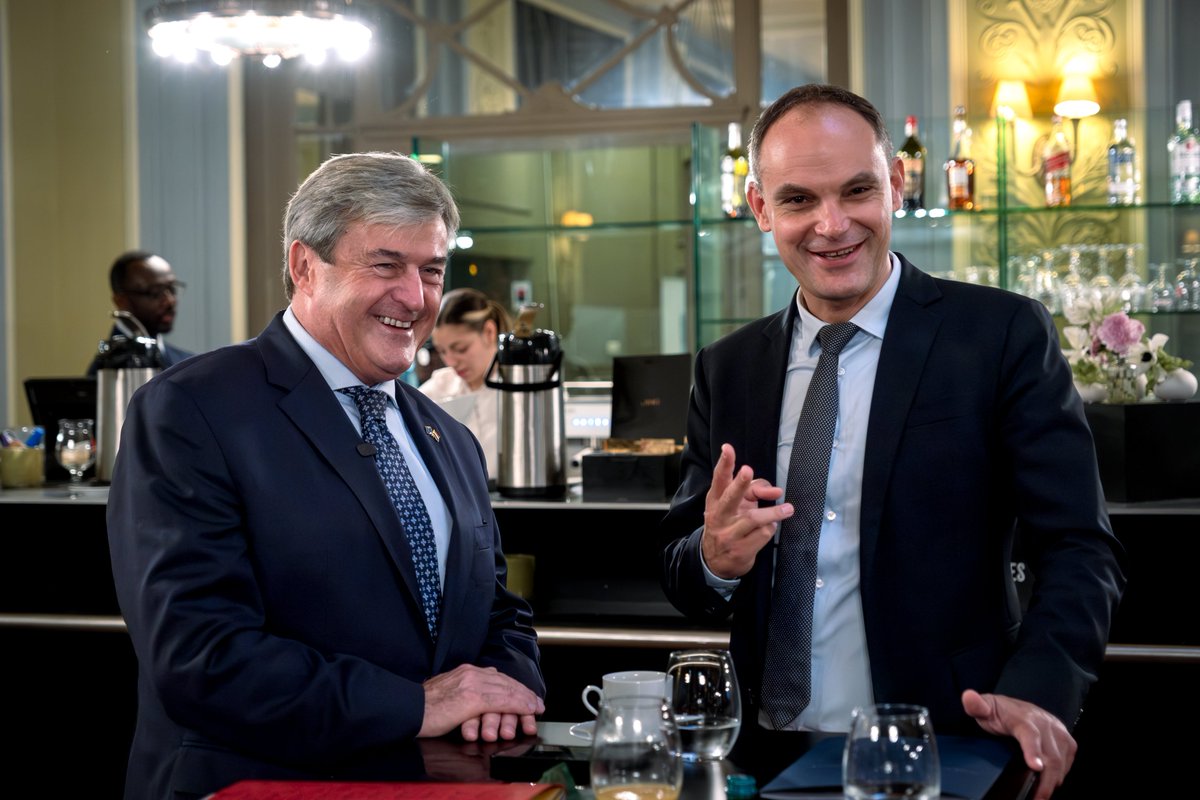
In Brussels, ahead of the Competitiveness Council meeting, I met @AnzeLog, Slovenia’s Minister of the Economy, Labour and Sport.
It was a useful discussion, and the message was simple: we both want closer Hungarian–Slovenian cooperation.
I invited him to Hungary, and he invited me to Slovenia. But we also discussed something broader: deepening economic cooperation among the Central European Five - Austria, the Czech Republic, Hungary, Slovakia and Slovenia - within the framework of the C5 initiative.
If our region acts in a coordinated way, we can represent our interests in Europe much more strongly.
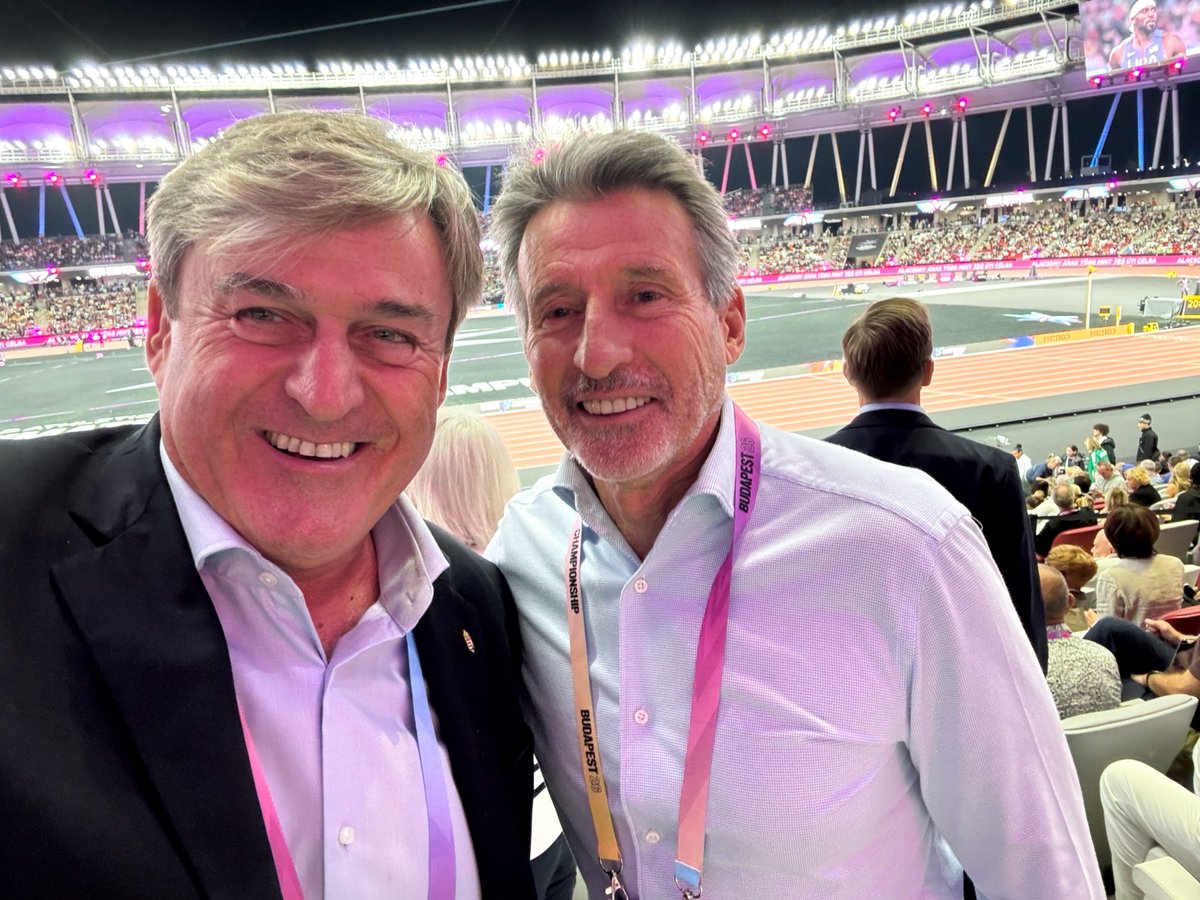
With @sebcoe, President of World Athletics, on the final day of the highly successful Ultimate Championship Budapest!
My heartfelt congratulations to all the organisers. It was a world-class sporting event that greatly strengthened Budapest’s reputation around the world and, through this, also contributed to the further development of Hungarian tourism.
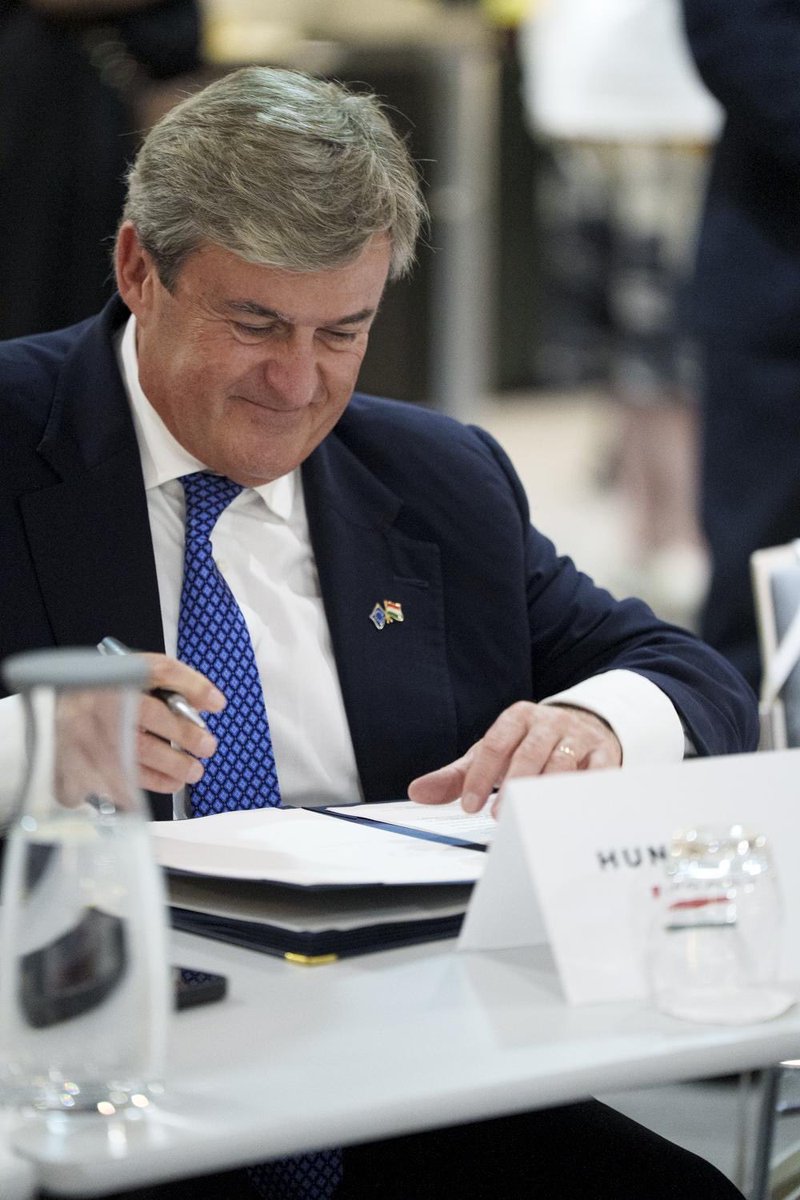
This morning, at the invitation of @irlembbudapest, I attended a breakfast at Barabás Villa, organised on the occasion of Ireland’s rotating Presidency of the Council of the European Union.
It is a particular pleasure that this year we are also celebrating the 50th anniversary of the establishment of Hungarian–Irish diplomatic relations, and before the event we had the opportunity to visit the exhibition created for this anniversary. And to make the timing of the day even more exciting: the V4+Ireland Summit is also taking place today.
At the breakfast, we had the opportunity to discuss the new directions of the Hungarian economy with EU ambassadors, representatives of the European Commission and the European Parliament: economic growth, investment promotion, our energy strategy, the effective use of EU funds, and our consistent fight against corruption.
Thank you to Irish Ambassador @IrlAmbHungary Ragnar Almqvist, for the excellent organisation and the meaningful exchange of views.
Last night, I was the guest of British Ambassador @JustinMcKenzieS at the Embassy, where I sat down with the leadership of the British Chamber of Commerce in Hungary and representatives of some of the largest British companies operating in Hungary.
Nearly 700 British-related companies are present in the country, providing jobs for around 45,000 Hungarian people.
Hungary must become an attractive place for investment again. But we do not want just any kind of investment. We do not want to see assembly plants. Instead, we need to build on knowledge, especially on the expertise of Hungarian people.
We need investments that bring development, research and well-paid professional jobs for Hungarian engineers and specialists.
For this, three things are needed: predictable regulation, less bureaucracy and competitive energy prices. Because without competitive energy, there can be no competitive industry.
And I added one more thing. Hungary is an open, export-driven economy. Economic isolation and turning away from our European friends can never be the right direction. Our government stands for openness.
Thank you to Ambassador Justin McKenzie Smith for the invitation and for the open discussion.
Yesterday, we held the ministry’s weekly meeting. The first item on the agenda was clear: how we will continue the work we have already started.
Following EXIM Bank, we will now review the other state-owned companies under our responsibility. One by one, thoroughly, and in every case on the basis of documents, we will examine contracts and previous decisions. We are putting things in order because this is the mandate we received from the voters. Whatever we uncover will be forwarded to the competent authorities. From that point on, it will be their responsibility to take the necessary steps.
We also reviewed the current situation regarding the EU funds that belong to Hungary. We are using every tool available to ensure that these funds reach their proper destination as soon as possible: Hungarian businesses and Hungarian families.
The third topic was particularly important to me. Over the past weeks, we have held a series of consultations with professional organisations, trade unions, entrepreneurs and key players in the Hungarian economy. Yesterday, we summarised everything we had heard during these meetings. We received many valuable proposals, and they will be incorporated into our decisions.
A ministry functions well when it listens to those who keep the economy running every day: employees, entrepreneurs, professional communities and, of course, its own staff.
Our direction remains unchanged: transparent operations, responsible decisions and continuous dialogue. We are working to make Hungary more competitive and to ensure that our decisions bring positive change to the everyday lives of the Hungarian people.
I am pleased to introduce Attila Ságodi, the new CEO of Paks II Nuclear Power Plant Ltd.
With more than 25 years of experience in strategy, corporate management and the energy sector, as well as his in-depth expertise in nuclear technologies, Attila is exceptionally well prepared to lead the Paks II project through its next phase.
Throughout his career, he has successfully led the implementation of numerous large-scale strategic, regulatory, governance and operational transformation programmes in complex business and industrial environments.
I am convinced that he will lead the project with the highest professional standards, impeccable integrity and a strong sense of responsibility.
I expect him to ensure transparent governance, cost-effective project delivery, and the highest possible standards of nuclear safety, quality assurance and regulatory compliance.
Yesterday, together with Prime Minister @magyarpeterMP , we received Toshihiro Suzuki, President and CEO of Suzuki Motor Corporation, and discussed the company’s plans in Hungary.
The Esztergom plant provides jobs for nearly 2,800 people, and almost 90 percent of its production is exported. Suzuki is now preparing a HUF 76 billion development project, which will also involve the production of electric vehicles and battery packs.
Our goal is for the investment to bring more Hungarian suppliers, more Hungarian engineers, more research and development, and closer cooperation with universities, while fully complying with environmental regulations.
Hungary does not simply want assembly plants, but knowledge, technology and higher Hungarian added value.
I announce that today I relieved Gergely Jákli of his duties as CEO of Paks II Nuclear Power Plant Ltd.
I will introduce the new CEO later this afternoon.
One of my powers is being abolished. And that is the right decision.
Until now, under the law, the minister responsible for the economy — in other words, me — could have decided alone where battery recycling facilities would be located in Hungary.
Our Government is now abolishing this power.
This is how the previous government imagined decision-making: unclear criteria, decisions made by one person alone, without consulting local communities. Fortunately, no such procedure had been completed by the time of the change of government. But the real problem is not how many decisions were made in this way. The principle itself is wrong.
Where should a question like this be decided? On a minister’s desk, or by a body in which environmental experts, engineers, academics and public authorities examine every case together, according to the same standards?
The answer is clear. We can protect people’s health and the environment only when every relevant professional consideration is placed on the table — not just one.
After 40 years of leadership experience, I have learned that a good leader does not accumulate power, but places decisions in the right hands.
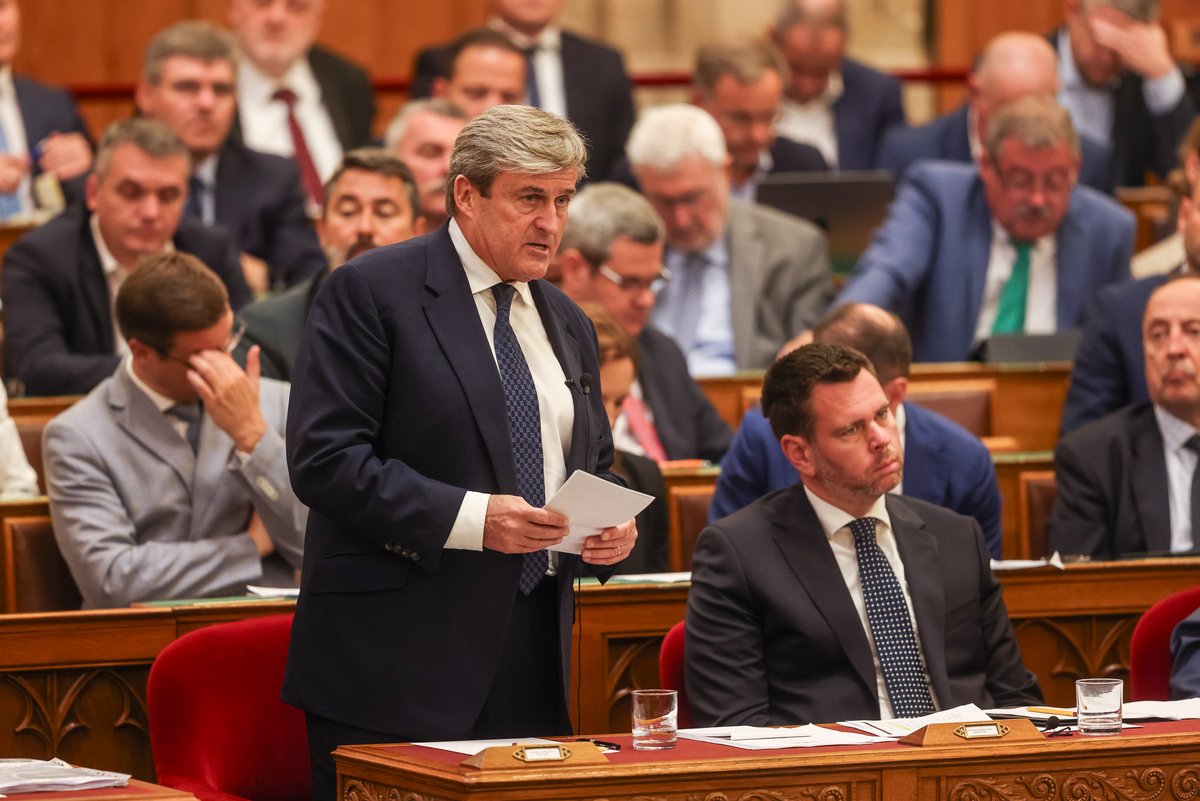
Preparing the abolition of this power was one of the first tasks assigned to me following the Government’s formation. We completed the work by the deadline, and Parliament is debating the proposal today, at this very moment.
In June, we also established an interministerial working group involving sectoral, environmental and academic experts to redesign the entire regulatory framework of the battery industry: stricter official controls, real sanctions and, above all, the protection of local communities, workers and the environment.
Today, together with Prime Minister @magyarpeterMP , I visited the Mercedes-Benz plant in Kecskemét, where the company inaugurated a new production line.
Thanks to this €1 billion investment, the next generation of the electric Mercedes C-Class will be produced here. The development will create 3,000 new jobs, while the plant’s annual production capacity will soon reach 350,000 vehicles. This will make Kecskemét Mercedes-Benz’s second-largest plant worldwide and its largest in Europe.
I started the day with CEO @OlaKaellenius and his senior management team, with whom I discussed opportunities for our future cooperation. He highlighted that, since its opening, the Kecskemét plant has become one of the Mercedes-Benz Group’s leading facilities in terms of quality, innovation and management culture.
It was particularly important to hear that Hungary is no longer seen merely as a manufacturing location, but as a key part of the company’s global innovation base.
During the plant tour, I was once again able to see the knowledge and outstanding professionalism of Hungarian experts.
Kecskemét was the first location in the world where a fully automated in-plant parts transportation system was tested. It was also here that the first realistic digital twin of an entire assembly plant was created, allowing production processes to be designed and tested in a digital environment before their actual implementation.
The advanced capabilities of the plant are also demonstrated by the fact that electric and conventionally powered vehicles can be produced one after another on the same production line.
Today’s inauguration is an important milestone, but our joint work does not end here.
We will continue working to ensure that investments of this kind create opportunities for more Hungarian suppliers, engineers and researchers. Our long-term goal is for Hungary to host not only manufacturing, but also an increasing amount of development, innovation and other high value-added activities.
The extraordinary heatwave is affecting the whole of Europe. Therefore, at the initiative of MAVIR, I have granted a partial exemption to the Paks Nuclear Power Plant from further output reductions for today and tomorrow, on grounds of security of supply.
The legislation in force allows that, in such extreme weather conditions, temporarily and under strict conditions, the secure electricity supply of the country may be treated as the primary consideration.
This does not mean the suspension of environmental protection rules. The water temperature of the Danube is being measured continuously, and its ecosystem is not at risk. This decision is a strictly regulated, temporary instrument to manage the extraordinary heatwave.
Hungary’s energy supply remains secure and continuous. My colleagues and the experts are monitoring the situation 24 hours a day and are taking all necessary measures to protect both security of supply and our natural values.
Big changes can only be achieved at great pace.
We are working with this strength because Hungary cannot afford to slow down when the task is to put the country back in order.
There are many challenges ahead of us, but with such a fantastic team, we have already delivered on dozens of our commitments in the first 50 days, as Prime Minister @magyarpeterMP has also reported.
Another important announcement: Hungary has joined the trilateral agreement established with the participation of 22 EU Member States, several European Union institutions and industry stakeholders to accelerate the deployment of energy storage across Europe.
Energy storage is a key issue for the future of energy supply. It helps integrate renewable energy more efficiently into the system, makes the grid more flexible and secure, and also supports the reduction of energy prices paid by Hungarian people.
The 22 Member States have committed to creating a total of 45 GW of storage capacity between 2026 and 2028. Hungary will contribute to this effort by developing 700 MW of new storage capacity.
This will strengthen security of supply and energy sovereignty, while also complementing the previously announced grid development projects and the expansion of wind energy capacity.
This is another EU-level cooperation that serves the success of Hungarian people, Hungarian businesses and Hungarian industry.
We have taken all necessary measures to ensure that Hungary’s electricity supply remains secure.
Due to the high water temperature of the Danube, a legally required reduction of output will take place at the Paks Nuclear Power Plant. This is a predefined and regulated measure: when the temperature of the Danube reaches the threshold set by law, the power plant adjusts the output of its units in line with environmental regulations.
The public will not experience any direct impact from this. Hungary’s electricity supply remains secure and continuous, while the operation of the Paks Nuclear Power Plant is determined in every situation by strict legal and professional requirements.
The water temperature of the Danube is being measured continuously, and all operational decisions are made on the basis of measured data and the regulations in force. The regulatory system provides a clear framework for responsible and predictable decision-making.
The current heatwave is affecting the whole of Europe, which makes it especially important to ensure both the protection of the environment and Hungary’s secure energy supply.
Just as we pay special attention these days to children, the elderly and proper hydration, it is also our shared responsibility to contribute — even through small steps — to the balanced operation of the system by using energy more consciously and, where possible, reducing unnecessary consumption.
I had a meeting in Luxembourg with @DanJoergensen, European Commissioner for Energy and Housing.
We discussed the energy situation in Europe and Hungary, the need to ensure continuous and predictable energy supply for our country, and Hungary’s commitment to renewable energy.
With Commissioner Jørgensen, we agreed that we will continue to focus on cooperation and constant dialogue in the future.
Hungary is once again taking part in European energy cooperation as an active, open and reliable partner — in the interest of Hungarian consumers.
A comprehensive organisational and operational review is being launched at EXIM, HEPA and HIPA.
The Hungarian people want a transparent, efficient and functioning country — this is what the overwhelming election victory in April clearly showed. The task is clear: we must do everything to ensure that the key institutions of the Hungarian economy become truly effective organisations that are able to adapt to changes in the international economic environment and serve the growth of the Hungarian economy.
Therefore, as of today, a comprehensive legal, operational and financial review has been launched at the institutions operating under the foreign economic affairs portfolio of the Ministry for Economic Development and Energy: EXIM Hungary, the Hungarian Export Promotion Agency — HEPA, and the Hungarian Investment Promotion Agency — HIPA.
The purpose of the review is to ensure that these institutions serve the interests of the Hungarian economy, export growth and the promotion of high value-added investments arriving in Hungary with the greatest possible efficiency, transparency and effectiveness.
Independent external experts and legal advisers will take part in carrying out this task. The review will cover the institutions’ operational processes, contract portfolios, governance structures and the efficiency of the use of public funds.
The Government is committed to ensuring that Hungary’s export and investment promotion system operates in line with international best practices and at the highest possible professional standard.
Based on the results of the review, the necessary organisational, operational and efficiency-enhancing measures will be taken.
Today I had a meeting with Marko Primorac, Vice-President of the European Investment Bank.
Our discussion focused on the opportunities for cooperation in the energy sector: how we can ensure a more diversified, more efficient and more secure energy supply in Hungary.
It was a constructive and forward-looking meeting, which can be an important step towards a stronger and more predictable Hungarian energy system.
Today I had a meeting with European Commissioner @steph_sejourne
The meeting was constructive and encouraging. Our European partners see Hungary’s development potential, and they are open and supportive towards the new direction we represent.
It is a good feeling to experience every day that we are received as partners, because they can see that serious changes have already started in Hungary in just a few weeks.
We discussed bringing home the EU funds that belong to Hungary, strengthening industrial investments and innovation, the opportunities offered by the Industrial Accelerator Act, and how we can attract more foreign direct investment to Hungary.
The TISZA government does not seek confrontation and does not create enemies. We are working instead to make Hungary once again a strong, reliable and successful European partner, while keeping our national interests firmly in mind.