“International community”, “international partners”.... I don’t really believe in any of these phrases.
If Somaliland were attacked by a foreign actor tomorrow, the people sitting in these rooms would give you, at best, a single PDF statement.
I don’t believe international forums are where Somaliland will secure recognition, or frankly where we should expect much practical value.
We don’t have a full list of who attended, but assuming they were mostly ambassadors accredited to Somalia, these forums were designed largely as a one-way mechanism: to assess Somalia, advise Somalia, and tell Somalia what needs fixing.
They were never designed as a forum for diplomats to review or reconsider their own governments’ policies towards Somaliland.
That does not make them useless, however.
The people in the room can act as messagers. They can take Somaliland’s message back to their foreign ministries, governments and capitals. In that sense, these forums are places where people collect notes.
And, as you can see, they were taking plenty of notes.
What matters is what happens after those notes leave the room.
Again, Somaliland’s diplomatic focus should therefore remain overwhelmingly bilateral, not multilateral.
On the speech itself, there was a lot to admire. The repeated emphasis on Somaliland’s sovereignty (at the beginning, throughout the speech and again at the end) alongside the clear call for Somaliland’s recognition, was excellent to see.
And the language of seeking partnership rather than simply asking for aid was particularly strong. It was, in my view, one of the finest speeches I have heard from an African leader before an international audience.
It was a moment of pride.
Where I have reservations is when the conversation moves into Somaliland’s internal affairs.
I do not believe the people in that room have any role in supervising, approving or receiving reports on Somaliland’s domestic governance. We are not seeking permission for how we govern ourselves. We govern ourselves for ourselves.
These are matters within Somaliland’s own sovereign competence.
There should not be an expectation that Somaliland comes before international partners to explain how its internal political system is functioning, as though we are reporting to them. Their own governments do not appear before forums like this to justify every aspect of their domestic affairs.
So I do not like seeing internal governance presented as something for external approval, assessment or reward.
That is not why Somaliland governs well. Good governance is for Somaliland and its people.
The same applies even more strongly to defence.
The speech touched on the extremely sensitive issue of Somaliland’s defence and the eastern regions. Again, an international forum is not where Somaliland should be looking for permission, approval or validation to defend its territory.
A sovereign country does not ask permission to defend itself.
So that’s my two cents.
Waxaan soo dhoweynayaa doodda ay qabanayaan Amnesty International Africa iyo Somali Journalists Syndicate (SJS) ee ku saabsan kiiska Sadia Moalim Ali iyo xaaladda xorriyadda hadalka ee Soomaaliya.
Xorriyadda hadalka, madaxbannaanida warbaahinta iyo ilaalinta xuquuqda aadanaha waa qiyam caalami ah oo mudan in meel kasta la ilaaliyo. Doodaha noocan oo kale ahi waxay muhiim u yihiin kor u qaadidda caddaaladda, isla xisaabtanka iyo ixtiraamka xuquuqda aasaasiga ah ee muwaadiniinta.
Waxaan ku baaqayaa in Sadia Moalim Ali si degdeg ah loo sii daayo, isla markaana loo xaqiijiyo in dhammaan xuquuqdeeda sharciga ah la ilaaliyo, si waafaqsan waajibaadka xuquuqda aadanaha ee caalamiga ah. Amnesty International ayaa ku tilmaantay xadhigeeda mid sharci-darro ah waxayna ku baaqday in si degdeg ah oo shuruud la’aan ah loo sii daayo.
Somaliland–Israeli Meeting in Nairobi, Kenya 🇰🇪📍
The President of the Republic of Somaliland, accompanied by the Minister of Foreign Affairs and the Head of the Somaliland Mission in Kenya, held a meeting in Nairobi with the Israeli Ambassador and a delegation of diplomats from Israel's Ministry of Foreign Affairs.
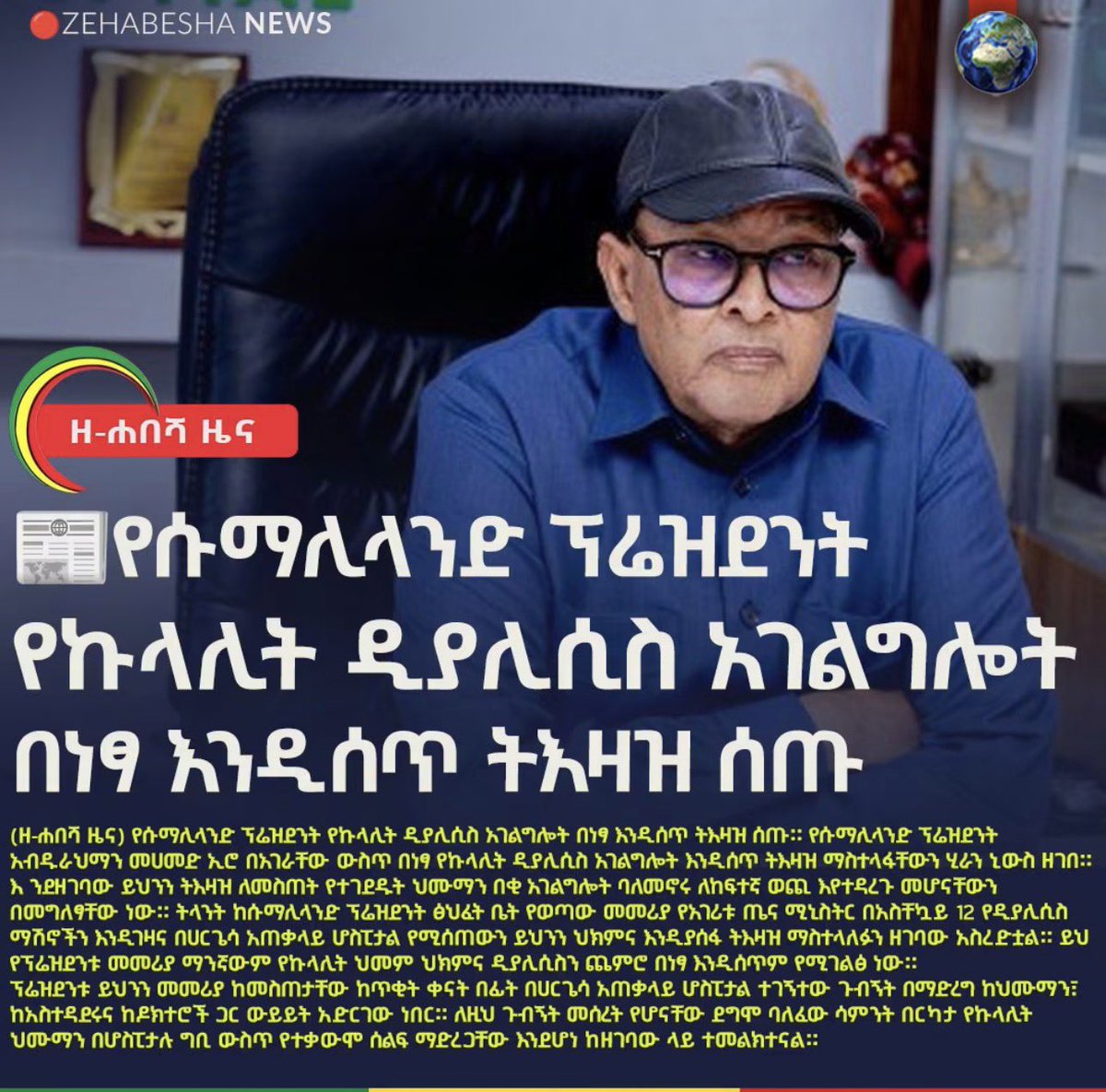
(The Habesha News) Somaliland president ordered to give kidney dialysis service for free. Somaliland President Abdurahman Mohammed Iro has ordered to give free kidney dialysis services in his country.
According to the report, those who were forced to give this order are because of the lack of adequate services, the patients are being paid for a high cost. The instruction from the office of the president of Somaliland stated that the minister of health of the country has issued an order to buy 12 dialysis machines and expand the treatment that is being given at Hargeisa General Hospital. This is the instruction of the president to provide any treatment for kidney disease including dialysis. It means it's free to give it away.
A few days before the president gave this instruction, he visited Hargeisa General Hospital and discussed with patients, administration and doctors. We have seen from the report that the basis for this visit is that last week many kidney patients protested in the hospital premises.
But nice to meet you. I don’t want to go too deep into this. Nowadays, every country looks after its own interests, and we are one of them. We tried to rebuild Somalia, but it didn’t work out, so now we are focusing on what is best for us and our future. We respect all countries, even those who don’t support us. With time, things can change and countries can build better relationships.
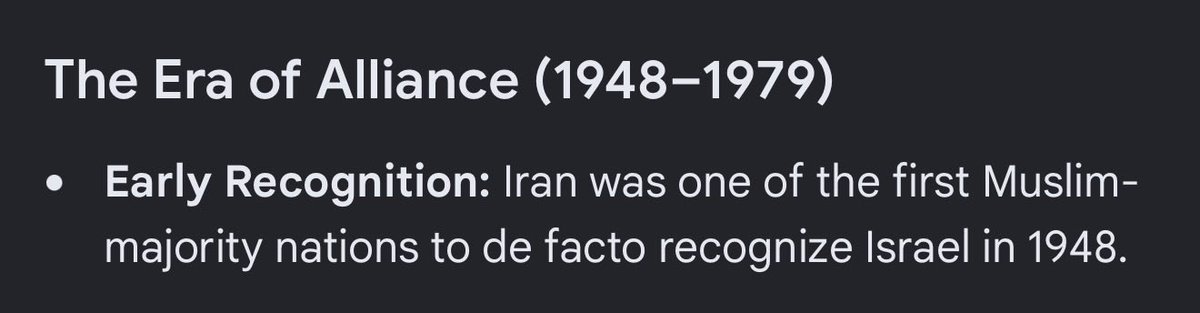
What I asked was only a simple yes or no question. But if you look at Iran’s history, you will see that Iran was actually one of the first Muslim-majority countries to recognize Israel in 1948. This happened before the 1979 revolution, when Iran had different relations with the United States and Israel. So my question was simple: was Iran an American country, or did it have its own history and decisions?
@SamanyShyl18040@RyanRozbiani Can you explain that? You didn’t know that before? You sade( Do you know that in Jewish Zionist thinking, all people in the world are called Jewish slaves? )
You said many countries don’t support Israel. Can you name them? As far as I know, almost every country has some level of cooperation with Israel.
But do you really think I care what the world says? I don’t care if they support Israel or not.
What people don’t understand is that our country has a lot of natural resources, including gas, minerals, and gold. We want to develop our country, attract investment, create jobs, and give our people a better future.
Like every successful nation, we want peace, economic growth, and strong international partnerships. If other countries are willing to invest and help us achieve that, we welcome their support. That’s what matters to us