Many CIOs position their IT departments as innovation-oriented functions, yet have no meaningful metrics to confirm or disprove that claim.
And what about the trend in innovativeness?
Without a feasible metric, it's more opinion than evidence.
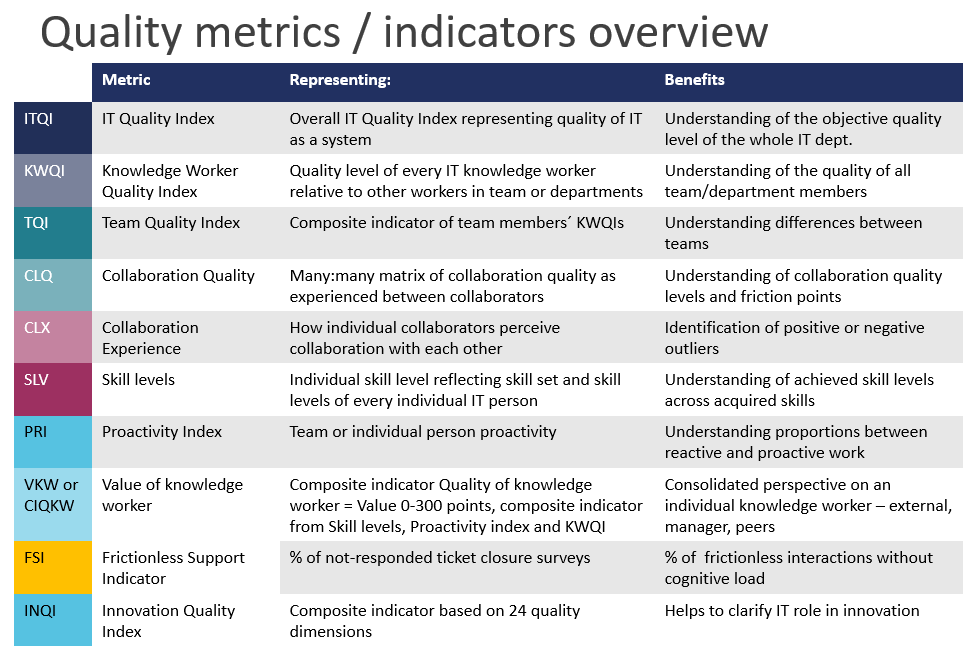
#INQI
This example shows how traditional IT metrics overfocus on reactive support activities while obscuring more important proactive qualitative metrics.
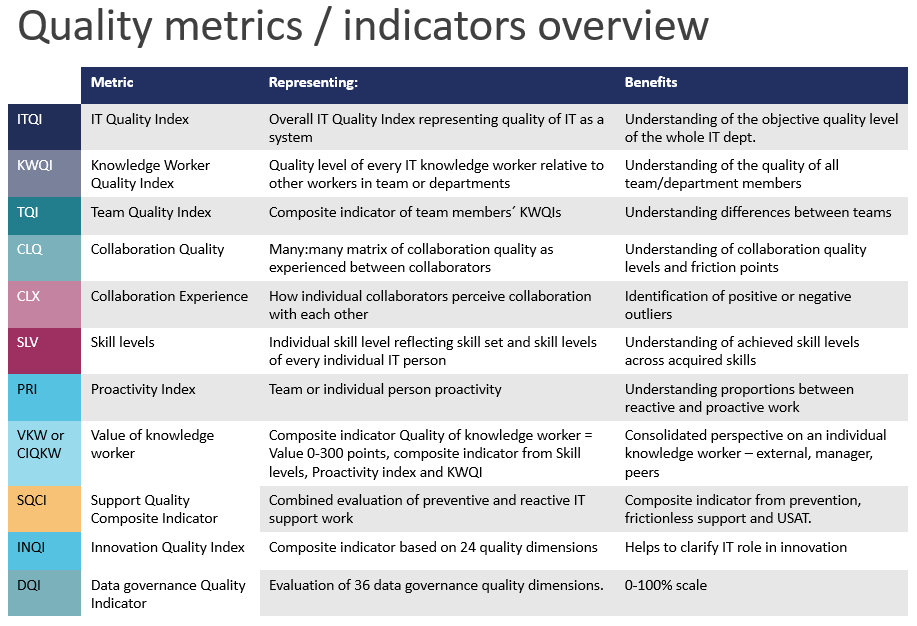
Eg. Support Quality Composite Indicator (#SQCI) can represent the absence of incidents through productivity oriented indicators.
What is better?
A/ Higher USAT scores from ticket closure surveys
B/ Fewer incidents (and lower USAT)?
B/ is better for the organization.
Yet many IT teams still optimize for high USAT scores.
Preventing incidents should be a higher priority than chasing higher USAT scores.
Support Quality Composite Indicator #SQCI aims to reduce the overreliance on USAT metrics and evaluate support from a more holistic perspective.
How innovation-oriented is your IT?
Can we measure it?
The Innovation Quality Index (#INQI) provides an effective way to assess the baseline and track trends over time. It also serves as a mediation tool to help define the right context-relevant target level.
The concept of continual improvement assumes activities can be improved independently, without unintended effects on other metrics.
In complex environments, this rarely holds—interdependencies mean improving A inevitably impacts B and C.
Metrics should be seen as a web.
Quantitative and qualitative IT metrics are structurally different.
The former fits routine, repeatable work; the latter captures proactive, preventive, and future-focused knowledge work.
For many in IT management, quality is reduced to monitoring SLAs and user satisfaction scores. But the entire domain of IT quality is much broader when viewed from a system-level perspective. IT departments are complex, multidimensional systems.
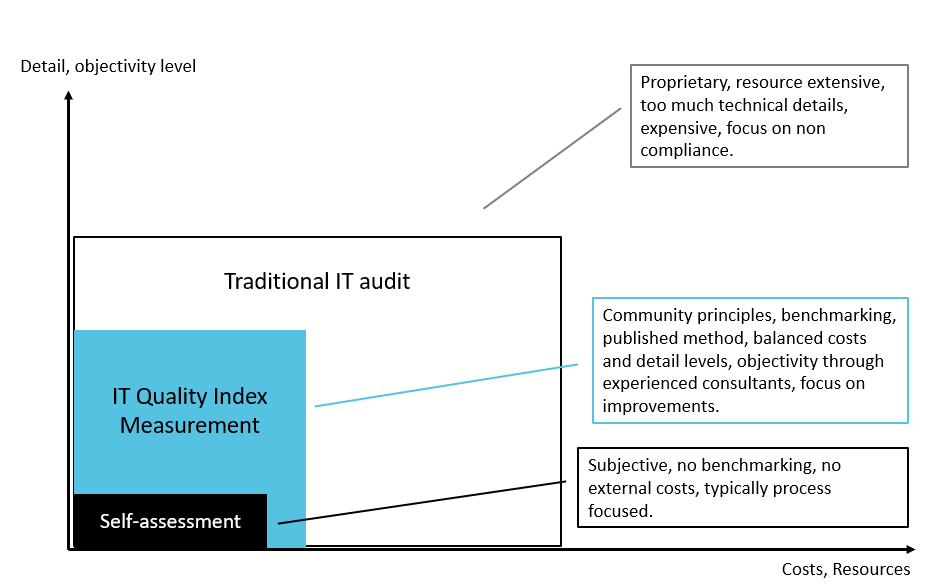
Self-assessment
or full audit?
In many cases, neither works well - low objectivity on one side, high cost on the other.
IT Quality Index sits in between:
an independent quality assessment with low demands on time, money, and effort.
The primary goal of IT is to minimize the need for support.
That’s why making Customer or User Experience the primary metric is misguided.
#SQCI#SupportQuality#ITManagement
When your Service Desk excels in user satisfaction scores from ticket closure surveys, it may signal poor overall IT quality.
Why?
Because the desk is efficiently solving issues that shouldn’t exist in the first place.
#SQCI metric
Many IT departments still miss one key perspective: understanding their position through innovation contribution.
The Innovation Quality Index (from IT Quality Index 2026 Edition) enables fast assessment - and sharper decisions on IT’s future role.
#INQI#itQuality
Best practices come with a risk: overadoption.
Strong IT organizations spot it early and simplify or remove practices when the cost/benefit balance no longer makes sense.
#ITQualityIndex shows where improvement isn’t needed.