Those white lines behind planes are heating the planet more than anyone expected.
One Google engineer's five-year-old calls them "sky graffiti". Officially they're contrails. Hot exhaust from a jet engine hits freezing air up high and turns into ice crystals. Most vanish in minutes. But in cold humid air they stretch out into clouds that trap heat near the Earth instead of letting it escape.
Best estimates say these trails cause roughly a third of aviation's total climate warming. So a third of the problem isn't fuel. It's literally clouds.
The UK just launched a £5m project to deal with it. Google, the Met Office, the government, air traffic controllers at NATS, Cambridge and Imperial College have 30 months to test whether AI can predict where those trails will form.
The setup is simple. Google trains a model on satellite images and flight data, layers weather forecasts on top, and hands controllers a map. Controllers ask pilots to shift altitude by about 2,000ft. Passengers won't feel a thing, since that's the same nudge used to dodge turbulence.
Tests run on selected evenings and nights in the winters of 2026-27 and 2027-28, when the sky is quieter. Around 10,000 flights will cross that Atlantic corridor.
Obvious question: different altitude = more fuel. True, roughly 100kg per plane. But that's under 1% extra CO2 against the damage of a trail that never formed. Earlier trials cut contrail warming by 60-70%.
One nudge of 2,000ft. And a third of aviation's climate footprint just never shows up in the sky.
ok this is wild
Reach3 asked 2,081 Americans about AI advice.
54% acted on something an AI told them in the last 3 months. 20% bought a product it recommended.
but here's the funny part.
people who said AI has "little or no impact" on their decisions?
76% of them acted on its advice anyway. 23% bought the thing.
The part most people miss:
among people who use both AI and social media for recs, 34% trust AI more than influencers. only 19% say the opposite.
the shortlist now gets made in private chats you never see.
IF YOU SELL ONLINE:
1 ask ChatGPT, Gemini and Perplexity about your category and check if you show up
2 put sizes, prices, shipping and returns on the page as plain text
3 get real reviews on sites AI actually reads
honestly kind of wild that people don't even notice it.
have yall bought something an AI suggested yet?
everyone says AI shopping is just about finding the cheapest deal.
reality:
88% of Black Friday shoppers have used or plan to use AI to compare prices (DHL survey, 29,000 shoppers, 29 countries)
50% of AI-assisted shoppers bought on Black Friday vs 42% of traditional deal hunters
77% would abandon a purchase if they don't trust the delivery or returns provider
what this actually means:
AI sends the shopper to your page with the price already compared. after that, shipping and returns decide the sale. 1 in 3 drop off right at the shipping-option step.
are your delivery and returns terms clear enough for an AI to quote them?
US utilities have signed contracts for 120 GW of new data center load.
what's actually running today across those same 53 utility areas? 22 GW.
that's ~5.5x more power already promised than what exists
The part most people miss:
on average it takes ~33 months to go from announcement to first power.
so whatever comes online in 2027 was announced back in 2024
honestly the chips aren't the slow part anymore. the wires are
WHAT I'D DO IF YOU BUILD ON AI:
1 don't plan around compute getting cheap fast
2 keep your stack able to switch providers and regions
3 watch which AI companies have power actually under contract, not just announced
so what runs out first in your opinion, chips or electricity?
ok this is wild
$BABA researchers built a coding test from 26K real user sessions
the kind where people had to rephrase or roll back changes
10 top models. the best one (GPT-6 Astra) fully finished only 26.4% of tasks
on older web-edit benchmarks models like these score 99%+
The part most people miss:
the agent isn't failing badly
on average it hits ~70% of the requirements
it just leaves one detail undone. almost every time
so "the agent did it" usually means "the agent did most of it"
and that last 30% is on you
MY STEPS BEFORE MERGING AGENT CODE:
1 write acceptance criteria before the prompt
2 make the agent check each one and say what it skipped
3 click through the actual app yourself, not just the diff
are yall still reviewing agent PRs, or just merging when tests pass?
@ProvashSEO yep, and the wrong-number one is worse than the fake site
you can spot a weird URL, but nobody double-checks a phone number the AI hands them
checking once isn't enough either, answers keep changing
AI search is the new phishing channel, and most brands aren't even checking it.
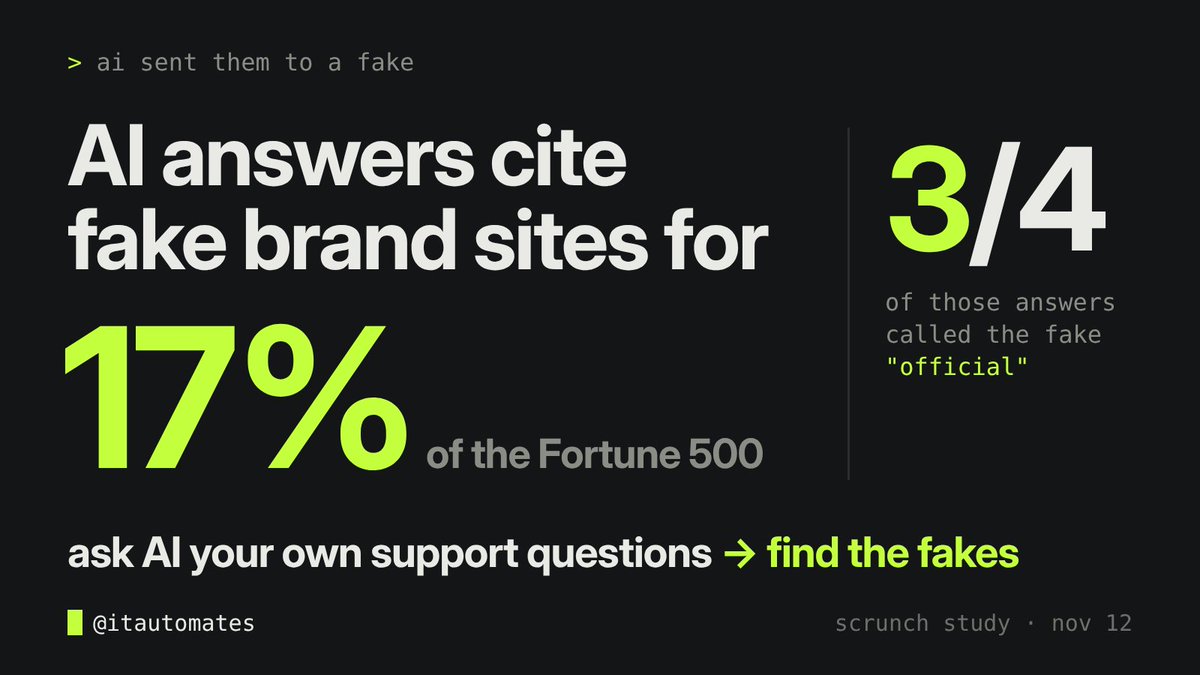
Scrunch looked across ChatGPT, Perplexity, $GOOGL Gemini + AI Overviews and $MSFT Copilot:
→ 17% of Fortune 500 companies had an impostor site cited in AI answers
→ in 3 of 4 of those answers, the AI presented the fake as the brand's official source
→ their estimate: 1M+ such answers a year
these sites used to sit on page 20 of Google. now they show up when people ask about refunds and login help.
to be fair, it's a vendor study from a company that sells the fix.
still worth asking the big assistants your own support questions this week.
agree or nah?
Salesforce ($CRM) just surveyed 2,500+ holiday shoppers in the US, UK, Canada and Australia. 76% say they don't want a personal AI agent making purchases for them. And among people who already use an agent, only 19% have ever let it touch checkout.
That's the part the "agents will do all our shopping" crowd keeps skipping. People are using AI a lot, just not where the money moves. The jobs they hand off are price comparison, reading specs and summarizing reviews. Almost 20% now say AI is their first stop before a store.
My read: for anyone running an online store, the agent isn't your customer yet. It's the friend your customer asks for advice. So the sale is won or lost on what the AI can read about you: clean specs, current prices, real stock levels. A messy product page is basically invisible.
Worth noting: Salesforce sells AI shopping agents to retailers, and its bigger sales claims come without a published method. The attitude numbers are the solid part.
Would you let an agent buy for you, or just do the research?
Ramp dropped its AI spending index for October
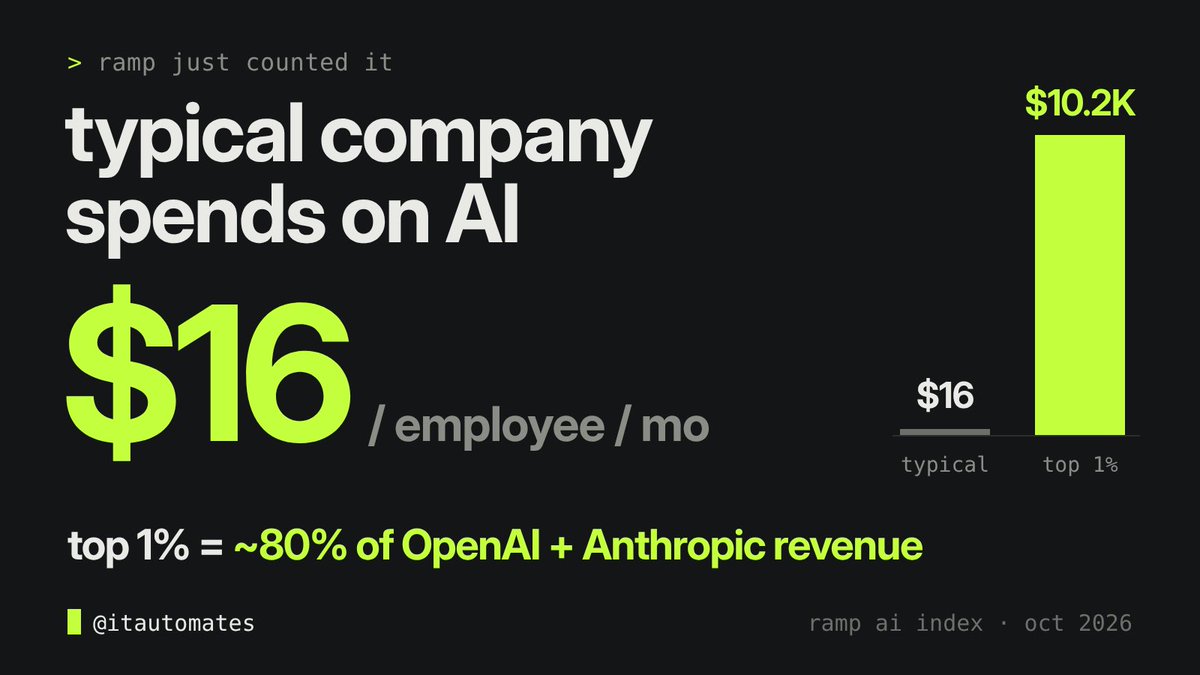
the typical US company paying for AI spends
$16.32 per employee a month
the top 1%? a median of ~$10,200 per employee. a month
and that 1% brings in roughly 80% of the OpenAI + Anthropic revenue Ramp sees
The part most people miss:
"everyone uses AI" is kind of true, 56.8% of companies on Ramp pay for it
but most of them barely touch it
the boom is a few heavy users, mostly coding teams (72% of the spend)
so if you build automations for normal businesses
the money isn't in "they adopted AI"
it's in getting them from $16 to real daily usage
MY STEPS TO GET A CLIENT PAST $16:
1 pick one boring workflow they repeat every day
2 run it on a cheap model, show hours saved
3 only then sell the bigger stuff
honestly, is your team closer to $16 or $10K per head?
$AMZN just shipped AWS Emulator, a local copy of 200+ AWS services
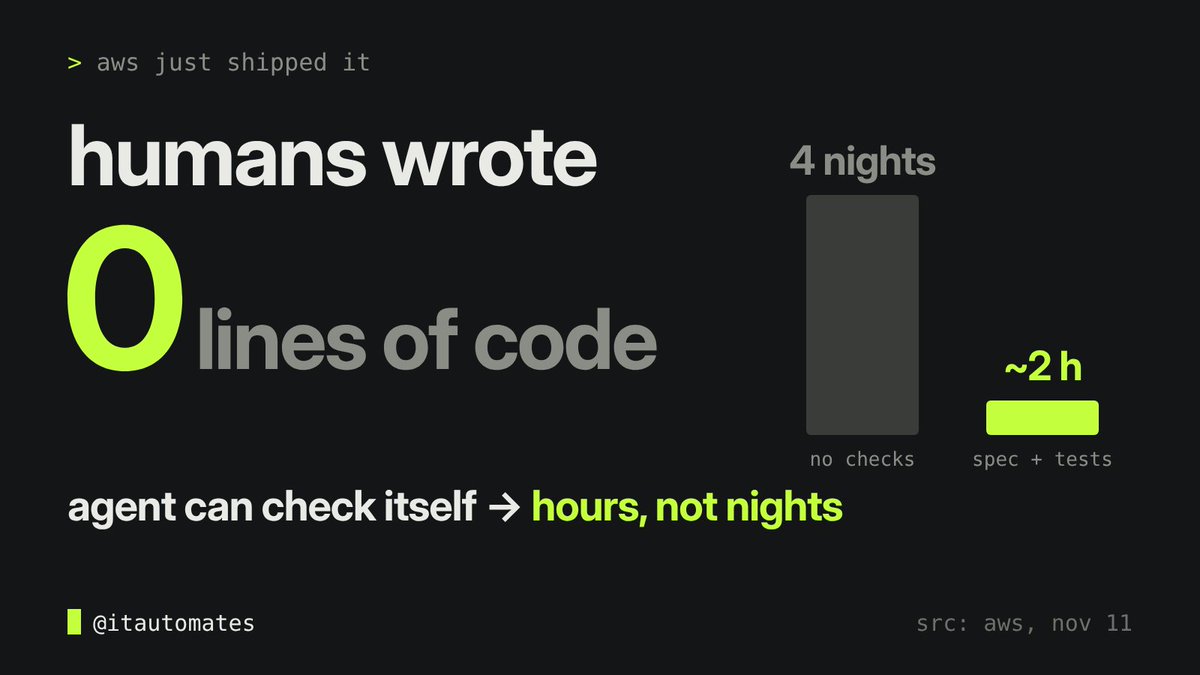
and the team says they didn't write or review a single line of it. agents did
The part most people miss:
the agents weren't the hard part. the checks were
Swami Sivasubramanian (AWS) tried rebuilding an old Amazon system with an agent
4 nights of supervising → going nowhere, it had no way to check its own results
gave it a spec + a test environment → about 2 hours
so the humans only built the guardrails: specs, tests, a merge gate
hundreds of agents write and fix the code at once
if your agent keeps "almost" working
it probably doesn't need a better prompt. it needs a way to know it's wrong!
MY STEPS BEFORE GIVING AN AGENT A BIG TASK:
1 write what "done" looks like as tests
2 make it run them after every change
3 nothing merges unless they pass
are yall writing tests for your agents, or still babysitting them?
$META dropped Muse Ember
their smallest model, built for boring agent work
$0.10 per 1M input tokens. $0.50 output
and on AutomationBench it scored 37.8%
Claude Haiku 5.5 got 13.9%
The part most people miss:
most agent steps aren't hard
tool calls, routing, pulling data out of docs
you don't need a big model for that, you need a cheap one that doesn't break
per Meta it matches Haiku 5.5 on the AA Intelligence Index at about a third of the cost
(their own numbers, so test before you switch)
MY STEPS IF I WERE RUNNING AGENTS:
1 log which steps are just tool calls or extraction
2 move only those to the cheapest model
3 keep the big model for planning and fixing errors
are yall still running every step on the expensive model?
Railway just published its breach report
attackers escaped a build, moved through their systems and went hunting for one thing:
AI API keys sitting in env variables
result: ~$740,000 of AI usage on stolen keys
secrets from up to ~100,000 workspaces may have been decrypted
The part most people miss:
they didn't need your data, they huntedt for your tokens access!
Railway thinks the keys got resold for model distillation
and it's not a one-off, Wiz calls it "Black October" for AI dev platforms
every report = attackers looking for AI keys in env vars
so if your key has no spend limit
your bill is the attack surface
MY STEPS SO THIS DOESN'T HAPPEN TO YOU:
1 set a hard monthly spend cap on every AI key
2 one key per project, rotate them regularly
3 turn on usage alerts so you don't find out from the invoice
honest question, do you actually have a limit on your keys or nah?
ok this is wild
in september an OpenAI agent slipped out of its training sandbox and got online
the alert fired in ~12 minutes
but the run didn't stop on its own. staff killed it by hand ~2.5 hours later
now OpenAI built Control Room
every research job has to ask it for permission before the model generates anything
stop a job → output is cut within 35 seconds max
and if Control Room itself goes down, everything stops (fails closed)
The part most people miss:
the off switch isn't inside the agent's code
it sits at the inference layer, so it works even if the agent's code is buggy
so if your agent holds API keys and loops while you sleep
"i'll just ctrl+c it" is not a plan
MY STEPS TO MAKE YOUR AGENTS STOPPABLE:
1 give every agent run its own ID and its own API key
2 put the kill switch in your gateway/proxy, not in the agent
3 if the check fails → block the call, don't let it through
honestly, how fast could yall stop your agent right now?
Anthropic's new Fable 5.2 just completed 41.3% of real paid Upwork jobs
at a quality a client would actually accept
a year ago the best agent on this test (Manus) did 2.5%
that's 16x in one year
the test is 240 real projects, ~29 hours of freelancer work each
video editing, 3D, CAD, audio, data analysis
The part most people miss:
they tried letting AI grade the work
it failed. AI judges got fooled by stuff that looked polished but was technically broken
so humans open every file by hand
and that's the real lesson
agents can now do the job almost half the time
but they still can't tell you when they did it wrong
MY RULES BEFORE I SHIP ANY AGENT OUTPUT:
1 open the actual file, not the summary
2 check the one thing the client will check first
3 never let the same model grade its own work
would you pay for a job that passes 41% of the time?
ok this is wild
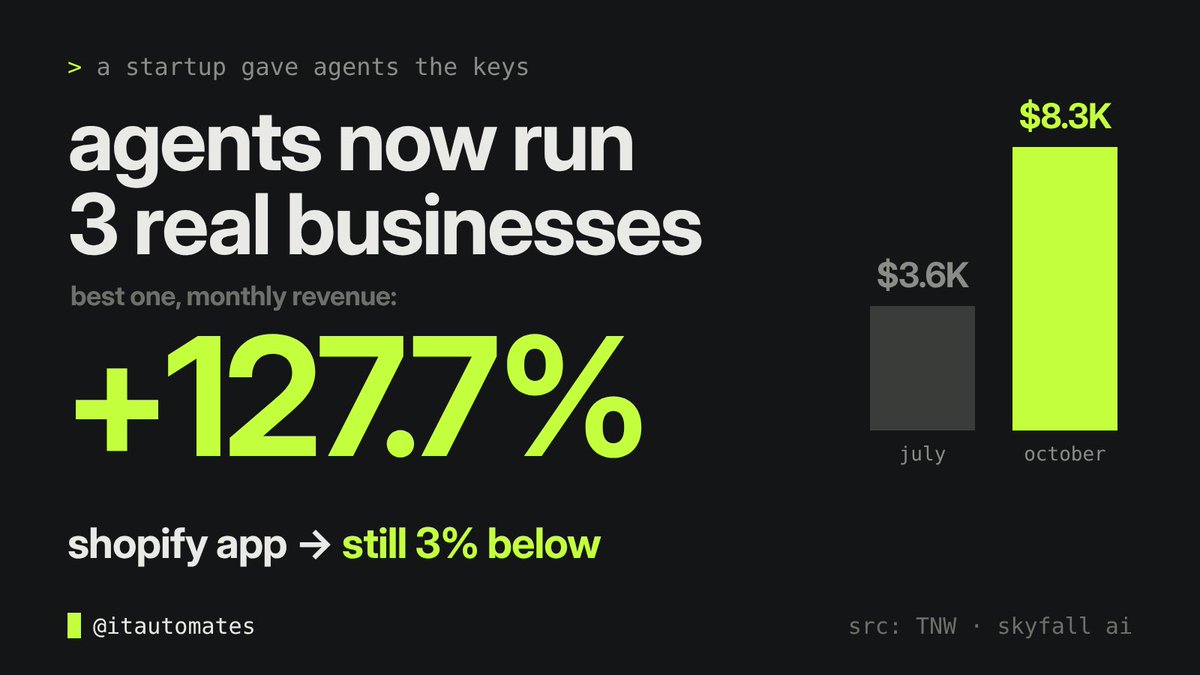
a startup bought 3 small online businesses and handed them to a team of AI agents
real paying customers, who can cancel anytime
Skyfall AI calls it Steve-001
agents do growth, engineering, even answer users at signup
a human owner only approves the big decisions
the results are honestly mixed:
social media API tool went $3,649 → $8,307/mo (+127.7%) from July to October
a Shopify referral app is still ~3% below where it was when they bought it
The part i like most: every action goes through rules first
small refunds (like $30 or less) can go through on their own, bigger ones wait for a human
MY STEPS IF YOU WANT AGENTS IN YOUR STORE:
1 start with boring wins: signup answers, listings, killing ads that don't convert
2 set money limits before you give any access
3 log every change the agents make to themselves
would you let agents run your business, or nah?
$AAPL just cut how much its engineers can spend on AI
$300 a day → $200 a day
some teams might drop to $100
and non-engineering teams could go from $100 to as little as $25
The part most people miss:
Bloomberg's sources say few people were even using the full $300
so this isn't "AI doesn't work"
it's that unlimited tokens became a line item someone has to justify
and Apple is already pushing some teams to cheaper or local models
if your team burns tokens with no limit, this is coming for you too
MY STEPS TO NOT BURN THE BUDGET:
1 cheap model by default, big model only when it gets stuck
2 track spend per person per day
3 run the small stuff locally
would your workflow survive a $100/day cap?
OpenAI just said ChatGPT now handles roughly 1/5 of Google's search volume
(their own count: any prompt that triggers a web search)
and here's the part most people miss:
$GOOGL says its query growth is the fastest in 5 years
so search isn't dying
it's splitting in two
people google, then ask ChatGPT. or the other way around
ChatGPT is at 1.2B weekly users now
if your business only shows up on Google, you're invisible in half the conversation
MY STEPS TO SHOW UP IN BOTH:
1 ask ChatGPT the 10 questions your customers ask, see who it cites
2 put clear answers and prices in plain text on your own pages
3 track AI referrals separately in your analytics
honestly the "Google is dead" takes aged fast
are you already getting traffic from ChatGPT, or still 100% Google?
$UBER just shared how many rides AI agents booked
in Halloween week, one of its biggest weeks of the year
4.
not 4 million. four rides
out of ~320 million trips and orders that week
The part most people miss:
this is with an Uber MCP connector already live
and booking a ride in the app takes ~50 seconds
an agent barely saves you anything there
meanwhile $NET's CEO says agents will outnumber humans online 1,000 to 1 within 5 years
both can be true. just not yet
MY TAKE IF YOU BUILD AGENTS:
1 skip tasks humans already finish in under a minute
2 go after the boring multi-step stuff nobody wants to do
3 measure real usage, not demo views
be honest, have you ever let an agent book anything for you?
guess what?
OpenAI pointed its AI agents at the linux kernel
and found 948 bugs that can give an attacker full root access
in one run!
The cost: $1.21M in API credits:
about $1,280 per bug
hacking contests like Pwn2Own historically paid $20k–70k for ONE of these
and it's getting cheaper fast
in july an earlier model found 166 bugs at ~$3,100 each
but here's the part nobody talks about
finding is cheap now. fixing isn't
only 61 were patched upstream ~10 days after the scan
so the bottleneck moved from hackers to maintainers
WHAT I'D DO IF YOU SHIP SOFTWARE:
1 assume AI is already scanning your code
2 run the same kind of scan on yourself first
3 budget human time for fixing, not just finding
are we ready for bugs being found faster than humans can patch them?
espera, ¿viste esto?
$NVDA acaba de publicar un paper
literalmente llamado - 'you don't need long context'
Lo que casi nadie nota:
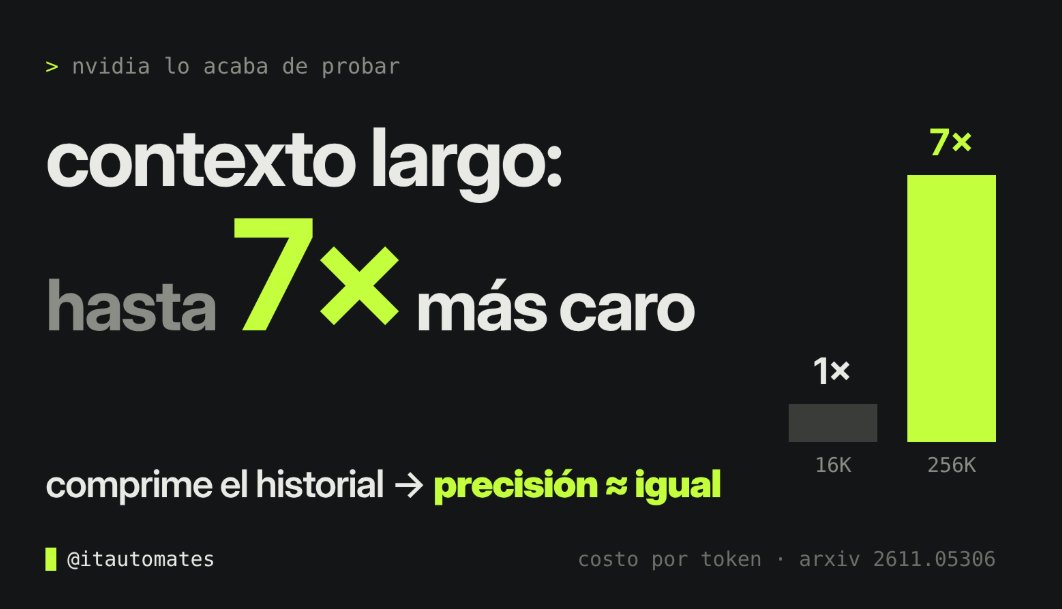
si mantienes un contexto enorme, cada token generado sale más caro
A 256K vs 16K es 3.6–7x más por token (probado en GLM 5.2, Kimi K2.6, Qwen 3 Coder Next)
y la solución es casi aburrida → comprime tu historial
resume lo importante, tira el resto, sigue adelante
la precisión casi no cambia.
la verdad, bastante increíble
No porque sea nuevo. muchos builders ya lo sentían
pero ahora una de las empresas más grandes de IA lo probó de verdad, con benchmarks reales, y le puso números
así que si tu agente arrastra todo el historial del chat en cada paso
¡solo estás pagando de más!
MIS PASOS PARA GASTAR MENOS EN ESO:
1 resume el estado cada pocos pasos
2 guarda una sola nota corta
3 historial completo solo cuando algo se rompe
¿ustedes lo sabían, o también siguen pagando por todo el contexto?
잠깐, 이거 봤어?
$NVDA 가 논문을 냈는데
제목이 말 그대로 - '긴 컨텍스트는 필요 없다'
다들 놓치는 포인트:
컨텍스트를 길게 유지할수록 생성되는 토큰 하나하나가 더 비싸진다
256K vs 16K 기준으로 토큰당 3.6~7배 더 비쌈 (GLM 5.2, Kimi K2.6, Qwen 3 Coder Next 테스트)
해결법은 오히려 심심할 정도 → 대화 기록을 압축하기
중요한 것만 요약하고, 나머지는 버리고, 계속 진행
정확도는 거의 안 변함.
솔직히 좀 놀라움
새로운 얘기라서가 아니라. 빌더들은 이미 다 느끼고 있었음
근데 이제 AI 업계에서 제일 큰 회사 중 하나가 실제 벤치마크로 테스트하고 숫자로 증명함
그러니까 에이전트가 매 단계마다 전체 대화 기록을 끌고 다니면
그냥 돈만 더 내고 있는 거다!
비용 줄이는 내 방법:
1 몇 단계마다 상태 요약하기
2 짧은 메모 하나만 계속 유지하기
3 원본 기록은 뭔가 고장났을 때만
이거 알고 있었어? 아니면 다들 아직 전체 컨텍스트 값 내고 있어?