"Women are the only 'oppressed' group to own more of the culture's luxury items than the 'oppressor...'"
-Warren Farrell
More spicy Farrell quotes here:
https://t.co/3ibFg4mNtE
Why the Ancient Brahmins of Kerala 'converted' to Christianity
Manu Joseph
It is dangerous to make people renounce Hinduism in today's India; how then in ancient times did a start-up religion survive, forget thrive?
I believe that in ancient times a new religion could survive its infancy because it wasn't perceived as a faith as such, but as something mystical. Hinduism was so deeply ingrained in India that the adoption of Christianity, even if it came with a sprinkling of water, did not alter much. Certainly it did not alter the caste of the elite.
This phenomenon might also explain why polytheism preceded monotheism in many regions of the world. The many gods of Hinduism point to an ancient polytheist society. Once upon a time, the conventional wisdom is, it was no big deal for people to have more than one faith. But this view misses an important clause. Once upon a time it was no big deal for people to have more than one faith, because the entrenched faith was the primary way to be. It is only when we look back from centuries away that it appears, in a retrospective illusion, there was a cluster of equal gods.
But this is an incomplete theory without another mechanism of human behavior. It will not only explain why the ancient Brahmins appeared to convert to a new religion, but also why only a Brahmin conversion could have made the new religion triumph.
(Read the full argument free on my Substack. Link is in the comments.)
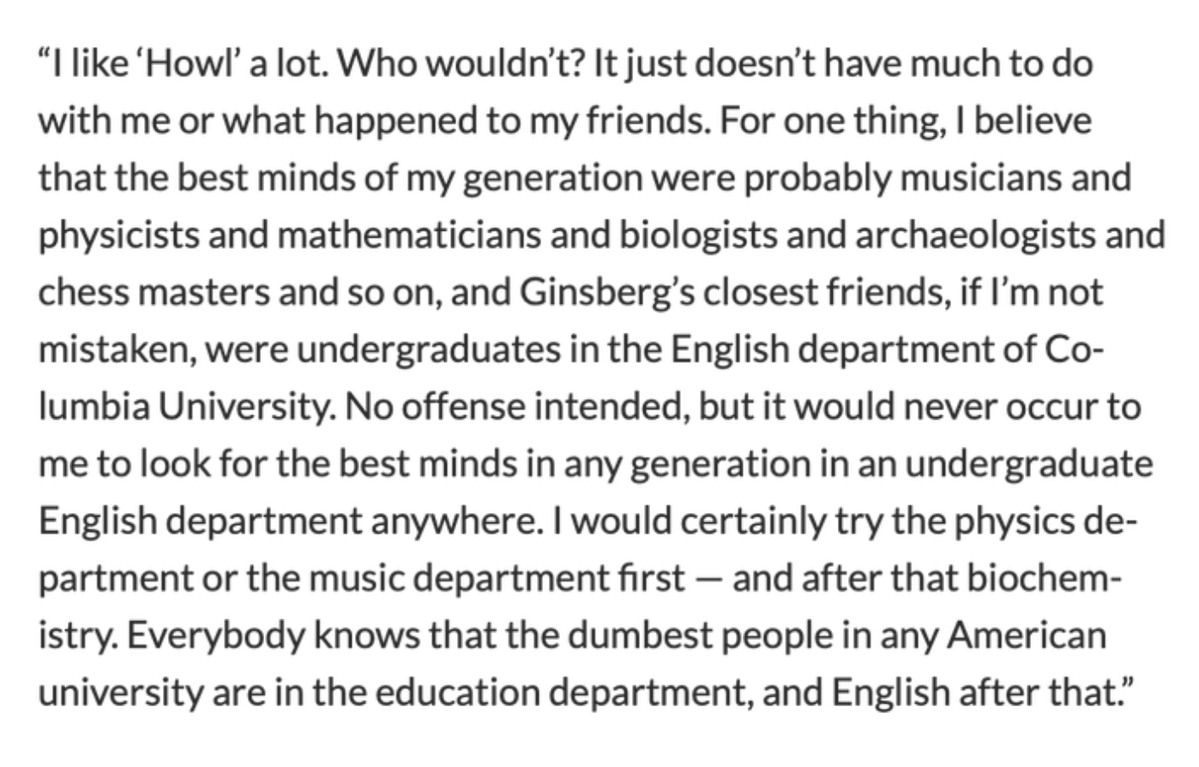
I don't care what he thinks about video games, Roger Ebert had the ultimate redpill on nerd culture as a whole.
This basically describes every fandom on earth, and once you see it, you can never un-see it.
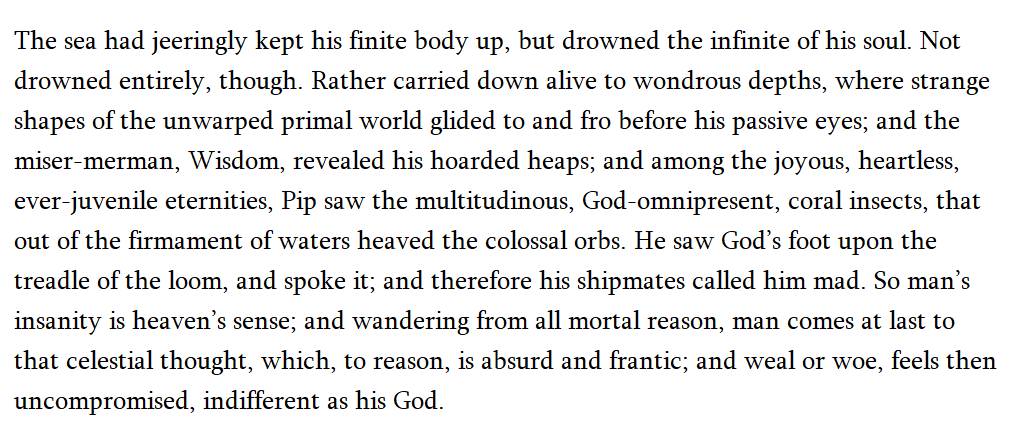
This is the single greatest paragraph in American literature.
It comes at the close of chapter 93 of Moby-Dick. Young Pip, a Black cabin-boy, beloved by the crew of the Pequod, is inadvertently stranded alone on the open sea. The experience of being lost for hours in the middle of those “heartless immensities” drives the boy to insanity. But in that madness, Melville argues here, is a kind of wisdom. Pip had a vision of the inner workings of all things, and it drove him mad.
On the first day of my final year in college, my literature professor, Dr. Gaines, asked each of us to name a favorite work of art: song, book, film, it didn’t matter. When my turn came round, I opened a copy of Moby-Dick that I happened to have brought with me and read this passage aloud. By the time I had finished reading, Dr. Gaines was in tears. He said, “Class dismissed.” In all the years I knew him, he could never get through this paragraph. It haunted him. It haunts me.
Christopher Hitchens identifies the creation of identity politics as the moment the left lost. I wonder if he imagined the damage it would still be causing nearly sixty years later.
Life is amazing:
-gyms exist
-Coke Zero exists
-hot girls outnumber even moderately put-together dudes 2000 to 1
-you and your wife can drink 4 bottles of wine then smash all night without a condom
-you and your friends can hit the gym then smoke a joint and watch The Godfather
-every food item in the world has been hunted and gathered for you (grocery stores)
-you could be working 16 hour days in a coal mine in a third world country
-you’re spinning on a sphere in an infinite universe and the fact you’re alive is a 1 in 500 trillion miracle - every day you wake up you win the freaking lottery :)
"Out of India’s improved English education there has come a crop of novels — a fair number are also by Indian expatriates, mainly from the United States — and there is a new one almost every month. These novels are by and large autobiographical. Every Indian who looks within himself finds the matter for a family story, with great characters, daddyji and mamaji and nanee and chacha, against a background of the extended Indian family. Since no writer can have two extended families, these novels appear to be rationed, one per writer. One writer, one book: it may not build a literature, but it is a system that allows new writers and new families to come up all the time.
Is this writing just old-fashioned Indian boasting? Or are
these books to be seen as part of a new Indian literary awakening, matching Bengal’s of a hundred years ago, helping India now to understand its more complicated self, to develop an autonomous cultural life, to bridge the gap between native and evolved? Or do they belong more to the publishing culture of Britain and the United States? The question has to be asked, because no national literature has ever been created like this, at such a remove, where the books are published by people outside, judged by people outside, and to a large extent bought by people outside."
-Naipaul (2006)
@sissenberg@nytimes A correction will appear in tomorrow's print edition:
"A headline with an article on Friday about President Trump’s threats to leave NATO misstated the full name of the body. It is the North Atlantic Treaty Organization, not the North American Treaty Organization."
it's impossible to explain the early 2000s to zoomers, but just to give you a sense:
in 1995, backpack rapper will i am started a backpack rap group called Black Eyed Peas with a mexican-american and a filipino guy, released two albums, added a blonde female vocalist and moved to pop-rap.
the pop-rap album is recorded over the course of 2001, and is allegedly both interrupted and inspired by 9/11
9/11 album has three singles: let's get retarded, shut up, and a kind of 'do they even know it's christmas' consciousness-raising song called 'where is the love?' about how we just have to love each other. the album is now quadruple platinum
after this, will i am starts a tech co and acquires an israeli machine learning company. i think he also made hardware for the early iphone
this year he's teaching a course on agentic AI at ASU
Hormuz is a weapon that can only be fired once
No one should expect a quick resolution to the current crisis, but across the next decade, even the next 3-5 years, the choke point of Hormuz will be massively substituted for
The Gulf Arab states are all very rich, with high per capita GDP - the best single measure of relative state capacity - easy access to global markets, especially financial, and have the favorable backing of the US
Everyone has known about the Hormuz vulnerability for decades. The Iranians have continually hinted around closing it, but never did. Now they have, but Hormuz is a gun that cannot be reloaded.
Deterrents work only up to the point of use. Once used, they have failed. The purpose of a deterrent is to *not* be used
Many analysts have made this basic mistake. They think that Iran is now in a position of strength, having exercised its Hormuz option. But the opposite is true. A state is weakest after it has used its deterrent. The cost of that deterrence is now priced in. The worst having been done, the targets of the deterrent are now free to make other arrangements. Before, they were reluctant to do so because of the switching costs. Now, they have no choice; they will not allow themselves to be controlled in this way again
Hormuz may never reopen. But the importance of this is a depreciating asset.
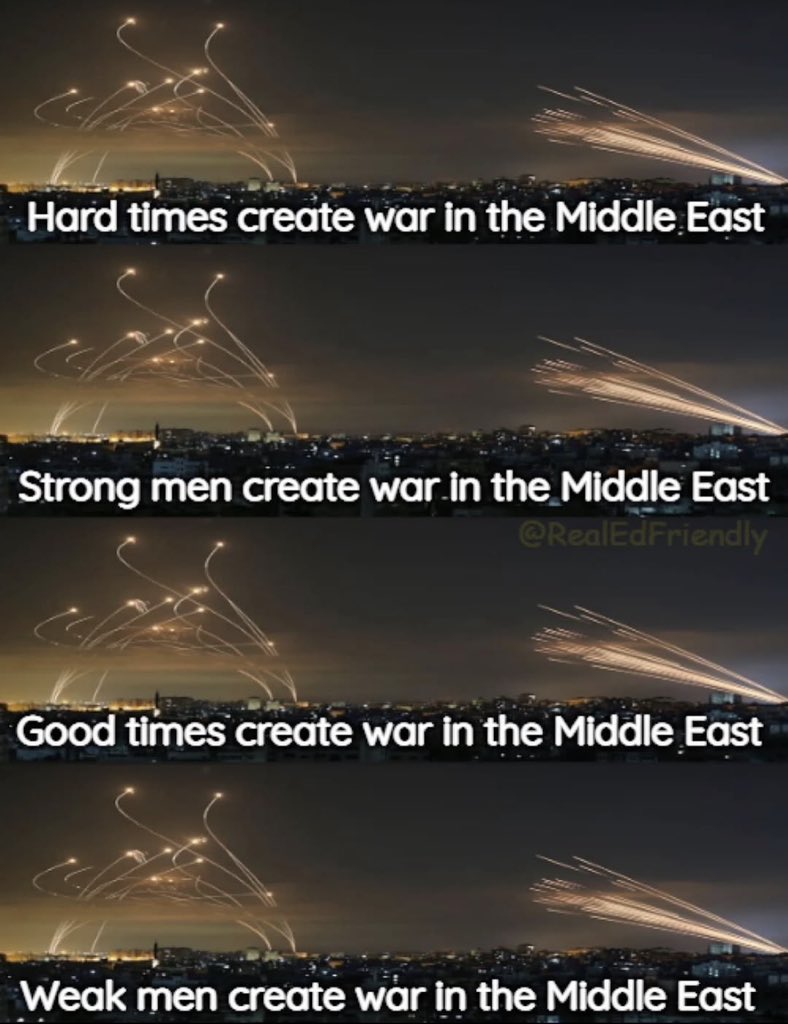
There are now two quotes that frame the narrative of this war.
Feb 1: Khamenei -- "The Americans must be aware that if they wage a war this time, it will be a regional war."
Mar 16th. @realDonaldTrump "Nobody expected that. We were shocked."
The discovery of ancient Sumer came as a real shock to 19th century historians. It was a true forgotten civilization. The ancients didn’t know of it. The Bible doesn’t (directly) talk about it. Genesis references some of the Sumerian cities, but not Sumer as such.
That there was this entire civilizational layer beneath Babylon and Assyria was entirely in known. Urban civilization was far older than anyone suspected
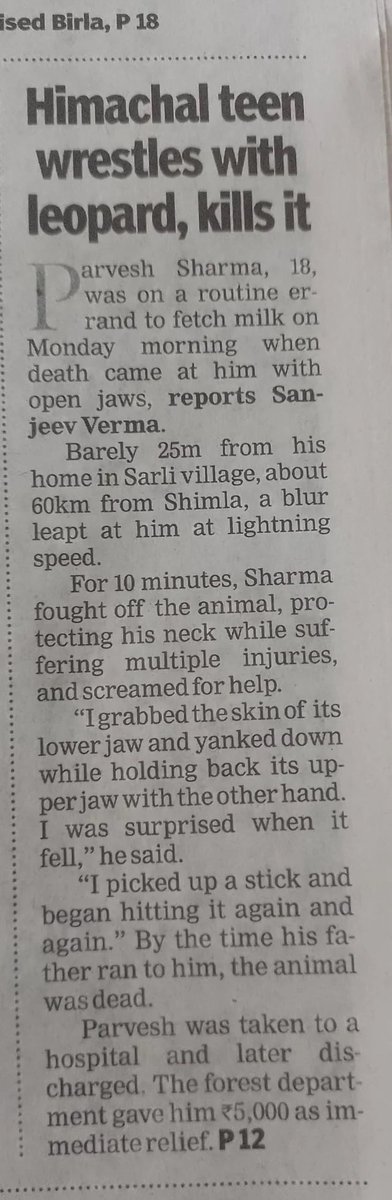
18 year old pahari kid went out to fetch milk, got ambushed by a leopard 25 meters from his house, fought it bare-handed for 10 minutes protecting his own neck, pried its jaws open, then beat it to death with a stick. By the time his father showed up it was already over. Built different doesn't even begin to cover it.
This is easier to understand when you realize that the typical american planner in the 2000s takes it for granted that no third world country would be foolish enough to fight a no holds barred war with the USA if they can avoid it.. The eye cannot see what the mind no longer knows..