Veni, Vedi, Velcro - I came, I saw, I stuck around.
Ex-academic historian. Ex-policy advisor/speech writer. Ex-hausted father.
Marginalia on history & culture.
Bond has taste. He is a dream character for most men. Wouldn't everyone like to have the birds fighting over them, and be able to tell a bartender how to make cocktails?
- Anthony Sinclair
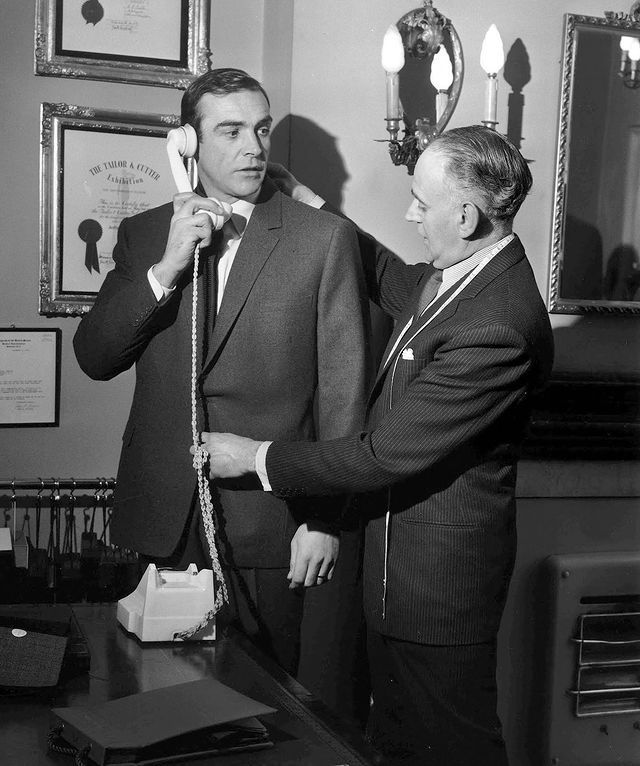
Anthony Sinclair was the tailor who defined James Bond’s iconic look. He dressed Sean Connery in the first five 007 films: Dr. No, From Russia with Love, Goldfinger (including the legendary three-piece suit), You Only Live Twice, and Diamonds Are Forever.
It was director Terence Young who brought in his own Savile Row tailor, Anthony Sinclair, to transform the rough, working-class Connery into the sleek, sophisticated gentleman spy we know today. For the shirts and ties, they turned to Young's personal shirtmaker, Turnbull & Asser, who created Bond's signature double-cuffed shirts.
Connery wasn't used to wearing suits, so Young made him live in them - reportedly even sleeping in the tailored outfits - to ensure that by the time filming began, the clothes felt completely natural. The transformation was total.
It's a tough choice, as each of these directors could easily be considered the top Bond director for very different reasons. Guy Hamilton gave us the single best Bond film with Goldfinger. Lewis Gilbert delivered the standout Roger Moore entry in The Spy Who Loved Me. Martin Campbell successfully reintroduced Bond to a new generation when many were doubting the character's relevance, first with GoldenEye and later with Casino Royale. John Glen, meanwhile, gave us the version of Bond closest to Ian Fleming's books during the Timothy Dalton era.
These directors - far more than the auteur-style talents like Sam Mendes - always let Bond be Bond. They never imposed their own personal authorial stamp on the character. Each of the directors of the earlier Bonds knew the director was never bigger than Bond himself.
If I'm forced to pick just one, I would go with Terence Young. Without him there simply would be no James Bond as we know it. His influence extended far beyond the screen: he played Professor Higgins to Sean Connery's Eliza Doolittle in Pygmalion, transforming Sean Connery - who grew up working-class in a rough part of Edinburgh - by teaching him how to dress and cultivate the manners of a 1960s gentleman-spy.
Marvellous. It might look more Churchillian if they had just left the clutter and the soft toys.
Christopher Long, later one of the longest-serving British journalists covering the Balkan Wars (1989 - 1999), lived down the road from Chartwell. He was only 17 when he and his mother were asked to help Churchill's private secretary, Grace Hamblin, catalogue and sort books and papers in the study shortly after Churchill’s death. He later wrote (of his work in 1966):
"I had carefully sorted the books so that every one could be put back on its shelf precisely where Churchill had left it. This had not been difficult to achieve. I simply adapted Churchill's own habits. Whenever he removed a book from a shelf he would stick one of his children's stuffed toys – piglets, bears, etc – into the gap to mark the spot."
Must Farm offers an astonishingly intimate window into the daily lives of ordinary Bronze Age Britons around 1000–800 BC. This settlement is rightly called called Britain's Pompeii. It perfectly captures a thriving community of stilted roundhouses that burned and collapsed into waterlogged silt, freezing everyday moments in time: a bowl of porridge with a wooden spoon still resting inside, yarn balls on spindles, and tools laid down mid-task.
I've talked to Cambridge archaeologists familiar with the digs and they paint a rich picture. Far from a primitive existence, the people enjoyed a rich, varied diet of wheat porridge topped with meat juices and fats, honey-glazed venison, dairy, fresh fish, wildfowl, and home-brewed drinks. They kept dogs as pets and hunting companions, penned sheep indoors, wore finely woven textiles, and crafted sophisticated wooden wheels and tools that would impress modern carpenters. Glass beads reveal far-reaching trade networks stretching to the Middle East.
The 2024 publications from the Cambridge Archaeological Unit bring this human story vividly to life. Must Farm's astonishing preservation doesn't just show us "prehistoric" survival. It reveals real people much like us: connected, resourceful, and making the most of their world. It further proves there was never a "lost primitive past," only a vibrant Bronze Age human story waiting to be uncovered.
If you want to delve deeper then link to to the 2024 Cambridge Archaeological Unit (CAU) / McDonald Institute publications on Must Farm:
Volume 1: Landscape, Architecture and Occupation (thematic synthesis) → https://t.co/YO3i8Ar6xV
Volume 2: Specialist Reports (detailed scientific analyses) → https://t.co/h2UarvsUdv
Both volumes were published on 20 March 2024 and are fully open access and can be downloaded as pdf.
You can also find them via the University of Cambridge repository or the official announcement page: https://t.co/0ViWOorbdJ.
Half the pictures don't even match the dish.
In another universe, Marcel Proust dips a plump sausage into his tea instead of a delicate madeleine - and is instantly transported back to childhood.
Thus was born the French literary classic: À la recherche des saucisses perdues (In Search of Lost Sausages). 🇫🇷
Witness (1985). A classic from Peter Weir. Coming off the massive success of Star Wars and the first two Indiana Jones films, Ford was largely perceived as a charismatic, wisecracking action hero - reliable at delivering thrills and charm, but not necessarily celebrated for deep dramatic range. Witness changed that perception dramatically. The film overall was fantastic.
Big fan of the later Robert Ludlum books in the same series.
The Whig Ultimatum: Lord John Russell and the Whigs deliver their ultimatum in 1846: repeal the Corn Laws or face starvation and riot. Peel crosses the floor, the protectionists shatter, and free trade becomes Britain’s new religion.
Eden, in his somewhat intermediate level German, complimented Hitler on his knowledge of the bigger picture in his sector, which was good ‘for a Corporal.’ Hitler rather wilted after that, which he took as patronizing. Eden subsequently used it as an example for diplomats of why
This is fascinating - my Chinese is pretty limited (I only reached basic conversational level when I lived and worked in Shanghai), but I love this stuff.
From what I know, 法兰西共和国 (Fǎlánxī Gònghéguó) is the full official name, equivalent to "French Republic" or "Republic of France." Chinese use that in formal contexts like treaties, diplomatic communiqués, and official documents.
As for the everyday short form 法国 (Fǎguó) - the 'Law Country', no one, as far as I can tell, knows exactly who coined it, but that's a feature, not a bug. From what I've been told, to Chinese ears it carries really positive connotations of law, rules, order, and method - perfectly in tune with how they viewed France during the Enlightenment, the Revolution, and especially the Napoleonic Code. It's a clever double win: phonetic and semantic.
(And yes… I was clearly trolling about modern French bureaucracy. It's not even funny anymore 😂)
The 1963 film Shéhérazade (also known as Scorching Sands) is a colourful French-Italian-Spanish adventure directed by Pierre Gaspard-Huit. The film reimagines Shéhérazade as a beautiful young woman presented as a "gift" to the historical Caliph Haroun al-Rashid. She is not a storyteller but a contestant in a one-time, high-stakes beauty-and-wit competition among princesses involving deadly trials (such as poison cups). She wins the throne through her poise, hypnotic presence, and cleverness in a single ritual, while secretly loving a French Crusader knight named Renaud de Villecroix who had rescued her earlier. It really has very little do with the Shéhérazade of the famed 1001 Nights.
Never in my life have I observed anything more bizarre than the first sight of Tangier. It is a tale out of the Thousand and One Nights… A prodigious mix of races and costumes… This whole world moves about with an activity that seems feverish.
- Eugène Delacroix, Letter to Alexis de Tocqueville, 1832
Eugène Delacroix's 1832 journey to Morocco, as part of a French diplomatic mission, profoundly influenced his art and inspired vivid reflections in his notebooks, letters, and essays. Delacroix wrote his thoughts to Tocqueville upon arriving in Tangier, capturing his immediate fascination with the city's vibrant, unfamiliar culture, which fueled his Orientalist paintings.
When we lived in Shanghai for a few years, we quickly picked up that the Chinese name for France is 法国 (Fǎguó) - literally "Law Country" or "Country of Rules." At first we thought it was just a phonetic choice with a nice, orderly vibe. But after dealing with French bureaucracy, I'm convinced the Chinese were being polite and prophetic.
Getting a Carte Vitale, Carte de Séjour, or even a simple livret de famille (the famous French marriage book) feels like someone designed an obstacle course where the rules change every lap and the finish line keeps moving. Like most things if you live in France, you show up with a perfectly organised folder (dossier), only to be politely told you're missing Form XYZ-47-B, which can only be obtained on the third Tuesday of the month between 9:03 and 9:07 a.m.
The French have elevated red tape to an art form that would leave even the most seasoned Chinese Communist Party official staring in awe - and probably quietly weeping into his green tea.
Poor George. Game of Thrones is crying out to be finished along the classical convergence of tropes within the DNA of our most cherished stories: heroes, destiny, epic battle between good vs evil, the triumph of good against the bad etc. But George Martin can't or won't finish his tome because the story begs to be told in a way that goes against Martin's political instincts and beliefs.
I think you have a bit of a point, but it's a touch overdone.
The much vaunted French concours system, especially for the École Normale Supérieure, really is gloriously parochial: everything happens in French, the brutal two-year prépa pipeline is almost entirely homegrown, and it barely glances at talent from beyond the Francophone world. Compare that to Harvard, MIT, or Oxbridge vacuuming up the planet's brightest kids, and you see why the system can feel like a splendidly elegant bubble. It's more glaring given how education and research is now a global game.
As a sidebar, yes, France's independent nuclear force and those superb submarines are genuine feathers in the cap (certainly compared to the woeful British), and Paris-Saclay has quietly overtaken the historic ENS in several major research rankings.
That said, dismissing the whole enterprise as producing "no discernible" results feels a touch unfair. ENS still boasts an almost absurd Nobel-per-student ratio (14 Nobels and a dozen Fields Medals from a tiny cohort), and its alumni basically rewrote 20th century philosophy, mathematics, and politics - even if I (like many) intensely dislike Foucault and Sartre, no one can dismiss their intellectual pedigree. Yes, the French love polishing their own prestige (who doesn't?), but the intellectual firepower is real - especially in the more theoretical realms. It's just less flashy in today's Silicon Valley–driven world.
So, you're right that ENS is insular and a little overhyped abroad. You're wrong to suggest it's all froth and no substance.
With respect to France, with its only truly sovereign nuclear deterrence in Europe, the sublime French nuclear subs, and one of the last vestiges of decent university education on the continent - Paris-Saclay, not ENS - the objective criterion of reality is practice, and in practice the concours system produces no discernible results. France has little to show for it, and it draws no talent beyond the Franco-sphere. The French seem to operate in their own bubble where they think this matters, or confers global prestige, but it really does not.
Camus - Sartre:
"He stayed fiercely loyal all his life to real human experience, artistic rebellion, and the gutsy refusal to buy into false hope or ideological violence - exactly what put him at odds with Sartre and that whole crowd."
On Hungary 1956: https://t.co/Nqn79cts7X
For decades, Albert Camus has been misleadingly cast as an existentialist and the high priest of the Absurd - a caricature he himself repeatedly rejected. Ryan Bloom's superb new complete translation of the Notebooks (1935–1959), together with the previously unpublished Oran Notebook, offers a decisive corrective. You should really take the time to wade through Camus' notebooks. They reveal how Camus consciously turned away from abstract philosophy towards a strictly literary art rooted in image, sensation, and lived experience.
We see Camus reshaping an early philosophical novel into The Stranger, sharply criticising Sartre and Kafka for subordinating art to ideas, and insisting in The Myth of Sisyphus that he was not constructing an "absurd philosophy" at all.
Above all, the notebooks reveal the deeply personal roots of his thinking. He stayed fiercely loyal all his life to real human experience, artistic rebellion, and the gutsy refusal to buy into false hope or ideological violence - exactly what put him at odds with Sartre and that whole crowd.
https://t.co/i6zfOc5I1v