Niklas Luhmann wrote 70 books out of a wooden box of index cards and refused to fully explain how the system worked while he was alive, and 19 years after his death a German researcher named Sönke Ahrens finally cracked the manual.
The story of the wooden box has been told a thousand times.
Luhmann was a civil servant in a small German town in the 1950s. He started taking notes on index cards, one idea per card, linking each card to other cards in the box.
By the time he died in 1998, the box held over 90,000 handwritten notes. He had produced 70 books and over 400 academic papers from it. He had invented an entirely new theory of modern society that sociologists are still arguing about today.
He gave interviews about the system. He told people that the box was smarter than he was.
He said it was his communication partner. He said it remembered connections his conscious mind had long since forgotten making.
He answered the question of how he was so productive with a single sentence. He said he never worked against resistance. He followed what the box was pulling him toward.
What he never did was write the manual.
He never sat down and explained, in a step-by-step way, what kinds of notes went into the box, how they were structured, how they linked together, how a person sitting in front of an empty box was supposed to actually start using one.
He treated the system the way a craftsman treats a craft. It was something he did. Not something he taught.
For 20 years after his death, hundreds of academics, writers, and knowledge workers tried to reverse-engineer the box.
People photographed the actual cards. People wrote dissertations on the linking structure. People built software trying to replicate the network.
Most of them ended up with elaborate filing systems that looked like Luhmann's box from the outside and produced almost nothing.
The problem was that everyone was copying the surface of the system and missing the engine inside it.
The cards were not the point. The links were not the point. The point was a specific cognitive workflow that Luhmann had been running inside his own head for 30 years, and nobody had been able to articulate it clearly.
In 2017, a German education researcher named Sönke Ahrens published a 178-page book called How to Take Smart Notes.
He had spent years studying Luhmann's archive, comparing it to modern research on learning and writing, and trying to extract the actual method from the physical artifact.
The book did not get a big release. It came out through self-publishing. It spread by word of mouth through writers, students, and knowledge workers, and within a few years it had become the single most cited modern guide to thinking on the internet.
The reason is that Ahrens finally explained what Luhmann had refused to explain.
The system, Ahrens said, runs on three kinds of notes, and almost everyone trying to copy Luhmann was failing because they were confusing the three.
The first type is fleeting notes.
These are the quick captures. The scrap of an idea you have in the shower. The thought that hits you on a walk. The half-formed reaction to something you just read.
Fleeting notes are written fast, by hand if possible, with no concern for structure or grammar. Their only purpose is to make sure the thought is not lost before you can do something useful with it.
Most people stop here. Their notebooks are full of fleeting notes that never go anywhere because nothing was ever done with them.
The second type is literature notes.
These are written while you are reading something. The rule is brutal. You are not allowed to copy and paste. You are not allowed to highlight. You are not allowed to summarize in the author's words.
You must read a passage, close the book or look away from the screen, and write down what the author was claiming in your own words. The act of translating into your own language is the act of finding out whether you understood it.
Most people skip this step because it is uncomfortable. The discomfort is the entire point. The discomfort is where the learning happens.
The third type is the one that makes the whole system work.
Permanent notes. These are written from your fleeting notes and literature notes once a day, ideally, while the material is still fresh in your mind.
Each permanent note contains one idea, written in your own words, structured as if it would be read by a stranger years later. The note must stand on its own. It must be specific enough to be useful and short enough to fit on a single card.
Then you do the thing almost nobody does.
Before you file the new note, you go into the box and find every other note it connects to. You write the links explicitly.
This new note about a behavioral economics experiment connects to that older note about a Stoic principle. This new note about a coding pattern connects to that older note about a biological system.
You force yourself, every single time you add a note, to physically interrogate the box for what it already knows that this new idea touches.
Over time the box stops being a storage system and becomes a thinking partner.
When you sit down to write, you do not stare at a blank page. You go to the box. You find the cluster of notes that has been quietly accumulating around a topic you did not know you were obsessed with.
You pull those notes out. You arrange them. You discover that you have been writing the article, the essay, the book chapter for months without knowing it.
The writing becomes assembly, not invention.
This is the part Luhmann never explained out loud, and the part Ahrens spent the entire book hammering on.
The system does not store knowledge. The system generates it.
The act of forcing every new idea into conversation with everything you already know is what makes the new idea sharper, and the act of linking thousands of ideas to each other over decades is what produces the kind of dense network where original thinking actually lives.
Ahrens called the book a manual for how to write a PhD thesis or a nonfiction book. The book turned out to be much bigger than that.
The system inside it is the operating manual for any person who works with ideas for a living. Researchers use it. Writers use it. Engineers use it. Entrepreneurs use it.
AI researchers use it to keep up with papers that are being published faster than any human can read.
The reason Luhmann would not have predicted any of this is that he was working alone in a quiet German town with a wooden box on his desk.
He did not know that the system he had built by accident was the answer to a problem the entire world was about to have.
Ahrens did what Luhmann never quite did. He turned the private habit into a public method.
And the most original thinkers of the next 20 years will not be the ones reading more books than everyone else.
They will be the ones with a better box.
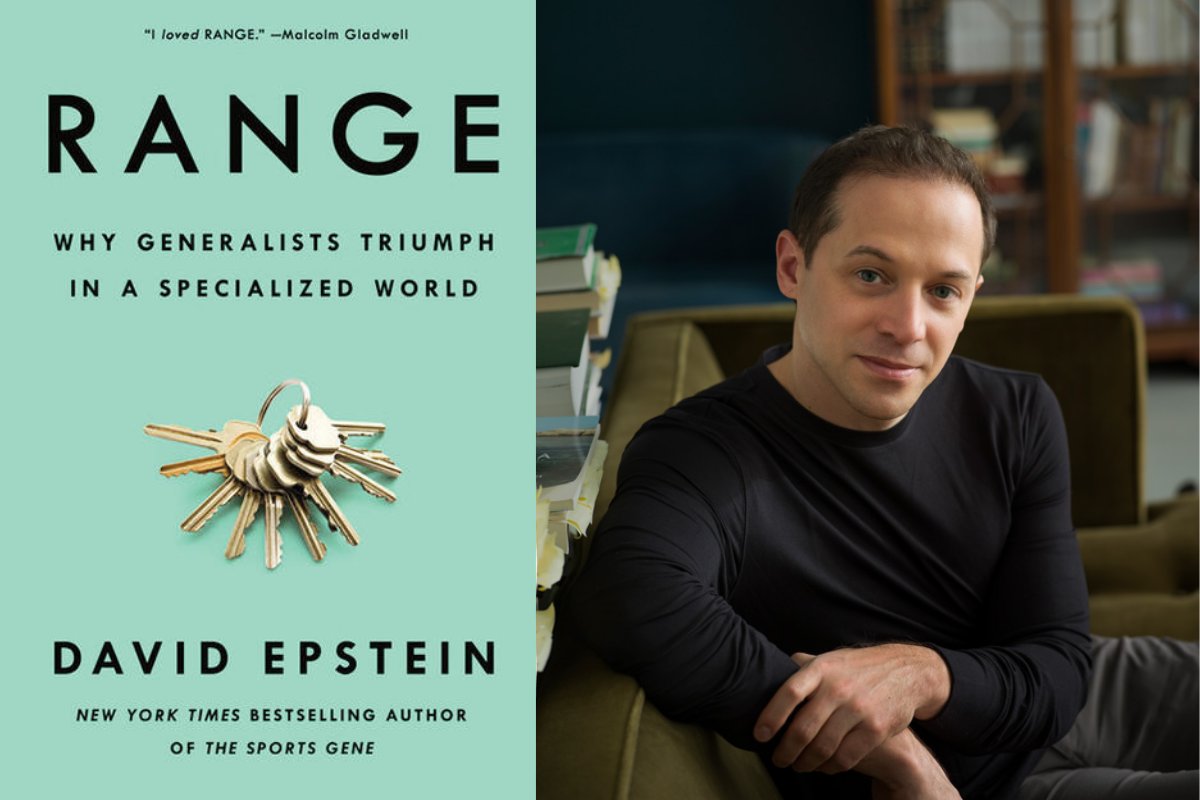
David Epstein studied the world's best athletes, scientists, and inventors, and found they all broke the same rule.
Here are 10 reasons from "Range" why generalists beat specialists in everything that matters.
1) Specializing late is an advantage, not a delay
A British biologist looked at 200,000 years of human history and found that the entire reason humans broke out of poverty was not intelligence, not language, not even agriculture, but one mechanism so simple a 6-year-old could explain it.
His name is Matt Ridley.
He is a zoologist by training, an evolutionary biologist by career, and in 2010 he wrote a book called The Rational Optimist that quietly argued the most important fact about human progress had been hiding in plain sight for the entire history of economics.
Naval Ravikant has been telling people to read everything Ridley has ever written for the last 15 years. The reason is the argument inside this one book.
For 200,000 years, anatomically modern humans walked around with the same brain you have right now. Same skull size. Same neural architecture. Same raw capacity for language, planning, and abstract thought.
For roughly 190,000 of those years, almost nothing happened. Generation after generation lived and died inside the same Stone Age toolkit their great-great-grandparents had used. Then somewhere around 50,000 years ago, the line on the chart of human progress started to tick upward. Then it bent. Then it exploded.
The question Ridley spent years on was the only question that mattered. What changed.
It was not the brain. The brain had been the same for 190,000 years. It was not language, which had existed long before the takeoff. It was not even agriculture, which arrived only 10,000 years ago and was actually preceded by the upward bend, not the cause of it.
What changed was that humans started trading with strangers.
This sounds too small to be the answer. Ridley argues that it is the answer to almost everything. The moment one human exchanged a useful object with another human from a different group, something happened that no other species on earth had ever done.
Two ideas that had developed in isolation came into contact. The flint knapper learned what the spear maker had figured out. The fisherman from the coast learned what the hunter from the forest had figured out. The two pieces of knowledge fused into something neither side could have produced alone.
Ridley calls this ideas having sex. The phrase sounds frivolous and it is meant to. The point is that ideas, like genes, get better when they combine with other ideas from different lineages.
An idea sitting inside one head, no matter how brilliant the head, eventually hits a ceiling. The same idea exposed to ten thousand other ideas does something genes do under sexual reproduction. It mixes. It recombines. It produces offspring nobody planned.
The cleanest proof of this argument is the most uncomfortable case study in the book. Tasmania.
Around 10,000 years ago, rising sea levels cut Tasmania off from mainland Australia. A population of roughly 4,000 humans was now isolated on an island, with no possibility of contact with the rest of humanity. They had the same brains. The same language. The same starting toolkit as their cousins 150 kilometers north. The natural experiment was now running.
What happened next is something no economist or geneticist had ever predicted.
The mainland Australians kept inventing. Boomerangs. Spear-throwers. Fishing nets. Bone needles for sewing fitted clothes. Watercraft with paddles. Their technology compounded slowly across the centuries.
The Tasmanians went the other way. They did not just fail to invent the new tools their cousins were developing. They started losing the tools they already had. Fishing was abandoned within a few thousand years. Bone tools disappeared. Fitted clothing disappeared. They forgot how to make fire from scratch and started carrying lit firebrands from camp to camp instead, relighting their fires from a neighbor's whenever their own went out.
By the time European explorers arrived in the 17th century, the Tasmanians had the simplest toolkit of any human society ever recorded. Their material culture had gone backward for 8,000 years.
The archaeologist Rhys Jones called it a slow strangulation of the mind.
Joseph Henrich at Harvard later proved with formal mathematical models that there was nothing wrong with Tasmanian brains. There was something wrong with their network. A toolkit requires a critical mass of people exchanging skills to maintain itself.
The act of teaching a skill is imperfect. Every generation loses a small percentage of what the last generation knew. If your population is large enough and trading widely enough, those losses get caught and corrected by someone else who still remembers.
If your population shrinks below a certain threshold and stops mixing with outsiders, the small losses compound until entire technologies disappear.
This is the part that should haunt anyone reading this in 2026.
Intelligence is not a property of the individual brain. Intelligence is a property of the network the brain is connected to. A genius in isolation will produce less than a mediocre thinker inside a dense exchange of other mediocre thinkers.
The thing your ancestors needed in order to break out of 190,000 years of stagnation was not better brains. It was better connections between brains they already had.
The implication for any individual is direct and uncomfortable. If you are smart and isolated, you will be outproduced by people half as smart who are connected.
The most successful people in any field are almost never the smartest people in it. They are the ones positioned at the intersection of the most idea flows. They are reading more authors than their competitors. They are talking to more people from more disciplines. They are in the rooms where ideas from different lineages bump into each other.
Ridley ends the book on the line that sounds optimistic but is actually a warning its this "The future will be invented by people who connect ideas, not by people who guard them."
instead of watching 2 hours of Netflix tonight, watch this Stanford lecture
it's the clearest explanation I've seen of how ChatGPT and Claude actually work
useful whether you've never touched AI in your life or have been using it every day for the past year
I took the key ideas and turned them into a practical guide on how to actually get 100% out of Claude
everything in one place
Mohnish Pabrai: "We have limited bullets in the gun."
"One of the important mental models is focus. You've got to go all-in on what you're passionate about. If you want to uplift the people who are below you, please make that your life's mission. Don't try to do that as an extracurricular project. It's not going to work."
The strongest men are gentle.
The smartest men are quiet.
The wealthiest men are simple.
The happiest men are private.
Real power doesn't need to prove itself.
Eden Gardens hasn't hosted Australia since 2001. Wankhede hasn't hosted Australia since 2004. And it will be at least 2031 until the might be able to. It's an absolute joke how we treat our iconic Test venues.
20 Problems = 20 Books
1) Want to break a bad habit?
Read "Atomic Habits" by James Clear.
2) Keep getting distracted while working?
Read "Indistractable" by Nir Eyal.
3) Feeling lost in life?
Read "Man's Search for Meaning" by Viktor Frankl.
4) Have trouble controlling your emotions?
Read "Meditations" by Marcus Aurelius.
5) Bad at socializing or communicating?
Read "How to Win Friends & Influence People" by Dale Carnegie.
6) Lose motivation to work out quickly?
Read "Can't Hurt Me" by David Goggins.
7) Always saving information but never using it?
Read "Building a Second Brain" by Tiago Forte.
8) In debt or bad at budgeting?
Read "I Will Teach You To Be Rich" By Ramit Sethi.
9) Want to change your limited mindset?
Read "Mindset" by Carol Dweck.
10) Terrible at small talk?
Read "The Fine Art of Small Talk" by Debra Fine.
11) Scared of starting a creative project?
Read "The War of Art" by Steven Pressfield.
12) Want to make smarter financial decisions?
Read "The Psychology of Money" by Morgan Housel.
13) Want to become happier, healthier, and wealthier?
Read "The Almanack of Naval Ravikant" by Eric Jorgenson.
14) Bad at negotiating?
Read "Never Split The Difference" by Chris Voss.
15) Want to make more but work less?
Read "The 4-Hour Workweek" by Tim Ferriss.
16) Want to build resilience and a stronger mind?
Read "Grit" by Angela Duckworth.
17) Overthinking every decision?
Read "Thinking in Bets" by Annie Duke.
18) Have a product that isn't doing so well?
Read "$100M Offers" by Alex Hormozi.
19) Afraid of being judged or disliked?
Read "The Courage to Be Disliked" by Ichiro Kishimi.
20) Feel overwhelmed by too many priorities?
Read "The ONE Thing" by Jay Papasan.
In Japanese, "tsundoku" means collecting books and letting them pile up,
not from neglect,
but for the joy of knowing they're there,
full of untold stories.
This sentence by Dostoyevsky hits so hard.
“You sensed that you should be following a different path, a more ambitious one, you felt that you were destined for other things but you had no idea how to achieve them and in your misery you began to hate everything around you.”
I’ve been asked many times by friends what books I would recommend about #Iran, especially this week. Here are some I’ve treasured over the years to keep me connected to a homeland I cannot set foot in. There are so many more, these are simply the ones I always go back to.
Suggestions welcome 👇
Did an AI analysis on all TKP interviews from start to present day. Over 200 transcripts in total.
Here is what I learned.
High Level
Across the full run, you consistently maintain approximately 15-25% you 75-85% guest. You are among the most disciplined listeners in long-form podcasting. With verbose guests (Balaji, Naval, Rory Sutherland, Nathan Myhrvold), you drop to 5-10%. With friends and repeat guests (Neil Pasricha, Ryan Holiday, Matt Holland), you rise to 30-35% and the conversation becomes genuine dialogue.
** Strengths **
Preparation is your superpower. You are one of the most prepared interviewers working today. You read every book. You find the obscure biographical detail — Esther Perel's parents' specific ages during the Holocaust, Frank Stephenson's top-10 motocross ranking, Indra Nooyi's first date at the Sandburg Theatre watching Silver Streak. You arrive with 200+ questions for Nicolai Tangen. You find the specific quote from a guest's prior interview and surface it. Guests respond to this with visible delight — they feel respected, and they open up in ways they wouldn't for someone who skimmed the Wikipedia page. Susan Cain said it directly: "This is the best podcast interview I've ever done. You're the best interviewer in general."
You know when to shut up. This sounds simple. It is the rarest skill in interviewing. You don't interrupt. You don't compete for airtime. You don't try to prove you're as smart as your guest. When Naval wants to monologue for five minutes about the meaning of life, you let him. When Schwarzman wants to tell story after story, you make space. The 15-25% talk ratio is not accidental — it is discipline, and it produces better conversations than any amount of clever questioning could.
Vulnerability. You share personal stories sparingly but with real impact. Your divorce (Sophie Gregoire Trudeau, Jim Collins), your body image struggles (Neil Pasricha: "I've had body issues my whole life"), your troubled relationship with your biological father (Harley Finkelstein context), your parenting failures ("At my worst, I catch myself using screen time as currency" — Becky Kennedy). These moments are never performative. They land because they're rare. They create psychological safety that gets guests to go places they wouldn't otherwise go.
The post-interview reflections. A genuine innovation. You record honest assessments of what you learned, what you missed, and where you wish you'd gone deeper. You admit when you were naive (David Heacock), when you interrupted (Bret Taylor), when you let an important thread go (Josh Wolfe on biology's speed limits). This transparency builds audience trust and reveals a host committed to continuous improvement.
*** Weaknesses ***
Agreement as verbal tic. You say "I love that," "That's really interesting," "That's a great point," "I like that a lot," and "Exactly" with metronomic frequency. Across episodes, these affirmations function as filler — they signal that you're about to move to your next prepared question rather than genuinely engaging with what was just said. With some guests (George Stalk Jr., parts of Adam Robinson, John Maxwell), your contributions devolve into rapid "Yeah" and "Totally" that add nothing. These moments read as uncritical agreement rather than genuine engagement, and they erode the intellectual rigor of the conversation.
You lose control of verbose guests. With Balaji Srinivasan, Nathan Myhrvold, Barbara Tversky, Marshall Goldsmith, Alan Mulally, and early Adam Robinson, you become a passive audience for multi-thousand-word monologues. You don't redirect. You don't say "Let me bring you back to…" You don't interrupt to make the content more accessible. The Nathan Myhrvold episode is the clearest case — he covers climate, nuclear weapons, Mars colonization, and medieval cooking in what amounts to a solo performance. Your restraint, normally a strength, becomes a liability when it means abdicating editorial control.
You underexplore personal failure. You ask about failure conceptually — "What have you learned from mistakes?" — but you rarely ask "Tell me about a specific time YOU failed and what it cost you." The Jerry Colonna opening ("you wanted to kill yourself") and the Immelt opening ("your legacy is at best controversial") are the rare exceptions. With most guests, you let them discuss failure at a safe, philosophical distance. The result is that failure segments often produce platitudes ("failure is a great teacher") rather than genuine, specific, revealing stories.
The bottom line: You are a top-five long-form interviewer. Your preparation, restraint, and synthesis are world-class. The gap between where you are and where you could be is almost entirely about one thing ...
I'll leave the specific suggestions out and see if you notice a change.
Listen and Learn: https://t.co/exI3x3yI4T
🚨BREAKING: Someone turned Naval Ravikant's mental models into AI prompts and the results are insane.
It's the closest thing to having the AngelList founder rebuild your career from scratch.
Here are the 10 prompts that completely changed my life: