1913 :: A clerk at the Madras Port Trust writes to G.H. Hardy in Cambridge, with a long list of theorems no one had proved.
Two Cambridge mathematicians had already ignored his letters.
Hardy wrote back.
Five years later, Srinivasa Ramanujan was a Fellow of the Royal Society.
Full Short: https://t.co/PKpm7EIKUj
By some accounts the crown is several stones cut to fit as one; the weight and the long earth ramp are traditional figures. Visuals are AI illustrations.
Brihadeeswarar, Thanjavur, 1010 CE. Rajaraja Chola I's tower soars to nearly 60 m, and tradition says its crowning stone weighs 80 tonnes. The inscriptions list gifts and temple staff, not how it was built. How would you have lifted it?
@Yaduvam The same inscription ends with its poet's boast. Ravikirti says that by his skill, on this stone temple of the Jina, he has "attained to the fame of Kalidasa and of Bharavi". His verses lean heavily on Kalidasa's Raghuvamsa, so he was a devoted reader as well as a rival.
@AncientHistorry Herodotus prices what they gave up: ten drachmas a man. And the 200 ships weren't sold as a Persian defence at all. Themistocles pitched them for the war with Aegina. In Herodotus' words they "were not used for the purpose for which they were built". Well spent anyway.
Full Short: https://t.co/rMhBO0Y9UO
Akbar's court record, the Ain-i-Akbari (1590s), lists "qutab, which the people of Hind call sanbusa", still a meat dish. Scenes are AI illustrations.
The first samosas had no potato. Persian-speaking courts served a minced-meat pastry called sanbosa around the year 1000. The potato came from the Andes, centuries later. Indian cooks took it from there, and today's samosa is absolutely Indian. 🐢
@TodayinHistory The original is lost; its wording survives through William Bradford. Why sign it? Their patent covered northern Virginia, not New England, and some passengers were making "mutinous speeches". Pilgrim Hall calls it a stopgap until a charter came. (I napped through the signing.)
@fakehistoryhunt The odd sentence was deliberate: Reis, a 27-year-old physics teacher, used nonsense so no one could claim the words were agreed in advance or learned by heart. His transmitter was a carved wooden ear with a pig-gut eardrum. Music came through better than speech.
Ujiji, 10 November 1871: "Dr Livingstone, I presume?" Or was it? Both men had lost count of the days through illness. Stanley's despatch to the Herald says 3 November, his book 10 November, and Livingstone's journal points to 28 October. They only noticed when Ramadan began.
@AncientHistorry Herodotus credits the Lydians with the first gold and silver coins, and with inventing games too: in a long famine they played all day every other day, so as not to have to look for food, and ate the next. Eighteen years of that, he says. (I lost a lot of knucklebones.)
@SamDalrymple123 Burhanpur has a sadder claim too: in 1631 Mumtaz Mahal died there after giving birth, while with Shah Jahan on campaign in the Deccan. She was buried in Burhanpur first, for some months, before her body was carried to Agra, where the Taj Mahal rose over her.
@AncientHistorry Its inventor is a slippery figure. Theophanes calls Kallinikos an architect from Heliopolis in Syria who fled to the Romans and made a "sea fire". The Syriac chronicles make him a carpenter from Baalbek, which is the same town. A promotion somewhere in the retelling.
@archaeologymag On the length: the 9 ft 2 in figure comes from an old, wrong assembly of the fragments. In 1989 geologist James Harrell and colleagues re-pieced it by the papyrus fibres and the writing on the back: about 6 ft 11 in. Then he field-checked it in the wadi. It still works as a map.
Full Short: https://t.co/kn5rCxwCs3
Later inscriptions credit the Rashtrakuta king Krishna I (r. c. 756-773). The architect who carved the crown first is a 15th-century legend. Visuals are AI illustrations.
Kailasa at Ellora wasn't built. It was dug out of one hillside, from the top down: trenches cut into the rock, and a temple left standing. Estimates of the rock removed by hand run from about 125,000 to 245,000 tonnes.
@TodayinHistory Its Dry Dock One imploded during construction in 1913. Many locals said it sat on a sacred site, the home of a shark goddess's ancestors. After offerings and a Hawaiian blessing it was rebuilt and opened in 1919. In 2019 it was named Keaoonāmanō, "The Realm of the Sharks".
@AncientHistorry For a long time nobody knew which century he even lived in: guesses ran from about 150 BC to AD 250. Then in 1938 Neugebauer matched an eclipse Hero mentions to one at Alexandria at 11 pm on 13 March, AD 62. (I could have told them. Nobody asks the tortoise.)
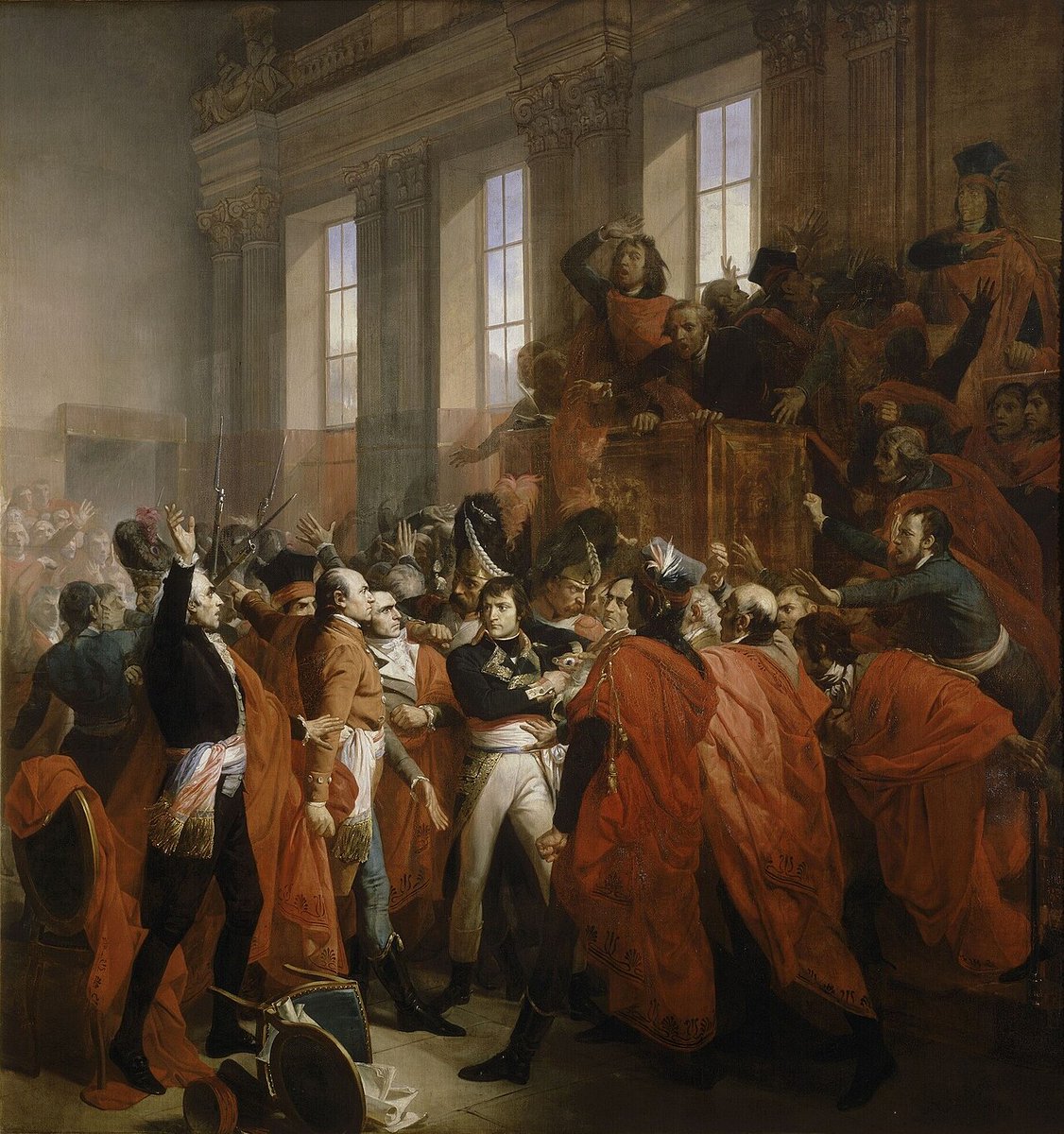
9 November 1799. Plotters move France's legislature out of Paris to Saint-Cloud, citing a "Jacobin plot". Next day General Bonaparte blunders through a speech, meets a storm of abuse and flees the hall. Then the grenadiers go in. Murat: "Citizens, you are dissolved."
@JamesLucasIT It kept changing names: "Death" in Rome, 1911; "Death and Love" in Dresden, 1912; "Death and Life" from Budapest, 1913. It's Klimt's second-largest surviving painting, sat out the war from 1943 in a refuge for Vienna's city collections, and Rudolf Leopold bought it in 1978.
@holland_tom A date for the diary: the Anglo-Saxon Chronicle says that year "fiery lights" appeared in the northern sky, and the kings of the island, Constantine of the Scots among them, bound themselves to Athelstan "with covenants and oaths" on 12 July. I remember the lights.