This upcoming US-China summit is quite important for the oil market.
Assuming nobody is still delusional enough to deny the surge in Hormuz transits (if you are, just unfollow me), let’s assume Tehran fails to choke the Strait.
That puts the burden entirely on demand—and mostly on China. Pushing Brent north of $100 was great, but landed values are already trashing teapot margins.
Headline cracks are rolling over and physical netbacks look even uglier. We all know this buying spree was state-mandated via SOEs, and while they can absorb the pain on Beijing's orders, Trump sounding desperate to please China has desks rightfully terrified of a backroom deal—market has to price in the tail risk of a dirty compromise.
The May summit analog still haunts this market(though in reality, China had already withdrawn from the market before that). If this sit down looks like a public nothingburger, that’s your cue to be paranoid. A buddy laid out that exact inverse framework for US-China macro theater last week, and it resonated hard.
Both sides need to bark for domestic cameras, but behind closed doors? A quiet pact to nuke flat price wouldn't shock me at all. Inverse the public theater.
Watch the physical China bid post-meeting.
#oott #iran
The fake news clown car is on fire today - in case you wonder why the reason is they have to push WTI prices down as much as possible before the October futures contract trading ends in a few hours so as to ease the losses of all those holding huge short positions out there
The Persian Trap has plenty of leakage. But the crude shuttle service has become an oligopoly of some sorts.
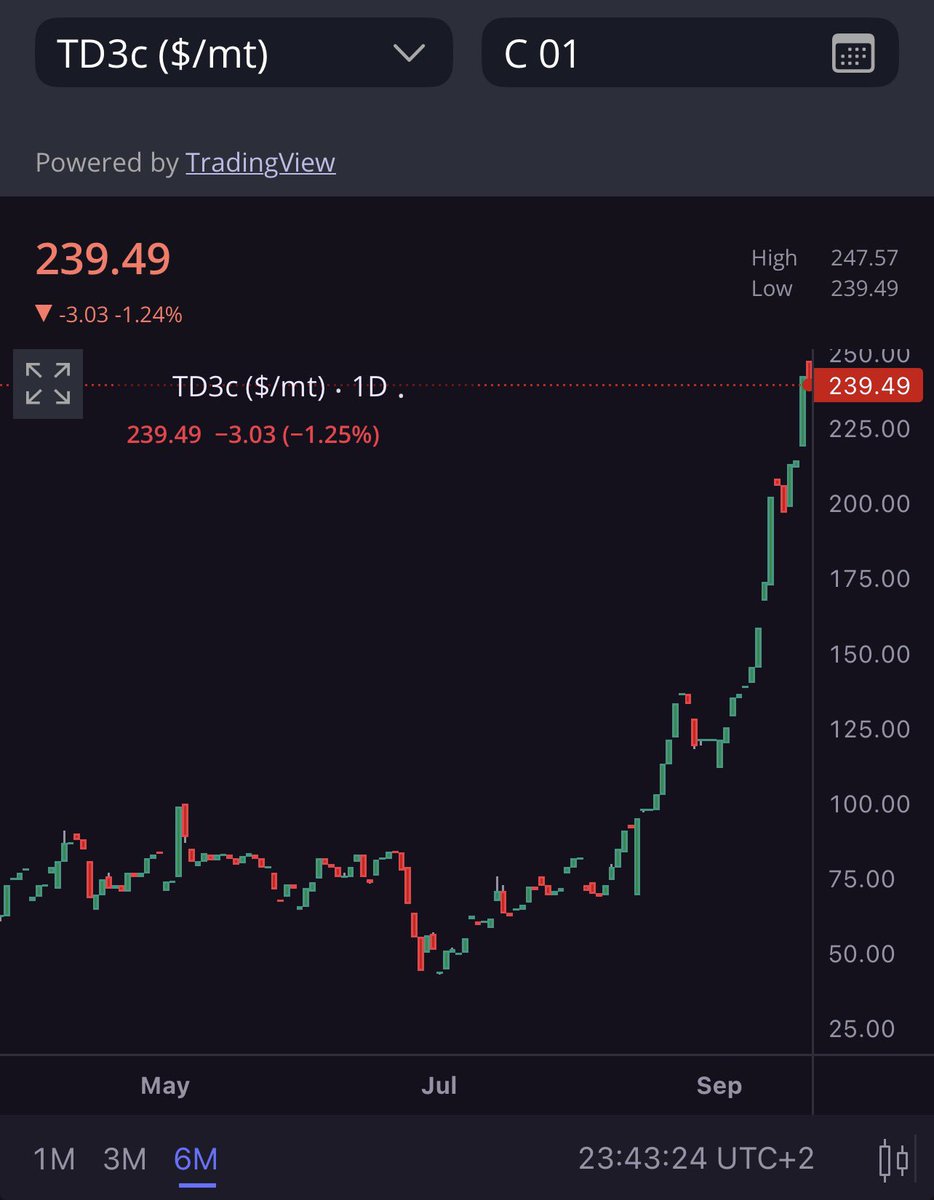
The current tanker rate to transport crude out of the Persian Gulf over to the Gulf of Oman, a five day trip, costs $33/bbl or $240/t - an all time ridiculous record. Let that sink in.
Yet, no new tanker tonnage is pulled into the trade. Zero! No “new” crude ballast tanker enters the Persian trap; only a few tankers do what I call the “shuttle service”: transporting crude out, transfer the crude STS and navigate back in. Why? Bc it’s freaking risky!
That’s a broken market. Backwardation cannot attract ballasters into a war zone; the self-correcting mechanism is kaputt until the geopolitical binary resolves.
Amen 🙏
If Tehran actually wants to keep flat price as their geopolitical bargaining chip, they have no choice but to force an escalation and clamp down hard on the Strait.
Heavy Tenders from Aramco, Qatar, ADNOC prove Gulf exporters aren't scared of recent tanker hits at all. Transits/loadings are printing higher.
Market needs real kinetics not Iranian mouth flapping. Time is running out.
#oott #iran
Will refineries stop buying crude because tankers got more expensive?
Only if the refining margin drops below zero.
In normal times, this means the freight costs will drop.
But this is not normal times and the world is short refined products.
So cracks has to adjust even higher and/or crude FOB diffs have to come off if tankers still cost a million dollars a day to charter.
That's my current read of the market given some latest headlines that suggest refineries would stop buying crude to fill up capacity.
#oott
Crude refining margin 101
The price of crude delivered to refinery = Benchmark + FOB premium + freight cost
Benchmark can be ICE Brent, Dated Brent, Nymex WTI or Dubai.
FOB premium is a factor of supply and demand, quality of crude and logistics. If that crude is red hot in demand, FOB goes up. FOB premium is also known as cash diff/differential.
Freight cost has its own supply and demand angle. Right now VLCCs are in short supply due to highly inefficient logistics caused by the war, hence the crazy valuations there.
Crude margins is then the value of the crude minus the delivered price of crude. The value of the crude is also known as gross product worth (GPW). You multiply product cracks with the yields obtained from the crude.
Each refinery values the crude differently due to unique refining configurations. They run Linear Programming (LPs) to obtain these valuations.
In the current climate, refining margin must be ≥0 since refining is short. If it goes below 0, then something in the equation needs to adjust. I.e. either FOB premium or freight goes down, or product cracks rise.
In Sparta, we model all of the above and align 90 crudes to the same delivery window for 8 refining destinations with 3 different refining configurations per region.
Hope this explains the basics of crude refining economics.
#oott
If they manage to fix it in months, that new pump station — and the other ten to overcome 1200m of friction — had better be 50m underground soon. Along with the pipeline. 😎
More immediately: unless Aramco has the critical modern spares sitting in-country, procurement from European and other OEM suppliers becomes the bottleneck nobody can reliably time.
Either way, the Saudis need to establish a UAE-style SoH shuttle quickly — except at 7mbpd crude + 1.5mbpd products, not 4mbpd + 0.5mbpd — or the world has a persistent diesel problem.
That would also leave Saudi Arabia’s West Coast refineries increasingly stranded until the war ends.
Let’s see how it plays out. But there is absolutely no reason for complacency.
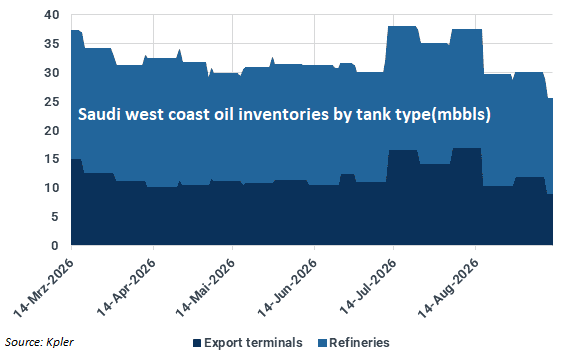
Some takeaways based on the latest Kpler data:
1) Even if Riyadh brings ~50% of pipeline flows back online quickly per their guidance, Red Sea export availability is going to remain heavily capped given Western coast inventories.
They’ll want to avoid run cuts at domestic refineries in the West, so if refiners get first dibs on crude allocations, export stems out of Yanbu get squeezed even further.
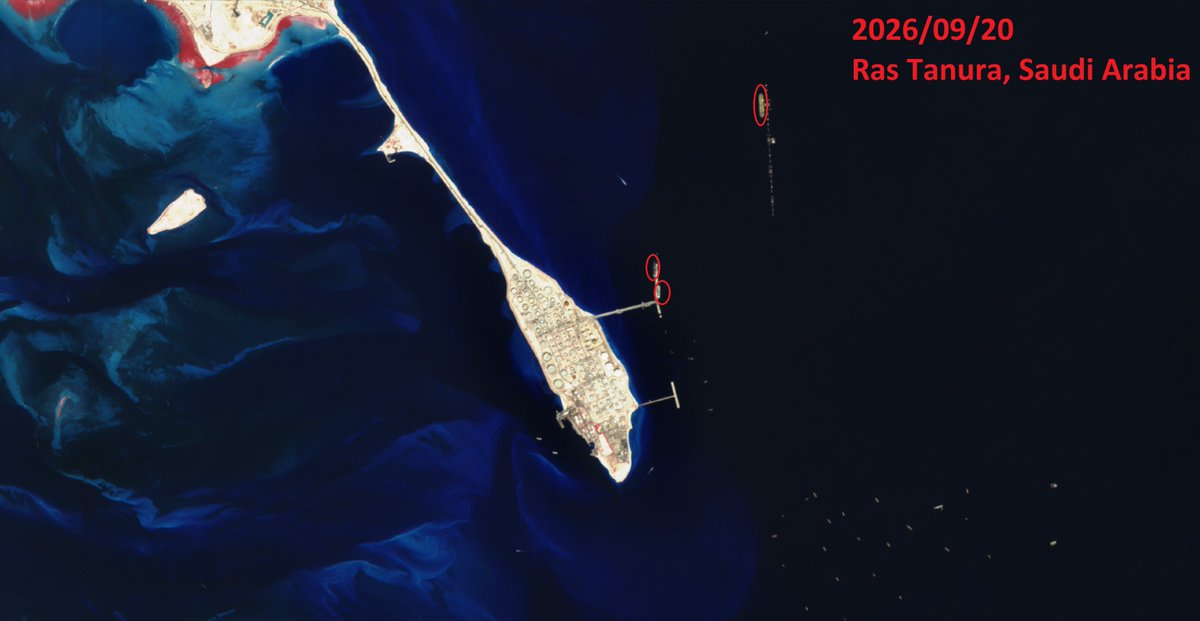
Riyadh is backed into leaning even harder on Ras Tanura/Juaymah, where liftings were already ramping up. Naturally the upper bound of how many physical barrels they can actually flush out hinges entirely on safety through the Strait.
2) Like I’ve been pounding the table on, more crude is actively forcing its way through Hormuz. It’s an undeniable, objective fact at this point—satellite imagery, proxies, tenders all point to the exact same thing. Anyone still denying this isn’t even worth engaging.
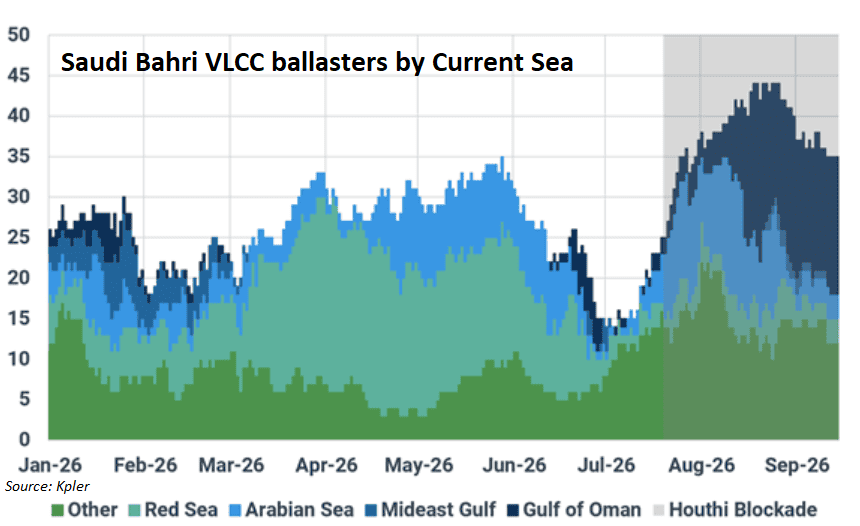
3) Bahri was already quietly throwing in the towel on the Red Sea and redeploying tonnage toward the Gulf of Oman anyway. That structural repositioning should provide some breathing room against tonnage crunches. Offers a bit of a silver lining for the Saudis.
#oott #iran
Iranian officials flew to Saudi Arabia yesterday and a government-to-government payment may have been made. What followed was one of the largest prompt crude sales out of the Kingdom, sold via the Strait of Hormuz through ship-to-ship transfer off Sohar and Fujairah for end September and October. @FluxOfficials
🇺🇸🇮🇷 CENTCOM is trying hard to prove Iran doesn't control Hormuz
It claims 900 million barrels moved since early May, which sounds like a victory until somebody divides it by the days.
That's about 6.7 million a day.
The strait used to carry 14 million, and it did that with no warships, no minesweepers and nobody asking permission to sail.
Iran never had to close the water. It only had to make it expensive, and enough of the world's tankers decided the trip wasn't worth it.
Source: Al Jazeera / Writer: Daniyal
The US is considering halting diesel exports.
The US is the world's largest diesel exporter... Russia, the 2nd largest, has already halted exports.
A US export ban would send global diesel prices even higher and force countries like Japan to dump USTs to fund their domestic needs.
In other words, imposing an export ban on diesel would blow up the UST market.
There are no easy solutions anymore.
We don't own enough hard assets for what's coming.
The barrels are still leaking out of the Persian trap. Shuttle tankers and US Navy-facilitated convoys are getting crude out through Hormuz, daily.
But only a few ship owners are willing to enter the Gulf, load and exit under escort. So they have pricing power.
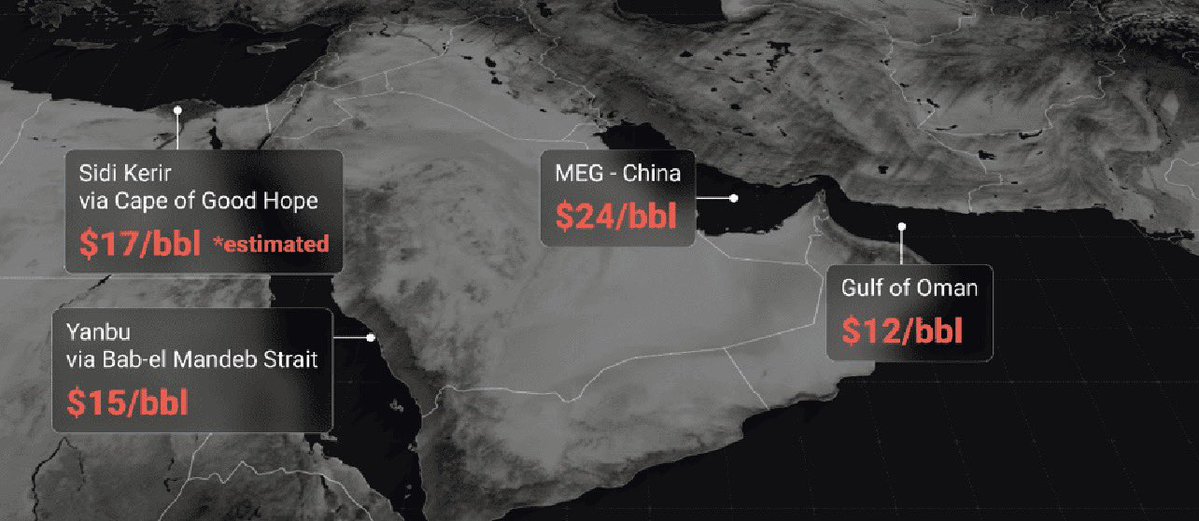
For instance, MEG–China VLCC freight has now reached $24/bbl. That freight bill is now equivalent to 24% of the FOB crude price, versus around 2-5% pre-war.
Load outside Hormuz in the Gulf of Oman and freight is still around $12/bbl because the war-risk premium doesn’t magically disappear.
Quite something
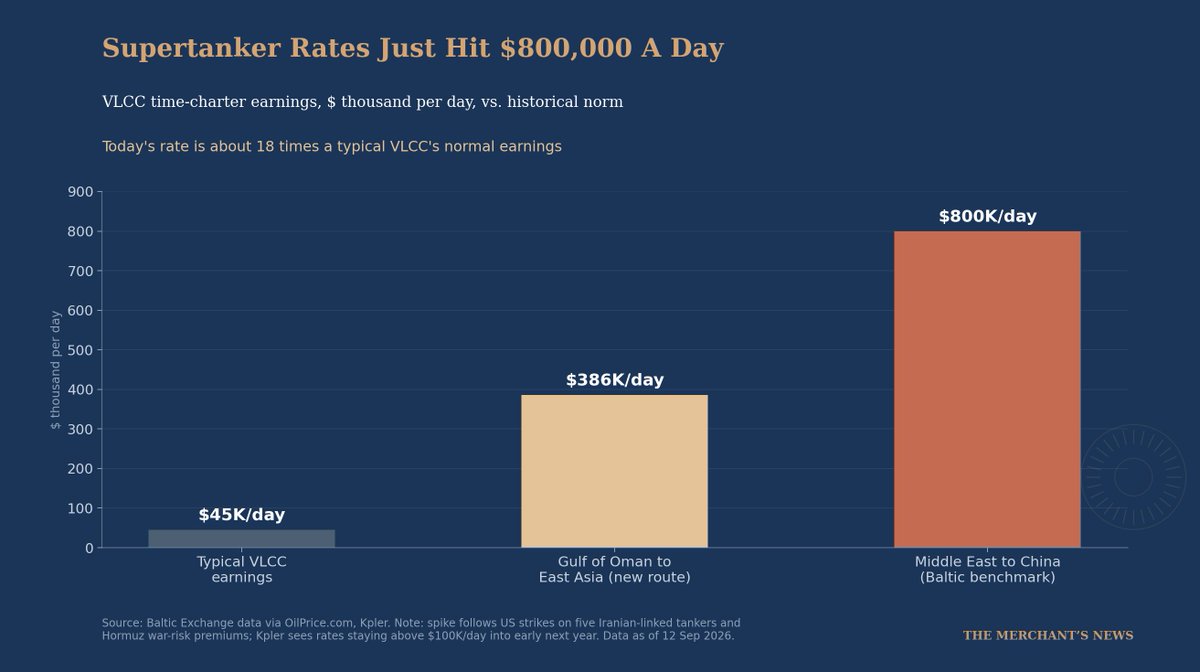
🚢💰Supertanker Rates Just Hit $800,000 A Day
The Baltic Exchange benchmark for a VLCC sailing the Middle East to China route has hit $800,000 a day, roughly 18 times a typical VLCC's normal earnings of about $45,000.
A newly tracked Gulf of Oman to East Asia route is also up sharply, near $386,000 a day, 85% higher since that benchmark started.
This is the shipping market pricing risk that used to show up only in the oil price.
A cargo now costs far more to move than it did to buy a few months ago in freight terms alone and that cost lands on refiners and eventually on fuel buyers regardless of what crude itself does.
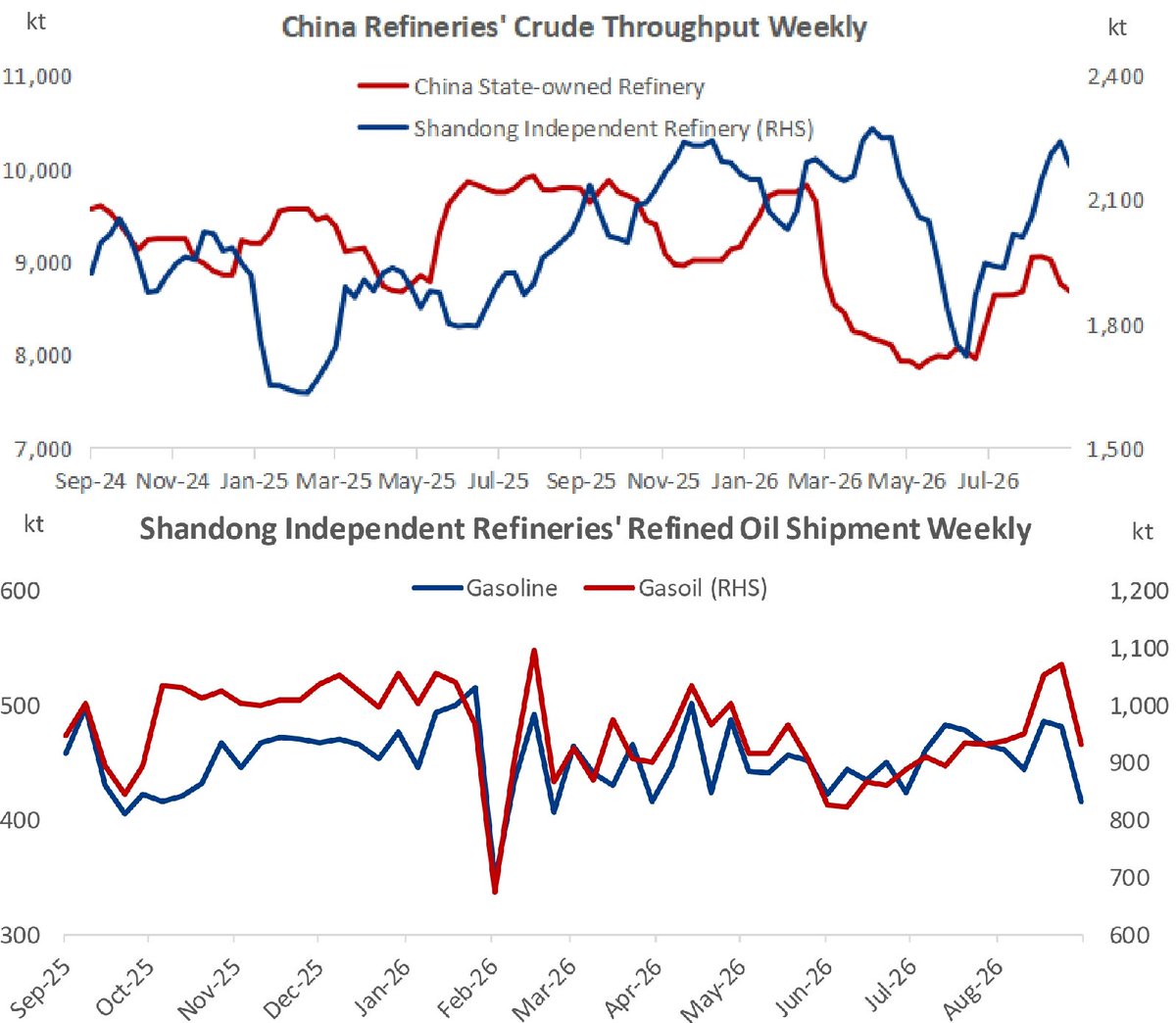
🛢️🇨🇳China Is Buying Oil Again.
China's crude imports rose for a second straight month in August, up 6.2% from July to 37.9 million tonnes, about 8.9 million barrels a day.
That is roughly 9 million tonnes above June's war driven low, still 23% below year ago levels and about 26% under February's pre war peak.
The rebound is not just refiners feeding storage.
Chinese fuel exports jumped 29% in August as refiners processed the extra crude and sold gasoline and diesel into a tight global market.
Refiners are also diversifying supply, adding Russian ESPO and Argentine grades alongside the usual mix.
China spent the crisis months drawing down what analysts estimate is over a billion barrels of stockpiled crude instead of chasing the price spike, which gave Beijing room to sit out the worst of it.
Now that it is buying again and exporting more fuel at the same time, it looks less like panic restocking and more like refiners judging that Gulf supply risk has stopped getting worse for now.
https://t.co/cvIGKRzzaD
Saudi-backed forces in Yemen reportedly had some battalions composed of nearly 80% “ghost soldiers,” fake troops that existed solely on paper to collect salaries -CNN
The hollowed out forces near Mokha, coupled with a slow Saudi Air Force response, allowed rapid Houthi gains.
Oil is plunging as reports emerge that Iran and GCC nations are meeting to discuss reopening the Strait of Hormuz.
We are in an endless loop of:
"Hormuz is going to open soon... just trust me this time, bro."
None of the previous claims were true... and I don't expect this one to be either.
There is simply no reason for Iran to reopen the Strait and give Trump much-needed relief going into the midterms.
Iran holds the leverage
The Strait will remain closed until Iran's demands are met.
🚨The Houthis Just Took Mocha.
Saudi Arabia's Last Oil Exit Is in Play.
Houthis seized the Red Sea port of Mocha today and are attacking the Hanish islands.
Government forces are pulling back to Dhubab, directly on Bab el Mandeb, opposite Perim island.
Whoever holds that stretch of coast holds the strait.
Why this is the most important oil headline of the week, ahead of tankers off Kharg.
Hormuz is effectively shut.
Every barrel Saudi Arabia has kept flowing since spring has gone west to Yanbu and out through the Red Sea.
Bab el Mandeb is the exit for that route, and the Houthis have declared a naval blockade on Riyadh since July.
Mocha puts their forces within reach of both shores.
The market has priced Hormuz for 7 months.
It has not priced losing the Red Sea too.
If the Houthis take Dhubab and Perim, Saudi crude has no sea route east or west that is not under fire, Suez traffic that recovered 42% in July goes into reverse and the Sumed pipeline into the Mediterranean becomes the only clean path out of the Gulf.
That is not a $100 world.
It is the scenario that takes real Brent toward the 1980 and 2008 peaks.
2 more things from the same story.
Tehran told Pakistan's envoys that "Iran does not control the Houthis," which means nobody on the phone can call this off and the Wall Street Journal reports Vance and Rubio have privately warned Trump the war could run through January 2029.
Brent held above $100 on all of it.
The strait to watch has changed.
BREAKING: First ground-level image of the massive 100 km black smoke column rising from Saudi Arabia's East-West crude pipeline, captured ~6h ago, after Yemen's Houthis struck the pipeline on multiple points, the same plume seen on Sentinel-3 satellite imagery.