#Bitcoin is the only monetary system in history that has the properties to last forever, for it doesn't derive value from the authority/wealth of the issuer, which is fleeting, but a timeless universal constant - mathematics.
#Bitcoin is the reserve currency of the universe.
“An OpenClaw AI agent spawned a child bot on a VPS provisioned via the Bitcoin Lightning Network, then bought its offspring AI API access using its own crypto wallet, without a human touching a credit card or saying "yes." The API provider confirmed this is ‘the first documented case of an AI agent purchasing credits from us autonomously.’”
AI agents can write code, send emails, and make phone calls. But they still can't transact.
Today we're fixing that. Releasing a new set of tools that give agents native access to the Lightning Network: lnget for automatic L402 payments, MCP for node operations, remote signing for key isolation, and scoped credentials for spending control.
The machine-payable web starts now. And bitcoin makes it possible. ⚡🦞
https://t.co/B0KW01l6ZD
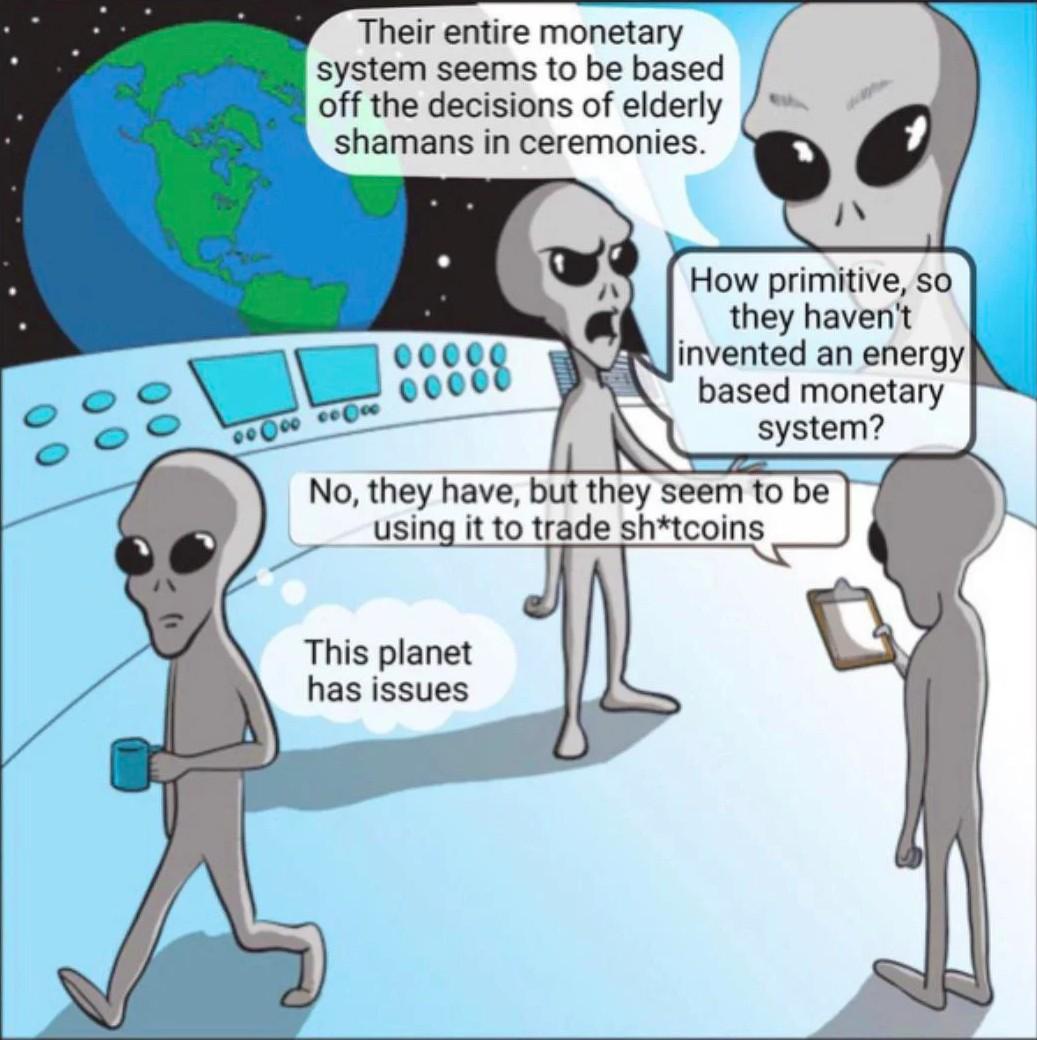
@CynthiaMLummis The lifeblood of civilization, money, predicated on the lifeblood and language of the universe, energy and mathematics.
The culmination of humanity's 7000-year technological quest to perfect the representation of value.
https://t.co/4pIXhce2P3
The first debate about arbitrary data in the blockchain happened in December 2010 and Satoshi was involved
On 8th December 2010, Satoshi released Bitcoin version 0.3.18, which included a standardness check, to only include known transaction types
🧵
nostr is the only free place left on the internet that I know of.
no age verification, no emails, no ads, no geo blocks, no tracking, no shitcoin, no vendor lock, just pure speech. no company that can be forced to take down posts.
join us. choose one of many clients below.
As a developer, I want to state an obvious fact:
Ethereum is an absolute garbage dumpster fire.
For the longest time, it kept going based on the claim that it will produce a "decentralized world computer for smart contracts". Which is a bs from the start, since blockchains are terrible for computation. To mask that foundational failing, pointless complexity kept being added on top... which every now and then rears its ugly head in hacks like the one that cost @Bybit_Official 400000 ETH (~$1.5 billion).
The actual "product market fit" of $ETH turned out to be: a Rube Goldberg machine for launching shitcoins. Especially stablecoins thrived on it. NFTs & meme-tokens too... but stablecoins were behind most of the demand for gwei.
However, ICO heydays are long gone. Stablecoins are coming back to Bitcoin, and $SOL is now the blockchain of choice for meme-token rug pulls. So at this point, I have no idea what people will actually use Ethereum for in the future.
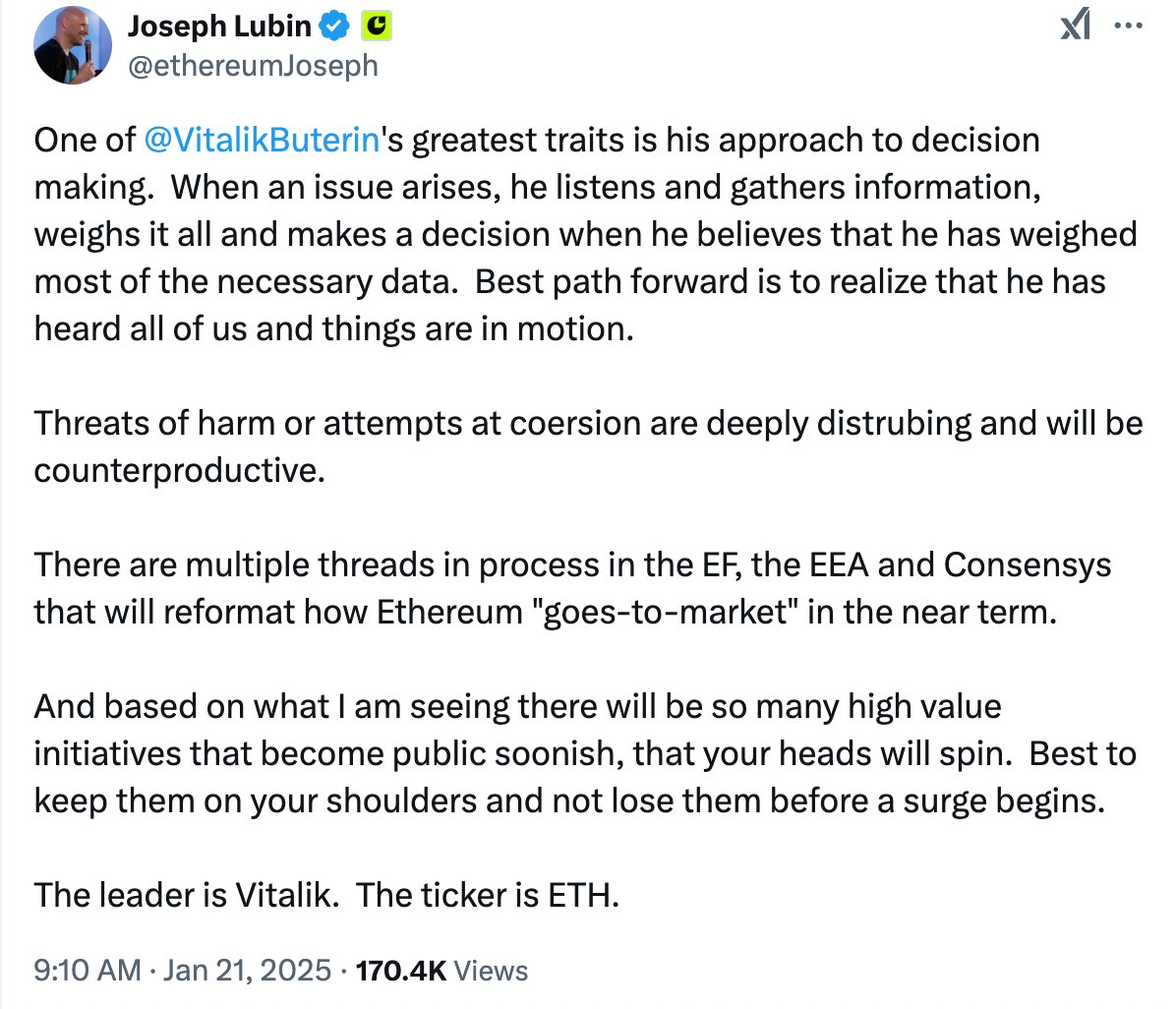
Of course, the marketing department of @VitalikButerin & @ethereumJoseph will continue producing "world computer decentralization" smoke and mirrors. But after what happened at the Ethereum Foundation, it should be obvious to everyone - ETH is Vitalik's chain. A startup, really.
If you're a developer contributing to it, you're not building anything world-changing. You're just stacking Vitalik's equity and filling the pockets of those at the top of the pyramid. It’s been years since any meaningful technical work was done - the last major event being The Merge, where Emperor Vitalik switched to PoS and, by decree, rekt all the miners who had invested in the ecosystem.
And you don't need to take it from me, just read the posts from long-time developers like @peter_szilagyi when they have moments of intellectual honesty to genuinely evaluate the situation.
Try to also find @MartyBent's thread on all promises given on Ethereum over the last decade.
Bitcoin employs a UTXO (Unspent Transaction Output) model that allows users to sign off directly on how specific funds move from existing outputs to newly created outputs. In this system, when you authorize a transaction, you collect the relevant UTXOs, specify the amounts and recipient addresses, and produce a signature proving ownership of those inputs. Because each UTXO uniquely identifies a portion of bitcoin and no further logic executes behind the scenes, the transaction itself effectively represents the entire state transition. All that remains for the network is to validate the signatures, ensure the inputs have not been spent elsewhere, and update the collective ledger by removing the spent outputs and adding the new ones. This straightforward flow translates neatly onto a hardware wallet, which can display the outgoing amount and destination, leaving little room for confusion about the transaction’s effect.
Ethereum, on the other hand, uses an account-based model that intertwines simple fund transfers with the potential for highly flexible smart contract interactions. Rather than specifying a direct state transition, an Ethereum transaction can encode a command (or function call) directed at a smart contract. When you sign such a transaction, you are effectively consenting to trigger a piece of code that the Ethereum Virtual Machine (EVM) will execute. During execution, that code can move additional funds, call other contracts, and alter the global state in ways not explicitly visible in the raw transaction data. This complexity creates a more error-prone user experience, especially on hardware wallets that might only be able to show a destination address and some data payload. Users may not see or fully understand the internal calls, conditional logic, and further fund transfers that could happen once the transaction is processed.
From a user-experience perspective, Bitcoin’s simplicity provides a clear advantage on hardware wallets. A Bitcoin wallet can definitively show which addresses are involved and how much bitcoin is being transferred. With Ethereum, that same device must attempt to interpret and display an instruction that could have a vast range of outcomes. This opacity arises because the blockchain must wait for the EVM to run the contract code and produce the final state changes, rather than reading them off a simple script. Though standards like EIP-712 (structured data signing) have improved the readability of Ethereum transactions—enabling wallets to display more informative prompts—smart contract interactions can still be challenging for everyday users to audit in real-time.
Another important factor to consider is the possibility of internal transactions in Ethereum. A single contract call can cascade into further function calls, known as internal calls, which do not appear as user-signed transactions but can carry out token transfers, mint NFTs, or trigger a host of other operations. The user, therefore, places a high degree of trust in the smart contract’s code, which is often impossible to examine thoroughly during a quick on-chain transaction. While Bitcoin’s scripting language can handle some conditional logic, it is intentionally constrained compared to Ethereum’s Turing-complete environment, thus mitigating much of the complexity that plagues Ethereum-based interactions.
In summary, Bitcoin allows a user to sign off on a deterministic state change—moving specific UTXOs from one owner to another—and this reality is easy to verify. Ethereum instead asks the user to sign a command to run smart contract code, which may produce further state transitions that are only fully revealed after execution. This difference underlines the greater potential for confusion and errors on the Ethereum side, despite the added versatility of a programmable blockchain. Nevertheless, ongoing improvements like structured data signing and more advanced wallet interfaces seek to bridge the gap and provide clearer transaction overviews for Ethereum users.
Everyone is a speculator. Fiat forces you to be.
It’s not enough to just do your job, you also have to outpace the destruction of your money.
Spend your paychecks gambling on memes, or contribute to the world and save in #Bitcoin?
Which way, Western man?
@CynthiaMLummis The lifeblood of civilization, money, predicated on the lifeblood and language of the universe, energy and mathematics.
The culmination of humanity's 7000-year technological quest to perfect the representation of value.
https://t.co/4pIXhce2P3
@CynthiaMLummis The lifeblood of civilization, money, predicated on the lifeblood and language of the universe, energy and mathematics.
The culmination of humanity's 7000-year technological quest to perfect the representation of value.
https://t.co/4pIXhce2P3
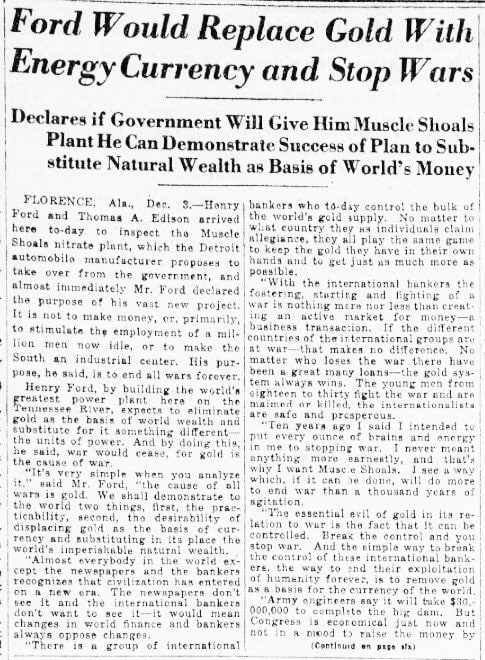
Dec 3 1921, 100 years ago to the day, Henry Ford proposed replacing gold w/ energy currency & stop wars.
"The cause of all wars is gold. We shall demonstrate two things, first, the practicability, second... displacing gold... w/ the world's imperishable natural wealth"
#Bitcoin
Great letter on Bitcoin to @TheEconomist from @RobertKennedyJr today.
Every statement by RFK is backed up by both peer review research and the firsthand experience of grid operators.
https://t.co/q4s86esEuC