@Arthur_van_Pelt@knutsvanholm@saylor Did you read the Blocksize War?
You used to cite paragraphs from it in your podcast
Vision, culture and "social consensus" don't matter. All that matters is is it a literal change in the rules on block validity
You are again repeating defeated BCash talking points
The impulse to change Bitcoin’s rules merely to prevent others from using Bitcoin in ways you disapprove of is statist and alien to a community rooted in liberty, property rights, free markets, natural law, and Austrian economics. BIP 110 would impose monetary purity by fiat.
> I starting a never-ending whack-a-mole process
Exactly correct and it should be noted that:
1. The spammers can move a lot faster than Bitcoin, which is slow moving and very conservative by nature
2. It's not never ending, because that spammers can eventually adopt a mathematically robust solution that can never be stoped
See: https://t.co/LaoyYr9sjY
Choose you battles.
Don't fight battles you are destined to lose
> I starting a never-ending whack-a-mole process
Exactly correct and it should be noted that:
1. The spammers can move a lot faster than Bitcoin, which is slow moving and very conservative by nature
2. It's not never ending, because that spammers can eventually adopt a mathematically robust solution that can never be stoped
See: https://t.co/LaoyYr9sjY
Choose you battles.
Don't fight battles you are destined to lose
Hard to say.
For this fork, I’d have to agree that something is indeed killing me by a thousand cuts, rather than just a background nuisance held in check by the block size limit and fee market. Defining the scale of the problem, in other words.
Second I’d have to see what methods of fighting back actually work without breaking much, and weigh those methods relative to my perception of the threat (existential or nuisance or somewhere in between). Can it solve the problem or just move it somewhere else? I’d make sure I’m not putting effort into something that is more performative than functional. And what commitment am I getting into? Can one fork mostly solve the issue, or am I starting a never-ending whack-a-mole process against the problem, while the problem evolves around my attempts, and each attempt comes with potential technical trade-offs such as potentially affecting the prospects of LN Symmetry (a monetary improvement) and so forth? And *precisely* how small do I want to make the spam bucket that doesn’t contribute much to UTXO bloat (op return) while preserving the other spam methods that do? Who knows- the burden of evidence and specifics are on the proponents.
Third I’d make sure not to damage the movement with sensationalist marketing. Self-appointed main characters don’t last long in the bitcoin space. “Pass my fork or Bitcoin dies” is unlikely to win, and may set back the movement. The sensationalist marketing and scale of infighting is what led a podcast host to ask me about it, for me to answer, for others to respond to me, and for me to respond to them with a more public position against this specific fork at this specific time. I’d have otherwise remained publicly indifferent at this time (since it’s a young fork and doesn’t mitigate a whole lot). Wasn’t it @giacomozucco who said that the knots movement was growing until this fork killed it, (his words, not mine)? Something like that. You know how many forks are looking to solve problems in bitcoin and have been seeking consensus for years? Welcome to the party.
Fourth, I’d weigh it against other development considerations in terms of time-resources spent. How does this compare to making Lightning better via LN Symmetry? How does this compare to preventing some potentially serious exploits via Consensus Cleanup? Etc.
Fifth I’d weigh it against other threats. How about governments trying to ID-verify everything at the operating system level? The attack on net privacy is about 100x a bigger concern to me than this. It’s a gift for them to have half the bitcoin space fighting over a contentious fork that just mildly rearranges the buckets for where spam goes (and for which some aspects I might even be in favor of) rather than defending against all the ways that Bitcoin’s privacy and usability can and is being attacked. I want to see a flourishing ecosystem of coinjoins, smooth lightning UX, Chaumian ecash, Ark, and whatever else people can build to improvement payments and route around censorship and ubiquitous surveillance.
Best thing an enemy can do is get you to focus on paper cuts while they’re swinging their machete.
@hodlonaut@Excellion None of this would have happened if.....
So fucking what? An infinite number of things could have happened in the past which could have prevented us from being here
That is not a logical argument
We are were we are
@mattkratter@Stanorajis BIP-110 does not help reduce the resources required to run a Bitcoin node
Your claim is false
Bitcoin Core has made huge progress in reducing the computational resources necessary to run a node.
> why change the default
To improve the performance of various aspects of the node, for instance:
1. Pre confirmation signature validation caching
2. Compact Blocks
3. Potential for more reliable fee estimation
4. Improved user interface options for incoming zero conf transactions (e.g. what if a merchant receives a payment, that is a decedent of a transaction with a large OP_Return output?)
@DetroitMatthewD@Excellion Bitcoin is a system which requires that the rules are extremely robust
If someone tries to fight over politics, culture or vision using the rules, it's critical that the existing rules prevail
@DetroitMatthewD@Excellion Bitcoin is a system which requires that the rules are extremely robust
If someone tries to fight over politics, culture or vision using the rules, it's critical that the existing rules prevail
@murchandamus@dathon_ohm@JimAndrews77 This is correct.
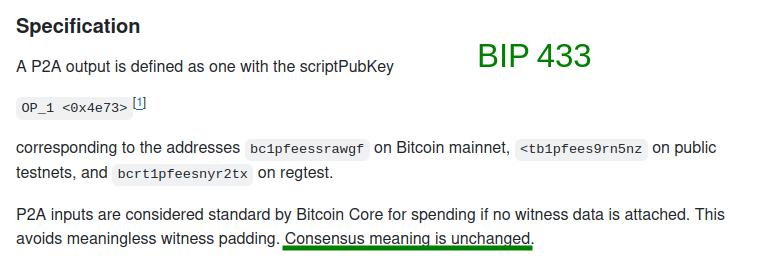
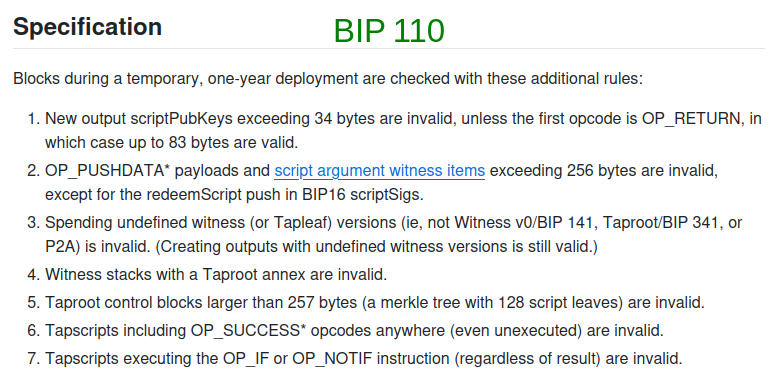
This is not a "consensus bug" in the same way Block Slop is, but this is a failure to honestly document all of the consensus changes that are included in BIP 110.
FYI to @FoundryServices - BIP 110 has not documented all the consensus changes it makes.
@dathon_ohm@JimAndrews77 Many RDTS proponents seem to be confused about the difference between mempool policy and consensus rules. I was hoping that you understood it.
Anyway, please point out where in BIP 110 the existence of a witness for P2A is specified to be consensus invalid.