Two Tumbles And A Jump
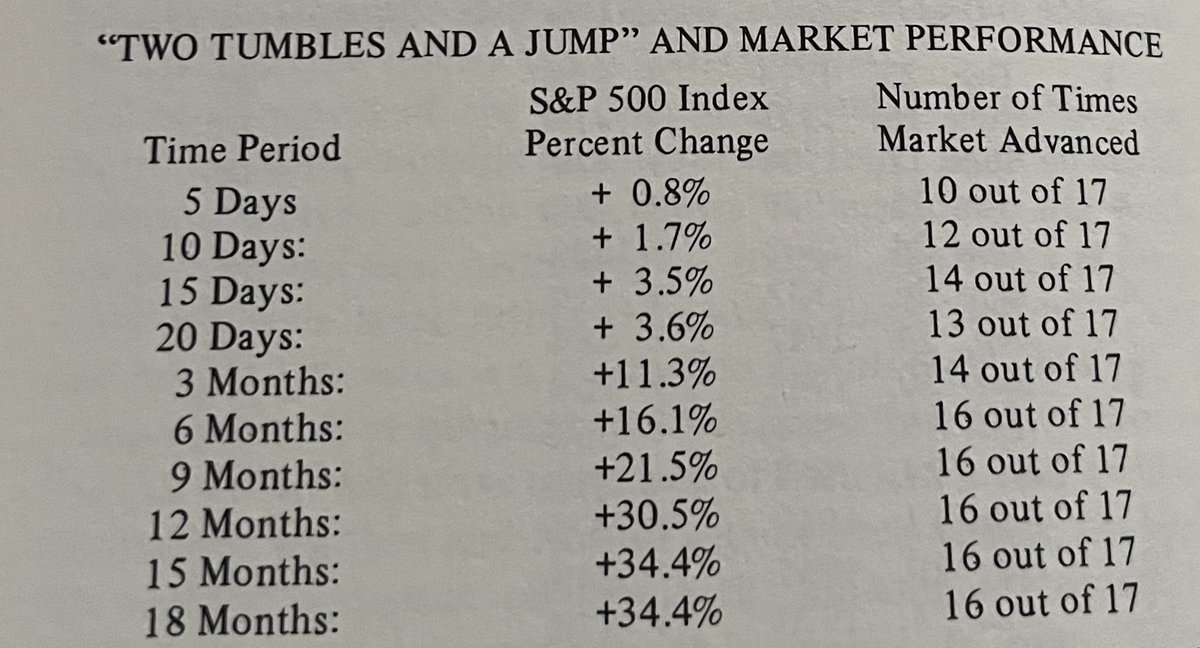
The "Two Tumbles And A Jump" rule states that when the Federal Reserve eases the monetary climate by decreasing one of the three basic policy variables (Discount Rate, Margin Requirement, or Reserve Requirement) two times in succes-sion, conditions are favorable for an ensuing "jump" in stock prices. It was first proclaimed by Fosback in 1973. The rule was then next triggered on January 9, 1975, following the Fed's second consecutive cut in the discount rate. The market shot upward from that point, with the S&P 500 Index increasing 32% after one year and reaching a peak interim gain of 34%. Though impressive, it was only an average "Two Tumbles And A Jump" performance.
Had an investor bought at each "Two Tumbles And A Jump" signal date and sold the position one year later, he would have realized a handsome return. Although he would have been invested for only 17 of the last 69 years, an initial $10,000 investment would have grown to $542,304 by year-end 1983. Alternatively, an investor who disdained the market during those 17 years and held stocks only through the remaining 52 years would have seen an original $10,000 investment shrink to just $6,450. The "Two Tumbles" rule more than captured the entire market rise since World War I The great bull markets of every decade have been accompanied by "Two Tumbles And A Jump" signals. Even the November 15, 1929, signal was propitious, for it precisely caught a 28% six month rally between the quick, panicky crash in the fall of 1929 and the real crash of mid-1930 to mid-1932. The December 3, 1981, signal was early, but it preceded the largest market breakout in half a century. Furthermore,on average the
"Two Tumbles" signals have yielded impressive gains across all holding periods. In fact, it is one of the very, very few indicators in existence with a near perfect half-century record. Economic theory holds that the Federal Reserve System can snap an economic or stock market expansion quite easily by taking restrictive monetary action, but that it has a much more difficult time reversing a contraction. The theory is often described in terms of "pulling or pushing on a string." (It is obviously easier to pull a string than to push one.) According to the theory, when the economy is operating at or near full capacity or when the market is straining toward new heights, the strings are tight and the Fed can pull them around at will. When the economy is depressed, the strings are slack, and the Fed has great difficulty pushing them in the direction and with the force it desires. Although this theory seems plausible, it is not supported by the "Stumbles" and "Tumbles" rules. While the expansionary "Two Tumbles And A Jump" rule has a truly superlative record of forecasting market and economic upturns, the restrictive “Three Steps And A Stumble” rule has only a moderately good record of forecasting downturns. Strangely enough, it is the latter which has gained a relatively wide following in the investment community, while the former has escaped "discovery" until relatively recently. Even technical analyst Edson Gould, one of the most vocal supporters of the "Three Steps" rule, has pointedly remarked that restrictive Fed actions are more significant than actions of moderation.The evidence casts considerable doubt on that hypothesis.
Colby Covington got into it with Chechen fighter Ibragim Islamov at the Hype Ecuador press conference 😳
🗣️ Colby: "You couldn't afford my price bro. You fight for pennies, I fight for millions. There's a difference. My suit costs more than your house."
🗣️ Ibragim: "Be careful, you're in real life not behind an iPhone."
🗣️ Colby: "I'm shaking, I'm so f*cking scared. Bro I know what real life is. I know some dangerous motherf*ckers. I got some crazy motherf*ckers with me too, I don't know if you wanna go down that route."