My name is Yuxian Xiao and you can call me Gordon.
The account is for class WR39C this Spring quarter at UCI!
My Tweets will mostly be about #39Canimals
#WhatIlearnedin39C By researching sperm whales by referring to potential environmental and anthropogenic problems and the corresponding solution through both google scholar and social media, Twitter, I got myself informed to the worldwide circumstances about ocean security
#WhatIlearnedin39C Through the study of bird brains, I got impressed with how intelligent different types of birds are in terms of their emotional expressions, tool-using intelligence, social interaction, and communication
#WhatIlearnedin39C This is my first time doing research on my own and reading most scholarly articles to know more about my favorite species, which highly improves my reading skills and understanding about sperm whales' social interaction patterns
#WhatIlearnedin39C I had a wonderful experience in researching cetaceans like sperm whales and dolphins, including knowledge about dolphins that their intelligence may be attributed to their big brains
#WhatIlearnedin39C I appreciated that I've learned from TIME Magazine that domesticated cats and dogs also differ in their relationships with the owners in terms of natural characteristics.
#39canimals ...increase in surface activity and reduction in blow rate of sperm whales might be related more to the presence of seismic array......cetaceans’ normal communication, behavioral patterns, and spatial distribution (444).https://t.co/oeUKyc3ywY
#39canimals Nicola Jones reports that United Nations agreed on resolutions to conserve ocean health that noted an urgent need for research and cooperation to counter the disruptive effects of anthropogenic noise in the ocean......marine life (158). https://t.co/uarP1ZDTAq
#39canimals "Meanwhile, some of the causal relationships between multiple sources of noise and the amodal behavioral patterns or physiological response we know today are vague or subtle, though the others are active and dramatic (1107)."https://t.co/CogxOGkPpE.
#39canimals "Sivle et. al. shows that for sperm whales, the long frequency active sonar systems will cause disruption of feeding activity as their normal diving behaviors are altered (9)." https://t.co/3zU8iTWN1h.
#39canimals "Among all potential threats, the ocean noise pollution causes the most disruptive problem to sperm whales since it leads to distortion and confusion among sperm whales’ communication and socialization."
#39canimals The strategies proposed by the official institution should be paid attention to and actually be enacted to better preserve the environments and protect the relationships between nonhuman species and humans
"The synchrony performed in cooperating tasks and other scenarios such as chasing predators away further supports the claim that dolphins understand when cooperation is needed." #39canimals https://t.co/D7KuWoGn6V
https://t.co/Yp7dAeO4m5
#39canimals To integrate the philosophical question related to human morality and the anthropogenic threats like poaching, I deem that the elephant population is under great risk and that human should reconsider their behaviors endowed by their ridiculous "superiority."
#39canimals
One of the most important problems contributing to the dramatic decline in elephant populations is poaching.
check the website to know more information
https://t.co/DMUTnfuUHf
While dolphins are capable of adapting to living in small tanks, “cetaceans are so complex that life in the barren tanks” is far from “meeting their needs (Marino 183).” #39canimals
https://t.co/evbgVHxkem
#39canimals while we have to admit that humans are trying best to form a better relationship with nonhuman animals to some extents, we should also ensure the security and integrity of those animals, avoiding causing any kinds of anthropogenic threats to whatever species
#39canimals To better live with domesticated animals like cats and dogs, we indeed need to pay more attention to them and try our best to save them when they are facing danger!
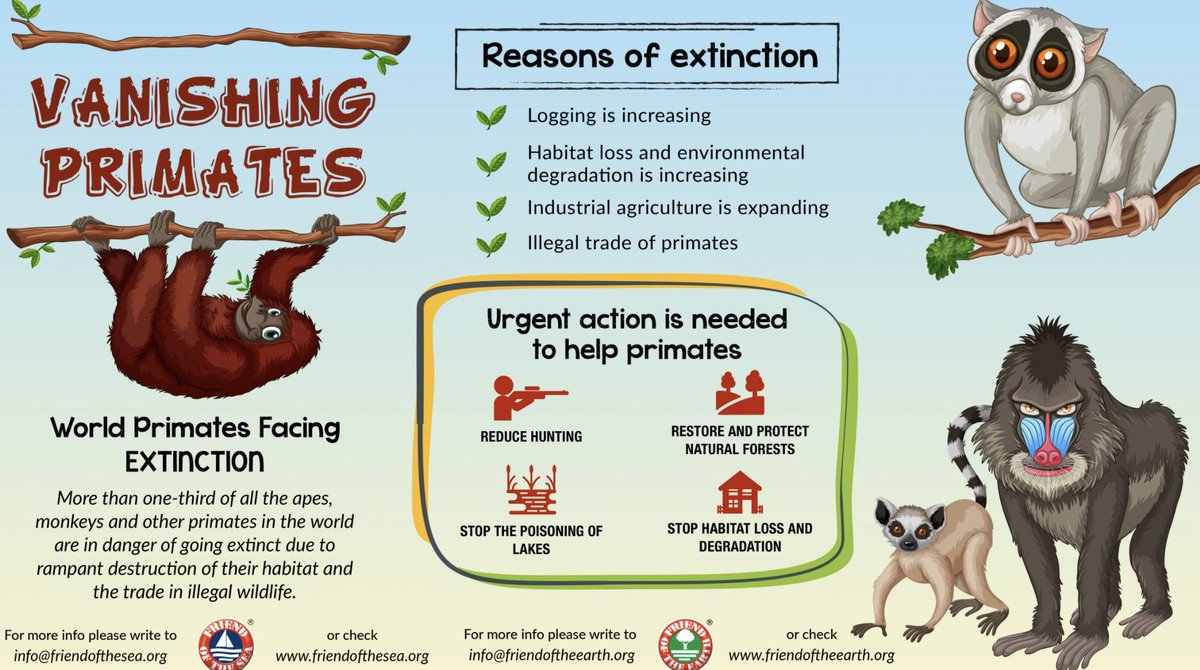
The WSO proposed several ways to protect primates. Site/area protection and management, conservation of resources and habitat, and restoration of habitat and natural processes will ensure that it continues to reproduce and reproduce. #39canimals
#39canimals It's true that the nonhuman species and we human share the same ecosystem in this world and we should not immorally treat them but ethically protect them and live together
“We share the world with creatures whose curious brains peacefully seek us,” and we mistreat and unethically use them for our own advantage (Safina 375). #39canimals