Father of 5, husband & and full-time tennis coach trying to implement a nonlinear approach. Its a game first Informed by evidence shaped by experience.
My take on : Task simplification & manipulating constraints,in this case (equipment) in beginners tennis. Tennis has traditionally treated newcomers to the game as if they're incapable of PLAYING tennis until all the technical "fundamentals" are in place. I was guilty of this 🤦🏽♂️.
Some still think FUN is a waste of time
“My child is here to learn, not just play games.”
But FUN is not the opposite of learning.
It can include effort, challenge, improvement, connection, and competence.
Graphic informed by Visek et al.’s Fun Integration Theory.
Using principles allows players to explore without being dictated to on exactly how the movement should look.
It gives them a direction, not a script.
That creates space for creativity, while still helping them make informed choices during play.
For years, I thought coaching meant players conforming to my instructions.
How wrong I was.
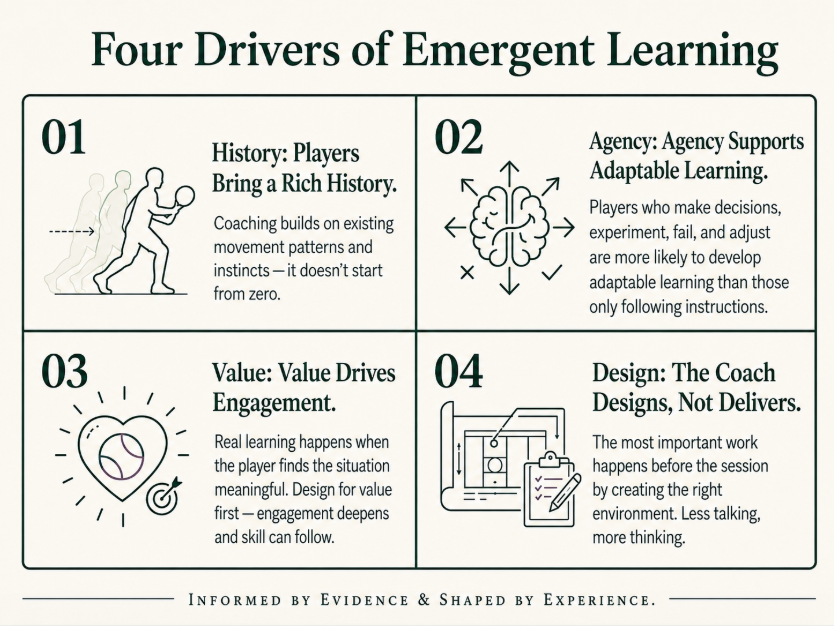
Players bring history, need agency, and learn through environments designed around real problems.
Learning does not emerge from compliance.
It emerges from interaction.
Talent decisions based on a snapshot in time risk two mistakes
Overlooking late developers too early.
Overburdening early developers by mistaking temporary physical advantage for talent.
Current performance ≠ long-term potential.
Talent ID must look past the talent that shouts. Often, the ones who whisper are overlooked.
Traditional pathways reward immediate performance, creating structural blind spots that bleed long-term potential.
Ref: Cobley et al. (RAE) & Malina et al. (Maturation Bias).
Managing expectations as a parent is a crucial factor in shaping both the relationship with your child and their experience in sport.
Being aware that our role as parents shifts over time can help alleviate potential issues along the way.
To a player under stress, a physical gap only becomes a real affordance if their grip, balance, and fatigue allow them to exploit it. Change the action capacity, and the space lights up naturally.
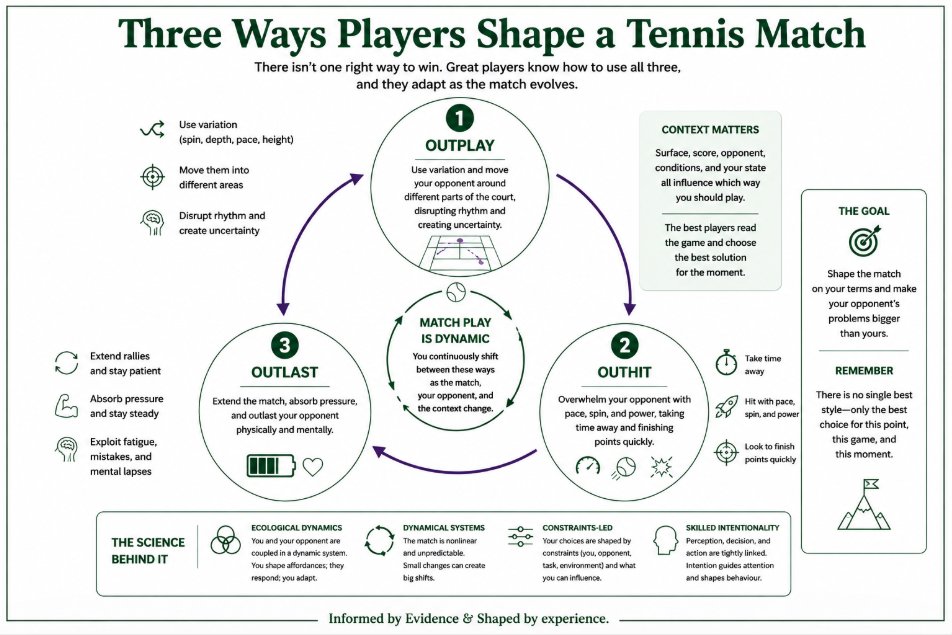
Elite players don’t just solve problems they set them.
Within 1 point, a player may need to outlast, outhit, and outplay their opponent as the point unfolds.
The differentiating factor between levels is the ability to continuously attune and adapt to what is emerging in real time
Returning a 220 km/h serve may require stabilising coordination.
An open-stance forehand winner may require exploiting movement variability.
Expertise is not “loose” movement alone.
It is adaptive movement relative to the demands of the GAME. 🎾🧠
@UKLionsHockey1 Agreed two fundamentally opposing views on perception. Yet the athlete is situated in both with agency to shape their current situation.
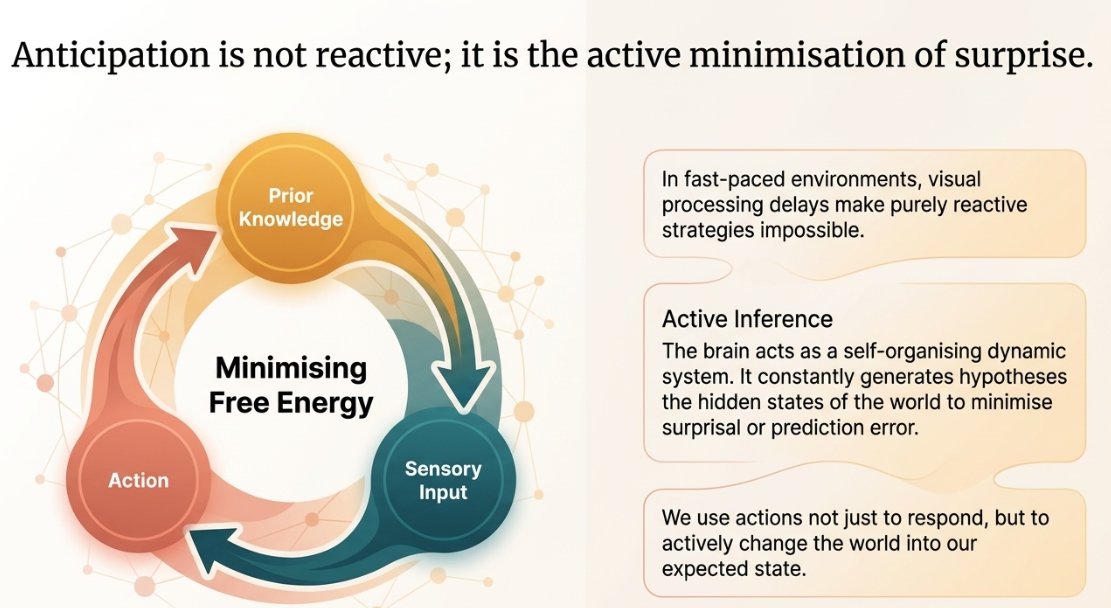
Maybe Ecological Dynamics and Active Inference are explaining similar behaviours through different language.
Ecological Dynamics:
Players become attuned to affordances and specifying information.
Active Inference:
Players minimise uncertainty through prediction and action🎾🧠
@kestrelpsych I agree Tom, what I'm personally wrestling with is, as a player I feel like I'm doing both ! I bring my priors to the match through lived experience previous encounter against the same opponents while also using real time information ! I'm finding (AI) really interesting atm.
Are we only attuning to the specifying information present in the environment or are we also drawing on contextual priors ? My interpretation from the perspective of how players engage in the return of serve in tennis ! Can we do both ?
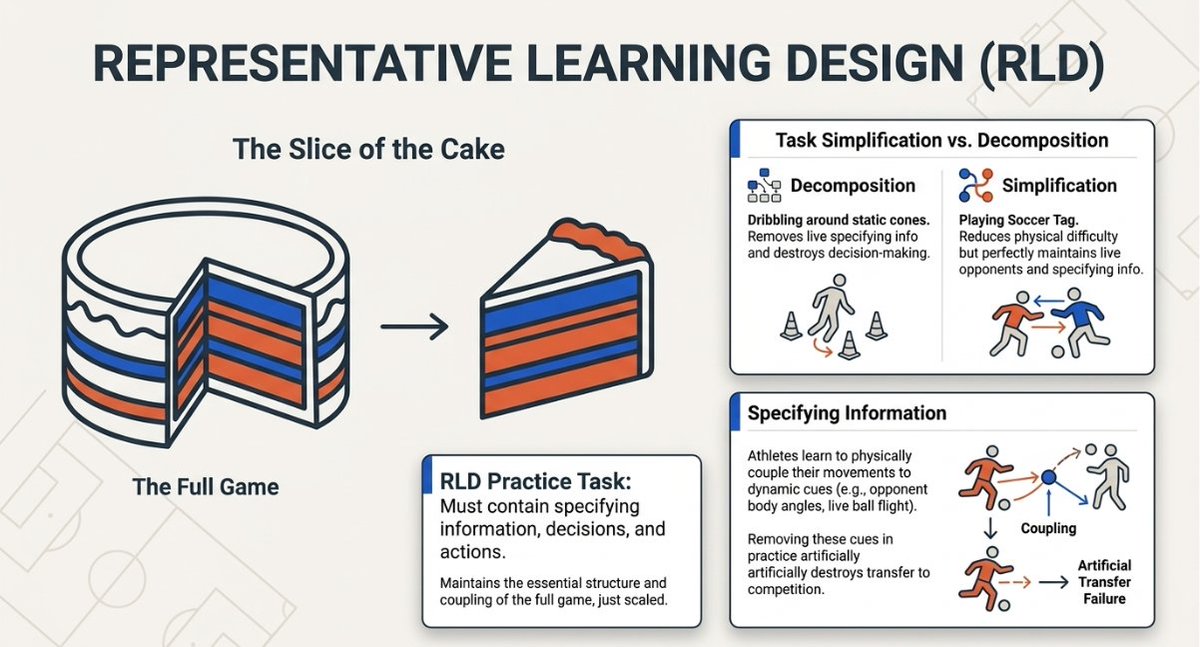
IMHO technical development that emerges within the context of the game is far more likely to transfer to the match court . Non linear coaching does NOT mean we don't work on technique. Technique isn't removed from non-linear coaching decontextualised technique is.
In tennis we have 5 main slices/situations. Serving, Returning, Both Back, Volleying, Passing /Lobbing. All of which can be practiced in a representative way to include an opponent a barrier & consequences.