@MahaDGIPR हीच गंमत असते.... आता पालिकेच्या सर्क्युलर मध्ये शाळांबरोबर कॉलेजचाही उल्लेख आहे. पण डी जी आय पी आर ने मात्र शिताफिने फक्त शाळांचा उल्लेख केलाय. मग कॉलेजेस आणि पोस्ट ग्रॅज्युएट इन्स्टिट्यूटने काय करायचं? याचं नक्की उत्तर नाही...
@mybmc Hope you know that several colleges wait and do not take decisions till HE Dept issues circular...
We need clarity @CMOMaharashtra , @htedmaharashtra
Some Interesting Statistics...
The Central and State governments in India collectively collect approximately 56% of the petrol price as tax, about ₹7 lakh crore. Combined expenditure of the Center and States on infrastructure projects is roughly ₹20 lakh crore. 1n
if this spending were reduced by an additional 10%, it would be possible to double the government's expenditure on education in India. This is aside from the environmental benefits gained by preventing the damage often caused by these massive projects... What's to be done? 3n
How did Stalin lose despite such high economic growth in Tamil Nadu?
Actually, he lost because of it.
It is true that factory production has grown at a remarkable pace under the DMK - three times as fast as the rest of India.
But this has come at the expense of the states workers - often from the most exploited castes - who work long hours for poor pay.
This is especially true in the Coimbatore-Tiruppur textile and garment belt. Several investigations have revealed that young underage girls are employed in these factories, under a modern day variant of bonded labour.
Even in the more 'modern' electronics industry, wages have been stagnant for years and workers have been angry for a while. A case in point, is the 38-day Samsung strike in Sriperumbudur in late 2024, where workers complained of poor working conditions and low pay hikes.
But this is no different from other states with robust factory sectors. Everywhere real income of workers has been stagnant for over a decade, while profits have shot up.
What makes Tamil Nadu different is that its business class has a much wider base, unlike other states where a few families and conglomerates control everything.
This means, it is much more difficult for a party in power to develop a symbiotic relationship with the corporates of the state.
In other states, it has been historically possible for the state govt to patronise a few business houses, and in return get funding and financial heft to control institutions, including the media.
In Tamil Nadu, favouritism in govt contracts immediately gets a pushback from those left behind, because they also have signficant clout.
Stalin's govt has been accused of favouring a few corporates in doling out govt contracts in several sectors. The AIADMK even submitted a formal dossier, this January, alleging irregularities in govt contracts worth ₹4 lakh crore.
It is not that Tamil Nadu doesn't have large business houses. There are several - TVS, Murugappa, Amalgamation, Sanmar, Ramco, etc - and their relationship with Dravidian politics has been well studied by scholars. But many of these have had a love-hate relationship DMK-aligned entitites like the Sun group, owned by the Marans.
Although Stalin fell out with his cousins - the Marans - they reconciled and the relationship has been stable since then. There were even reports last year that Stalin had personally intervened to resolve disputes within the Maran family.
That is why Sun's shares crashed on the 4th, when it became clear that the DMK was heading for a crushing defeat.
The point is that Tamil Nadu's stellar economic growth hides internal tensions - from inter-capitalist rivalries to worker agitations - which erupt every now and then.
This time, these tensions have combined to push up Joseph Vijay, and take down MK Stalin.
Shocking experience from @Myntra... Ordered product can be seen in one image, some old, worn out and shabby set of clothes were delivered... When asked for return, it falsely claimed no one at home... Pls note @MyntraSupport
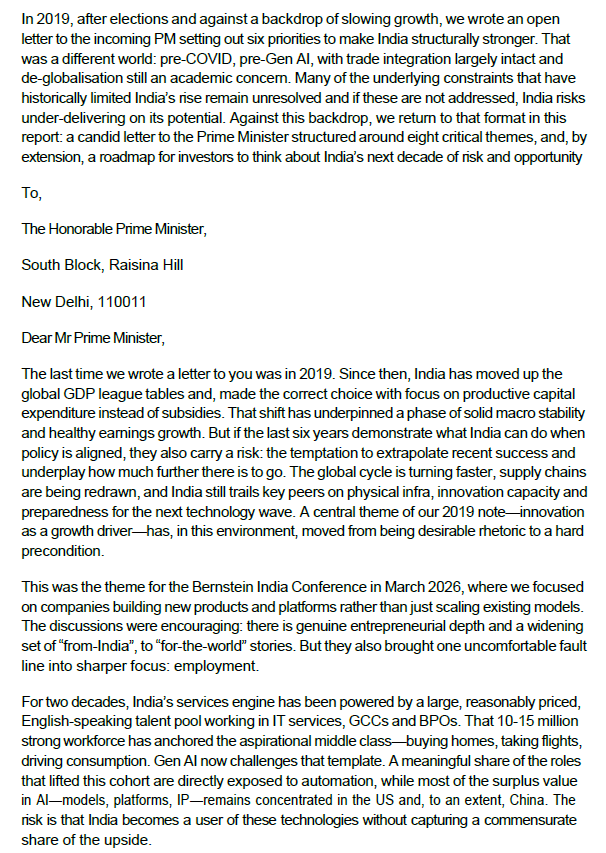
Bernstein just wrote an open letter to India's Prime Minister — and it is asking some hard questions. (23rd April India Strategy note) 👇
1/ The employment question is existential, not cyclical - India's 10–15 million strong IT/BPO workforce — the backbone of the aspirational middle class — is directly in Gen AI's crosshairs. Manufacturing can't absorb the slack at current trajectory. The real question: does the next growth leg create engineers and product builders, or mostly drivers and delivery staff?
2/ Agriculture is stuck in a 1970s policy loop 42–45% of the workforce. 15–16% of GDP. - Below 1-hectare average holdings. Monsoon-dependent farming. Loan waivers instead of reform. The farm laws rollback made things harder, not less necessary. Rs 3–4 trillion in annual input subsidies need to shift toward post-procurement income transfers — and cold storage/logistics investment is not optional anymore.
3/ India risks becoming a permanent AI consumer, not a creator - Data centers are not a strategy. India doesn't own a single frontier AI model. If Indian data keeps training US and Chinese models while domestic capability goes unbuilt, the IT services sector hollows out with nothing to replace it. Bernstein's ask: fund domestic foundation models, build compute capacity, and push global AI companies to list in India — sharing value with the public.
4/ Manufacturing ambition keeps outrunning manufacturing depth - PLI created momentum, but the share of manufacturing in GDP is still stuck at 16–17%. Even in EVs, battery cells — 30–40% of cost — are largely imported from China. The pattern of late entry into industries after global supply chains are already formed needs to break. The next bet must be placed before the race is lost — automation, robotics, advanced materials, AI-integrated manufacturing.
5/ Cash transfer schemes are quietly crowding out capex - Women-only cash transfers across a dozen-plus states now total Rs 1.7–2.5 trillion annually — roughly 0.5% of GDP — and rising. In some states, these schemes absorb 2–3% of GSDP, squeezing infrastructure budgets. Bernstein isn't saying scrap them — targeted support has a role. But election-synchronised, unconditional, permanent transfers risk locking India into a low-productivity equilibrium where taxes fund today's consumption instead of tomorrow's capabilities.
6/ R&D spend of 0.6–0.7% of GDP is not a serious number for a country with semiconductor ambitions Merit-diluting reservation policies are hollowing out research institutions. Without fixing the talent pipeline and funding base, aspirations in AI, deep tech and semiconductors remain exactly that — aspirations.
Bernstein's closing line: "India does not lack capital, talent, or ambition. What it requires now is a sharper willingness to take difficult decisions early, rather than defer them. The window to act is still open, but it is narrowing."
#nifty #india #stockmarket #investing
--------------------------------
Informational only. Not investment advice. Investments subject to market risk. | GoIndia Advisors LLP | SEBI Registered Research Analyst | Reg. No. INH000020040 | SEBI (RA) Regulations, 2014.
For Serious Investors → https://t.co/WTgxJOd1UV
Follow us for more insights.
@dineshwadera By 2024, social media, or at least genuine accounts, had totally turned against him. Traditional media completely lost its credibility (and profits, too) and internet usage has increased three fold. Still he wins, and no one discusses this as a factor🤔🤔🤔 2/2
@dineshwadera That's very much true about a lot of non CA groups as well...
In 2014 when Modi won, dominating social media was touted to be one of the major reasons. Traditional media was already decaying but wasn't at such a bad level as it is today. 1/2
@TVMohandasPai@RahulGandhi Classic case of misleading sir. He didn't q equality of quantum! His q was how we define them? Also, do these spends, on A&A or Farmers, lead to social benefits?E.g. cong/atal govt gave IT sector huge tax benefit. Though no one calls it revdi, it at least generated some benefits.