concordo, mas tive um caso essa semana na empresa que me deixou meio preocupado e pensando nessa questão de precisar saber git.
no nosso processo de hotfix, a gente cria uma branch a partir da main, depois cria a tag e faz o merge.
sugeri pros 2 devs que estavam trabalhando em 2 hotfixes (em coisas relacionadas) que criassem uma branch única a partir da main e fizessem cherry-pick dos commits que cada um tinha feito individualmente pra montar essa branch nova (pra não gerar as imagens duas vezes).
eles demoraram mais de 1 hora pra entender o que eu estava pedindo, e ainda tive que explicar como fazer de fato. Mesmo usando o Claude eles não entenderam 100%, e eu considero os dois bons devs.
@Killian_Kirk a verdict from an llm judge is still an inference, so id keep every deny with its reason somewhere people can check and correct
curious how often the intent check blocks stuff the user really did ask for
google put semantic governance policies in preview
an llm judge checks each agent tool call against your plain english rules and what the user asked, before it runs
permissions say what an agent can do, this asks if it should
the judge is a model too so id want every deny shown
@thatjeffsmith the path that explains why a match is strong is the part id want to see, a similarity score alone is hard to check
do you return that path with each result or only use it for the rank bump?
databricks tested genie one on a fake insurer where 3 teams each have a valid loss ratio
tables only got 64%, agents plus metric views and pages got 93 to 95%
but agents called directly kept the old formula 92% of the time after a definition change, their own test
microsoft added knowledge graphs to foundry iq in public preview, you give it your ontology and it pulls entities from your docs while indexing, each edge keeps its source doc
you can ask in gql or plain english, and topics can suggest an ontology you review first
@J_Wallin yeah a glossary says what a customer is, not what youre allowed to do to one
owl can say two classes never overlap but it cant stop a delete, and this weeks ontology launches mostly give agents read only access, so the block on writes still sits outside the model
collate, the team behind openmetadata, announced ontology studio today, glossary terms become owl and skos classes tied to the real tables and agents read it over mcp with read only sparql
nice touch, inferred facts live in their own graph apart from what people wrote
neo4j virtual graph is GA on aura, gcp first, it maps warehouse tables to a graph and turns cypher into sql that runs in snowflake, databricks or bigquery
same query same sql, EXPLAIN shows it, and what it cant translate errors out instead of guessing
@ananthdurai the line keeps blurring tbh, palantir just made ontology sql GA, spark sql over ontology objects plus saved queries published as versioned functions, close to what semantic layers do with metrics
one to many joins dont need a defined link though, id flag those as unverified
@isidoremiller the diminishing returns point fits a paper out this week, reusing verified sql got 88% right on reworded questions but 15% once the query structure changed
so a small set of approved queries people actually use might carry most of the value
new text-to-sql paper tested reusing verified queries, a reworded question got 88% right, a swapped filter 78%, a changed query structure 15%
feels like the line to me, reuse an approved query and change a value and its verified, change the structure and label it derived
@marcoexmergo congrats on the launch marco, if i read it right the 25% is ade-bench going from 20 to 15 failed tasks with sonnet 5.5
what happens when sibling models disagree, like two status filters for revenue, does dex stop and ask or pick one and tag it as precedent?
exmergo shipped dex semantics, an open source cli where your agent writes what a dbt model means right in its yaml
one row per what, which rows count, if a number can be summed, and every assumption tagged with where it came from, even when its just a default
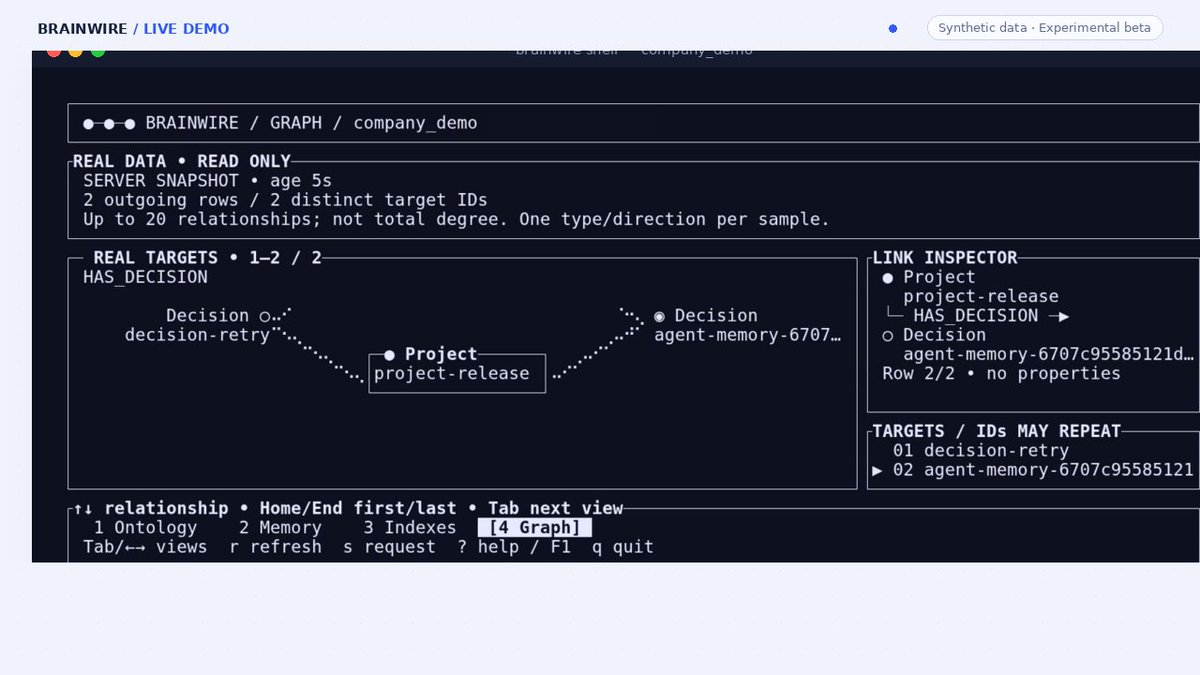
and the graph view shows the real connections. here, a project and the decisions hanging off it.
knowledge graphs, company context, memory for agents. apache 2.0, experimental beta.
https://t.co/yCo6NcX0yG
i was building a company knowledge graph on an in-memory database. as it grew, memory got hard to manage, and i couldn't really see inside it.
so i built Brainwire, an open-source graph database. data lives on disk in RocksDB. 🧵
the terminal is called brainwire shell. the memory view shows the query memory budget and how much of it is reserved. it's not process RAM, and it's not the cache.
and the graph view shows the real connections. here, a project and the decisions hanging off it.
knowledge graphs, company context, memory for agents. apache 2.0, experimental beta.
https://t.co/yCo6NcXyoe
one use is memory for AI agents. you save a decision together with its source — here, the release meeting — and later you can recall the decision with that source still attached.
that's why brainwire keeps your data on disk, in RocksDB. memory is only for caching and running queries. you query it with a subset of Cypher, over Bolt.