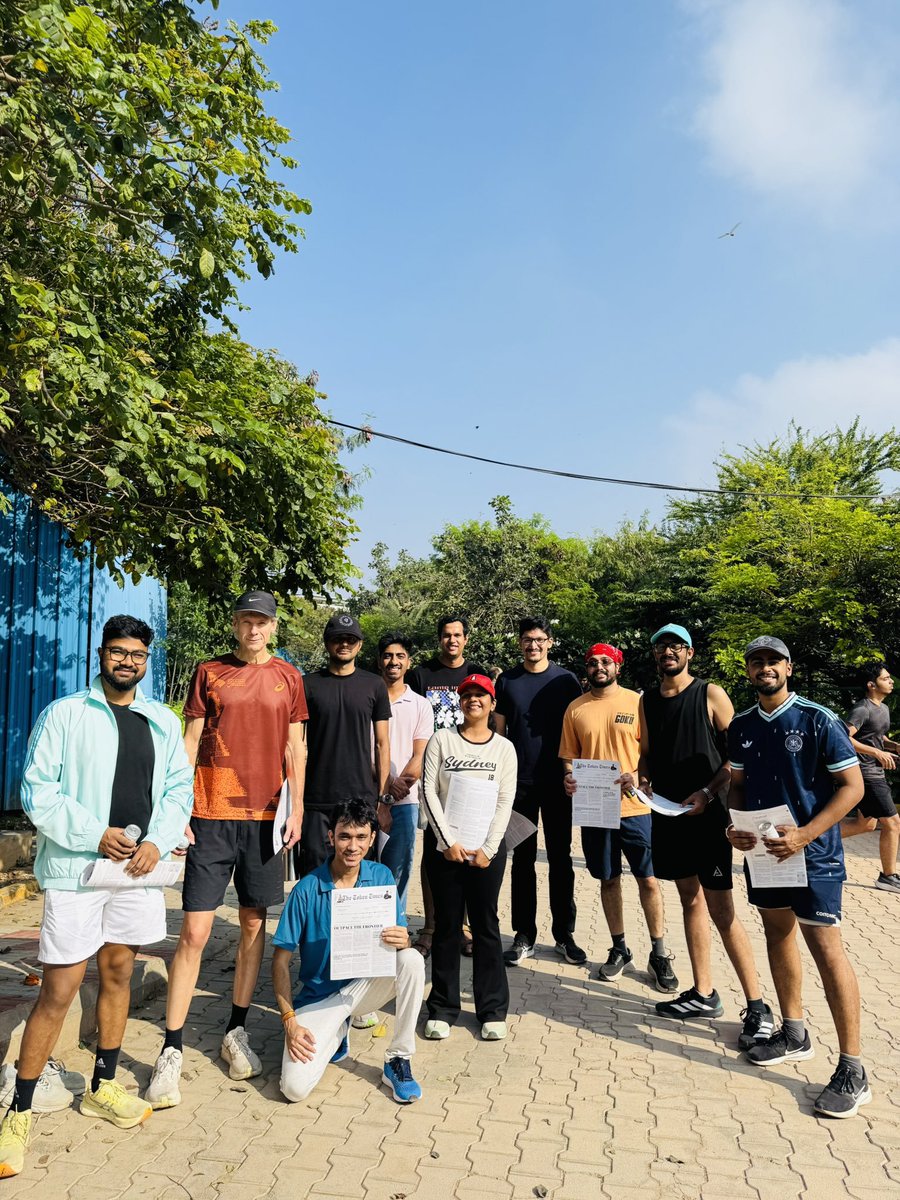
At @WeAreDevs today! 🚀
As someone building in AI and robotics, I'm excited to meet fellow builders, exchange ideas and explore what's next in AI, physical intelligence and emerging technologies.
If you're around, let's talk tech!
Shoutout to @adityaoberai for the tickets 🚀🚀🚀
After a month-long break, we're back with the 2nd edition of Invite-Only.
Over the past month, we've seen new startups emerge, technologies evolve, industries get disrupted, and conversations around the future become increasingly interesting.
But somewhere between scrolling through X, attending conferences, and exchanging LinkedIn profiles, we've lost the space for genuine, unfiltered conversations.
Conversations about what we're building, what isn't working, the problems nobody is talking about, and what the next few years could look like.
That's exactly why we started Invite-Only.
Not another networking event.
Not another panel discussion.
Not a room full of people trying to pitch something.
Just 12 curious minds around a dinner table, bringing different perspectives from fintech, healthtech, B2B, and security.
This edition, we want to explore some interesting questions:
→ With a new startup emerging almost every day, what problems are actually worth solving?
→ How will emerging technologies reshape healthcare, finance, and the broader economy?
→ As we build increasingly digital businesses, are we doing enough to protect the people who trust us with their data?
→ What's the next big opportunity that most of us aren't paying attention to?
We don't expect everyone to have the answers. In fact, the best conversations often begin with disagreement, curiosity, and a willingness to challenge what we already believe.
The idea is simple: good food, interesting people, uncomfortable questions, and conversations that stay with you long after dinner.
Bengaluru, we're back.
If you're building something, exploring an idea, or simply curious about what's next, we'd love to hear your perspective.
What's one conversation you wish more founders were having right now?
Welcome to Invite-Only
BLR folks, scene this Saturday? 👀
Getting ~15 fintech, healthtech & security people around one table in Koramangala. Filter kaapi, some snacks, and real talk about what's actually breaking👇
Not a meetup. Not a panel. Not a networking thing where you leave with eleven business cards and nothing else.
A dinner, in Bangalore, for twelve people who build in fintech, healthtech, B2B and security, talking about everything that went wrong on the internet this month.
We are coming up with our 2nd edition of Invite-only.
Let me know if you are interested
#startups #bangalore #Founders
This restaurant in Bangalore is going crazy with vibe coding So I was at this place babai tiffins this morning and I was just shocked the way they vibe coded a waiting / token system. You could literally see a live progress bar for your order and it just arrived in the estimated time. That's the part that matters, anyone can show a number, holding to it is operations. It is surprising the way they optimise the orders and deliver on time. Small businesses quietly adopting this stuff is the real AI story, not the demos. Great job BAB-AI Tiffins. #VibeCoding #breakfasttimes
I was wrong a couple of months ago. When we started SWICHH, we thought consumers look at pricing rather than value.
We began with one question: how did the global beverage market evolve? Whenever per capita income goes up, expenditure goes up and two things happen:
1. The barrier between needs and wants breaks down. People spend more than the average.
2. Consumers are willing to pay more if the product is genuinely better and adds value to their lifestyle.
This is a fact !
Every market in the world proves it: as income rises, the line between "need" and "want" disappears. People pay more for better.
India optimised for cost and distribution for 30 years. Rarely for quality.
So we stopped competing on price.
“Consumer experience first”. That's the whole agenda.
I would love to attend Engineering AI Strategy: Beyond the Hype
Getting a prototype to work is the easy half. What I don't have good instincts for yet is the rest. how to trace a failure through four chained model calls, when inference cost actually justifies a smaller model or a classical one, what observability even looks like when the output is non deterministic, and how to argue for infra budget before the thing is in production rather than after it breaks.