Creator of Opportunity Economics: empowering you to rebuild capitalism for opportunity and a stronger democratic, pluralistic constitutional republic +Tech+AI
Use federal resources to help working people, small businesses, and communities build wealth. Don't wait for capitalism to collapse or accept rigged markets: organize the economy around creating opportunities for everyone. https://t.co/ClNJEEjtOI
That's not what I said. I never proposed making theft legal. I proposed a way to stop the misuse, not to excuse it.
And no one's money is being taken. A member trading stock is using their own money. The problem is what they trade on: information the public doesn't have.
That's insider trading, and it's already illegal for members of Congress. The STOCK Act made that explicit in 2012. You can even call it theft of information, since the law treats confidential information as belonging to the public office it came from, not the person holding it.
So the rule isn't the problem. Enforcement is. To prosecute, you have to prove what a member knew, when they knew it, and that it drove the trade. That's nearly impossible when the information came from a closed briefing and the trade looks routine. The ban exists; the trading continues.
That's where Americans tend to lose the forest for the trees. We write an ideal rule and watch it fail. Then we either demand a stricter version of the same rule, or give up on the process entirely, which has become the dogma of conservative politics.
I'd rather be practical. Build a structure that enforces itself. Disclose every trade before it executes, with a waiting period, so the public can act on the same information first. The informational edge disappears, and you no longer need to prove what anyone was thinking.
Disclosure doesn't make misuse legal. It makes it pointless.
Read Treasury's own release closely. The claim is that 96% of filers receiving one of the new tax cuts earned under $200,000 (Treasury). That's a count of people, not dollars. Treasury doesn't say how much of the money went to whom.
The average cut for a household earning $50,000 to $100,000 was just over $815 (Treasury). Meanwhile, the Tax Policy Center found households earning $217,000 or more get nearly 60% of the law's total tax benefits, the top 5% about a third, and the lowest-income filers about 1% (TPC).
The $82 billion also counts only the new individual breaks like tips and overtime (Treasury). It leaves out the bigger pieces: the extended 2017 cuts, the business deductions, and full expensing for corporations.
And it leaves out what the same law took away. Add in the Medicaid and food assistance cuts and this administration's tariffs, and Yale's Budget Lab projects the bottom 80% of households lose income on average through 2034. The bottom tenth loses more than 6.5%; the top tenth gains nearly 1.5% (Yale Budget Lab).
The federal government creates dollars every time it cuts taxes or spends. The question is always who ends up with them. Count the people and it looks like a middle-class win. Count the dollars and it flows up.
This administration has only one promise: Feed the wealthy and asset holders, starve the wage-earners.
These numbers cover 2025, and economies move slowly, so much of what produced them was set in motion before that year began.
The official poverty rate fell to 10.2% (Census). But the Supplemental Poverty Measure, which counts taxes, benefits, and costs like medical care and child care, came in at 13.1%, not statistically different from 2024 (Census). Real income rose at the top of the ladder but not at the bottom (Census). And none of it captures this year: the Medicaid and food assistance cuts in the One Big Beautiful Bill aren't in the data (CNN), and neither is the Iran war's spike in gas and diesel.
The Census Bureau published all of this, with methods, definitions, and margins of error. The White House stripped it down in the style of the Trump propaganda machine: announce a conclusion, drop the timeframe, hide the method, and credit the leader. Americans are supposed to take it on faith.
This country doesn't work on faith. Our tradition is to show the evidence, explain how it was gathered, expose the conclusions to third-party scrutiny, and let citizens judge for themselves. Public agencies publish their methods so anyone can check the work. Leaders who skip that step aren't informing the public. They're managing it.
Good news deserves to be reported… honestly: where it came from, what period it covers, and who it reached. A government that hands citizens conclusions without the evidence is asking for faith, not consent.
Show the work.
Conservatives are outraged that universities hid billions in foreign money. Fair enough. Now ask how anyone found out.
It wasn't self-reporting. The $6.5 billion surfaced after Education Department investigations. Ohio State, Stanford, Delaware, and Maryland paid settlements to the Justice Department. Every finding came from federal staff doing slow, unglamorous work: auditing filings, checking grant records, building cases.
That's what accountability looks like. Trump runs the opposite play.
He fired more than a dozen inspectors general in his first week back, the officials whose whole job is catching fraud. He cut the Education Department's workforce nearly in half and signed an order to dismantle it, while taking credit for policing the foreign money that agency tracks.
This is how authoritarians govern. He said he'd be a dictator "on day one." He federalized California's National Guard over the governor's objection and took over policing in D.C. Weak institutions can't check that kind of power.
Gutted public schools feed his other goal: steering public money private through vouchers and tax-credit scholarships. And the rhetoric tells you who he thinks deserves less. Immigrants "poisoning the blood" of the country. Haitian neighbors accused of eating pets. "Shithole countries."
Fixing a broken system means building a better one: stronger compliance, better data, public reporting on who pays whom. Demolition serves the people doing the demolishing.
If you want transparency, fund the people and processes who do the work to produce it.
Yes, and there are two parts to it: who controls production, and where public money flows.
On control, the administration took a roughly 10% stake in Intel, a "golden share" in U.S. Steel, and an equity stake in MP Materials, and it takes a cut of Nvidia's and AMD's chip sales to China. That's public ownership of production by any textbook definition.
But it isn't public control. It's one man's control. The stakes weren't set by Congress or run by accountable institutions. They're deals struck by the president, and companies that want favorable treatment know who to call. That's not democratic socialism. It's state power concentrated in a single office.
Then there's distribution. The federal government issues the dollar, so the real question is who gets the new money. Under Trump it goes to asset holders: tax cuts aimed at the top, $928 million to TotalEnergies to drop wind for oil and gas, and cuts to Medicaid and food assistance for everyone else.
Put those together and you get concentrated control of production plus public money flowing up. That's socialism for the wealthy, run from the Oval Office.
I wrote about how that system works: https://t.co/0qpVDET6ur
America isn't center-right. It's been trained to talk center-right. Most Americans say the rich don't pay their fair share. Yet they still believe the government is a household that has to "pay for" everything, which is why popular ideas get called Marxist. That mythology never applies to bailouts or tax cuts. I wrote a Decoder ring to help everyone through the misunderstanding: https://t.co/w8y706o9O6
On the border: in 2024 a Biden-backed bipartisan bill, co-written by a Republican Trump himself called "Strong on the Border," won the Border Patrol union's endorsement. Trump, a private citizen, told Republicans to kill it. They did. His substitute was a Day 1 proclamation that a federal appeals court has ruled unlawful.
That's not how American government works. The Constitution gives Congress the power to write immigration law. The president's job is to faithfully execute the laws Congress passes, not replace them by decree. Our system runs on legislators negotiating, compromising, and voting. Trump short-circuited that twice: first by killing a bipartisan deal from outside government, then by governing through proclamation. The court said it plainly: Congress never gave him that power.
Voters wanted the border fixed. Congress had a fix. Trump chose the issue over the fix, and his own power over the Constitution's design.
If "government using public money to redistribute wealth" is socialism, look at who's actually receiving it.
Strip away the moral framing and the test is simple: is government using public resources to enrich a particular group through political decisions rather than market activity? Apply that honestly to the last 50 years and it lands on the asset-holder class.
Trump just made it explicit. His administration paid TotalEnergies $928 million in public money to abandon offshore wind and put it into oil and gas. His tax cuts created trillions in new dollars aimed at the top, paid for partly by cutting Medicaid and food assistance (CBO). And while an oil shock he started pushed gas past $4, Chevron posted its biggest quarterly profit ever (Reuters).
That's massive government intervention and wealth redistribution. It just flows up.
The fear campaign isn't about the climate. It's the one that tells you any public investment for ordinary people is socialism, while the socialism for the wealthy runs quietly underneath, for decades.
I wrote about how that system works on my blog: https://t.co/a9q4DW9bkb
As for "our money going to people here illegally," undocumented immigrants are barred from nearly every federal benefit program: SNAP, non-emergency Medicaid, Social Security, and ACA subsidies. Many pay taxes into programs they'll never collect from. Every federal program that does exist was passed by Congress, Republicans and Democrats alike, through public law with a stated purpose. Calling it illegal doesn't make it so.
The lawbreaking runs the other way. Congress funded programs, and Trump shut them down on his own. That's the separation of powers being dismantled, with a Supreme Court that granted him broad immunity for official acts.
And corruption is now a marketplace. A 60 Minutes hidden-camera investigation this week found pardon brokers with ties to the president charging as much as $3 million to seek clemency (CBS News).
The "massive spending" line misses the point too. The federal government issues the dollar, and it isn't a household. Trump's One Big Beautiful Bill created trillions in new dollars, mostly through tax cuts at the top, paid for partly by cutting Medicaid and food assistance (CBO). The question was never how much gets spent. It's who it goes to.
Right now the answer is clear: tear down the checks, enrich the few, weaken the many, and blame immigrants for the bill. That’s un-American by any measure.
Monitoring and punishment is what we have now. The STOCK Act has required disclosure since 2012, and late filings typically draw a $200 fine. Members keep trading, and the people who write the rules decide how hard to enforce them.
Calling it "not allowed" doesn't settle anything. The law says whatever Congress writes, and Congress writes it for itself. We've been idealistic about this for over a decade. It isn't working. So be practical and change the incentives.
Bank compliance programs don't rely on punishment alone. Employees pre-clear trades, disclose accounts, and hold positions for set periods. The firm sees everything before it happens.
Do the same for officials, but make the public the compliance department. Disclose every trade before it executes, with a waiting period so everyone else can act on the same information first. Once the public can trade alongside them, the advantage disappears. Nobody has to catch them, and no pardon can undo it.
Keep the penalties for anyone who hides a trade. But transparency does the enforcing up front, instead of hoping someone catches it later.
Violent crime fell 9.3% in 2025, the biggest one-year drop since the FBI started estimating in 1936. Murder fell 18.1% (FBI, Reported Crimes in the Nation, Aug. 2026). The administration says mass deportation did that (DHS, July 2025).
The numbers say otherwise.
The decline started first.
Violent crime and murder have fallen every year since the 2022 spike. In 2024, before the enforcement surge, the violent crime rate dropped 4.5% and murder dropped 14.9% (FBI). A cause can't arrive after its effect. 2025 continued a trend already two years old.
It happened everywhere, because the causes were everywhere.
The FBI data shows declines in every population group: big cities, small towns, suburbs, rural counties (Axios analysis of FBI data). State reports match. California's violent crime rate fell 10.2% (California DOJ). Texas fell 13.2% (Texas DPS). Minnesota hit its lowest rate since 2019 (Minnesota BCA).
Criminologists across the spectrum point to forces that hit the whole country at once. The pandemic drove violence up through job losses, school closures, stress, and empty streets; as life returned to normal, that spike unwound (NORC; Council on Criminal Justice). Federal recovery money paid for counselors, teachers, police, and violence intervention programs in cities nationwide (NORC; Pew). Police departments short on staff focused on the small number of people and places driving most shootings (Manhattan Institute, via Pew). None of these depended on where ICE was operating.
ICE wasn't removing violent offenders.
Interior deportations rose about four and a half times, and ICE got there by arresting people off the street, many with no criminal record (Deportation Data Project, UC Berkeley). Only 5% of people booked into ICE custody this fiscal year had a violent conviction. In November 2025, 70% of people deported had no criminal conviction at all (Cato Institute, citing ICE data). ICE's arrests of people with criminal histories stayed flat or fell even as its budget tripled (Brennan Center).
Do the math. You cannot cut the national violent crime rate by 9% by deporting people who weren't committing violent crime.
Enforcement may even cut the other way.
Research on the earlier Secure Communities program found that aggressive enforcement made Hispanic crime victims less likely to report crimes to police (Secure Communities study, via Briefing Book). When victims stop reporting, offenders go uncaught.
The crime drop is real and it is good news. It was underway before this administration, it reached every corner of the country, and the people ICE removed were overwhelmingly not the people driving violent crime.
@jonbrooks A literal gift. Bank accounts stuffed with generational wealth accelerating the wealth divide. Not the sarcastic debt that has to be repaid. We exist in a soft money economy.
A 1913 dollar is worth three cents today. So what?
Nobody holds a dollar for 113 years. Nobody in 1913 was paid in 2026 wages or bought 2026 goods. A dollar isn't a gold coin you bury in the yard; it's a measurement system for coordinating who does what work and who gets what stuff. Asking what a 1913 dollar buys today is like complaining that an inch from 1913 doesn't cover as much of a modern highway.
The number that matters is what people can buy with what they earn, and what they can do with what they save. Wages rose over that century. Savings go into bank accounts, bonds, homes, and businesses that pay a return. A steady, modest decline in cash purchasing power pushes money toward use and investment instead of hoarding.
The chart undercuts its own story. The dollar lost roughly half its purchasing power in the first decade, while still tied to gold. Its biggest "gain" came during the Great Depression, when prices collapsed along with jobs, farms, and banks. Hard money didn't protect ordinary people. It gave them deflation and bread lines.
Money mechanics feel backwards for a reason. After 1971, when Nixon ended gold convertibility, the US moved to a soft money economy, and the household intuitions most of us carry stopped applying to the federal government.
A household earns, then spends. The federal government spends first, creating dollars when it pays for things, and taxes afterward. Taxes don't fund federal spending; they manage inflation and create demand for the dollar.
A household in debt is poorer. When the federal government runs a deficit, the private and foreign sectors gain exactly that amount in financial assets. The "national debt" is savings sitting in the safest asset on earth.
A household that pays off its debt is better off. If the government retired every Treasury bond, it would pull that safe asset out of the financial system and push savers into riskier bets.
A household's debt grows because it overspends. The national debt grows because Congress underspends: it budgets for interest on maturing bonds and never for principal, so the principal rolls over. Congress could pay it off anytime. It doesn't have to.
The real constraints are real resources and inflation, meaning whether we have the workers, materials, and capacity to back what we spend. Running out of dollars isn't one of them.
That's what a three-cent-dollar cartoon hides. The real questions are whether wages keep up, whether we're building productive capacity, and who the public's money-creation tool gets pointed at. For fifty years, the answer to that last one has been asset holders.
https://t.co/J7eQH81bzQ
The credit card metaphor is hard money thinking, and it doesn't fit a soft money economy.
A cardholder borrows dollars someone else issues. Since Nixon ended gold convertibility in 1971, the US government issues the dollar, and its bonds are payable in dollars only it can create. Before 1971, foreign governments could drain our gold and we could actually run out. Now we can't. Nobody has to "allow" the government to pay.
The rollover is real, and it comes from underspending. When bonds mature, Congress budgets for the interest and never for the principal, so the principal rolls into new bonds. That's a choice. Congress could appropriate the principal and pay off the debt anytime.
We don't have to, and we shouldn't. In a soft money economy, Treasury bonds are investor products the government offers, not a household's unpaid bills. They absorb excess dollars, help manage interest rates, and give banks, pension funds, and savers the safest asset in the world. Every dollar of "national debt" is a dollar of private-sector wealth. Paying it all off would pull that safe asset out of the financial system.
The real risks are inflation, if spending outruns what the economy can produce, and currency instability, if the world loses confidence in how we manage it. Running out of money isn't on the list. That's why the demographic point cuts the other way: a shrinking workforce is a real-resource problem, and the answer is investing in capacity, which we keep skipping while we panic about debt.
https://t.co/2tllZxLlEl
You don't need a grand plan to explain this. You just need to ask who gets paid.
When Treasury yields rise, the federal government pays more interest to bondholders. Those bonds are held mostly by banks, funds, and the wealthiest households. Higher rates mean a bigger stream of risk-free, government-backed income flowing to people who already own the most, and much of it ends up in stocks and other assets. The bottom half of the country gets the other side of the trade: pricier mortgages, car loans, and credit card balances.
Then comes the second payoff. A rising interest bill becomes the "debt crisis" story, and that story gets used to cut Social Security, Medicare, and anything else built for ordinary people. The government that can always pay its bondholders suddenly "can't afford" you.
That's how socialism for the wealthy works. Public money flows up freely under names like "monetary policy" or "emergency response," while the household-budget myth gets applied only when working people ask for something.
As for "resetting the monetary order," watch that one closely. A move back toward hard money doesn't free anyone. It hands control of money to whoever holds the commodity, and that has always been a small, concentrated class. The dollar is a public tool. The question is who it's pointed at, and for fifty years the answer has been the same: aspiring authoritarians and oligarchs, and now we’re here.
https://t.co/KUwmLz6rCM
I see a problem too, just a different one.
This post treats the federal government like a household that has to collect $3.1 trillion in income taxes before it can spend anything, then watch interest eat more than half of it. That logic fit the US before 1971, when foreign governments could redeem dollars for gold and we could actually run out. Since Nixon ended convertibility, the federal government issues the dollar, and its bonds are payable in dollars only it can create. Tax receipts don't sit in a pot that interest drains first. Congress appropriates, Treasury pays.
The debt keeps growing because Congress budgets for the interest on maturing bonds and never for the principal, so the principal rolls into new bonds. That's a choice. Congress could appropriate the principal and retire every bond whenever it wanted.
It shouldn't. That $40 trillion is somebody's savings: pension funds, banks, retirees, foreign central banks. Treasuries are the safest asset in the world and the collateral the credit system runs on. Every dollar of "national debt" is a dollar of private-sector wealth, and the interest is income paid to those savers.
The real limits are inflation and real resources: workers, materials, productive capacity. Those deserve a serious argument. Whether the issuer of the dollar can find dollars doesn't.
The crisis is that we keep making 2026 decisions with gold-standard reasoning, and skipping the infrastructure, education, and capacity that would grow the economy.
https://t.co/0sYw3jowVG
It's a little ironic to see a conservative asking for an FDA for polling. If a Democrat proposed a federal agency to regulate political speech about public opinion, the same crowd would call it censorship and demand it be shut down.
This post follows a familiar pattern: everything is rigged, nothing can be trusted, and no one offers a way to make it better. That's not reform. It's giving up and asking everyone else to do the same.
There are ways to tell good polls from bad ones, and they don't take a new agency.
Check whether the pollster belongs to the AAPOR Transparency Initiative, which requires members to disclose who sponsored the poll, how people were sampled, the question wording, and the margin of error. Look for the full methodology, not just the headline number. Pew Research Center publishes all of this with every survey. Check pollster ratings that grade firms on their track record. Look at averages across many polls rather than one outlier. And notice who paid for it. An internal campaign poll is marketing, not research.
Do that homework and the "pure fiction" polls are easy to spot.
Telling people nothing can be believed has become a go-to tactic of the Trump era. It doesn't make anyone smarter. It makes them easier to ignore. When ordinary people stop trusting any measure of what the public thinks, their collective voice gets weaker, and the only people who benefit are the ones with the money and power to act without it.
That's who this narrative serves, whether he means it to or not.
I'd caution against using "billionaire" as the test. Anyone, rich or not, can back billionaires, wave the flag, or reach for authoritarian power. Wealth isn't the pattern to watch. Power is.
Being MAGA has meant being an enthusiastic fan of tearing down the institutions that protect us: cheering as agencies were gutted, officials fired for reporting bad numbers, and power pulled into one man's hands- checks and balances diminished.
That's the perspective that has to change.
So don't waste energy rallying against billionaires. They'll never go away, and they'll never stop trying to dominate the rest of us. Fight instead for what keeps them in check: strong institutions, room for many voices, power shared across states and communities, and government that's transparent and answers to the people. Vote for whoever stands for that, and hold them to it.
That's the real reason your gas costs $4.89. The war with Iran sent oil soaring. Diesel just passed $6, which raises the price of everything trucks deliver (AAA). Meanwhile Chevron posted its biggest quarterly profit ever (Reuters). And when asked if Americans' finances were pushing him toward a deal, Trump said: "Not even a little bit."
That's what unaccountable power looks like. One man starts a war, the costs land on Main Street, and the profits land with people who already own the assets. Nothing checks it, because the checks were what got torn down.
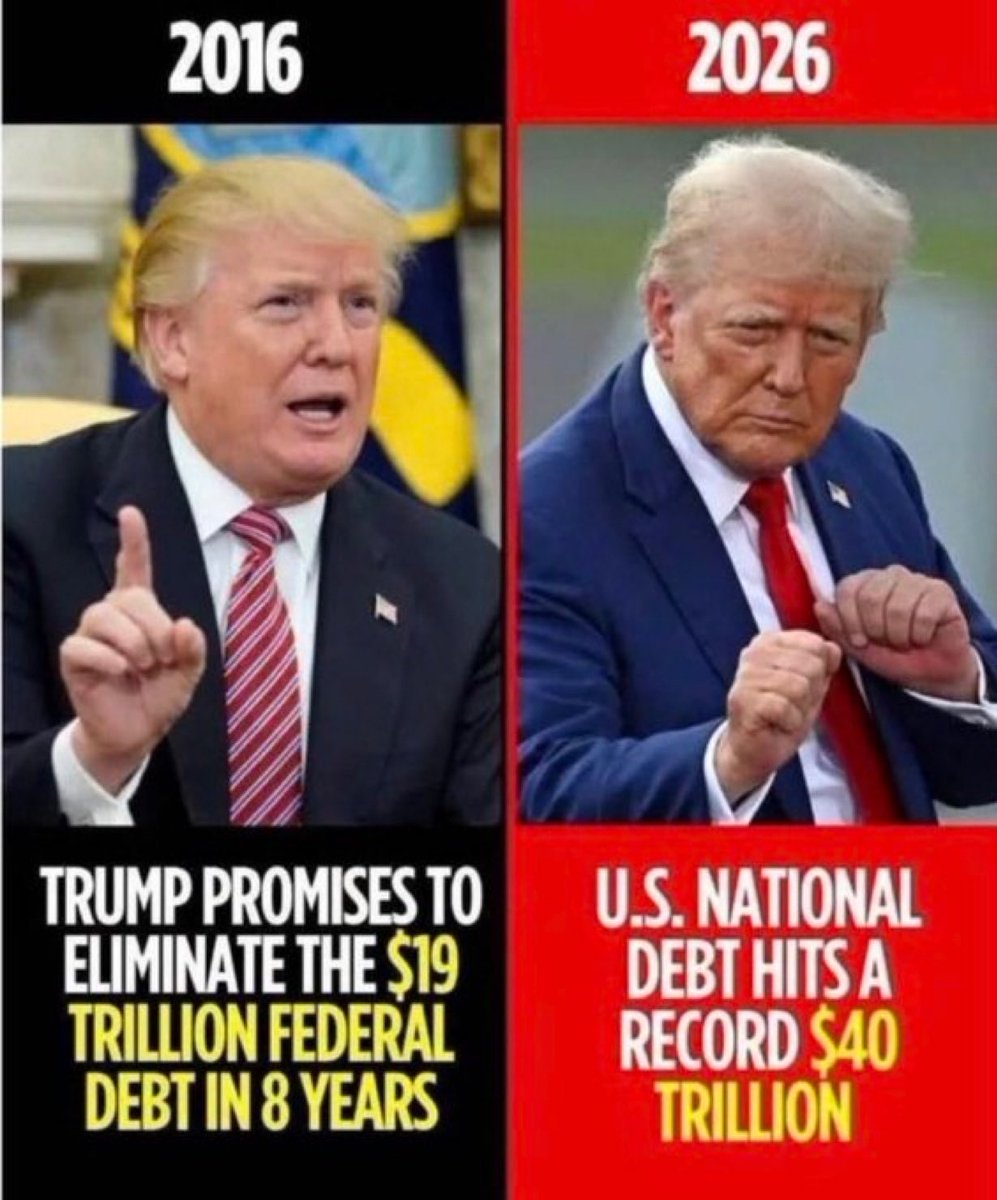
He promised to erase the debt. It passed $40 trillion. The dollars got created; they just didn't go to you.
The question now isn't who's rich. It's who answers and is accountable to you.