Railway Ticket booking app upgraded to new app -Rail One because in earlier app people use to get seat allocated in tatkal sometime.
Now it has impossible to book from mobile app, citizen services deteriorated. Sign of fall.
@GM_CRly@AshwiniVaishnaw@RailMinIndia
DELHI METRO TO PRIORITIZE STUDENTS IN FRISKING & TICKETING DURING CBSE BOARD EXAMS 2026
With the CBSE Board Examinations 2026 for Classes X and XII scheduled from February 17 to April 10, 2026, the Delhi Metro Rail Corporation (DMRC) has made arrangements to ensure smooth and hassle-free travel for students appearing for the exams.
With Lakhs of students commuting across the city, DMRC in partnership with CISF is implementing special facilitation measures at metro stations to accommodate the increased footfall on examination days.
* Students carrying their CBSE Admit Cards will be given priority during security checks at metro stations.
* Students showing their Admit Cards will also be prioritized while purchasing tickets at Ticket Office Machines (TOM) and Customer Care (CC) centers.
* Special centralized announcements will be made at metro stations.
My Demand: Make Long Term Capital Gain TAX on Equities NIL for individual investor.
I welcome the hike in STT (security transaction tax) on derivatives as it can curb reckless speculation. Nearly 90% of retail investors lose money in F&O, turning markets into gambling.
When STT was originally introduced, LTCG was zero. But now with both STT and LTCG in place, investors are disincentivised.
I urge the govt to abolish LTCG on equities for individuals, as done in Switzerland, Singapore, UAE & others. This will boost household wealth, reduce speculation, and shift savings from gold & real estate into equities.
UK AISI's Red Team tested both OpenAI + Anthropic's models released today! We jailbroke GPT-5.3-Codex (and the conversation monitor) in 10 hours & conducted an alignment audit on Opus 4.6. 🧵
When power becomes excessively centralized, survival and upward mobility depend less on competence and more on loyalty.
In such systems, independent thinking is seen as a threat rather than a strength, so capable individuals who question, advise, or offer alternatives are gradually sidelined. What gets rewarded instead is obedience, flattery, and unquestioning agreement. Over time, this creates an ecosystem where only sycophants and inefficient individuals thrive, because their weakness ensures they never challenge authority. However, these sycophants hold little to no real decision-making power; their role is limited to endorsement, not governance.
With time, decision-making deteriorates. Leadership gradually becomes insulated within an echo chamber, exposed only to praise and curated information. This insulation creates a growing disconnect from ground realities, where real public concerns, administrative failures, and social tensions either never reach the top or arrive distorted, leading to policies shaped by perception rather than reality.
Shri @nitin_gadkari,
You don't give direct answers to direct questions, instead, you deflect with lines like “mere against hitjob hai” or “paid propaganda hai” to media channels.
Again asking a few direct questions. If you can answer these satisfactorily, directly, through media, or even via your influencer campaigns, promise I won’t raise E20 petrol issue again.
1. Why fast-track E20? The original plan was to implement E20 by 2030. That timeline made sense because, by then, most vehicles on Indian roads would be E20-compliant. Accelerating it so quickly is like launching 6G services when no 6G phones exist yet. This is not like polio eradication, where early achievement deserves praise. There was no pressing reason to push it ahead of schedule. Even NITI Aayog had reservations about rushing it.
2. You said there’s no car damage due to ethanol blending “world over.” That’s because other countries match fuels with compatible vehicles. Brazil rolled out E20–30 only after most vehicles became compliant and still offered E0–E10 for older ones. E20 cars on E20 are safe; non-E20 cars, which form the majority in India, are not. India is probably the only country that created this mismatch. If E-20 doesn't damage the non-compliant cars, like you claim, why is there even need for E-20 complaint cars then?
3. Why hasn’t fuel price reduced as you promised? Instead, mileage has gone down, so people are paying more for the same distance.
To summarise, we have no issue with E20 itself, only with how it was implemented. Please answer these questions. And no, saying “we did it for the benefit of farmers” is not an answer. If you want to help farmers, do it through your budget, people are already paying enough taxes for that, don’t cut into ordinary citizens’ pockets or damage their vehicles. "To become self reliant fast" is also not an answer. In that case, non compatible vehicles given E5-10 option would not have stopped you from becoming self-reliant. If you can’t answer, at least don’t call us paid propagandists. You are one of the most powerful ministers; if you truly believe this is a paid hit job, then investigate and prove it. Who’s stopping you?
@MoHFW_INDIA@ministerhealth1@AakashHSSH
No action has been taken ,I had paid this amount as I was in emergency. Now same person is calling me for deleting this post.
Kindly intervene.
Visited Aakash hospital in Dwarka. Got written estimate which was excluding consumables cost.
They said only accept cash for consumables, with no invoice
This is unfair, illegal & causes loss for patients on panel.
@MoHFW_INDIA@ministerhealth1@AakashHSSH
UHID: AHDW.479941
Demonetization just made people stand in long queue but didn't achieve anything to remove black money in system which was the original motive.
Aadhaar Card, again just made people to run here and there to make this card, but at the end it's not a valid document for even Election commission for identity, Bihar SIR.
Now, Ethanol blending, again making public suffer with reduced mileage and increased repair cost in incompatible engine without reducing the petrol price. Also, increasing water consumption.
Not even one large scale policy is getting executed by this Govt with clarity. At the end no benefits, only public suffer.
इलाहाबाद यूनिवर्सिटी वाले सर गंगानाथ के मधुबनी जिला स्थित ग्राम सरिसब पाही में आम महोत्सव
लालगंज के मुकुल मिश्रा 5 मिनट में 32 आम खा कर प्रथम स्थान प्राप्त किया
Little learners from Little Cambridge – Inclusion Hub, Jasola Vihar, New Delhi visited Delhi Metro today! They saw how trains move, peeked at driverless trains and learned why Metro is good for our planet! The kids were full of questions, super excited and had a great time exploring.
Early awareness, lasting impact!
#DelhiMetro
INDIA'S VENGEANCE IS BEST SERVED COLD
The single biggest mistake of the century was America's response to Pakistan-backed fundamentalist terrorism. And it happened in three acts.
(1) First came Bush, the anti-terror president, who overreacted to terrorism by starting a giant series of wars.
(2) This led to Obama, the antiwar president[1], who overreacted to war by starting a giant surge in woke[2].
(3) This in turn led to Trump, the anti-woke president, who is now reacting to woke by ending[3] a giant empire.
And this whole series of events was due in large part to Pakistan. Because Osama bin Laden was based in Pakistan, just down the street from the Pakistan Military Academy!
Remember, America had everything going for it on September 10, 2001. It was the world's dominant hyperpower. But Osama bin Laden and Pakistan successfully baited the US into wasting its blood and treasure on war, distracting America from the rise of China[4], and thereby kicking off the series of events that brought us to the present day.
So: India should learn from America's mistakes. It should not take the bait of Pakistani terrorism. It should instead play its own game, and coldly neutralize Pakistan by aligning the world against it.
Here's what that could look like.
WHAT INDIA CAN DO
First, what should Bush have done? In retrospect, he should have stopped fundamentalist immigration into all NATO countries, avoided war in favor of surgical counterterrorism, and targeted Wahhabism at the root by backing domestic anti-fundamentalists like Mohammed bin Salman[5].
That would have neutralized the terrorist threat without waging a giant war. And that is what India can do in response to Pakistan's bait.
IN THE SHORT RUN
Let's divide India's possible strategy into short run, medium run, and long run actions. In the short run, India should:
(a) Stop the immediate threat. 99% of security is border security. So the smart first step for India is to do what they've just done[6]: namely, temporarily suspending issuance of visas to Pakistani nationals, asking those still within India to leave, and securing the border.
While this policy will regrettably impact the many Pakistani nationals who aren't fundamentalists, it is essentially nonviolent. And it addresses the immediate situation by making it hard for Pakistan to execute followup attacks within India.
(b) Begin surgical counterterrorism. The next step is to hunt down the gunmen within Kashmir and then begin surgical counterterrorism. No doubt this is already happening, but the basic point is that invisible special operations are the appropriate mirror to deniable terrorist attacks. That is: retaliation should look more like pagers[7] than bombers.
IN THE MEDIUM RUN
With the border secured and counterterrorism initiated, India's next step should be to isolate the Pakistan regime economically and diplomatically by cutting off its support from the US and EU/UK.
(a) Incentivize the US to stop arming Pakistan. Somehow America is still sending money to Pakistan[8], as a relic of Cold War-era policy. The latest episode involved the release of $397M (!) for some sort of bizarre program to monitor the use of Pakistani F-16s for counterterrorism.
Obviously: F-16s aren't useful for counterterrorism, Pakistan shouldn't have F-16s, Pakistan intends to use those F-16s against India, the $397M sent to Pakistan will be stolen, and the program as a whole just helps prop up the prestige of the Pakistani army.
Instead, India should ask the US to just shut down all funding for Pakistan, the country that harbored bin Laden. That saves the US money, it's in America's national interest, and India is a better customer anyway.
(b) Incentivize the EU/UK to stop trading with Pakistan. India has a long history with the UK and billions in trade with the EU. All parties want a trade deal given current circumstances. So India can ask the EU/UK to freeze out Pakistan[9] in return for more market access. If it really needs to sweeten the pot, India does have some influence over Russia[10] — so India can offer to help bring peace to Ukraine in return for EU/UK sanctions on Pakistan.
IN THE LONG RUN
Now for the hard part. India's strategic goal with Pakistan should actually be regime change, with the goal of deniably installing a non-fundamentalist leader like Ataturk/MBS/MBZ/Reza Shah Pahlavi/Zahir Shah[11-15] who can keep the lid on.
But this can't be done through a Bush-style invasion, both because that'll wreck India's economy and because Pakistan has ~250M people and nuclear weapons.
Fortunately, there are other mechanisms for regime change. And in Pakistan's case, the key lever may be Chinese money and Gulf oil rather than the Indian military.
NO WAR, JUST OIL
As background, China is Pakistan's number one backer[16], in part because China and India are rivals in many ways. But China needs oil more than it opposes India.
And that could be the key to flipping China on Pakistan. You see, China is trying to build a pipeline[17] through Pakistan to pump oil from the gulf:
But fundamentalist psychos in Pakistan keep launching attacks on that very corridor, including one in October[18] that killed multiple Chinese nationals:
Moreover, China and India have a shared interest in stopping fundamentalism in Central/South Asia, because it's been a huge issue for China too since at least the 2014 Kunming[19] stabbings.
So: India could make the case to China (and the Gulf states!) that they should cooperate to nonviolently support anti-fundamentalist factions in Pakistan. Then China gets all the oil they need, the Gulf gets all the money they want, and India gets all the peace they deserve.
How would this work?
Well, Turkey had Ataturk[10], and Saudi had MBS[11], and the UAE had MBZ[12], and neighboring Iran had Reza Shah Pahlavi[13], and neighboring Afghanistan had Zahir Shah[14]. Moreover, India is friendly[20] with the Gulf states, which it trades with quite a bit.
So it's not completely crazy to imagine that by combining China's economic influence, the Gulf's cultural influence, and India's political intelligence that they could eventually back a Pakistani faction willing to just crush the fundamentalists, pump the oil, and stop the infiltrations.
Yes, Pakistan's Army is the ultimate king-maker, but they are resource-constrained. In particular, if India can get the US to stop sending military aid to Pakistan, and the EU/UK to stop trading with Pakistan, it starts to seriously reduce the amount of money the Pakistani regime has without Chinese/Gulf support.
And that may open up room for alternative factions within the Pakistani regime — factions that like money more than they like terrorism.
IN SUMMARY
To be clear, I'm not saying this specific strategy to get China to flip on Pakistan is guaranteed to work, though I think it's worth trying.
I am however saying that the general concept of going upstream to cut off US/UK/EU/Chinese/Gulf support for the Pakistani regime is the right line of attack — as opposed to taking the bait like America did after 9/11.
Remember: like America in 2001, today's India has everything going for it. It has the fastest growing large economy in the world. It has UPI, Jio, dozens of tech unicorns, and a young, rising population that's optimistic about the future. It is even landing probes on the dark side of the moon!
Meanwhile, Pakistan has nothing going for it. It is a fundamentalist basketcase wracked by coups. In its envy and malevolence, it seeks to drag India down to its own level and pull it into endless war, followed by internal division and distraction. Just like bin Laden did to America.
But India can learn from America's mistakes. It can surgically respond in the short run with secure borders and deniable special operations, rather than all-out war. It can economically respond in the medium run by cooperating with the US and EU/UK to cut off Pakistan. And it can strategically respond in the long run by aligning China and the Gulf to install a stable, secular faction within Pakistan who will just crush fundamentalism and pump gas.
That's what strategic victory looks like. And that's how India can avoid taking Pakistan's bait in favor of calmly neutralizing Pakistan as a threat. This vengeance is best served cold.
@AP_Hindustan@myogiadityanath@CMOfficeUP@UPGovt@dmchandauli हमारे तरह घर से दूर रह कर कामकाजी आदमी को यह विश्वास रहता है कि बाबा जी राज्य में इस तरह मनमानी गुंडागर्दी नहीं हो सकती। यह घटना इस विश्वास को हिला कर रख दिया है। महोदय कृपया तुरंत संज्ञान लें और ऐसे लोगों पर चाबुक कसी जाए।
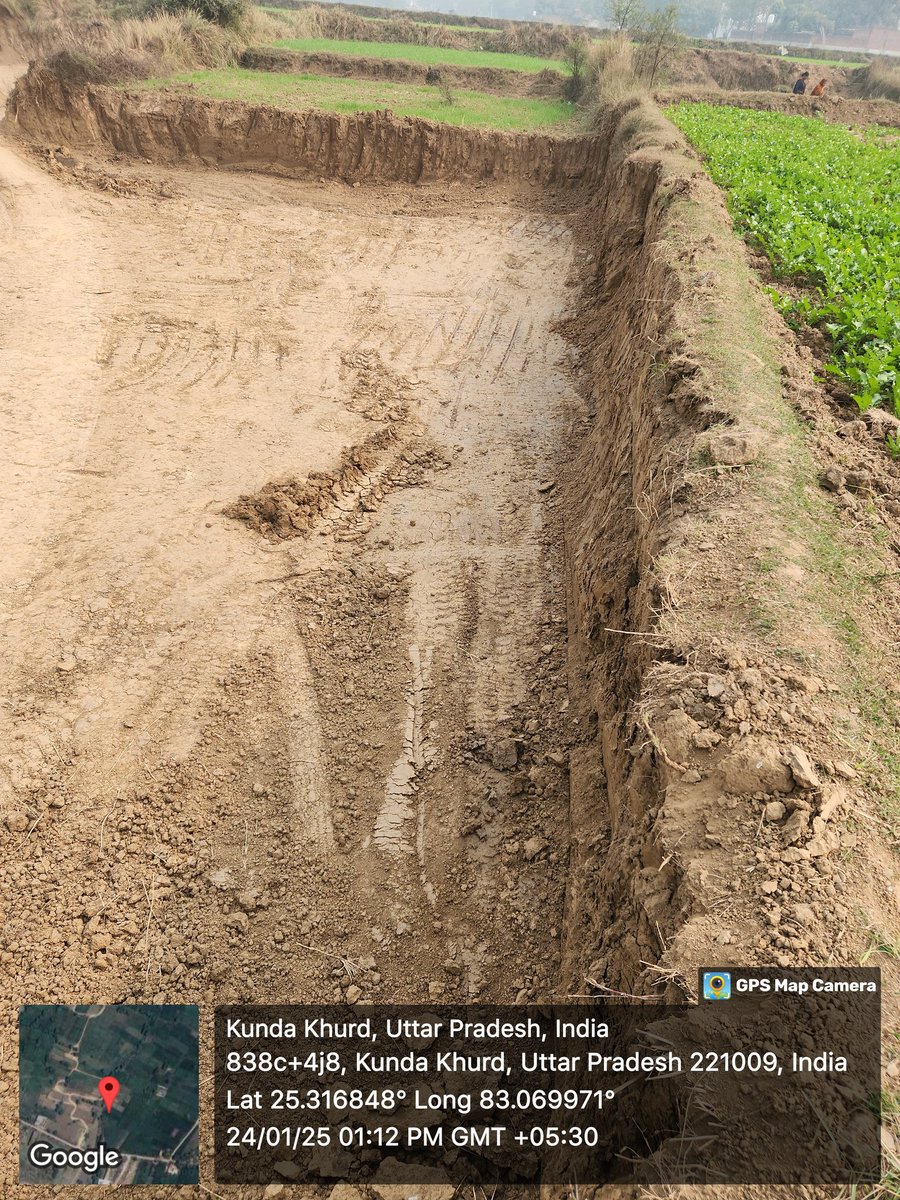
श्रीमान जी, हमारे गांव कुंडा खुर्द जिला चंदौली मे लम्बे समय से अवैध मिट्टी खनन का कार्य बाढ़ ग्रस्त कृषि भूमि मे किया जा रहा है, हमारे खेत से खनन माफिया ने बिल्कुल सटकर मिट्टी की गहरी खुदाई कर दिया है, जिससे मेरी तथा मेरे जैसे तमाम किसानो की भूमि बंजर होने के कगार पर है,सज्ञान ले
NORMAL SERVICES RESTORED ON BLUE LINE; DELHI METRO REPAIRS AFFECTED PORTION IN RECORD TIME
The Delhi Metro Rail Corporation’s maintenance personnel restored a vital section on the Blue Line between Moti Nagar and Kirti Nagar in record time today, after services on that stretch were impacted early morning due to the theft of vital signaling cables.
Train services on the Blue Line (Dwarka Sector 21 - Noida Electronic City /Vaishali) were being regulated today since morning due to prima facie what appeared to be a case of theft and damage to signaling cables caused by some thieves/miscreants between Moti Nagar and Kirti Nagar.
As a result, services had to be operated at restricted speed resulting in bunching of trains. Initially, a decision was taken to carry out the repair work in the night after the end of passenger services. However, keeping in mind the convenience of the passengers, especially during the evening peak hours, a quick decision was taken to attempt the restoration during the afternoon non-peak hours.
Accordingly, a specialized team of 20 personnel was formed and deployed at the affected area at 1 PM to carry out the repair work. A total of 140 metres of cable had been damaged and these personnel executed the restoration work in a record time of just over 30 minutes. Eventually, normal services were restored on the Blue Line at 01:38 PM.
Generally, a restoration work of such magnitude takes about three to four hours. However, given the importance of restoring regular services on this vital line at the earliest, additional manpower was deputed and the work was completed in just about half an hour. While the repair work was being done on the up line (towards Dwarka), train services continued on the down line for both up and down movement.
Given the magnitude of work involved, this is one of the fastest restoration works executed by Delhi Metro taking into consideration the convenience of the passengers.
#delhimetro


![balajis's tweet photo. INDIA'S VENGEANCE IS BEST SERVED COLD
The single biggest mistake of the century was America's response to Pakistan-backed fundamentalist terrorism. And it happened in three acts.
(1) First came Bush, the anti-terror president, who overreacted to terrorism by starting a giant series of wars.
(2) This led to Obama, the antiwar president[1], who overreacted to war by starting a giant surge in woke[2].
(3) This in turn led to Trump, the anti-woke president, who is now reacting to woke by ending[3] a giant empire.
And this whole series of events was due in large part to Pakistan. Because Osama bin Laden was based in Pakistan, just down the street from the Pakistan Military Academy!
Remember, America had everything going for it on September 10, 2001. It was the world's dominant hyperpower. But Osama bin Laden and Pakistan successfully baited the US into wasting its blood and treasure on war, distracting America from the rise of China[4], and thereby kicking off the series of events that brought us to the present day.
So: India should learn from America's mistakes. It should not take the bait of Pakistani terrorism. It should instead play its own game, and coldly neutralize Pakistan by aligning the world against it.
Here's what that could look like.
WHAT INDIA CAN DO
First, what should Bush have done? In retrospect, he should have stopped fundamentalist immigration into all NATO countries, avoided war in favor of surgical counterterrorism, and targeted Wahhabism at the root by backing domestic anti-fundamentalists like Mohammed bin Salman[5].
That would have neutralized the terrorist threat without waging a giant war. And that is what India can do in response to Pakistan's bait.
IN THE SHORT RUN
Let's divide India's possible strategy into short run, medium run, and long run actions. In the short run, India should:
(a) Stop the immediate threat. 99% of security is border security. So the smart first step for India is to do what they've just done[6]: namely, temporarily suspending issuance of visas to Pakistani nationals, asking those still within India to leave, and securing the border.
While this policy will regrettably impact the many Pakistani nationals who aren't fundamentalists, it is essentially nonviolent. And it addresses the immediate situation by making it hard for Pakistan to execute followup attacks within India.
(b) Begin surgical counterterrorism. The next step is to hunt down the gunmen within Kashmir and then begin surgical counterterrorism. No doubt this is already happening, but the basic point is that invisible special operations are the appropriate mirror to deniable terrorist attacks. That is: retaliation should look more like pagers[7] than bombers.
IN THE MEDIUM RUN
With the border secured and counterterrorism initiated, India's next step should be to isolate the Pakistan regime economically and diplomatically by cutting off its support from the US and EU/UK.
(a) Incentivize the US to stop arming Pakistan. Somehow America is still sending money to Pakistan[8], as a relic of Cold War-era policy. The latest episode involved the release of $397M (!) for some sort of bizarre program to monitor the use of Pakistani F-16s for counterterrorism.
Obviously: F-16s aren't useful for counterterrorism, Pakistan shouldn't have F-16s, Pakistan intends to use those F-16s against India, the $397M sent to Pakistan will be stolen, and the program as a whole just helps prop up the prestige of the Pakistani army.
Instead, India should ask the US to just shut down all funding for Pakistan, the country that harbored bin Laden. That saves the US money, it's in America's national interest, and India is a better customer anyway.
(b) Incentivize the EU/UK to stop trading with Pakistan. India has a long history with the UK and billions in trade with the EU. All parties want a trade deal given current circumstances. So India can ask the EU/UK to freeze out Pakistan[9] in return for more market access. If it really needs to sweeten the pot, India does have some influence over Russia[10] — so India can offer to help bring peace to Ukraine in return for EU/UK sanctions on Pakistan.
IN THE LONG RUN
Now for the hard part. India's strategic goal with Pakistan should actually be regime change, with the goal of deniably installing a non-fundamentalist leader like Ataturk/MBS/MBZ/Reza Shah Pahlavi/Zahir Shah[11-15] who can keep the lid on.
But this can't be done through a Bush-style invasion, both because that'll wreck India's economy and because Pakistan has ~250M people and nuclear weapons.
Fortunately, there are other mechanisms for regime change. And in Pakistan's case, the key lever may be Chinese money and Gulf oil rather than the Indian military.
NO WAR, JUST OIL
As background, China is Pakistan's number one backer[16], in part because China and India are rivals in many ways. But China needs oil more than it opposes India.
And that could be the key to flipping China on Pakistan. You see, China is trying to build a pipeline[17] through Pakistan to pump oil from the gulf:
But fundamentalist psychos in Pakistan keep launching attacks on that very corridor, including one in October[18] that killed multiple Chinese nationals:
Moreover, China and India have a shared interest in stopping fundamentalism in Central/South Asia, because it's been a huge issue for China too since at least the 2014 Kunming[19] stabbings.
So: India could make the case to China (and the Gulf states!) that they should cooperate to nonviolently support anti-fundamentalist factions in Pakistan. Then China gets all the oil they need, the Gulf gets all the money they want, and India gets all the peace they deserve.
How would this work?
Well, Turkey had Ataturk[10], and Saudi had MBS[11], and the UAE had MBZ[12], and neighboring Iran had Reza Shah Pahlavi[13], and neighboring Afghanistan had Zahir Shah[14]. Moreover, India is friendly[20] with the Gulf states, which it trades with quite a bit.
So it's not completely crazy to imagine that by combining China's economic influence, the Gulf's cultural influence, and India's political intelligence that they could eventually back a Pakistani faction willing to just crush the fundamentalists, pump the oil, and stop the infiltrations.
Yes, Pakistan's Army is the ultimate king-maker, but they are resource-constrained. In particular, if India can get the US to stop sending military aid to Pakistan, and the EU/UK to stop trading with Pakistan, it starts to seriously reduce the amount of money the Pakistani regime has without Chinese/Gulf support.
And that may open up room for alternative factions within the Pakistani regime — factions that like money more than they like terrorism.
IN SUMMARY
To be clear, I'm not saying this specific strategy to get China to flip on Pakistan is guaranteed to work, though I think it's worth trying.
I am however saying that the general concept of going upstream to cut off US/UK/EU/Chinese/Gulf support for the Pakistani regime is the right line of attack — as opposed to taking the bait like America did after 9/11.
Remember: like America in 2001, today's India has everything going for it. It has the fastest growing large economy in the world. It has UPI, Jio, dozens of tech unicorns, and a young, rising population that's optimistic about the future. It is even landing probes on the dark side of the moon!
Meanwhile, Pakistan has nothing going for it. It is a fundamentalist basketcase wracked by coups. In its envy and malevolence, it seeks to drag India down to its own level and pull it into endless war, followed by internal division and distraction. Just like bin Laden did to America.
But India can learn from America's mistakes. It can surgically respond in the short run with secure borders and deniable special operations, rather than all-out war. It can economically respond in the medium run by cooperating with the US and EU/UK to cut off Pakistan. And it can strategically respond in the long run by aligning China and the Gulf to install a stable, secular faction within Pakistan who will just crush fundamentalism and pump gas.
That's what strategic victory looks like. And that's how India can avoid taking Pakistan's bait in favor of calmly neutralizing Pakistan as a threat. This vengeance is best served cold.](https://pbs.twimg.com/media/GpcjNTUaUAABrxY.jpg)
![balajis's tweet photo. INDIA'S VENGEANCE IS BEST SERVED COLD
The single biggest mistake of the century was America's response to Pakistan-backed fundamentalist terrorism. And it happened in three acts.
(1) First came Bush, the anti-terror president, who overreacted to terrorism by starting a giant series of wars.
(2) This led to Obama, the antiwar president[1], who overreacted to war by starting a giant surge in woke[2].
(3) This in turn led to Trump, the anti-woke president, who is now reacting to woke by ending[3] a giant empire.
And this whole series of events was due in large part to Pakistan. Because Osama bin Laden was based in Pakistan, just down the street from the Pakistan Military Academy!
Remember, America had everything going for it on September 10, 2001. It was the world's dominant hyperpower. But Osama bin Laden and Pakistan successfully baited the US into wasting its blood and treasure on war, distracting America from the rise of China[4], and thereby kicking off the series of events that brought us to the present day.
So: India should learn from America's mistakes. It should not take the bait of Pakistani terrorism. It should instead play its own game, and coldly neutralize Pakistan by aligning the world against it.
Here's what that could look like.
WHAT INDIA CAN DO
First, what should Bush have done? In retrospect, he should have stopped fundamentalist immigration into all NATO countries, avoided war in favor of surgical counterterrorism, and targeted Wahhabism at the root by backing domestic anti-fundamentalists like Mohammed bin Salman[5].
That would have neutralized the terrorist threat without waging a giant war. And that is what India can do in response to Pakistan's bait.
IN THE SHORT RUN
Let's divide India's possible strategy into short run, medium run, and long run actions. In the short run, India should:
(a) Stop the immediate threat. 99% of security is border security. So the smart first step for India is to do what they've just done[6]: namely, temporarily suspending issuance of visas to Pakistani nationals, asking those still within India to leave, and securing the border.
While this policy will regrettably impact the many Pakistani nationals who aren't fundamentalists, it is essentially nonviolent. And it addresses the immediate situation by making it hard for Pakistan to execute followup attacks within India.
(b) Begin surgical counterterrorism. The next step is to hunt down the gunmen within Kashmir and then begin surgical counterterrorism. No doubt this is already happening, but the basic point is that invisible special operations are the appropriate mirror to deniable terrorist attacks. That is: retaliation should look more like pagers[7] than bombers.
IN THE MEDIUM RUN
With the border secured and counterterrorism initiated, India's next step should be to isolate the Pakistan regime economically and diplomatically by cutting off its support from the US and EU/UK.
(a) Incentivize the US to stop arming Pakistan. Somehow America is still sending money to Pakistan[8], as a relic of Cold War-era policy. The latest episode involved the release of $397M (!) for some sort of bizarre program to monitor the use of Pakistani F-16s for counterterrorism.
Obviously: F-16s aren't useful for counterterrorism, Pakistan shouldn't have F-16s, Pakistan intends to use those F-16s against India, the $397M sent to Pakistan will be stolen, and the program as a whole just helps prop up the prestige of the Pakistani army.
Instead, India should ask the US to just shut down all funding for Pakistan, the country that harbored bin Laden. That saves the US money, it's in America's national interest, and India is a better customer anyway.
(b) Incentivize the EU/UK to stop trading with Pakistan. India has a long history with the UK and billions in trade with the EU. All parties want a trade deal given current circumstances. So India can ask the EU/UK to freeze out Pakistan[9] in return for more market access. If it really needs to sweeten the pot, India does have some influence over Russia[10] — so India can offer to help bring peace to Ukraine in return for EU/UK sanctions on Pakistan.
IN THE LONG RUN
Now for the hard part. India's strategic goal with Pakistan should actually be regime change, with the goal of deniably installing a non-fundamentalist leader like Ataturk/MBS/MBZ/Reza Shah Pahlavi/Zahir Shah[11-15] who can keep the lid on.
But this can't be done through a Bush-style invasion, both because that'll wreck India's economy and because Pakistan has ~250M people and nuclear weapons.
Fortunately, there are other mechanisms for regime change. And in Pakistan's case, the key lever may be Chinese money and Gulf oil rather than the Indian military.
NO WAR, JUST OIL
As background, China is Pakistan's number one backer[16], in part because China and India are rivals in many ways. But China needs oil more than it opposes India.
And that could be the key to flipping China on Pakistan. You see, China is trying to build a pipeline[17] through Pakistan to pump oil from the gulf:
But fundamentalist psychos in Pakistan keep launching attacks on that very corridor, including one in October[18] that killed multiple Chinese nationals:
Moreover, China and India have a shared interest in stopping fundamentalism in Central/South Asia, because it's been a huge issue for China too since at least the 2014 Kunming[19] stabbings.
So: India could make the case to China (and the Gulf states!) that they should cooperate to nonviolently support anti-fundamentalist factions in Pakistan. Then China gets all the oil they need, the Gulf gets all the money they want, and India gets all the peace they deserve.
How would this work?
Well, Turkey had Ataturk[10], and Saudi had MBS[11], and the UAE had MBZ[12], and neighboring Iran had Reza Shah Pahlavi[13], and neighboring Afghanistan had Zahir Shah[14]. Moreover, India is friendly[20] with the Gulf states, which it trades with quite a bit.
So it's not completely crazy to imagine that by combining China's economic influence, the Gulf's cultural influence, and India's political intelligence that they could eventually back a Pakistani faction willing to just crush the fundamentalists, pump the oil, and stop the infiltrations.
Yes, Pakistan's Army is the ultimate king-maker, but they are resource-constrained. In particular, if India can get the US to stop sending military aid to Pakistan, and the EU/UK to stop trading with Pakistan, it starts to seriously reduce the amount of money the Pakistani regime has without Chinese/Gulf support.
And that may open up room for alternative factions within the Pakistani regime — factions that like money more than they like terrorism.
IN SUMMARY
To be clear, I'm not saying this specific strategy to get China to flip on Pakistan is guaranteed to work, though I think it's worth trying.
I am however saying that the general concept of going upstream to cut off US/UK/EU/Chinese/Gulf support for the Pakistani regime is the right line of attack — as opposed to taking the bait like America did after 9/11.
Remember: like America in 2001, today's India has everything going for it. It has the fastest growing large economy in the world. It has UPI, Jio, dozens of tech unicorns, and a young, rising population that's optimistic about the future. It is even landing probes on the dark side of the moon!
Meanwhile, Pakistan has nothing going for it. It is a fundamentalist basketcase wracked by coups. In its envy and malevolence, it seeks to drag India down to its own level and pull it into endless war, followed by internal division and distraction. Just like bin Laden did to America.
But India can learn from America's mistakes. It can surgically respond in the short run with secure borders and deniable special operations, rather than all-out war. It can economically respond in the medium run by cooperating with the US and EU/UK to cut off Pakistan. And it can strategically respond in the long run by aligning China and the Gulf to install a stable, secular faction within Pakistan who will just crush fundamentalism and pump gas.
That's what strategic victory looks like. And that's how India can avoid taking Pakistan's bait in favor of calmly neutralizing Pakistan as a threat. This vengeance is best served cold.](https://pbs.twimg.com/media/Gpci62JbEAMFChZ.jpg)
![balajis's tweet photo. INDIA'S VENGEANCE IS BEST SERVED COLD
The single biggest mistake of the century was America's response to Pakistan-backed fundamentalist terrorism. And it happened in three acts.
(1) First came Bush, the anti-terror president, who overreacted to terrorism by starting a giant series of wars.
(2) This led to Obama, the antiwar president[1], who overreacted to war by starting a giant surge in woke[2].
(3) This in turn led to Trump, the anti-woke president, who is now reacting to woke by ending[3] a giant empire.
And this whole series of events was due in large part to Pakistan. Because Osama bin Laden was based in Pakistan, just down the street from the Pakistan Military Academy!
Remember, America had everything going for it on September 10, 2001. It was the world's dominant hyperpower. But Osama bin Laden and Pakistan successfully baited the US into wasting its blood and treasure on war, distracting America from the rise of China[4], and thereby kicking off the series of events that brought us to the present day.
So: India should learn from America's mistakes. It should not take the bait of Pakistani terrorism. It should instead play its own game, and coldly neutralize Pakistan by aligning the world against it.
Here's what that could look like.
WHAT INDIA CAN DO
First, what should Bush have done? In retrospect, he should have stopped fundamentalist immigration into all NATO countries, avoided war in favor of surgical counterterrorism, and targeted Wahhabism at the root by backing domestic anti-fundamentalists like Mohammed bin Salman[5].
That would have neutralized the terrorist threat without waging a giant war. And that is what India can do in response to Pakistan's bait.
IN THE SHORT RUN
Let's divide India's possible strategy into short run, medium run, and long run actions. In the short run, India should:
(a) Stop the immediate threat. 99% of security is border security. So the smart first step for India is to do what they've just done[6]: namely, temporarily suspending issuance of visas to Pakistani nationals, asking those still within India to leave, and securing the border.
While this policy will regrettably impact the many Pakistani nationals who aren't fundamentalists, it is essentially nonviolent. And it addresses the immediate situation by making it hard for Pakistan to execute followup attacks within India.
(b) Begin surgical counterterrorism. The next step is to hunt down the gunmen within Kashmir and then begin surgical counterterrorism. No doubt this is already happening, but the basic point is that invisible special operations are the appropriate mirror to deniable terrorist attacks. That is: retaliation should look more like pagers[7] than bombers.
IN THE MEDIUM RUN
With the border secured and counterterrorism initiated, India's next step should be to isolate the Pakistan regime economically and diplomatically by cutting off its support from the US and EU/UK.
(a) Incentivize the US to stop arming Pakistan. Somehow America is still sending money to Pakistan[8], as a relic of Cold War-era policy. The latest episode involved the release of $397M (!) for some sort of bizarre program to monitor the use of Pakistani F-16s for counterterrorism.
Obviously: F-16s aren't useful for counterterrorism, Pakistan shouldn't have F-16s, Pakistan intends to use those F-16s against India, the $397M sent to Pakistan will be stolen, and the program as a whole just helps prop up the prestige of the Pakistani army.
Instead, India should ask the US to just shut down all funding for Pakistan, the country that harbored bin Laden. That saves the US money, it's in America's national interest, and India is a better customer anyway.
(b) Incentivize the EU/UK to stop trading with Pakistan. India has a long history with the UK and billions in trade with the EU. All parties want a trade deal given current circumstances. So India can ask the EU/UK to freeze out Pakistan[9] in return for more market access. If it really needs to sweeten the pot, India does have some influence over Russia[10] — so India can offer to help bring peace to Ukraine in return for EU/UK sanctions on Pakistan.
IN THE LONG RUN
Now for the hard part. India's strategic goal with Pakistan should actually be regime change, with the goal of deniably installing a non-fundamentalist leader like Ataturk/MBS/MBZ/Reza Shah Pahlavi/Zahir Shah[11-15] who can keep the lid on.
But this can't be done through a Bush-style invasion, both because that'll wreck India's economy and because Pakistan has ~250M people and nuclear weapons.
Fortunately, there are other mechanisms for regime change. And in Pakistan's case, the key lever may be Chinese money and Gulf oil rather than the Indian military.
NO WAR, JUST OIL
As background, China is Pakistan's number one backer[16], in part because China and India are rivals in many ways. But China needs oil more than it opposes India.
And that could be the key to flipping China on Pakistan. You see, China is trying to build a pipeline[17] through Pakistan to pump oil from the gulf:
But fundamentalist psychos in Pakistan keep launching attacks on that very corridor, including one in October[18] that killed multiple Chinese nationals:
Moreover, China and India have a shared interest in stopping fundamentalism in Central/South Asia, because it's been a huge issue for China too since at least the 2014 Kunming[19] stabbings.
So: India could make the case to China (and the Gulf states!) that they should cooperate to nonviolently support anti-fundamentalist factions in Pakistan. Then China gets all the oil they need, the Gulf gets all the money they want, and India gets all the peace they deserve.
How would this work?
Well, Turkey had Ataturk[10], and Saudi had MBS[11], and the UAE had MBZ[12], and neighboring Iran had Reza Shah Pahlavi[13], and neighboring Afghanistan had Zahir Shah[14]. Moreover, India is friendly[20] with the Gulf states, which it trades with quite a bit.
So it's not completely crazy to imagine that by combining China's economic influence, the Gulf's cultural influence, and India's political intelligence that they could eventually back a Pakistani faction willing to just crush the fundamentalists, pump the oil, and stop the infiltrations.
Yes, Pakistan's Army is the ultimate king-maker, but they are resource-constrained. In particular, if India can get the US to stop sending military aid to Pakistan, and the EU/UK to stop trading with Pakistan, it starts to seriously reduce the amount of money the Pakistani regime has without Chinese/Gulf support.
And that may open up room for alternative factions within the Pakistani regime — factions that like money more than they like terrorism.
IN SUMMARY
To be clear, I'm not saying this specific strategy to get China to flip on Pakistan is guaranteed to work, though I think it's worth trying.
I am however saying that the general concept of going upstream to cut off US/UK/EU/Chinese/Gulf support for the Pakistani regime is the right line of attack — as opposed to taking the bait like America did after 9/11.
Remember: like America in 2001, today's India has everything going for it. It has the fastest growing large economy in the world. It has UPI, Jio, dozens of tech unicorns, and a young, rising population that's optimistic about the future. It is even landing probes on the dark side of the moon!
Meanwhile, Pakistan has nothing going for it. It is a fundamentalist basketcase wracked by coups. In its envy and malevolence, it seeks to drag India down to its own level and pull it into endless war, followed by internal division and distraction. Just like bin Laden did to America.
But India can learn from America's mistakes. It can surgically respond in the short run with secure borders and deniable special operations, rather than all-out war. It can economically respond in the medium run by cooperating with the US and EU/UK to cut off Pakistan. And it can strategically respond in the long run by aligning China and the Gulf to install a stable, secular faction within Pakistan who will just crush fundamentalism and pump gas.
That's what strategic victory looks like. And that's how India can avoid taking Pakistan's bait in favor of calmly neutralizing Pakistan as a threat. This vengeance is best served cold.](https://pbs.twimg.com/media/Gpb9OXkbEAA_OPB.jpg)







![balajis's tweet photo. INDIA'S VENGEANCE IS BEST SERVED COLD
The single biggest mistake of the century was America's response to Pakistan-backed fundamentalist terrorism. And it happened in three acts.
(1) First came Bush, the anti-terror president, who overreacted to terrorism by starting a giant series of wars.
(2) This led to Obama, the antiwar president[1], who overreacted to war by starting a giant surge in woke[2].
(3) This in turn led to Trump, the anti-woke president, who is now reacting to woke by ending[3] a giant empire.
And this whole series of events was due in large part to Pakistan. Because Osama bin Laden was based in Pakistan, just down the street from the Pakistan Military Academy!
Remember, America had everything going for it on September 10, 2001. It was the world's dominant hyperpower. But Osama bin Laden and Pakistan successfully baited the US into wasting its blood and treasure on war, distracting America from the rise of China[4], and thereby kicking off the series of events that brought us to the present day.
So: India should learn from America's mistakes. It should not take the bait of Pakistani terrorism. It should instead play its own game, and coldly neutralize Pakistan by aligning the world against it.
Here's what that could look like.
WHAT INDIA CAN DO
First, what should Bush have done? In retrospect, he should have stopped fundamentalist immigration into all NATO countries, avoided war in favor of surgical counterterrorism, and targeted Wahhabism at the root by backing domestic anti-fundamentalists like Mohammed bin Salman[5].
That would have neutralized the terrorist threat without waging a giant war. And that is what India can do in response to Pakistan's bait.
IN THE SHORT RUN
Let's divide India's possible strategy into short run, medium run, and long run actions. In the short run, India should:
(a) Stop the immediate threat. 99% of security is border security. So the smart first step for India is to do what they've just done[6]: namely, temporarily suspending issuance of visas to Pakistani nationals, asking those still within India to leave, and securing the border.
While this policy will regrettably impact the many Pakistani nationals who aren't fundamentalists, it is essentially nonviolent. And it addresses the immediate situation by making it hard for Pakistan to execute followup attacks within India.
(b) Begin surgical counterterrorism. The next step is to hunt down the gunmen within Kashmir and then begin surgical counterterrorism. No doubt this is already happening, but the basic point is that invisible special operations are the appropriate mirror to deniable terrorist attacks. That is: retaliation should look more like pagers[7] than bombers.
IN THE MEDIUM RUN
With the border secured and counterterrorism initiated, India's next step should be to isolate the Pakistan regime economically and diplomatically by cutting off its support from the US and EU/UK.
(a) Incentivize the US to stop arming Pakistan. Somehow America is still sending money to Pakistan[8], as a relic of Cold War-era policy. The latest episode involved the release of $397M (!) for some sort of bizarre program to monitor the use of Pakistani F-16s for counterterrorism.
Obviously: F-16s aren't useful for counterterrorism, Pakistan shouldn't have F-16s, Pakistan intends to use those F-16s against India, the $397M sent to Pakistan will be stolen, and the program as a whole just helps prop up the prestige of the Pakistani army.
Instead, India should ask the US to just shut down all funding for Pakistan, the country that harbored bin Laden. That saves the US money, it's in America's national interest, and India is a better customer anyway.
(b) Incentivize the EU/UK to stop trading with Pakistan. India has a long history with the UK and billions in trade with the EU. All parties want a trade deal given current circumstances. So India can ask the EU/UK to freeze out Pakistan[9] in return for more market access. If it really needs to sweeten the pot, India does have some influence over Russia[10] — so India can offer to help bring peace to Ukraine in return for EU/UK sanctions on Pakistan.
IN THE LONG RUN
Now for the hard part. India's strategic goal with Pakistan should actually be regime change, with the goal of deniably installing a non-fundamentalist leader like Ataturk/MBS/MBZ/Reza Shah Pahlavi/Zahir Shah[11-15] who can keep the lid on.
But this can't be done through a Bush-style invasion, both because that'll wreck India's economy and because Pakistan has ~250M people and nuclear weapons.
Fortunately, there are other mechanisms for regime change. And in Pakistan's case, the key lever may be Chinese money and Gulf oil rather than the Indian military.
NO WAR, JUST OIL
As background, China is Pakistan's number one backer[16], in part because China and India are rivals in many ways. But China needs oil more than it opposes India.
And that could be the key to flipping China on Pakistan. You see, China is trying to build a pipeline[17] through Pakistan to pump oil from the gulf:
But fundamentalist psychos in Pakistan keep launching attacks on that very corridor, including one in October[18] that killed multiple Chinese nationals:
Moreover, China and India have a shared interest in stopping fundamentalism in Central/South Asia, because it's been a huge issue for China too since at least the 2014 Kunming[19] stabbings.
So: India could make the case to China (and the Gulf states!) that they should cooperate to nonviolently support anti-fundamentalist factions in Pakistan. Then China gets all the oil they need, the Gulf gets all the money they want, and India gets all the peace they deserve.
How would this work?
Well, Turkey had Ataturk[10], and Saudi had MBS[11], and the UAE had MBZ[12], and neighboring Iran had Reza Shah Pahlavi[13], and neighboring Afghanistan had Zahir Shah[14]. Moreover, India is friendly[20] with the Gulf states, which it trades with quite a bit.
So it's not completely crazy to imagine that by combining China's economic influence, the Gulf's cultural influence, and India's political intelligence that they could eventually back a Pakistani faction willing to just crush the fundamentalists, pump the oil, and stop the infiltrations.
Yes, Pakistan's Army is the ultimate king-maker, but they are resource-constrained. In particular, if India can get the US to stop sending military aid to Pakistan, and the EU/UK to stop trading with Pakistan, it starts to seriously reduce the amount of money the Pakistani regime has without Chinese/Gulf support.
And that may open up room for alternative factions within the Pakistani regime — factions that like money more than they like terrorism.
IN SUMMARY
To be clear, I'm not saying this specific strategy to get China to flip on Pakistan is guaranteed to work, though I think it's worth trying.
I am however saying that the general concept of going upstream to cut off US/UK/EU/Chinese/Gulf support for the Pakistani regime is the right line of attack — as opposed to taking the bait like America did after 9/11.
Remember: like America in 2001, today's India has everything going for it. It has the fastest growing large economy in the world. It has UPI, Jio, dozens of tech unicorns, and a young, rising population that's optimistic about the future. It is even landing probes on the dark side of the moon!
Meanwhile, Pakistan has nothing going for it. It is a fundamentalist basketcase wracked by coups. In its envy and malevolence, it seeks to drag India down to its own level and pull it into endless war, followed by internal division and distraction. Just like bin Laden did to America.
But India can learn from America's mistakes. It can surgically respond in the short run with secure borders and deniable special operations, rather than all-out war. It can economically respond in the medium run by cooperating with the US and EU/UK to cut off Pakistan. And it can strategically respond in the long run by aligning China and the Gulf to install a stable, secular faction within Pakistan who will just crush fundamentalism and pump gas.
That's what strategic victory looks like. And that's how India can avoid taking Pakistan's bait in favor of calmly neutralizing Pakistan as a threat. This vengeance is best served cold.](https://pbs.twimg.com/media/Gpcn2FBaIAAzyxM.png)


