Introducing Waddle Labs: Claude Code for robots.
Connect our API to your robot and enter a prompt, then our agents write code to achieve the task in 20 minutes.
@yiding_song@theWaddleLabs
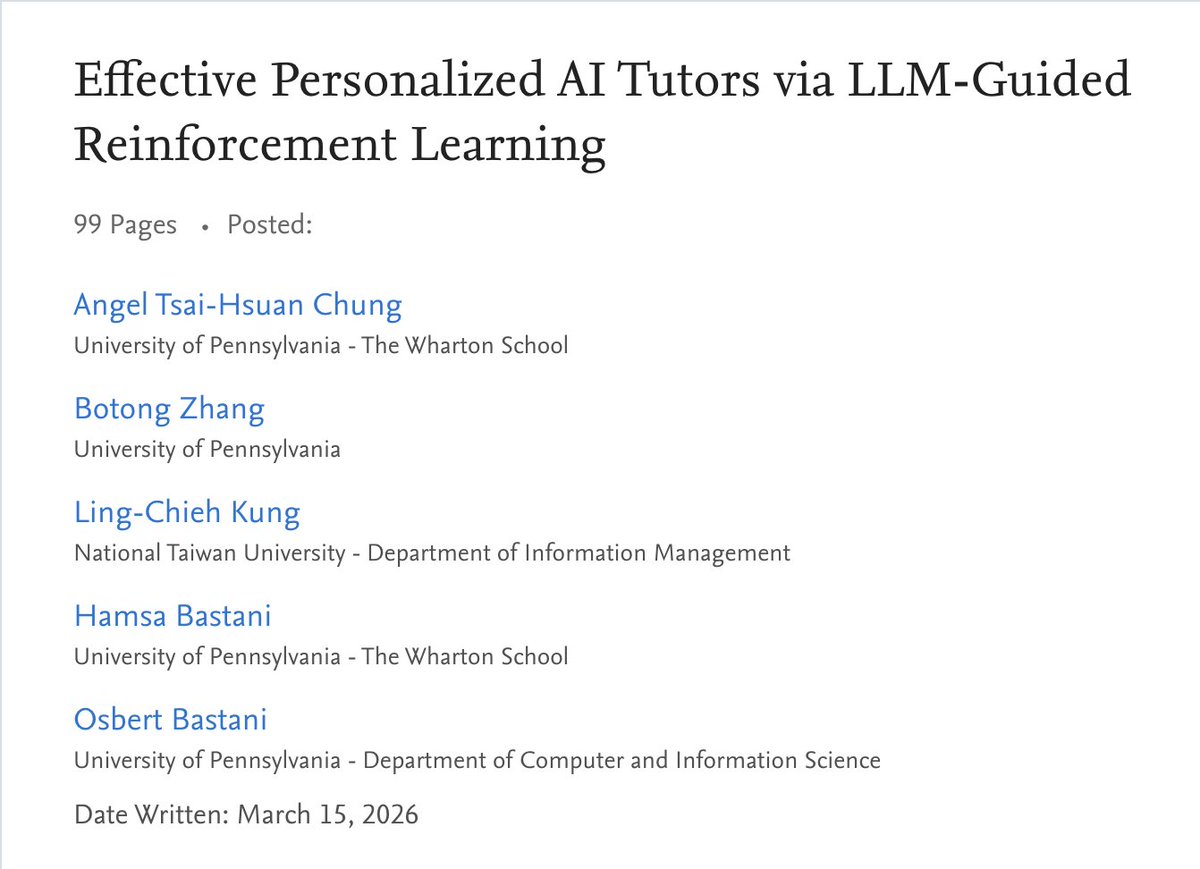
🚨🚨 Excited to share our first *positive* results on AI in education!
Most AI tutor work focuses on making the chatbot better. We suggest another lever: deciding what students should practice next to improve learning.
We combine an LLM tutor with reinforcement learning to personalize problem sequencing using signals from student-chatbot interactions and solution attempts.
We tested this in a 5-month randomized field experiment in a Python course across 10 high schools in Taipei. All students had the same course material and the same AI tutor. The only difference was adaptive vs. fixed problem sequencing.
Result: across 770 students, adaptive sequencing improved performance on an in-person final exam taken without AI assistance by 0.15 SD, with larger effects for beginners. Our evidence suggests the gains came from stronger engagement and more productive AI use.
New agent-browser skill: Electron
You can now control desktop apps built with Electron, including Discord, Figma, Notion, Spotify and VS Code
Or, use it to debug your own Electron app
Add it to any coding agent:
npx skills add vercel-labs/agent-browser --skill electron
New in Claude Code: Remote Control.
Kick off a task in your terminal and pick it up from your phone while you take a walk or join a meeting.
Claude keeps running on your machine, and you can control the session from the Claude app or https://t.co/er6Blrr63e
AI agents read markdown better than they read your mind
Built an ascii wireframe editor. Draw a page in 30 seconds, copy/paste into Claude Code and get a full working page back
What if scaling the context windows of frontier LLMs is much easier than it sounds?
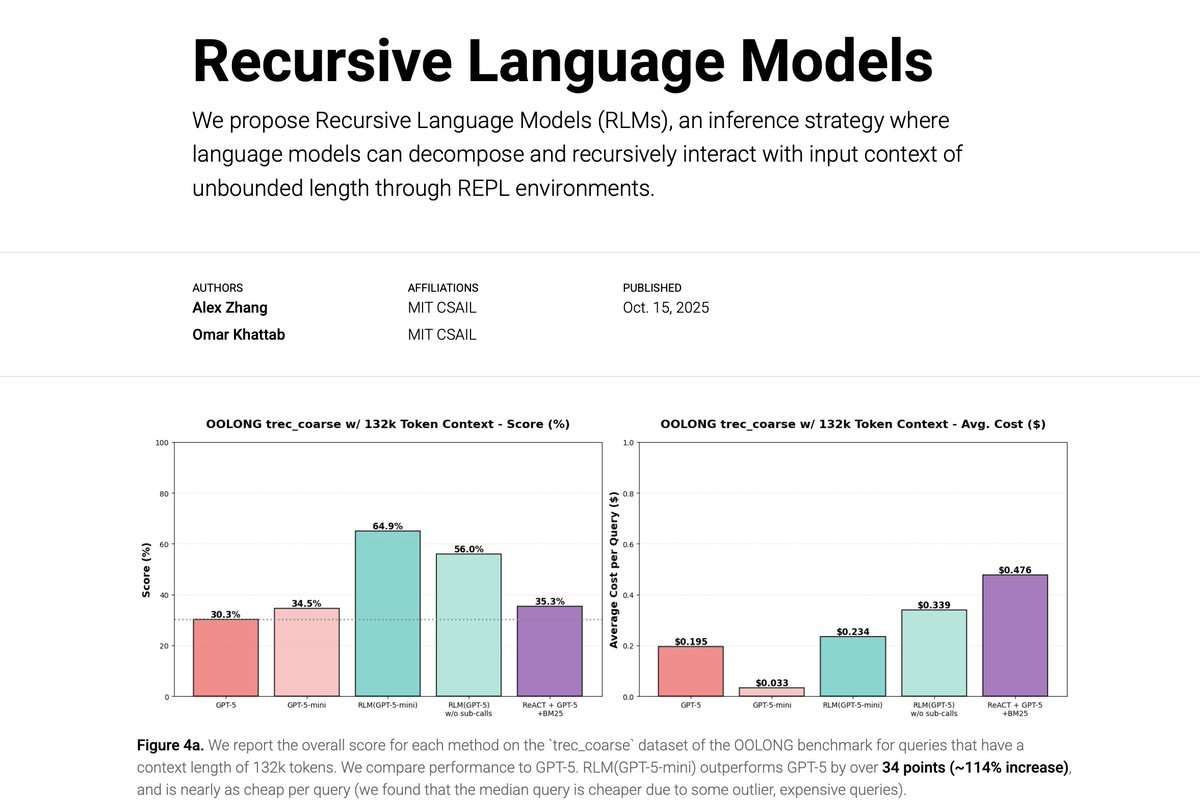
We’re excited to share our work on Recursive Language Models (RLMs). A new inference strategy where LLMs can decompose and recursively interact with input prompts of seemingly unbounded length, as a REPL environment.
On the OOLONG benchmark, RLMs with GPT-5-mini outperforms GPT-5 by over 110% gains (more than double!) on 132k-token sequences and is cheaper to query on average.
On the BrowseComp-Plus benchmark, RLMs with GPT-5 can take in 10M+ tokens as their “prompt” and answer highly compositional queries without degradation and even better than explicit indexing/retrieval.
We link our blogpost, (still very early!) experiments, and discussion below.
yes things are changing fast, but also I see companies (even faang) way behind the frontier for no reason.
you are guaranteed to lose if you fall behind.
the no unforced-errors ai leader playbook:
For your team:
- use coding agents. give all engineers their pick of harnesses, models, background agents: Claude code, Cursor, Devin, with closed/open models. Hearing Meta engineers are forced to use Llama 4. Opus 4.5 is the baseline now.
- give your agents tools to ALL dev tooling: Linear, GitHub, Datadog, Sentry, any Internal tooling. If agents are being held back because of lack of context that’s your fault.
- invest in your codebase specific agent docs. stop saying “doesn’t do X well”. If that’s an issue, try better prompting, https://t.co/SOjpn47yxo, linting, and code rules. Tell it how you want things. Every manual edit you make is an opportunity for https://t.co/S1ZvtYQwta improvement
- invest in robust background agent infra - get a full development stack working on VM/sandboxes. yes it’s hard to set up but it will be worth it, your engineers can run multiple in parallel. Code review will be the bottleneck soon.
- figure out security issues. stop being risk averse and do what is needed to unblock access to tools.
in your product:
- always use the latest generation models in your features (move things off of last gen models asap, unless robust evals indicate otherwise). Requires changes every 1-2 weeks - eg: GitHub copilot mobile still offers code review with gpt 4.1 and Sonnet 3.5 @jaredpalmer. You are leaving money on the table by being on Sonnet 4, or gpt 4o
- Use embedding semantic search instead of fuzzy search. Any general embedding model will do better than Levenshtein / fuzzy heuristics.
- leave no form unfilled. use structured outputs and whatever context you have on the user to do a best-effort pre-fill
- allow unstructured inputs on all product surfaces - must accept freeform text and documents. Forms are dead.
- custom finetuning is dead. Stop wasting time on it. Frontier is moving too fast to invest 8 weeks into finetuning. Costs are dropping too quickly for price to matter. Better prompting will take you very far and this will only become more true as instruction following improves
- build evals to make quick model-upgrade decisions. they don’t need to be perfect but at least need to allow you to compare models relative to each other. most decisions become clear on a Pareto cost vs benchmark perf plot
- encourage all engineers to build with ai: build primitives to call models from all code bases / models: structured output, semantic similarity endpoints, sandbox code execution. etc
What else am I missing?