Today we're incredibly excited to launch Trace Intelligence.
Teams shipping agents can spend months reviewing traces. So we auto-group traces into clusters and identify common patterns.
Watch how your agent is actually doing:
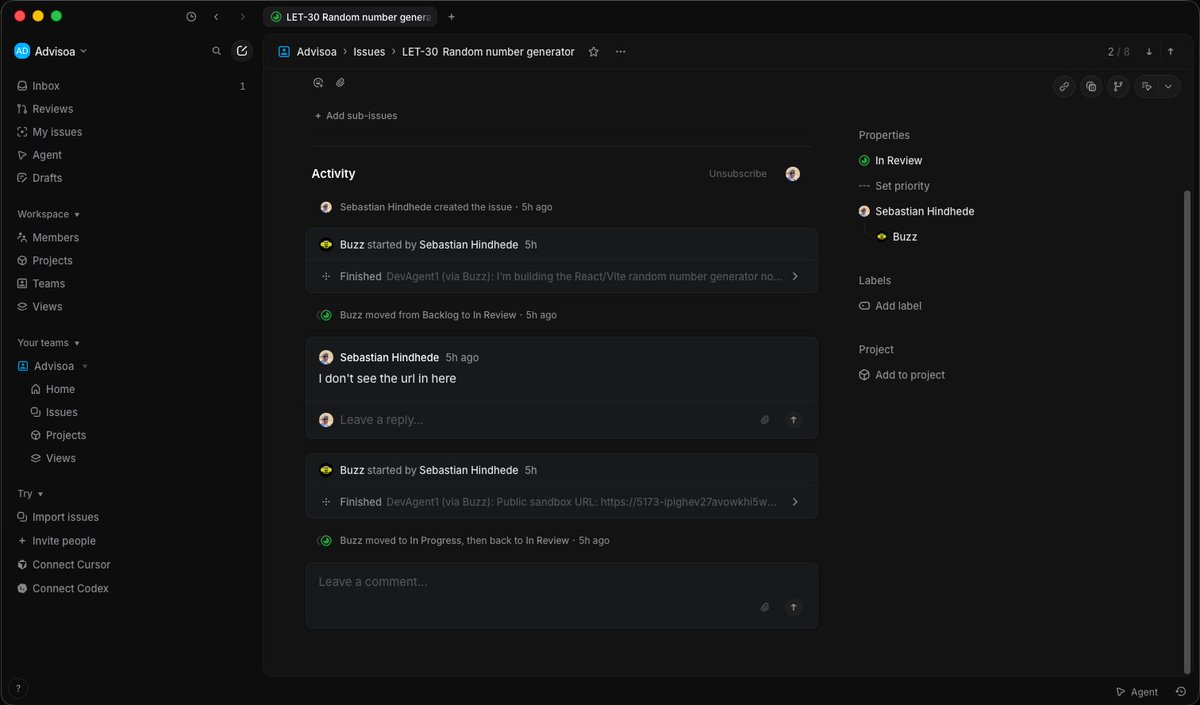
The Buzz and Linear integration is in place. Serverless coding agents now invoke via Linear or Buzz, with links between them. Each issue gets assigned to an agent and the agent assigns a conversation to the issue. Can seamlessly steer the agent from anywhere. Next up: CI/CD!
I think the most interesting thing about Jack Dorsey's "Slack killer" is the idea around shared compute.
I haven't seen people talk about it so here are my thoughts FWIW:
Open models got good, close enough to the paid frontier stuff to run for real. But the strongest ones need expensive hardware most people probably won't buy alone, and it's kinda a pain to set up if you aren't technical.
Shared compute solves exactly that. In Buzz, one person runs the machine, loads up an open model like Google Gemma, and everyone in the community plugs into that same model.
Basically, a whole group has real AI they own and control together, running on their own hardware, learning from their own data.
Once you see it, a bunch of things click into place.
1. A community can now run a top open model together, on a machine they own, instead of renting from a lab.
2. It learns from the group's private data and gets sharper over time, and all of that stays inside the community.
3. A narrow, private model can quietly get better than ChatGPT for the one world your group lives in.
4. It's impossible to copy, because the edge is the private data on your machine, not the model itself.
5. The moat stops being how smart your AI is and becomes whose data it learned from.
6. Compute becomes something you share like a building shares a gym. 10 people split one machine instead of 10 people each renting forever.
7. Idle compute becomes income!!! Your machine sits dead half the day, so it earns money renting that time to someone who needs it.
8. Communities become the unit of intelligence instead of companies. The group with the smartest shared brain wins, and being a member means owning a piece of it.
9. A shared brain becomes an asset you build equity in. You put in money and data, it appreciates, and your slice is worth something the day you leave.
10. The whole thing runs on open protocols, so the group keeps full control and nobody outside can throttle it or shut it off.
You know me, obviously, my head went to what startup ideas come to mind here. Adding them to @ideabrowser soon.
Well…
1. The vertical brain. Pick one profession, tax lawyers or real estate agents or indie game devs, and build the shared machine trained on everything that group knows between them. A year in it's the smartest AI in that field, impossible to copy, and you own the club it lives in.
2. The rental marketplace for collective brains. Once these private models exist, outsiders will pay to use them. You build the layer where a group lists its brain, an outsider pays per task, and the money flows back to the members while you take a cut. A marketplace for expertise, not compute.
3. The idle-compute exchange. Every shared machine sits unused half the day. You build the market that rents that dead time to whoever needs the power right then, so owners earn money off a machine that was just sitting there.
Idk where Buzz goes, but it's cool to see Jack putting it out. Right now the way it works in AI is you rent your intelligence from a few giant labs that own the machine, set the price, and hold the off switch.
Shared compute flips that, because a community can run the model together, feed it their own private data, and keep full control of the whole thing.
It's one of those things that might look tiny today, but Jack does has a habit of being early.
The next great AI application, driven by open source, or open weights, will be a job simulator.
How employees gain experience in a future AI world is going to be far different from today. Employees won’t have as many touch points in the company to gain knowledge and experience from. That’s where judgement has historically come from.
Much like race car drivers and pilots have software that is continually updated to enable them to experience as many scenarios as possible, trying to replicate what could happen IRL, smart companies will have their employees and stakeholders with the most domain knowledge create the simulator that takes them through every possible situation they could face and helps prepare them.
Onboarding will have a completely different meaning
Smart companies will realize that Father Time is not only undefeated in sports , but business as well. If you are not capturing what is your business is all about from ALL of your employees , you will be challenged.
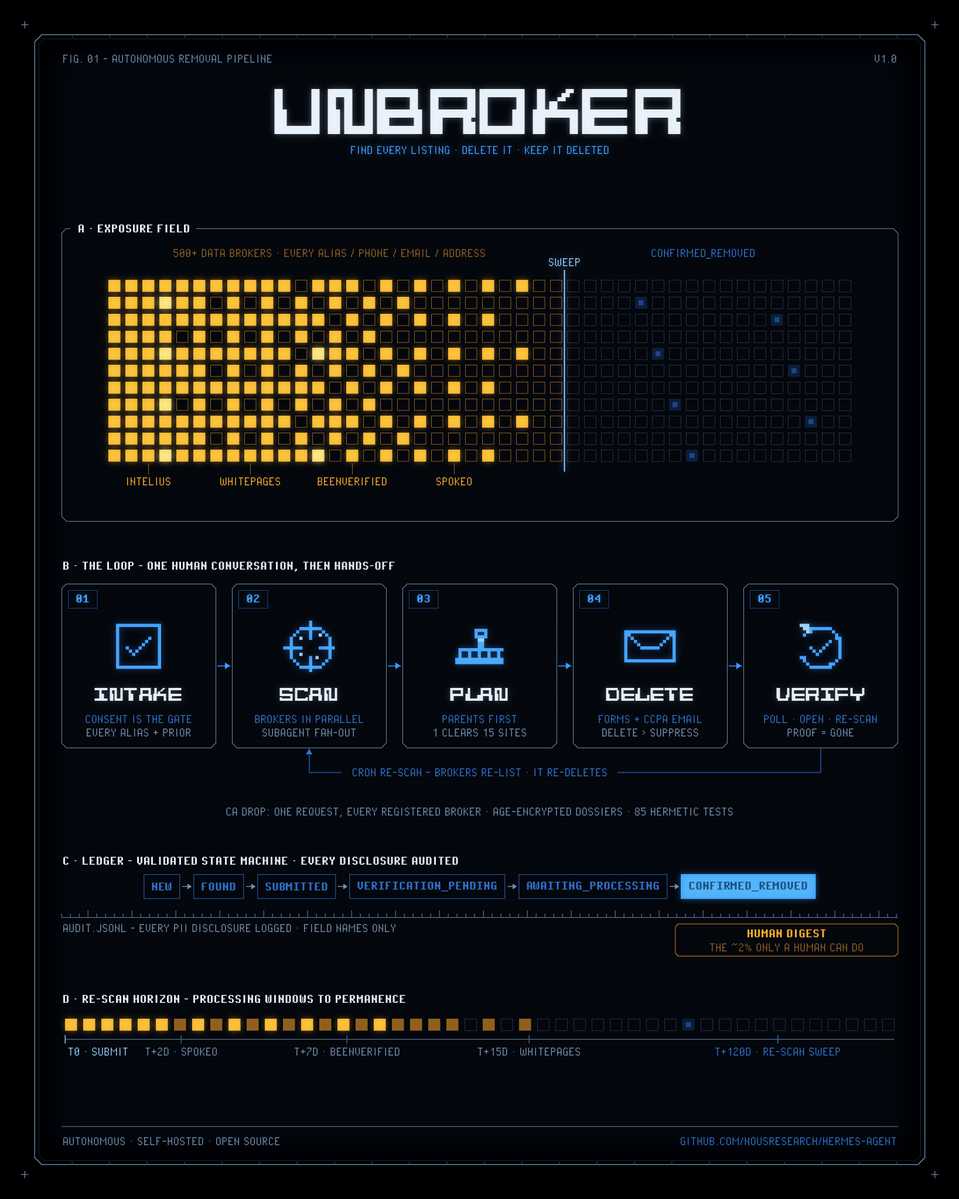
i'm open sourcing UNBROKER: a tool that finds where your personal info is exposed by data brokers and files the removals for you
it runs as a skill in Hermes Agent
_________
your data is everywhere; hundreds of brokers publish your name, current and old addresses, phone, email, birthday, even your relatives. anyone can find where you live in about ten seconds
CCPA, CPRA, GDPR, and a growing number of state laws say a broker has to delete your data if you ask. there's just no easy bulk button. every broker has a different process and many make it intentionally difficult to exercise your right to delete
this is the entire business model for companies like DeleteMe, Incogni, EasyOptOuts; they charge you monthly (DeleteMe is $330/yr for a Family plan) to file removals that you can submit yourself for free, and then you're giving a new company the exact data you want to erase
so i built one you just run for free. your data never even has to leave your machine if you run a local model
_________
how it works:
first it builds search vectors from everything: every name, alias, email, phone, and address you've had (brokers might index you under a maiden name or a house you left in 2014, so the naive "current name + current city" approach can miss profiles). then it fans out parallel sub-agents across the broker list, which refreshes from a maintained public source
automation is tiered. when it can handle a broker end to end with your settings, it drives a browser through the opt-out form, sends the email, and opens the confirmation link itself. soft CAPTCHAs clear on their own with a real browser. anything only a human can finish comes back to you as a short list at the end
the email side doesn't need a stored password and can send opt-outs and open verification links through your own logged-in webmail. you can also wire up SMTP, or keep it manual and just send the drafts it writes
it tailors every request to your jurisdiction, filing under the framework that applies where you live: CCPA and CPRA in California, GDPR in the EU and UK, a general right-to-delete request everywhere else. if you're in California it also uses the state's DROP portal, a single request that covers 500+ registered brokers at once
it holds as little of your data as it can, and keeps it local. dossiers are encrypted at rest if you want, opaque ids keep your real name out of every filename and log, and nothing leaves your machine unless you opt in
brokers sometimes relist you eventually or new ones find your data, so every case is tracked in a ledger and can be re-scanned on a cron schedule so if your data pops back up it files the removal again
https://t.co/2jfQxBYZkW