This post is NOT about the debate, but instead inspired by something I heard in the debate. This is meant to be a magnifying glass on just how things operate in DC, and how good intentions of elected representatives are almost always hijacked by lobbyists. I hope it reaches an audience.
Here we go!
Last night, during the debate, JD Vance spoke about one of Donald Trump’s achievements while in office. His introduction of Price Transparency. Price Transparency is a guidance mandating insurance companies to publish their contractual agreed-upon rates for services rendered with partnering healthcare providers (cost of services). The intent is good in practice: force insurance companies to make public just how much is costs to cover a knee-replacement surgery, or any other service!
Welp, let me explain just how that got hijacked by lobbyists.
In DC, lawmakers and lobbyists work together to draft the guidance for business operations in a particular industry sector. In most cases, lobbyists work hard to draft these guidances to create a favorable outcome for their business. In the case of Price Transparency data, they worked hard to make sure that the guidance created for price publication, is so complex and confusing that the average citizen still doesn’t have the access or information they want.
Let me tell you how.
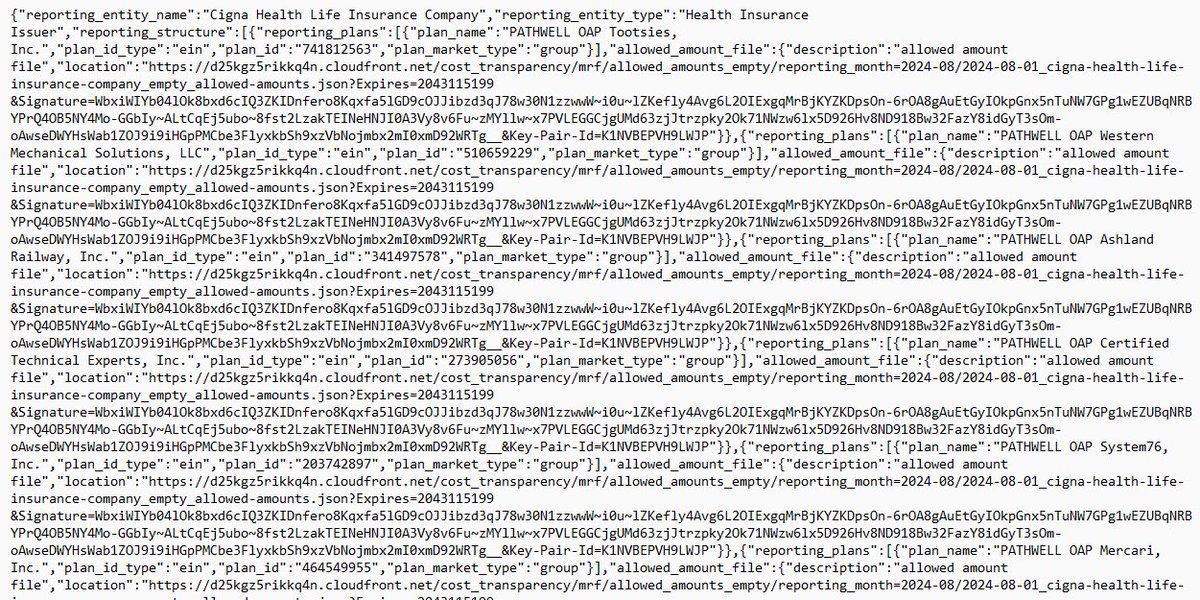
Machine-Readable Files (MRF) - This is something you’ll need to understand. See, in the agreements made with the lobbyists, insurance providers made claim that all this pricing data was too much! Too complex and too complicated to just publish in a way that makes it easily accessible to people. So, they decided to publish their data in large, complex JSON structured MRF’s. I’ve put an image below of just what these are.
Here’s the important part… if you wanted to use this data to compare the agreed upon in-network negotiated rates between healthcare providers and insurance providers, you’d need to analyze this information. But you can’t… at least probably not on your own personal computer.
These files exist in a certain structure, starting as a table of contents, which then contain a link to the in-network and allowed-amount files which contain the negotiated rates between providers and Issuers. These files are zipped and when unzipped can be up to 7-10GB of data. Multiply that by the number of links to files in the table of contents(ToC), multiplied by then number of insurers publishing ToC’s, you’re looking at tens of thousands, even hundreds of thousands of gigabytes (terabytes) worth of raw, unstructured data. And unless you’ve got 5+ years as a data engineer and some serious computing power, you’re out of luck!
To process this information, and get this data to a point that the average individual will be able to use for basic analysis, you need significant computing resources, and a large storage system to store the data… and perhaps some data engineering experience🥲.
This leads me to my grander point… while the intention of transparency is good, the execution of transparency was hijacked by lobbyists in DC. The intent to make this data so hidden and obfuscated is the quintessential characteristic of lobbyists. I hope this demonstrates just one of many ways lobbying impacts us.
Below I’ve posted some screen shots of this process:
The image is a a screenshot of the Table of Contents with links to transparency data files.
The gif with the black backdrop is a small subset of data in that file.
The Excel gif is the processed and parsed results in a remodeled data structure.
Notes on Process:
- Processed used a compute cluster with 122 GB of Memory, and 16 Cores with auto-scaling up to 35 workers at once if needed
- Over 1500 lines of code processing MRF to final data model (resulting table)
-Over 20 hours of run time on cluster for several terabytes.
Check out the following links and see for yourself!
https://t.co/DBk7vu51xb
https://t.co/T36PIt4qxh
Working on coordinating and building a private A.I. Lab and Small Modular Data Center in NYS to research and educate the public to see if the moratoriums on Data Centers passed by Kathy make sense. Any one who tells you blindly that it’s either completely stupid or completely warranted is an idiot. Truth is there needs empirical evidence to figure out the best way to do something with large energy, economic, and environmental implications. Let’s figure out what those are.
@Jason On-prem @Jason ! The future is on prem inference… look at the P/E of the current models. Even with cheaper models and better hardware the costs won’t go down as much as demand will rise. ON-PREM Small Modular Data Center!
@DutchRojas In fact there are several companies that sell these competitor products to mine for a few hundred thousand to large health systems so they can evaluate competitive reimbursement rates.
@DefiantLs Unlike the nuanced, deeply researched dialogues we need, the political panels on CNN and Fox News have devolved into superficial soundbites, reliant on some unsubstantiated platitudes that avoid any kind of rigorous evidence or intellectual depth.
Cleveland Clinic got 340B eligibility as a "rural referral center."
They're in downtown Cleveland.
Their Medicaid + uninsured payer mix: 15%. Metro Health — the actual safety net hospital serving Cleveland's indigent patients — has three times that.
Guess which one makes more off 340B.
I don’t understand why people don’t realize they can actually do this. Insurance companies publish their agreed upon reimbursement rates to hospitals for every plan. And hospitals publish their rates too. It’s law… but oh wait! It’s 300+ terabytes of poorly and asynchronously structured data that requires thousands of dollars in compute and storage to do anything with.
This entire conversation is relatively intellectually dishonest from both of you.
The data is available, you just won’t be honest about what’s required to compute expected costs. Plus you need access to a couple terabytes of medical claims data to get an idea of costs. You need to know if the health system owns outpatient clinics so they can get 340b reimbursement from the government for chronic care.
It’s frustrating listening to Directors of Hospitals talk this way, blaming legislation, when it is fully within your hands to spend the money to properly publish your rates with the payers you and your practices have operating contracts with.
Let’s have a more intellectually honest conversation @SaraForTexLege@mcuban
I just read through @Alison_Galvani papers and testimonies, including her new one where she compares US drug pricing to a group of western countries. But unlike the @FTC did, she uses estimates for pricing, rather than using @costplusdrugs actual costs where they match. But that’s a topic for another day ✌️
Back to M4A and her paper.. Nothing wrong with it at all. She uses population data, and estimates of costs, tax revenue, etc to come to her conclusions. It’s well written.
She even does a great job having a tool where you can change values and see the impact on the model.
It’s very similar to a project I did with Rand. The numbers were great. The implementation was going to be hard.
It’s the same issue for her. It’s a model. As a model, she does not deal with any of the issues I raised.
She didn’t interview hospitals, doctors, employers, care navigators, benefits officers at companies, etc. She did no behavioral analysis or analytics at all. (If I missed them @Alison_Galvani , please let me know where I can find them)
Her model , like the legislation, pretty much assumes that everyone will do what the legislation tells them to do. Insurance companies, PBMs, TPAs, RCM, Hubs, Switches, etc, etc will just fire everyone and go out of business. The model accounts for retraining and job costs like it’s a given and they will do nothing.
All hospitals are assumed to be the exact same. The model doesn’t account for any differences in operating costs, personnel, investment, at all. Which makes it a fun place to speculate from, but it doesn’t get from here to there. I
I’m not for or against Universal Care, Single Payer, M4A. The goal is to be in a position where we can actually determine what it would take to provide everyone, with the best possible healthcare, at a cost to the individual, employer, city , state, country, that creates as little stress as possible for all stakeholders.
You can’t do that by plugging numbers. You can’t just write legislation and tell people they will follow it. In this country ? Are you kidding me. lol
You need to account for all of those stakeholders, how they will respond, what might or might not change. It will be incredibly difficult.
So no. It’s a great political slogan to say “Medicare For All”. But it is currently nothing more than that.
if @elonmusk paid 100% of his net worth ($1.4 trillion) as a tax it would only cover federal government spending for 77 days. this isn’t a tax problem…
And what happens when 70% of that tax revenue goes to bureaucratic nonesense and 3 years from now some kids are still without because child care costs went up 800% just like every other program that’s ever been government subsidized.
I will be asking you to face the parents of children you lied to saying “If we just get this money we can pay for your child care”…
Can’t wait for lies to be exposed.
This AI just exposed the BIGGEST legal insider trading operation in America.
A platform called GovGreed built a seven-layer machine learning system that cross-references every stock trade disclosed by every sitting politician against the bills their committees control, the campaign donations they receive, and the companies their votes directly impact.
It scored all 540 politicians currently in Congress. And the numbers are crazy:
56% of every stock purchase made by Congress in the last 16 months was on a stock directly affected by a bill the buyer later voted on. That is 6,170 out of 11,016 total purchases.
More than HALF of all congressional stock buys are on companies whose fate that same politician is about to decide.
343 of 540 Congress members actively trade stocks while holding access to nonpublic legislative information.
That is 63.8% of the entire legislature making market bets with an informational edge that would put any hedge fund manager in prison.
The AI identified 752 active "Triple Signals" in the current Congress. A Triple Signal fires when three conditions line up at once:
The politician sits on the committee controlling a bill, they traded stock in a company affected by that bill, AND they received campaign contributions from that same industry.
Bills carrying these insider indicators pass at 5.4 TIMES the normal rate.
Now look at the individual leaderboard:
- Nancy Pelosi's estimated portfolio sits at $194 million with a Greediness score of 98.1 out of 100
- Ro Khanna made 13,231 trades across 800+ different tickers
- Michael McCaul made 32,302 trades and filed 6,670 of them late
- Thomas Suozzi filed 86.4% of his trades late with an average delay of 396 days, meaning his disclosures landed over a YEAR after he made the trade
And then there is Lisa McClain, the fourth-ranking Republican in the House. She has made 1,443 trades in three years, more than 98% of all politicians tracked.
She violated the STOCK Act twice in a single year, disclosing up to $900,000 in trades months after the legal deadline. Her husband bought up to $250,000 in Elon Musk's xAI, which quietly converted into SpaceX equity before last Friday's $2 trillion IPO.
The penalty for all of this? A $200 fine.
The number of Congress members ever prosecuted under the STOCK Act since it passed in 2012? Zero.
And the cruelest part is this:
A bill to ban congressional stock trading was introduced in January 2026. It has bipartisan support. Over 80% of American voters want it passed.
But Congress is sitting on it, because the people who would have to vote yes are the same people making millions from the system staying exactly the way it is.
They write the insider trading laws, they exempt themselves from enforcement, they trade on the information those laws generate, and when they get caught, they pay a fine that is basically nothing.
The AI didn't discover anything Congress was hiding. It just organized what was already public into a pattern so obvious that nobody can pretend it isn't there anymore.
never thought i’d say this… i wholeheartedly agree with elizabeth warren.
also, term limits.
being an elected representative should not be a career. there should be no path for wealth creation or perpetual income from representing the interests of the people, in service of the people.
private citizens should enter public service, leave, and return to private life, as the founders intended.
“politician” has become a lucrative career option for those skilled at public oration and persuasion.
while they may represent their constituents’ interests, the reelection mandate incentivizes short-term decision-making and voting, often counter to the long-term interests of the people.
and having unfettered private market access while holding the privileged position of influence over, and non-public knowledge of, those markets will inevitably incentivize bad behavior, to the politician’s benefit, and the public’s detriment.
these ideals may be too far-fetched for our modern political machinery to consider - they would be self-defeating of the machines themselves - but the citizens can still be deafeningly loud in demanding them.
thx senator warren for getting this half-right.. also, term limits.
Scott Pelley responds to Trump saying he doesn’t care about the country: “I’ve never worn the uniform, but I’ve been in combat for this country. In Afghanistan, and Iraq, Kuwait. Been shot at. Spent nights in foxholes filling up with water in the desert. I’m not aware that the president has ever done any of those things for his country. You become a journalist because you love the First Amendment, you love the country. While all the other descriptions the president used about me might be applicable, not that one”
@TheBrancaShow I’d argue that your sentiment toward the new ownership regarding the absence of knowledge of any contract or consignment is like sympathizing with buyers remorse when the buyer is negligible in doing their due diligence.
If you don’t do due diligence, it’s your fault, but own it!
🚨🇺🇸🇮🇱 Marjorie Taylor Greene was threatened until she quit. Thomas Massie was taken out with the most expensive House primary in history.
Now we know why.
Lt. Col. Karen Kwiatkowski says Section 224 will get pulled before December, but without Massie in Congress, it gets slipped back in quietly, and nobody stops it.
The strategy: public aid to Israel is becoming toxic, so bury the money inside a joint U.S.-IDF innovation center.
"This is why they hijacked Turning Point; this is why they freaked out when Charlie Kirk said I'm not taking your money."
@karen4the6th
@ScottJenningsKY People just throw the word antisemitic out there like it’s an article in a sentence now (a, an, & the are articles if you didn’t know. I don’t even think Scott knows what the word means anymore…