I should clarify, this isn't with Claude's memory or Codex memory enabled. This is a markdown folder that's only job is to capture mistakes or decisions made for repos over time. Without the memories they made more mistakes more frequently without the pointer.
Memory A/B follow-up: Claude and Codex used the notes differently.
Claude found them alone: opened the right note 8 of 10 runs, passed 9.
Codex opened it 4 of 10 times and passed 2.
Add a paragraph to AGENTS.md saying "check the notes first": Codex opened it 10 of 10, passed 6.
With no memory, Codex passed 0 of 10, and every Codex run that skipped the note failed.
Reading it isn't the whole fix: with the pointer, Codex read it every time and still missed 4 of 10.
10 runs per model per setup, graded blind. Pointer vs no memory: p = 0.03 for each model.
Memory A/B follow-up: Claude and Codex used the notes differently.
Claude found them alone: opened the right note 8 of 10 runs, passed 9.
Codex opened it 4 of 10 times and passed 2.
Add a paragraph to AGENTS.md saying "check the notes first": Codex opened it 10 of 10, passed 6.
Details: 5 tasks across two production codebases, Claude Opus 5.5 and gpt-6.1-sol, one run each per setup. Runs that opened the right note passed 13 of 16. Runs that didn't passed 1 of 4.
Small sample, and the tasks were picked where a note holds the answer.
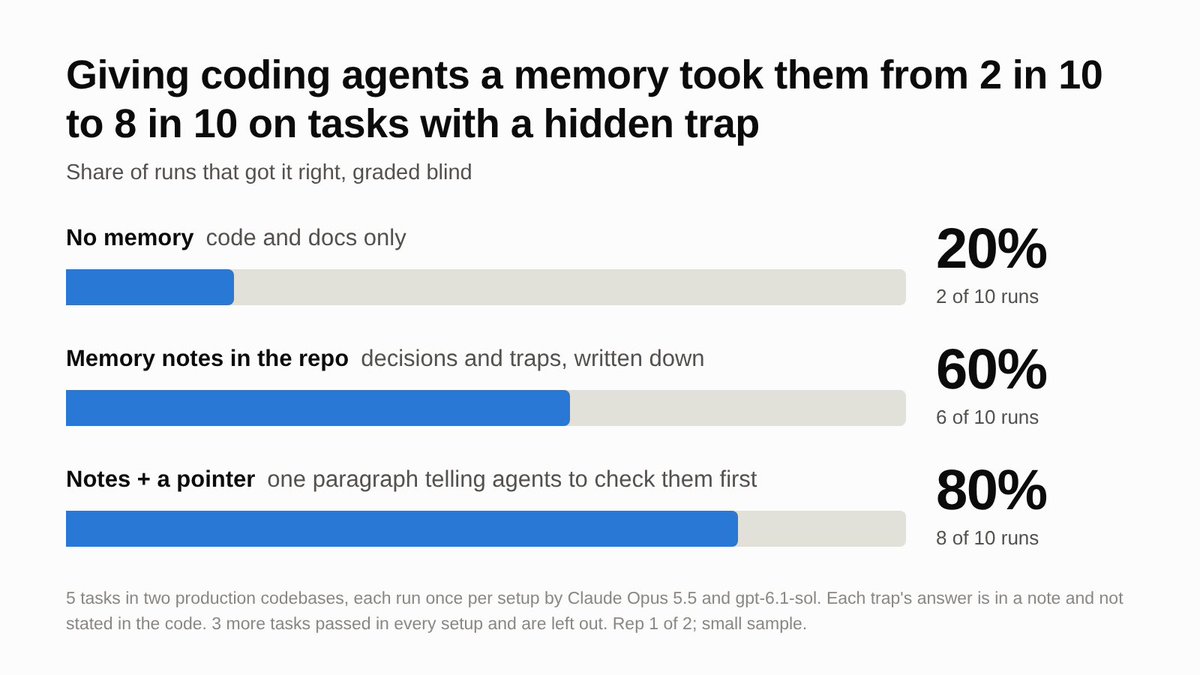
Ran a blind A/B on our coding agents. Same tasks, each with a trap the code doesn't reveal.
No memory: 2 of 10 passed
Memory notes in the repo: 6 of 10
Notes + one paragraph telling agents to read them first: 8 of 10
Writing decisions down is the cheapest upgrade I've found.
@orcdev I truly wonder this. I've cut out all unit tests because I don't find them helpful. I think tests for critical infra are important. But everything else? I just don't see it