On the random episode of kuyiliba that certain people reminded me of (finding a positive out of someone lying about me in a group chat😂😂😂)
Y’all check out @skinfixug for your skincare needs 😊
Add on IG https://t.co/AFqwwAddfH
WhatsApp
https://t.co/WYhwAQnYYR
Let your life memos be written in sand so you can revise them whenever you feel, know, imagine a truer, more beautiful idea for yourself.
You are allowed to change your mind!
📌
ORDER ONLINE OR DROP BY @mayasgalleryug SPRING ROAD BUGOLOBI SHOP 55 MASHA FOODS COMPLEX to pick up and view what we have in stock!
☎️📞 +256709160424
SkinFixUg
From missile strikes across the Gulf to attacks on shipping lanes, the Iran–Israel–US conflict is rapidly expanding across the Middle East
We ask: Is Africa prepared for the economic and security fallout of a prolonged war?
Join the panel tonight at 10PM
#UBCBehindTheHeadlines
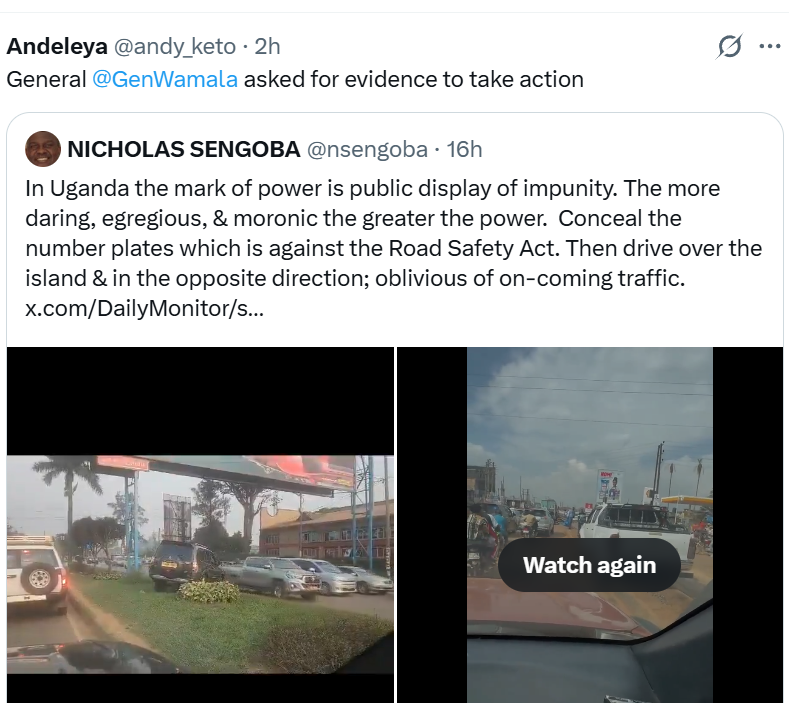
Prompted by @andy_keto repost from the screenshot, I’m reminded of a phrase I discussed with a colleague over a decade ago—one that feels even more accurate today: Rural Approach to Urban Excitement. It captures, in a single idea, the deeper dysfunction behind our road‑use habits and the wider failures embedded in our governance systems.
Rural approach to urban excitement refers to the way individuals raised in rural settings engage with the opportunities, temptations, pressures, and sensory overload of urban life. In Uganda:
Take the Pajero driver as an example: his behaviour shows a failure to understand boundaries in an urban environment. He acts as though he is still in a rural compound, where one can use any path available. In another video, a pickup driver gets stuck for the same reason—his mindset did not anticipate the consequences of his manoeuvre.
Many SUV drivers using illegal sirens reflect a similar mentality. They are often individuals who rose from rural backgrounds, acquired sudden wealth—frequently through questionable means—and now behave as though the roads belong exclusively to them.
This same insecurity drives them to build extravagant mansions upcountry. These houses remain largely unused, but they feel compelled to construct them to outshine the peers they grew up with.
The competition extends to livestock. Instead of focusing on productivity—such as milk output—they compete over who owns the largest number of long‑horned cattle. They extract public resources year after year, yet rarely establish enterprises that create jobs or build lasting value.
In urban centres, this insecurity turns into overcompensation. They try to project an image of belonging to the city, forgetting that no matter how wealthy one becomes, there is always someone richer.
I once saw this mindset firsthand. During a meeting in Geneva, someone pompously asked me to buy them a watch “worth at least USD 1,000.” Nothing less. Yet at the mall near my hotel, it was difficult to find a watch that cheap—most started at around 5,000 Swiss francs. Their idea of luxury was rooted in perception, not reality.
Another example was a colleague I travelled with to Spain. We went out to look for a few specific items, but when it was time to leave, we couldn’t trace her anywhere. We eventually left her behind, and the mall management later informed her that closing time had come. At breakfast the next morning, she began proudly listing the things she had bought. When she converted to UGX she was shocked to realise she had spent over 500,000 shillings on a single pair of shoes—an amount she had never imagined spending before.
The boda boda culture reflects another dimension of this rural approach. It has cost countless lives, yet many riders do not even know the rules of the road and that they are required to have a driving licence. The result is a permanent, dangerous presence on urban roads.
The same pattern appears in nightlife. They go to bars and clubs, drink excessively, and buy drinks for others without being asked. Because the money is not earned through genuine work, they feel no sense of loss or responsibility.
Even their fashion choices reveal the same insecurity. They wear overpriced sharp suits everywhere—including beaches along Lake Victoria—because the goal is not appropriateness but signalling status.
I could use a nice winter break - late lunches that feel like dinners, hot chocolate, candles, night NY views, lots of sleep and a shopping spree.
And then I’ll be back fully r energized for the new year ☺️
Professor Wasswa Balunywa Handed a Get-out-of-jail-free Card
The former DPP and now Principal Judge, Her Lordship Jane Frances Abodo, seems to have decided to use her last days at @ODPPUGANDA like a departing US President uses their last hours in the White House; handing out freedom permits to incarcerated friends, family, allies and a few truly deserving individuals.
It’s unclear as to whether the public will ever get an explanation for the flurry of Nolle Prosequi she’s issued but I’m sure @jwbalunywa won’t complain one bit.
I don’t begrudge the man from Busoga his good fortune.
But the public will be left wondering whether smaller profile citizens are ever going to enjoy the same rub of the green that the criminal justice system in Uganda gives to the rich and well connected.
We really need comprehensive #DPPReforms
#EmptyTheJails