#BTC 과거 강세장 평균 조정폭과 단기 투자자 손실 수준
최근 비트코인은 금리 인상 가능성에 대한 우려로 미국 국채금리와 달러인덱스가 강세를 보이고, AI 관련 주식까지 하락하면서 큰 폭의 조정을 받으며 시장 전반에 극단적인 공포가 나타나고 있습니다.
Bitcoin Bull Cycle Drawdowns 지표를 보면, 과거 강세 사이클에서 형성된 고점 대비 전체 평균 조정폭은 약 14.39%입니다. 비트코인의 시가총액이 증가하는 가운데, 최근 사이클에서는 이전보다 조정폭이 상대적으로 축소되는 모습도 나타났습니다.
현재 비트코인은 고점 대비 약 19% 하락하며 과거 강세장의 평균 조정폭을 넘어선 상태입니다. 상승장 구조가 유지되고 있다는 전제하에, 역사적 조정폭을 고려하면 주요 저점이 형성될 가능성에 주목할 필요가 있습니다.
한편 Bitcoin Short-Term Holder SOPR(7MA) 지표 역시 약 0.987까지 하락하며 단기 투자자들의 손실 실현이 확대되고 있습니다. 이는 과거 상승장에서 주요 저점이 형성됐던 구간과 유사한 수준입니다.
$BTC 📈
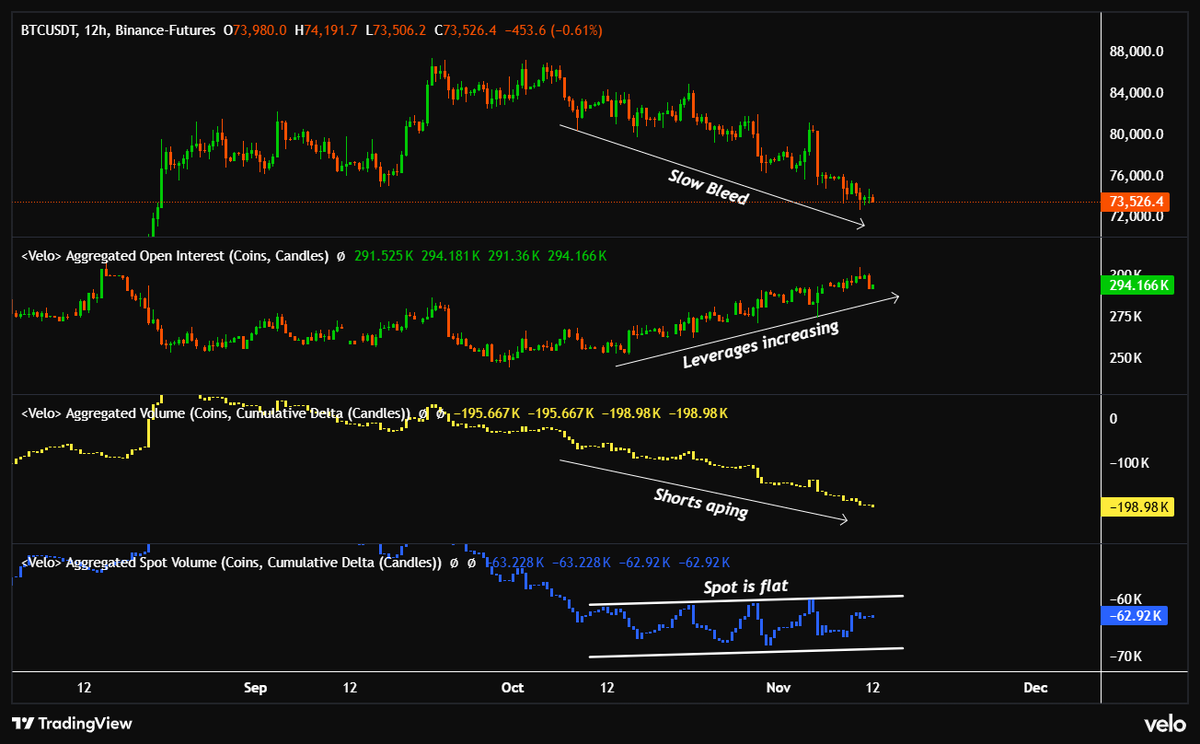
Perps are showing fresh shorts opening, while spot CVD is making new lows, signaling aggressive selling / selling with intent.
And for now, price is rewarding those sellers - bearish.
Just before the NY open, we saw shorts positioning into the range lows while spot buyers stepped in.
Ideally, if we see this flow I’d like to see a sweep of the highs to squeeze those shorts before the next move. Otherwise, there’s simply no high-probability entry worth taking.
As I said... "No clear edge, no trade."
Now I’m watching OrderFlow closely for the moment sellers stop getting rewarded for their aggression and start getting trapped.
That’s when things could get interesting. 👀
My next key level on the HTF remains $68K...
https://t.co/YtI8oc2G8d
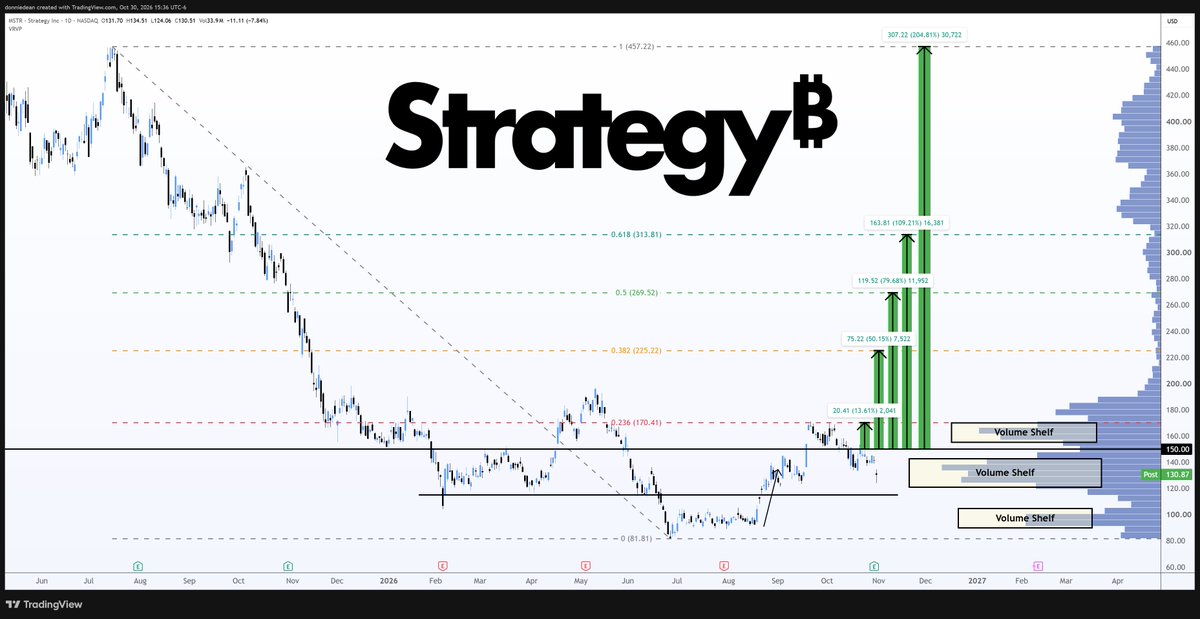
MSTR Removed from MSCI today!?
In about 7 hours from now (5pm ET) MSCI will most likely announce that MSTR is going to be removed from the index effective on the 30.11.2026.
It's highly unlikely this isn't going to happen, as Strategy themselves stated in the Q3 filings they expect to be removed. And betting odds are around 90%.
Here is what it means for you as a MSTR Shareholder:
-> ~13M shares force-sold by index funds.
-> A bit more than half a day's volume.
-> ~3% of the company's market cap.
What will happen to the price of MSTR?
The Good News:
-> Most of the impact usually happens before the announcement, as people anticipate it and want to front run it.
-> A backtest of the November 2025 MSCI rebalance found removed stocks fell an average of 24.5% in the anticipation phase, but only 0.7% after the official announcement.
The Bad News:
-> As BTC is currently quite volatile, and Strategy is amplified BTC, this news could throw some gasoline on the fire.
That's why I prepared with putting in some nice limit orders at lower prices to potentially buy more MSTR for an even cheaper price.
This could be one of your last generational Buying Opportunities of MSTR.
-> Bookmark this Post!
Are you ready to buy a generational Dip?
🚨 BREAKING:
Saylor Strategy could face $2.8 Billion in forced selling if MSCI removes it from its global indexes tomorrow.
Strategy already expects exclusion this month, according to its Q3 SEC filing. Any removal takes effect on Nov 30.
Tomorrow, MSCI will confirm the exclusion of $MSTR from its indices, bringing an estimated $2.8B+ of selling pressure and $11B+ if other indexes followed. Beyond the immediate impact, this will be a major blow to the “institutional adoption” narrative that the entire model is increasingly hinging on.
Good riddance.
It’s time to stop promoting the problem and start promoting the solution: Treasury 2.0. The evolution towards BTC-native operating models.
Acquiring BTC for a productive purpose. Building Bitcoin infrastructure, driving network adoption and monetary utility, and deploying, earning and compounding sats for shareholders through real operations at the forefront of the emerging agentic era.
You know, exactly the direction the MSCI and S&P are asking the sector to move towards…
I’ve been the only independent analyst consistently advocating for this obvious and necessary evolution, while much of the sector remains caught in a financially engineered trance, promoting structures that directly contradict Bitcoin’s principles and undermine its very value proposition.
The fiatisation of Bitcoin is being sold as its evolution, it isn’t…
The amount of pushback, dishonesty, personal attacks and even libel I’ve faced simply for trying to explain this to retail investors is astonishing. This sector is riddled with people who claim to understand both Bitcoin and capital markets, yet enthusiastically promote the very inversion of their underlying principles.
You cannot claim to champion and understand Bitcoin while advocating for its fiatisation.
This sector needs to wake up, recognise the distinction and start backing the businesses actually building Bitcoin’s future.
Thankfully, it’s only a matter of time. Bitcoin has a way of exposing those who attempt to distort and undermine its principles. And tomorrow is a major inflection point. Tick tock.
🚨 They tell you to keep your money in the bank because it's safe.
In just 24 hours, Indonesia's banks, finance and insurance firms were hit by 210,000 cyber attacks.
Not in a month. Not in a year. ONE day.
That's almost HALF of the 439,000 attacks blocked across the whole country.
And more than government, tech, transport, telecoms and every other sector on the list COMBINED.
Nationwide, about 5 attacks every second. 24 hours. NONSTOP.
And it's not only Indonesia.
🇲🇾 Malaysia: pages of Bank Rakyat's website were defaced on Friday night. Portals at several Malaysian banks were disrupted. The national cyber agency raised the threat level from LOW to MODERATE.
🇫🇷 France: hackers got into Crédit Mutuel Arkéa through one of its service providers and stole about €100 million from the bank's own account.
Your savings are not sitting in a vault.
They are numbers on a server. And that server is under fire around the clock.
Your bank's app will never show you numbers like these. This account will, every time they jump. Follow me.
I think this is worth reposting for people to study.
Bad news during a bull market = fuels continuation.
We’ve seen wave after wave of “bad” news and events, and it lines up with what we’ve seen in every cycle $BTC before.
🚨 INSIGHT: After every major crypto hack, $BTC has gone on to new highs
Mt. Gox (2014): $BTC roughly halved. It hit $19.7k by 2017, nearly 100x off its post-collapse low.
Bitfinex (2016): $BTC fell ~20%. It was back above pre-hack levels within 3 months and hit new all-time highs in 2017.
Coincheck (2018): The hack hit during the 2018 bear market. $BTC climbed from its $3.1k bottom to $29k by the end of 2020, then reached $69k in 2021.
Binance (2019): $BTC dipped ~4%. It rallied ~136% in just 7 weeks.
FTX (2022): $BTC fell ~22% in a week to ~$15.5k. It was up ~134% a year later and hit a new ATH of $73.7k by March 2024, ~375% off the low.
Bybit (2025): The largest hack on record at the time. $BTC dipped ~5%, hit a new ATH exactly 3 months later and went on to $126k, ~70% above its 2025 low.
Binance (2026): $BTC is down ~3% so far, Binance says user funds are SAFU, and ~$2.4B of the stolen funds is already frozen.
Not financial advice, and past performance doesn’t guarantee future results. But the pattern speaks for itself.
I think we've been looking at Strategy $MSTR through the wrong lens.
Over the past few weeks, I've been quite critical of several decisions made by Strategy.
The $STRC buybacks, the massive USD reserves, the reluctance to increase dividend rates, and even some of the communication surrounding these decisions.
And I know I'm not alone.
But after listening to @CJ_Bitcoin from Strategy and @ColeMacro from Strive $ASST on @chasepalmieri's podcast, I've started questioning whether we've been using the right framework to evaluate Strategy in the first place.
Strategy and Strive are playing two very different games.
Strive is optimizing for aggressive Bitcoin accumulation, amplification, and ultimately maximizing total returns for its common shareholders.
At its current scale, Strive can grow substantially by attracting retail and high-net-worth investors who understand Bitcoin, are comfortable underwriting its risks, and are willing to accept higher yields on Digital Credit.
Strategy, on the other hand, is increasingly positioning itself to attract institutional capital at an entirely different scale.
We're talking pension funds, insurance companies, banks, and other institutions capable of deploying billions of dollars.
And here's where things get interesting.
These investors don't think like us Bitcoiners.
They don't necessarily want the highest possible yield. They want liquidity, predictability, credit protection, stability, and confidence in the issuer.
Suddenly, some of Strategy's decisions start making a lot more sense.
→ The USD reserves: Not simply idle capital that could have been deployed into Bitcoin, but an important source of confidence for investors underwriting credit risk.
→ The STRC buybacks: Not necessarily a mechanism to drive immediate price appreciation, but potentially a way to demonstrate support for the instrument and strengthen confidence in its ability to trade near par.
→ The dividend policy: Raising yields might attract another few billion from yield-sensitive investors, but it could also send the wrong signal to institutions that associate unusually high yields with distress.
→ The communication: Increasingly focused on balance sheet resilience, risk management, and institutional credibility rather than the aggressive upside narrative many retail investors want to hear.
Matt Cole made a particularly interesting point.
Even if Strategy raised its dividend rates by 200 basis points and attracted another $3–5 billion, that wouldn't fundamentally change the equation for a company of its size.
Strategy needs to figure out how to attract the next $25 billion, $50 billion, and eventually much more.
That's a completely different challenge.
Does this mean Strategy has made all the right decisions? Absolutely not. Even CJ acknowledged that the way the USD reserve was managed created problems.
And understanding the rationale behind a decision doesn't automatically make it the right one.
But perhaps we've been making a mistake by evaluating both companies against the same objectives.
We've been asking why Strategy isn't behaving more like Strive, when we should be asking whether Strategy is successfully building the infrastructure needed to bring institutional capital into Bitcoin at scale.
Strive is trying to maximize the opportunity available at its current scale. Strategy is trying to dramatically expand the scale of the opportunity itself.
And ultimately, both approaches could be enormously beneficial for Bitcoin and the entire Bitcoin Treasury industry.
The more I think about it, the more I believe we need to rethink how we evaluate these companies.
Because if they're pursuing different objectives, targeting different pools of capital, and operating at fundamentally different scales, shouldn't we also be measuring their success differently?
Different investors. Different scales. Different strategies. Different measures of success.
JPMorgan estimates that follow funds could see an additional $8.8B in outflows
Combined with the direct impact, total selling could reach $11.6 BILLION in a worst-case scenario🤯
@saylor , your MSCI timeline is missing a pretty important piece of the picture