Sold over $450m on Amazon FBA. Helping Amazon Sellers with SmartScout, a tool for understanding Amazon (and making money!). I interview hundreds of Amazon Pros.
Every week, someone asks for help in growing their Amazon service business.
Here's what I tell them. This is how I built a business bringing in dozens of Amazon sellers, professionals, and brands... every day.
CONTEXT:
Six years ago, I launched SmartScout and received 75 paying customers on day one. It took hard work to get there. But that launch has carried me to today. Since 2020, I've constantly changed strategies and tactics. Trying to find the next thing that can grow and connect with sellers. So... here's what I tell them.
1. Podcast: High effort, solid connection.
Why it worked?
I was running a $65m Amazon business, and I shared everything. All the tools I used, the technical, the in-the-weeds stuff, and how we grew margins. Without that background, the podcast wouldn't have worked. Being a seller made the difference. Being a large seller helped even more.
Then the podcast became a way to meet leaders in the industry. I've interviewed over 200 guests. Some of these became excellent partners. If you want to do this. Have an angle why your ICP would actually listen. Being a founder isn't an angle.
2. Instagram. A high-effort channel. This is the best if you are trying to connect with educators and course sellers. They have a lot of influence on new sellers. These relationships take years to build. Worth it.
3. SEO. This took years to work. But it's really paid off. It's far easier now with the help of AI. But no, AI won't give you success. But it can make your good ideas better. Start off with three types of articles.
Listicles: "Best AI Tools for Amazon Sellers"
Alternatives: "Best Alternatives to xxxx"
Comparisons: "SmartScout vs xxxxx"
Write bottom-of-the-funnel content. Like what people actually get with your service. No upper funnel. Zero.
Ever since I've focused on content that explains exactly what SmartScout does, our AI visibility has shot up.
Bonus effort: I've spent the last year continuously bugging every blogger out there to include SmartScout in their list.
4. Events. Show up in person. All the time. Smile. Meet. Connect. Be interested in the community. Organize. Make big risks... like putting together a casino night in the stratosphere.
It worked.
I'd do it again and focus on experiences. Plan extensively. Right time, right place, right partners, right execution.
There are more misses than successes. But I've kept learning and still have fun playing the game.
Whether you're an agency, a software company, or a niche service. These have been the most beneficial channels for marketing my business. If you want me to help out with your approach to finding more customers. Send me a message!
Tried Grokbot yesterday and lost some sleep over it lol
I told it “log into SmartScout and get me an insight.” That’s it. Didn’t even say what category.
It comes back with K-Beauty. So I say ok, find me some K-Beauty brands. And it just goes in with my login and starts clicking around SmartScout like it’s done it a hundred times.
Kind of wild. Full ep Live On YT 🎧
Alexa for Shopping isn’t reading the same stuff ChatGPT is. 👀
ChatGPT pulls from retailer listings like Target, Walmart and Slickdeals. Alexa goes to editorials like Men’s Health and Architectural Digest.
So if you want Alexa recommending your product, two things matter:
Answer the questions shoppers are asking. “Best creatine for women?” “Does it have an aftertaste?” If your listing and content don’t answer it, someone else’s will.
Get written about in sources Alexa trusts. One mention in Men’s Health might do more for you than another 50 reviews.
Full Breakdown Live Now On YouTube
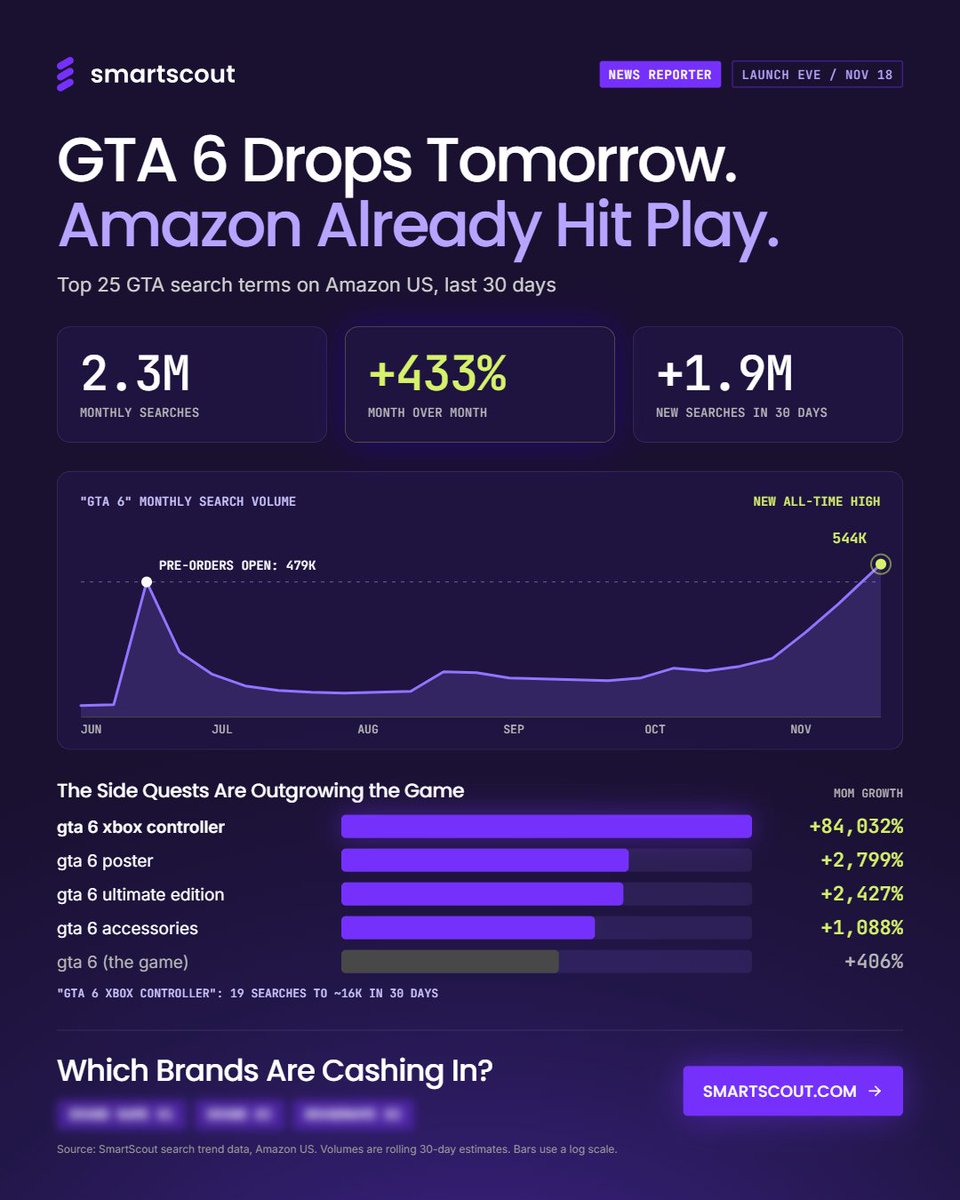
GTA 6 drops tomorrow, and Amazon shoppers have been in Vice City for weeks already.
The top 25 GTA search terms on Amazon just hit 2.3M monthly searches, up 433% in a month. “gta 6” itself just passed 544K, beating the record it set the day pre-orders opened.
But the game is the least interesting part. “gta 6 xbox controller” went from 19 searches to almost 16,000 in 30 days. Posters, ultimate editions and accessories are all growing 3x to 200x faster than the game.
Somebody is cashing in on all those side quests. We know exactly who. 👀
Is AI going to make us lazy? 🤔
Short answer: only if you let it.
AI can connect dots all day. But if you don’t understand your category, your marketplace, and the data you’re feeding it, you’re getting crap in, crap out.
And even when the analysis is solid, there’s still the “so what.” The story. That part still needs a human.
Full episode Out Now On YouTube!!!
The 100 most important Marketplace Companies. Anker #1, Thrasio #2.
In 2020, Marketplace Pulse released "The Marketplace 100".
This was peak COVID. The industry was booming. But a lot has changed.
So I set out to update it for 2026. And if you can't guess.... Thrasio is no longer #2.
(Congrats, Pattern?!?)
The Marketplace 100 | 2026 Edition: https://t.co/hRuPFGbkcZ
CONTEXT:
Marketplace 100 was first released in 2020.
My Amazon business was included.
It was nice to be included, but I didn't think it would mean too much.
But then, after I hired my first developer at SmartScout. He told me that because my business was on the list, he trusted me more and took the job.
Six years later, he's still leading our development.
But that list was six years ago. A lot has happened. Bankruptcies, Acquisitions, Launches. Hell, it was 3 years ago before TikTok Shop even opened its doors.
BACKGROUND:
Instead of an editorial judgment on the top 100 companies. We used data points across 5 metrics to determine the most important companies. The full criteria and dataset behind this are viewable.
Do you agree with the list?
I have some qualms with the list (agencies seem a little high?). But I do believe there has to be a set of criteria, and I worked out what I thought would be the most accurate. So, if you have suggestions for next time. Let me know!
Halloween’s over. Amazon already moved on.
One aisle grew 415% in the last 30 days, and it’s the thing you’ll be getting rid of on Christmas morning.
Holiday yard decor just did a $51M month. Matching family onesies are back. And space heaters are flying off the shelf because apparently it’s cold now.
Swipe for November’s hit list. Want the brands winning each one?
"I sure hope Amazon simplifies their fee structure."
-Every Amazon Seller
I recall programming every single fee structure into our system. One line at a time.
We had to get it correct for the 100k ASINs we were selling via FBA.
Good thing you can just slop this into AI and it'll do lots of the heavy lifting.
But look at how complex the fees are getting! So many buckets you can fall into. I'm counting 27... but it's actually 18 because apparently $10-$50 and $50+ are the same price.
If I'm being honest. This doesn't change my opinions of FBA that much. It's still the GOAT. We'll still love it. The same day and next day delivery for the millions of ASINs is undefeated.
But just gotta look at this!
Maybe next year they'll create a formula that can apply to more than just one size tier.
Maybe.
Amazon’s new AI full funnel ads are posting some insane ROAS numbers. 👀
Look closer and most of that spend is going to branded search. Those are shoppers who were already typing your name in, and now you’re paying to catch them.
And right now you can’t see under the hood or control where the money goes. Branded vs. new-to-brand is Amazon’s call, not yours.
I love the idea. Ads that work without being an ads expert is a big deal. But it’s early. Let Amazon dial it in before you hand over the budget.
Full Video Live On YouTube!!!
The old SEO playbook is running out of road. 🛑
Keyword stuffing and gaming the algorithm won’t hold up much longer. AI is getting smarter fast, and most listings are still written only for human shoppers.
Our guest’s bet is that the future of commerce will be agent-driven. By 2027, a big share of customers may never look at your listing at all.
They’ll tell an AI agent what they need and trust it to finish the purchase.
So who is your listing really written for? 👀
Full episode out now on YT
Amazon’s 2027 FBA fees are forcing expensive products to subsidize cheap ones.
Look at a small-standard product weighing 2 oz or less:
• Priced below $10: $2.64 to fulfill
• Priced $10–$50: $3.75 to fulfill
• Priced above $50: $4.31 to fulfill
Same size tier. Same weight bracket. A $1.67 difference based on the selling price.
Like... wow.
It's clever I gotta give them that.
I don't blame them. The cheap stuff is hyper competitive.
The higher-priced product pays 63% more in fulfillment fees.
And that gap is widening. In 2026, the difference between the lowest and highest price brackets was $1.15.
In 2027, it becomes $1.67.
These are non-apparel, non-peak rates, before the fuel and logistics surcharge.
My read: Amazon is using higher-priced products to help keep fulfillment affordable for lower-priced selection. The rate card doesn’t prove the underlying cost allocation, but it clearly shifts more of the fee burden toward expensive products.
There’s a business rationale here. A few dollars in fulfillment fees can make a $7 item difficult to sell profitably.
But for premium brands, this means your selling price affects more than your referral fee. It also changes what Amazon charges to fulfill the order.
Any true Amazon guru knows that you never sell a product for $10.49. You're hurting everyone there. Except for Andy Jassy.
Meta’s Muse picked up 10 million users in its first 6 weeks. 🤯
If it feels like you see a Muse ad every time you open an app, that’s because Meta is pushing it hard.
For sellers, the stat that matters is this one: over 25% of weekly active users ask it shopping questions. They’re using an AI assistant to decide what to buy.
So when a shopper asks Muse for the best product in your category, does your brand come up? 👀
FULL EPISODE LIVE ON YOUTUBE!!
Amazon is blocking shopping agents.
Except they're not.
In just a few seconds, I had Grok Bot buy something for a friend.
I had the agent do it because I didn't want to browse too much or manually enter another address.
So......
Agentic Shopping is here? For Amazon Sellers?
This is a very new dynamic that can have big impact for both small and large sellers.
I've tested at least 20 AI Visibility tools. I'm in them nearly daily.
There are two levers you have.
Improved Content.
Inclusion in Relevant Sources.
That's going to be more important than anything else riding into 2027.
I hated agentic shopping last year.
The switch has been flipped. It's coming. Fast.
What's the best solution here for sellers?
“There’s no such thing as free shipping.” —Abraham Lincoln (probably)
If you're an Amazon Seller. The cost of shipping is baked into the selling price.
Because someone does pay to get that package to your door.
I decided to track Amazon’s fulfillment fees for a 2-pound small-oversize example, starting when FBA launched:
• 2006: $5.76
• 2014: $5.76
• 2015: $6.03
• 2016: $6.54
• 2017: $7.24
• 2018: $8.51
• 2019–2020: $8.64
• 2021: $9.04
• Early 2022: $9.32
• April 2022: $9.79
• 2023: $10.15
• 2024–2025: $9.99
• 2026: $8.21
• 2027: $8.18 scheduled
One important detail: Amazon has changed its size tiers. The later figures represent the corresponding product example under newer classifications, rather than an unchanged “small oversize” category.
The interesting part? The cost hasn’t moved in only one direction.
The 2027 figure is about 42% above the launch-year fee, but below the 2023 figure. That's because they introduced placement and low inventory fees.
These are nominal fulfillment fees and exclude storage, inbound shipping, referral fees, and other applicable charges.
For sellers, that’s a reason to check the actual dimensions and fees of your products each year.
A headline about average fee increases won’t tell you what happens to your specific catalog.
What do you think?
8 lessons from Operators on taking Amazon seriously in a multichannel world.
CONTEXT: Mike Beckham Turned an Amazon business into a brand. He's on shelves in major retail and has seen multiple brands and categories succeed.
When he says something about Amazon on his channel. I listen.
1. "Amazon is not over 50% of our revenue, but it is over 50% of our contribution profit."
2. "You go out of stock and you just drop off the algorithm."
3. "Your best stuff is going to be your best stuff no matter the channel."
(Katy Mimari saw Caden Lane's Amazon sales improve after adding proven bestsellers. Jason Panzer's advice was simple: put your best products there.)
4. "Losing website sales to Amazon may be overstated. The bigger risk is price conflict with retail partners like Target, Walmart, and Costco." Don't worry about cannibalization. Look at pricing parity in retail so you don't get price compared by robots.
5. "Amazon needs an owner with authority. An agency can execute, but it can't make the trade-offs for you." Mike say's you must have an executive in the Amazon loop.
6. "Amazon is basically your resume to the customer."
Your presence matters even when Amazon isn't where the sale happens. Shoppers check reviews there after discovering you somewhere else.
7. "You have 20 products on Amazon. You can put 10 products on deal on Prime Day and not put the other 10."
Design promotions for total profit. As Beckham describes it, many shoppers come for the deal and then pick a full-price variation.
What a great listen! Operators episode 188
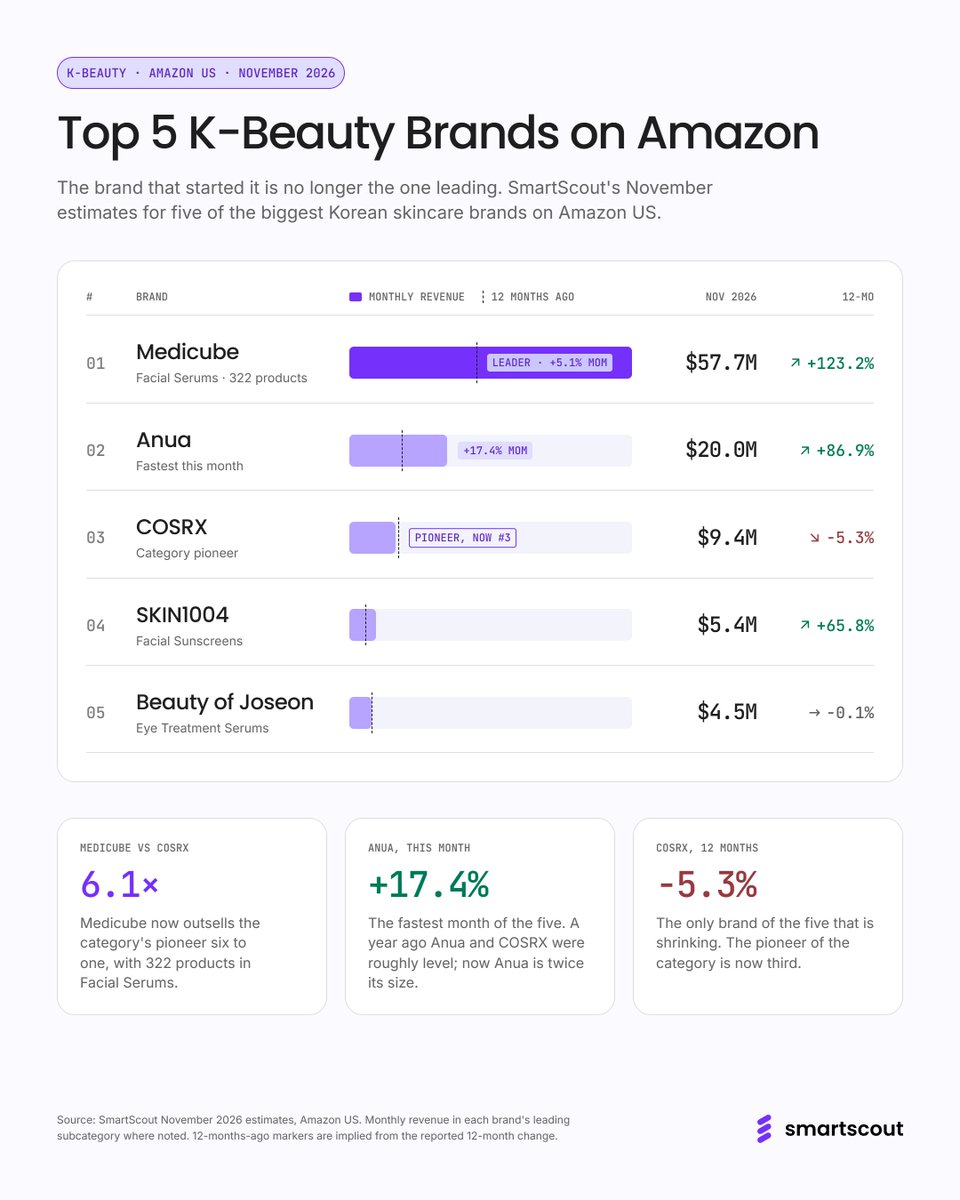
The Brand that built K-Beauty is no longer running the show.
COSRX, the pioneer, is getting beat by Medicube... and it's not really that close anymore.
If you peak over into the TikTok Shop, they are so so dominant. No one compares.
We looked at SmartScout's November estimates for five of the biggest Korean skincare brands on Amazon US. Here's how each one is doing:
• Medicube: $57.7M/month in Facial Serums, up 123.2% over 12 months, across 322 products. It's the clear leader and still growing (+5.1% this month).
• Anua: $20.0M/month, up 86.9% over 12 months. Its +17.4% this month is the fastest of the five.
• COSRX: $9.4M/month, down 5.3% over 12 months. The pioneer of the category is now third.
• SKIN1004: $5.4M/month, up 65.8% over 12 months. It's growing in Facial Sunscreens, not serums.
• Beauty of Joseon: $4.5M/month in Eye Treatment Serums. Flat over 12 months (-0.1%).
What other sellers can learn:
1. Being first doesn't mean you stay on top. COSRX taught US shoppers to buy K-beauty on Amazon, and newer brands took the growth.
2. These brands treat Amazon as their own direct channel. Each one does 81–99.8% of its sales through its own seller account, and Amazon isn't the main seller for any of them. They control pricing, content and inventory themselves instead of wholesaling to Amazon.
3. The categories are still wide open, even at the top. Medicube leads Face Moisturizers ($134.7M/month) with only 5.6% share across 3,940 brands. In Facial Serums ($127.2M/month) it has 7.4% across 2,310 brands. Even the leader holds a small share, so there's plenty of room left.
4. Growth comes from claiming a category, not from copying the leader. SKIN1004 is growing on sunscreen while everyone else fights over serums. A narrower niche you can own can beat a crowded one.
Amazon just launched new FBA Fees. Let's take a look at what the fees were up to now!
What did it cost to fulfill a small product through Amazon when FBA launched?
We tracked an 8 oz small-standard item from the beginning:
• 2006: $2.42
• 2014: $2.48
• 2015: $2.54
• 2016: $2.56
• 2017��2019: $2.41
• 2020: $2.50
• 2021: $2.84
• Early 2022: $3.07
• April 2022: $3.22
• 2023: $3.58
• 2024–2025: $3.43
• 2026: $3.66
• 2027: $4.11 scheduled
About 70% higher than at launch, before adjusting for inflation.
The interesting part is when it happened. In 2019, the fee was still a penny below its 2006 level.
There's no such thing as free shipping on Amazon. The shipping is baked into the cost. So when fees goes up. Prices go up.
Full history:
https://t.co/uqe6OErQyj
1 in 5 American households now has someone on a GLP-1.
So we checked Amazon. One supplement aisle is up 39% in a year, and it’s not the one with the flashy packaging.
Protein drinks, meal replacements and electrolytes are all riding the same wave. Meanwhile potato chips are down and spaghetti is quietly losing its spot in the cart.
When the news changes how people eat, it changes what sells. Swipe for the full winners and losers. Want the revenue behind them?
The after effects of GLP-1 are visible on Amazon shelves.
All the largest Protein brands are getting bigger.
The surprising grower is Ghost. An unlikely candidate to jump into Protein Powder and start taking serious market share.
They are growing the fastest, but its hard to catch up with those that have been selling protein for years.
“Your product has to be under $15 and sold to young women. That’s the only way to win on TikTok Shop.”
That’s the advice everyone gave our guest when they started. Their actual customers are over 65, and the product costs more than $50. So that’s every rule broken, and it still works.
The bigger point is that a category that looks small on TikTok Shop usually means nobody has cracked it yet. That doesn’t mean it can’t be cracked, and it doesn’t mean you can’t be the one to do it.
Nobody knows what TikTok Shop will look like 6 months from now. 👀