One year ago, I knew almost nothing about crypto.
A year later, I've gained a much deeper appreciation for the intersection of innovation, consumer protection, and public policy.
Here are a few thoughts on what I've learned and why I believe this conversation is about much more than digital assets. Why now is the time for Congress to pass The Clarity Act with essential protections for developers.
Thank you to the incredible team at the @fund_defi for expanding my perspective and challenging me to think differently every day.
https://t.co/RQpuse2B77
"At the heart of America's innovation story lies a simple truth: protecting individual rights and freedoms fuels progress....When it comes to building the digital financial systems of tomorrow, safeguarding the rights of software developers and users is not just smart policy, it’s a reflection of what it means to be American."
Check out a new piece from DEF's @itstaliad at the link below 👇
As someone new to crypto and DeFi, I’ve seen how the technology could reshape financial freedom in America.
In my new piece for @fund_defi I explore why this innovation transcends politics.
https://t.co/MwWLcRT3Qz
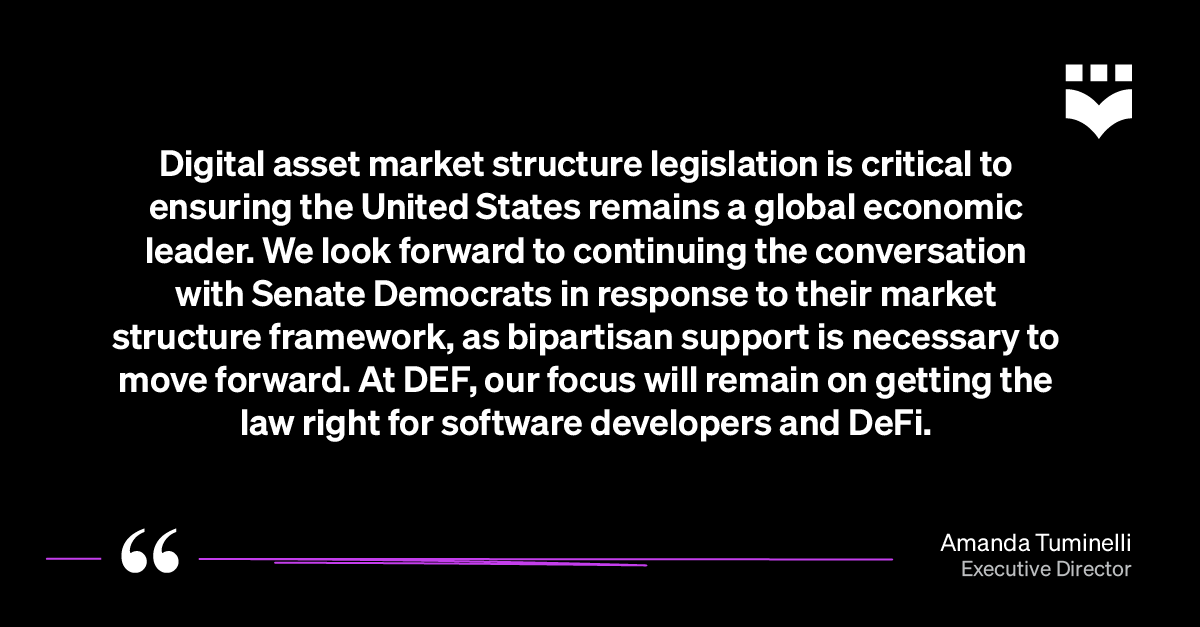
"The DEF team remains unwaveringly committed to continuing constructive, nonpartisan engagements to advance digital asset market structure legislation. We are at a pivotal moment in crypto’s history where there is an unprecedented amount of bipartisan interest from lawmakers and regulators to develop clear, practical rules for crypto. DEF recognizes this is an important opportunity to establish durable policies that simultaneously protect consumers, software developers, and users of this evolving technology, and we will continue to educate, build coalitions, and advocate for a successful outcome."
1/ [🚨NEW] DeFi Education Foundation is excited to debut a national study by @Ipsos KnowledgePanel and supplemented by in-depth interviews from the Bronx & Queens, NY, providing timely insights into how Americans view the U.S. financial system & emerging tech, like DeFi! 👇
Today, a coalition of 100+ signatories join DEF in sending a letter to Congress.
Software developer protections are a non-negotiable in digital asset market structure legislation. This critical issue unites us — crypto and tech builders, investors, and advocates.
NEW from DOJ on Section 1960 policy:
We may, under certain circumstances, bring cases under Section 1960(b)(1)(C), which prohibits the transmission of funds that the defendant knows are derived from a criminal offense, or are intended to be used to support unlawful activity. However, going forward, consistent with principles of notice and fairness, let me make the following clear:
Many developers have relied on regulatory guidance to suggest that non-custodial cryptocurrency software does not constitute an unlicensed money transmitting business. While that guidance may not be binding on the Department, its implications can of course factor into prosecutors’ charging decisions. Therefore, where the evidence shows that software is truly decentralized and solely automates peer-to-peer transactions, and where a third party does not have custody and control over user assets, new 1960(b)(1)(C) charges against the third-party will not be approved. Though, if criminal intent is present, other charges may be appropriate. All of a subject’s conduct and the services they provide end-to-end will be considered.
Generally, developers of neutral tools, with no criminal intent, should not be held responsible for someone else’s misuse of those tools. If a third-party’s misuse violates criminal law, that third-party should be prosecuted — not the well-intentioned developer.
The ACTING HEAD OF THE DOJ CRIMINAL DIVISION just stated the following regarding Section 1960(b)(1)(C) and third-party liability for software developers:
“We may under certain circumstances bring cases under Section 1960(b)(1)(C), which prohibits the transmission of funds that the defendant knows are derived from a criminal offense, or are intended to be used to support unlawful activity. However, going forward, consistent with principles of notice and fairness, let me make the following clear:
Many developers have relied on regulatory guidance, to suggest that, non-custodial cryptocurrency software does not constitute an unlicensed money transmitting business. While that guidance may not be binding on the department, its implications can of course factor into prosecutor’s charging decisions. Therefore, where the evidence shows that software is truly decentralized and solely automates peer-to-peer transactions, and where a third-party does not have custody and control over user assets, new 1960(b)(1)(C) charges against the third-party will not be approved. Though, if criminal intent is present, other charges may be appropriate. All of a subject's conduct and the services they provide end-to-end will be considered.
Generally, developers of neutral tools, with no criminal intent, should not be held responsible for someone else's misuse of those tools. If a third-party's misuse violates criminal law, that third-party should be prosecuted – not a well-intentioned developer.”
The President’s Working Group on Digital Assets just released its long-awaited report.
On first glance, we are pleased by the recognition of DeFi, self-custody, and financial privacy as priorities and look forward to diving in.
Stay tuned for more from the DEF team.
https://t.co/ivjXUoBKrq