After too many hours of research/DD to count, these are my Top 5 AI Stocks in the Top 5 AI Sectors to Invest in:
1. Neoclouds: The GPU & Compute landlords. Whoever owns the compute owns what every AI company on the earth needs to grow & succeed.
$NBIS - Nebius. Spun out of Yandex, rebuilt as a pure-play AI cloud. Microsoft and Meta committed billions in contracted backlog. The fastest growing neocloud on the board. My favorite pick as a long-term investment.
$CRWV - CoreWeave. The American-founded neocloud. SemiAnalysis rated this Neocloud in a class of it's own, which can not be understated. Deals with Anthropic, OpenAI, Meta, Perplexity, Google, Microsoft... the list goes on forever.
$HUT - Hut 8. Started as a bitcoin miner, pivoted hard into AI hosting and power infrastructure. Owns the power, not just the GPUs. They're landing deals left and right, definitely an underappreciated sleeper pick.
$APLD - Applied Digital. Same playbook. Former crypto miner now building purpose-designed AI data center campuses with long-term hyperscaler leases.
$CIFR - data center host for Anthropic's directly, purchased Google TPU v7 Ironwoods (400K units, ~$10B), backed by a 10-year, $3B+ Fluidstack hosting deal where Google guarantees $1.4B of lease obligations for a 5.4% equity stake. One of the only neocloud-adjacent names with real exposure to Google's silicon instead of pure Nvidia GPU rental.
2. Optical / Photonics:
Because every GPU is useless if it can't talk to the GPU next to it.
$CRDO - Credo. The connectivity layer inside every AI cluster. Active electrical cables and DSPs that scale with every rack hyperscalers deploy.
$LITE - Lumentum. Legacy telecom optics company that's become a core 800G/1.6T transceiver supplier for the AI buildout.
$ALAB - Astera Labs. Connectivity chips that solve the bottleneck between GPUs, memory, and storage. Pure-play AI infrastructure with almost no legacy drag.
$COHR - Coherent. Lasers, optical components, and transceivers spanning the entire photonics stack from datacom to industrial.
$MRVL - Marvell. Custom silicon and photonic fabric for hyperscalers. The company quietly inside more AI racks than people realize.
3. Memory:
The most cyclical, most violently mispriced sector in semis. HBM demand changed the entire setup.
$DRAM - DRAM ETF. One ticker, every important memory company on the planet, including South Korean companies like SK Hynix and Samsung Electronic, companies you CAN'T INVEST IN with most brokerages.
$SNDK - SanDisk. Spun off from Western Digital, now a pure-play NAND flash story riding the same supply tightness as everyone else in this sector.
$MU - Micron. One of three companies on Earth that makes HBM. The clearest direct line from AI buildout to memory revenue.
$WDC - Western Digital. Hard drive and enterprise storage demand riding the same data center capex wave as everything else on this list.
$STX - Seagate. The other half of the storage duopoly. Enterprise nearline drives are seeing the same supply crunch dynamics as memory.
4. Analog / Power Semis:
Unsexy. Necessary. Every data center, every EV, every robot needs power management silicon that doesn't get the AI premium yet:
$MXL - MaxLinear. Smaller-cap analog and mixed-signal play with infrastructure and data center exposure that's still flying under the radar.
$STM - STMicroelectronics. European chip giant spanning auto, industrial, and power semis. Way out of favor relative to its diversification.
$ON - ON Semiconductor. Power semis for EVs and industrial, now leaning harder into data center power delivery as a growth vector.
$VSH - Vishay. Passive components: resistors, capacitors, diodes. Boring until you realize literally everything electronic needs them.
$POWI - Power Integrations. High-voltage power conversion chips. Small cap, niche, and positioned for the power efficiency problem AI data centers haven't solved yet.
5. Physical AI / Robotics:
It's coming, soon, and the market is beginning to realize it.
$OUST - Ouster. Lidar for robotics, industrial, and autonomy. Consolidated the space after merging with Velodyne, now the survivor.
$VICR - Vicor. High-density power modules for robotics, AI servers, and defense. Power delivery at the component level, not the rack level.
$VPG - Vishay Precision Group. Precision sensors and strain gauges. The torque and force-sensing hardware that gives robots a sense of touch.
$AEVA - Aeva. 4D lidar with built-in velocity sensing. Smaller and earlier stage than the rest of this list, highest risk, highest ceiling.
$AMBA - Ambarella. Edge AI vision chips. Powers the cameras and perception systems inside cars, robots, and security infrastructure.
I believe a portfolio with these 25 names will severely outperform the market over the next few years. I have 7 figures throughout many of these names. These are all names I'm currently invested in, or plan on investing in in the near future.
None of this is financial advice.
🌐 THE FUTURE ECONOMY -> mapped
Forget the headlines. Here's the infrastructure the next decade actually runs on, and the names building each layer 🧵👇
💡 PHOTONICS - light replaces copper
$CRDO · $SIVE · $AAOI
The interconnect bottleneck of AI. Every GPU cluster moving from electrons to light.
🔷 GLASS & OPTICAL MATERIALS - the substrate light runs on
$GLW · $LPTH · $LPKF
The fiber that carries the signal, the infrared optics that shape it, the glass cores going into advanced packaging.
⚙️ AI INFRASTRUCTURE - the compute buildout
$IREN · $NBIS · $DGXX
Power, data centers, neoclouds. The physical backbone of the AI economy.
📡 CONNECTIVITY & RF - moving the signal
$AMPG
Re-shored 5G and the RF signal chain. The certified domestic alternative for 5G networks, SATCOM, and defense.
🤖 PHYSICAL AI - intelligence that acts
$OUST · $AMBA · $KRKNF
The eyes, the brain, and the body. AI moving into the real world.
🛸 AUTONOMY & DRONES - machines that operate themselves
$ONDS · $AUR · $MRLN
Aerial drones, driverless freight, autonomous flight. The re-shored defense and logistics layer.
⚡ ENERGY & STORAGE - powering the buildout
$TE · $EOSE · $SPKL
Domestic solar, long-duration grid storage, and short-duration data-center backup. The full duration stack.
🪨 CRITICAL MINERALS - the hard constraints
$MP · $UAMY · $ASPI
Rare earths, antimony, nuclear fuel. The materials China controls that the West must re-shore.
🚀 SPACE - the orbital economy
$ASTS · $RKLB · $PL
Direct-to-cell satellites and the launch backbone.
The thesis in one line: own the chokepoints and physical inputs the digital economy can't function without.
The screens get the attention. The infrastructure gets the returns.
🤖Physical AI is the next trillion-dollar buildout, and the market is still pricing it like a demo reel.
It's also just one layer.
Here's the whole map of what the next decade actually runs on, and the names building each piece 👇
In 2023, the AI trade was $NVDA and the hyperscalers. The brains. In 2026, the body went into production. Figure's factory is reportedly turning out a robot an hour. Boston Dynamics has its entire 2026 Atlas output pre-committed to Hyundai and DeepMind. Unitree shipped more than 5,500 humanoids last year and is targeting five figures this year.
Demos don't need supply chains. Production lines do. Every robot that ships is a bill of materials, and every line on that bill is a company. The market pays full price for cash flow after it arrives. The asymmetry is owning the chokepoints before it does.
Robots can't run on vibes. Here's the stack that builds them, asymmetric setups up top, anchors at the base.
THE ASYMMETRIC SETUPS��
Small-cap chokepoints. Multiple-X potential if the theme delivers.
🧠 BRAIN: Edge Compute
$AMBA: edge-AI vision SoCs with a 46M-unit installed base, and a fresh Hanwha LTA worth $800M+ over a decade spanning robotics, industrial automation, and security. One of the first deals of its kind in edge AI.
$CEVA: the IP royalty toll on edge silicon. Every device that thinks locally pays someone for the architecture.
$AIP: the on-chip highway. Network-on-chip IP licensed into the SoCs the robots run on.
👁 EYES: Perception
$OUST: digital lidar plus cameras after the Stereolabs deal. Q1 revenue +49%, the 13th straight quarter of product revenue growth, and Rev8, the first native-color lidar. The company calls itself sensing and perception for Physical AI, and the numbers back the name.
$AEVA: FMCW 4D lidar that reads velocity, not just distance. Exclusive long-range lidar supplier for Daimler Truck's autonomous program.
💪 MUSCLE: Magnets
$USAR: commercial NdFeB magnet production live in Oklahoma, ramping toward 1,200 tonnes by early 2027, with a new South Carolina plant targeting 10,000 tonnes of domestic capacity. China still makes roughly 90% of the world's magnets. Every robot joint needs one.
⛏ FEEDSTOCK: Upstream Supply
$MP: the domestic mine-to-magnet chain. The raw input the chokepoint runs on.
🦾 BODY: Embodiment
$KRKNF: subsea autonomy, the rare robotics name already adjusted-EBITDA positive. Q1 revenue +35%, and the C$615M Covelya deal closes within weeks, taking the combined company to roughly C$365M of revenue at a 24% EBITDA margin. The ocean is a robotics theater too.
$RR: service humanoids built on NVIDIA's robotics stack.
$SERV: autonomous sidewalk delivery, spun out of Uber, NVIDIA-backed.
$PDYN: embodied-AI software for industrial robots and drone swarms.
🛸 AUTONOMY: Air & Ground
$ONDS: Q1 revenue up 10x to $50M, full-year guidance raised to $390M+, backlog at $457M, and $1.48B in cash to keep consolidating. The Mistral deal brought U.S. prime contractor status, including participation in a $982M Army loitering-munitions program.
$RCAT: tactical defense drones, built for the NDAA-compliant procurement lane.
$AUR: driverless freight, commercially live in Texas. The first robot most of America will share a road with is a truck.
⚡ POWER: The Nervous System
$NVTS: GaN and SiC power semis, working with NVIDIA on the 800-volt architecture the next datacenter and robot generation runs on. Efficiency is the constraint as fleets scale.
🎒 FIELD COMPUTE: Edge AI Deployed
$OSS: datacenter-class AI compute ruggedized for drones, vehicles, and defense platforms. The brain has to survive the field.
🏛 THE ANCHORS
Own the theme durably. Not asymmetric, but they cannot lose the war.
$NVDA: Isaac GR00T and Jetson Thor. The OS every robot trains on, and the checkbook funding the whole stack.
$TSLA: Optimus. The only player with the manufacturing base to brute-force mass production.
$TER: industrial automation and cobots. Universal Robots already on factory floors.
$QCOM: the Dragonwing edge platform. The fleet's connectivity layer.
$ARM: the IP tax inside nearly every edge chip.
$POWI: the established, profitable high-voltage power anchor.
$ISRG: surgical robotics. Proof the category can print money, decades ahead of the rest.
The asymmetric upside lives in chokepoints capital can't easily replicate: IP, perception, magnets. The anchors are how you own the theme while you wait.
The counter-thesis, because every map needs one. Most of the asymmetric layer is pre-profit, and the real revenue inflection is 2027 and beyond. China is the other side of this trade: Unitree and AgiBot are shipping volume at price points Western names can't yet touch, and if embodiment commoditizes the way solar did, the hardware layer gets squeezed while the IP and feedstock layers keep the margin. Several of these names have already re-rated hard this year. This is a patient, multi-year allocation. Size accordingly.
The robots stopped being demos this year. They became purchase orders.
Own the parts inside them.
Bookmark this one. It will still be the map when the cash flow shows up. Then tag the investor still pricing robots as science fiction.
Jensen Huang just explained AI in a way that makes the investment thesis for Nvidia almost impossible to argue with (Save this).
He said a single gigawatt AI factory costs around $50 billion to build but that same factory generates $300 to $400 billion worth of intelligence over its lifetime.
That is a 6 to 8x return on a physical asset, which is a better production ratio than oil, better than semiconductor fabs, better than almost any industrial asset class that has ever existed.
And these factories are being built right now, at scale, all over the world.
If you are a hyperscaler or a government or a sovereign wealth fund, you are not buying GPUs, but rather buying an intelligence production machine with extraordinary returns on capital.
That is why hyperscalers are committing $660 to $690 billion in AI infrastructure spending in 2026 alone, they have done the math and the math works.
Nvidia's numbers confirm every part of this.
The company just reported $81.6 billion in revenue for the quarter ended April 2026, up 85% year over year with data center revenue of $75.2 billion, up 92%.
Data center is now 92% of Nvidia's total revenue, and it is growing faster, not slower.
Jensen also said something that did not get enough attention.
He sees 2027 as a year where Nvidia's revenue could reach $1 trillion.
Keep in mind their revenue was $60 billion in 2023, $130 billion in 2024, $216 billion in 2025 and at that growth rate, $1 trillion by 2027 is not a s the base case if AI capex holds.
Come join Milk Road Pro for just a $1 for our full breakdown on Nvidia and how to capitalize on the hidden bottlenecks within the industry.
Link down below
This bull cycle will last far longer than Wall Street expects.
There is no bubble. AI infrastructure and semiconductor demand are still in the early stages, supporting S&P 500 earnings growth toward $650 by 2031.
Inflation is not the issue many claim; a supply shock simply changes relative prices. Why does everyone forget their undergraduate economics?
Warsh is not a hawk.
We are also heading toward a constructive Iran deal that restores risk-on momentum.
Ignore the doomers. This cycle has substantial room to run.
The reason I own $AAOI is because it builds the optical connectivity that lets AI chips move data across data centers.
As AI scales toward 500K+ GPU factories, copper becomes the bottleneck & optics become plumbing that moves data fast enough for training & inference to work.
(1/9) Keeta and ASK Group @askgroupae, a UAE-based investment group led by His Highness Sheikh Ahmed bin Sultan bin Khalifa bin Zayed Al Nahyan @asknahyan, have created a joint venture aiming to tokenize tens of billions of dollars of commodities and modernize cross-border payments in the Gulf Cooperation Council (GCC) region and beyond, contributing to the UAE's vision and commitment to growth as a global leader in digital finance and real-world asset infrastructure.
“The market is in such a bubble.”
Yet here are the 2027 earnings multiples for some of the largest companies in the world:
• $ORCL ~26x
• $AMZN ~25x
• $GOOGL ~25x
• $MSFT ~22x
• $NOW ~22x
• $AVGO ~20x
• $TSM ~19x
• $DELL ~19x
• $NVDA ~16x
• $META ~16x
• $CRM ~12x
• $SNDK ~9x
• $MU ~8x
The jobs report was a barnburner. Nonfarm payrolls increased by 172,000 versus expectations for 88,000, while prior months were revised higher by 93,000. Wage growth came in at roughly 0.3%. Yet the market sold off. In our view, the market is misreading the signal. It is assuming that stronger than expected employment and growth will cause a an acceleration in inflation. History would suggest otherwise. Productivity growth is running near 3%, while unit labor costs are hovering around 0.5%. Those are not the hallmarks of an inflationary boom. They are the hallmarks of healthy, productivity-driven growth that will lower inflation. Meanwhile, the yield curve continues to flatten despite a roughly 55% increase in oil prices year-over-year based on a three month moving average. In past cycles, an energy shock of this magnitude steepened the yield curve when the Federal Reserve was accommodating it. Instead, the bond market appears to be discounting something much more powerful: the deflationary impact of technological innovation, particularly artificial intelligence, which is beginning to increase productivity across broad swaths of the economy. If tensions with Iran ease and oil prices retreat, we believe inflation could move into negative territory before year-end. In our view, the Fed made a historic policy error when it raised rates aggressively into what was largely a supply-driven inflation shock in 2022. We do not believe the next generation of monetary policymakers will be eager to repeat that mistake. Notably, gold peaked on the day Kevin Warsh was appointed. The inflation trade may already be behind us. If our research is correct, the next phase of this cycle could be characterized by accelerating growth, declining inflation, falling interest rates, and a strengthening U.S. dollar. That combination would create a remarkably supportive backdrop for innovation-led equities and the technologies driving the next productivity boom. I discuss this framework in greater detail in this month’s episode of In The Know.
I multiplied my portfolio going all-in on $NBIS last year, and I believe $BRUN can run even faster. Just read the FACTS:
1,233% year-over-year ARR growth. ARR tripled from $30M to $96M in 4 months. Contracted backlog went from $120M to $1.45 billion in the same window. FY2026 ARR guidance of $400M+. Free cash flow positive at 15-20% margins.
NVIDIA Exemplar Cloud status. One of only 6 companies in the entire world to hold this designation. The others? CoreWeave. Nebius. Crusoe. Lambda. Vultr. YTL. Companies valued at $3.5B to $65B. The average market cap across all NVIDIA Exemplar Cloud holders is $27 billion.
$BRUN’s market cap is $1.2 billion.
That is not a typo. The average peer in this group is worth 22x more than BRUN right now. CoreWeave and Nebius are each 54x larger. Even Vultr, the smallest private peer, is a 3x premium to where BRUN trades today.
And it is not like BRUN is sitting here without business. $940M in long-term contracted revenue at listing. $1.45 billion in backlog. Majority of that revenue already in production. Multiple enterprise deals signed. 8 data centers live nationally. Running B300s and H200s on NVIDIA reference architecture. Preferred Cloud Partner status on top of Exemplar certification.
The infrastructure is real. The contracts are signed. The revenue is recurring. The growth rate is 1,233%.
There are 6 other companies with NVIDIA Exemplar Cloud status. Their average valuation is $27 billion. One of them trades on the Nasdaq at $1.2 billion.
That one is $BRUN.
I am long $BRUN. Not financial advice. Do your own research.
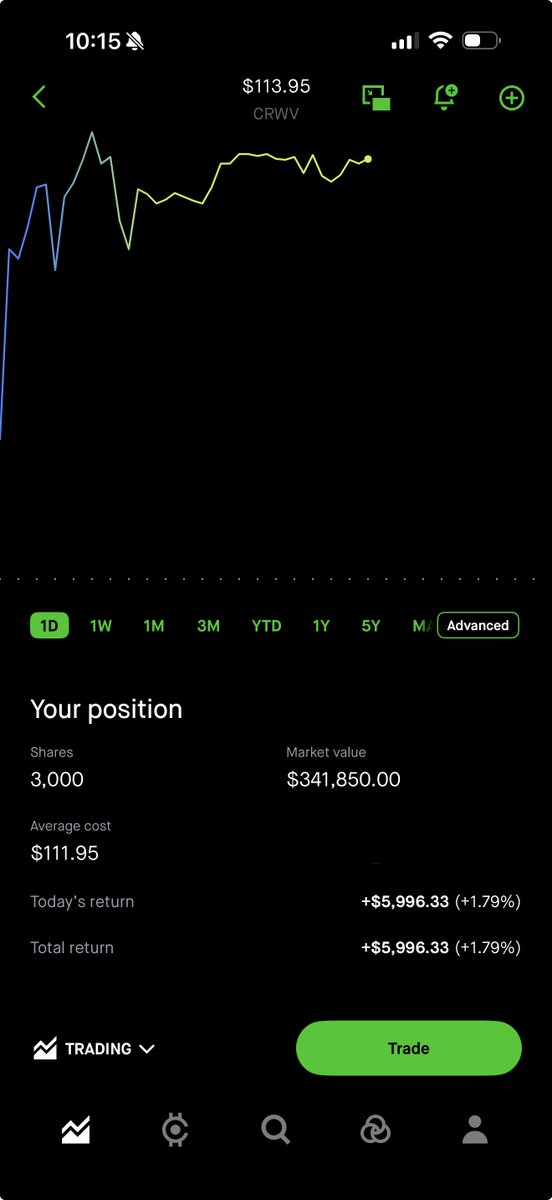
I've initiated a position in $CRWV in the overnight markets.
After being full-port $NBIS for a year, here's why I believe $CRWV is going to skyrocket in price over the next few months:
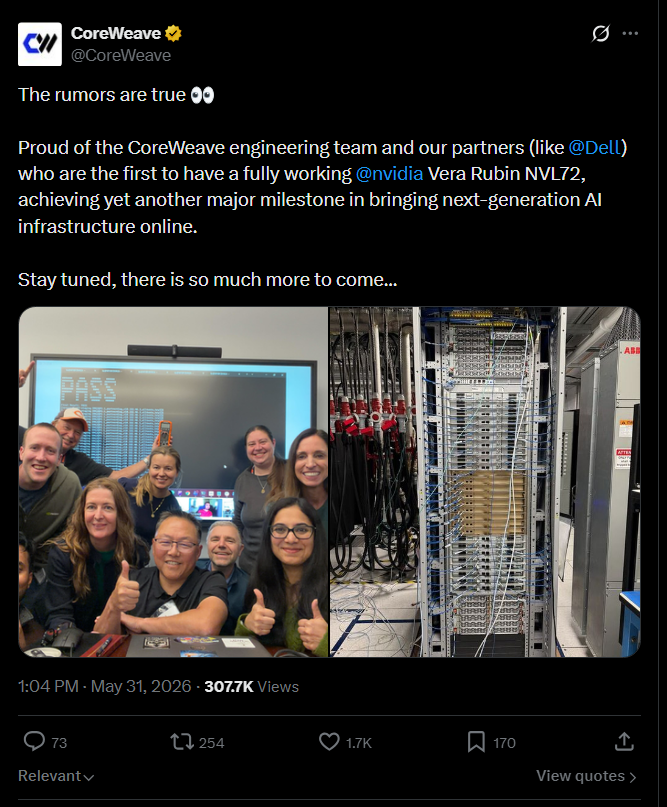
- $CRWV was named one of the first cloud providers to deploy Vera Rubin in H2 2026. Then Nvidia announced a brand new product, the standalone Vera CPU, and named CoreWeave as the first and only known customer. Another $2 billion invested directly into the company. 11% ownership stake. 8 gigawatts of AI factory capacity targeted by 2030.
- The "catch-up" trade: $CRWV is guiding $12 to $13 billion in 2026 revenue. $NBIS is guiding $3.3 billion. Same market cap. 4x the revenue.
The gap exists for a reason. CoreWeave carries severe debt and does not have a raid-boss CEO like Arkady running the show. Those are real risks.
But in a world where every tech company on the planet is compute-constrained, $CRWV has one direction in my opinion.
$200.
- SemiAnalysis, the most respected neocloud research firm in the world, gives CoreWeave their highest tier ranking. Not second. Not tied. Highest. The only cloud on earth with Platinum ClusterMAX status. Two years running.
- Revenue up 112% year over year. Backlog approaching $100 billion. The hyperscalers are customers, not competitors. Meta. Microsoft. Anthropic. They all pay CoreWeave because they cannot build what CoreWeave built fast enough themselves.
- The market cap is $60 billion on a business with $99 billion in locked revenue. Lol.
- I'm not worried at all about their debt. If they're not able to pay their debt for whatever reason, we've got bigger problems IMO.
I am the worlds biggest $NBIS bull, I could name every last aspect of that company, but $CRWV has gotten so cheap in my opinion that I had to take a position.
Not financial advice.
Many assumed $MU was overvalued at $300 in March, yet it has gained over 200% since then.
Many said $SNDK was overvalued at $500 in March, and it has also returned more than 200%.
Now, many are making the same mistake with $NBIS, calling it overvalued at $231 in May.
Leopold Aschenbrenner didn't buy a stock near its all-time highs for a 10% gain. He's likely positioning for a much larger opportunity.
The next six months could be transformative.
At a $58 billion market cap today, consider the potential if AI capex spending increasingly flows into neo-cloud platforms and the company eventually approaches a $200 billion valuation.
EPS has already improved from -2.28 in 2024 to 3.22 in 2026.
This could be the next $SNDK.
Not financial advice. Do your own research.
The US just got its first and only domestic producer of two metals the entire defense industry runs on.
Stock IPO’d at $14 in April and nobody is talking about it.
Here it is:
THREE LAYERS BENEFITING FROM AI COMPUTE REPRICING
Compute pricing is starting to reset higher with long-term contracts being locked in at premium prices, spot markets are firming & the AI infrastructure trade is splitting into three layers:
1. Hyperscalers | $GOOGL, $MSFT, $AMZN, $META, $ORCL, $BABA
These are still the largest buyers & builders of AI compute locking in multi-year capacity because spot availability is increasingly scarce. Microsoft’s $627B commercial RPO (+99% YoY), Oracle’s $553B+ RPO tied to OpenAI compute commitments, Google Cloud’s $460B backlog doubling YoY & Amazon’s $225B+ Trainium 2/3 bookings all point to the same thing that compute scarcity is getting priced into the cloud stack.
2. Neoclouds | $CRWV, $NBIS, $IREN, $WYFI
This is cleanest direct expression of the compute repricing thesis because these companies rent GPU capacity at market-clearing prices to AI-native customers. CoreWeave’s $67B backlog, IREN’s $13B+ contracted backlog, Nebius ~$49B total backlog & WhiteFiber’s $923M+ RPO all point to the same thing that AI-native compute is scarce, contracted capacity is getting locked up years in advance & pricing power is moving toward whoever can bring powered clusters online fastest.
3. High-Performance Computing | $APLD, $HUT, $GLXY, $WULF, $RIOT, $CIFR, $CORZ, $MARA, $CLSK, $HIVE
This bucket may be the most structurally interesting because the core asset is exactly what the AI economy needs most which is power-secured land, grid interconnects, substations, cooling infrastructure & gigawatt-scale operating experience.
2. $TE (T1 Energy)
A rapidly expanding player in the domestic clean energy sector, focused on building an integrated U.S.-based solar manufacturing supply chain.
The Turnaround:
Previously weighed down by regulatory headwinds, complex capital structures, and a constrained cash runway, $TE is now undergoing a major fundamental re-rating.
Driven by surging demand for domestic, Inflation Reduction Act (IRA)-compliant clean energy solutions, Q1 2026 revenue skyrocketed to $177.65 million, up from $53.45 million a year earlier.
The long-term upside depends on securing debt financing for its landmark G2 Austin facility, attracting institutional backing, and capitalizing on the rapidly growing energy demand coming from regional AI data centers.
Leopold Aschenbrenner just filed a 5.6% stake in a single AI infrastructure name.
12.4 million shares.
This is the guy who took his fund from $250M to $13.6B in under 2 years.
Here it is:
My SpaceX-Tesla Strategy
I will not sell a single share of Tesla stock to acquire shares of SpaceX during its Initial Public Offering (IPO).
Based on fundamental data, SpaceX is currently significantly overvalued; and although the company appears highly attractive from a long-term perspective, it will take years for it to grow into its current valuation.
Mayor revenue and profit income is years away and while I have no doubt in the success its a question of opportunity costs.
It is also highly probable that SpaceX stock will prove to be extremely volatile like Tesla and that excellent buying opportunities will arise further down the road so there is no reason to rush.
Tesla, on the other hand, is currently significantly undervalued. In the short to medium term, I anticipate an appreciation in the stock price as massive cash flow and profit levers are about to unlock.
My strategy, therefore, is not to sell a single share of Tesla, as doing so at this moment and time would be a bad deal. $tsla $SPCX
Yes, I need to make sure SpaceX stays focused on making life multiplanetary and extending consciousness to the stars, not pandering to someone’s bullshit quarterly earnings bonus!
Obviously, IF SpaceX succeeds in this absurdly difficult goal, it will be worth many orders of magnitude more than the economy of Earth, but don’t expect entirely smooth sailing along the way.