It’s not a coincidence that the more capitalist a country becomes the less people want to get married.
This is because capital markets make more money the more single people there.
Think about it. Single people generate massive economic activity. A single person requires their own fridge, their own TV, their own subscription services, and their own roof, whereas a married couple pools resources and creates economies of scale in a single home.
The fact that two adults living separately consume more housing, furniture, appliances, insurance, internet subscriptions, and utilities than one couple sharing those goods makes a huge difference in a capitalist economy.
Capitalism thrives on individualism, which is why advertising and consumer culture continually emphasise “personal branding” and “self-care”. Marriage and family, by contrast, require radical compromise and the pooling of resources.
Now, because capitalist culture prioritises the individual consumer, family commitment becomes less and less appealing as advertisements consistently emphasise “personal freedom” and associate this with having fewer family obligations. Everyone is told to “Live life on your terms”, “Do you”, “You deserve it”.
So, rather than building an identity through a family, individuals are encouraged to construct it through careers, fitness, fashion, travel, technology, and various “experiences”.
Because of this, long-term commitments like marriage feel like constraints to people who are accustomed to the idea that there are infinite possibilities out there, which in turn makes marriage feel like settling for less and forfeiting better alternatives.
With this mindset, the ideal participant in a capitalist economy is a “free” individual who continually defines themselves through consumption and whose self-worth is measured by how much they can keep spending and consuming.
Some may argue that this epidemic of singlehood is just a natural progression of civilisation, a sign of the times, and that capitalists are not conspiring to undermine marriage to boost their bottom lines.
But the thing is that, if capitalists did NOT actively fight to create more consumers by encouraging people to remain single, then they would be leaving money on the table and would not be maximising profit and shareholder value. This is the opposite of capitalism. So, it’s very naive to believe they’re not actively pursuing this strategy of keeping people single.
Also, it’s notable that popular culture, which is just capitalism, strongly glamourises solo- and co-parenting because this keeps current individual consumers while birthing new ones. A win-win.
Marketing campaigns explicitly promote single lifestyles and identities because they’re commercially valuable. They don’t have to meet in a room to discuss how to discourage marriage or family formation, they just know what they’re doing.
My argument here is not that capitalists are ideologically opposed to marriage because they want to depress you and steal your soul or something, but that they know that single people are better for profits.
If marriage made more money than singlehood, they’d promote marriage; and then the feminists and Andrew Tate fanboys would be wailing about how “the matrix” is using marriage to enslave them.
So, just in case it’s still not clear, capitalists are not anti-marriage. They’re pro-profit. If stable marriages and large families maximised shareholder returns, they would celebrate them as relentlessly as they currently celebrate individual lifestyles.
But because individual consumers purchase more goods and services per capita than families, firms have a financial incentive to normalise lifestyles that produce more independent consumers.
If a monkey hoarded more bananas than it could eat, while most of the other monkeys starved, scientists would study that monkey to figure out what was wrong with it.
When humans do it, we put them on the cover of Forbes.
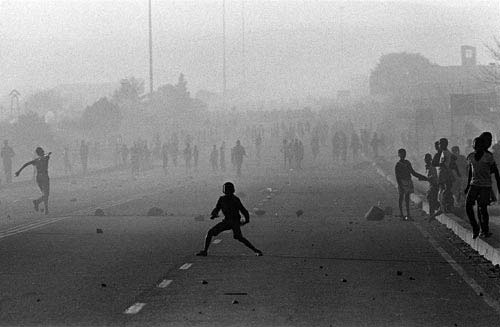
The Last Grave at Dimbaza (1973) is a seminal documentary that provided one of the first unflinching looks at the harsh realities of apartheid in South Africa for international audiences. Shot clandestinely with hidden cameras by South African exiles and British filmmakers, the footage was smuggled out of the country to bypass strict censorship laws. The producers included Nana Mahomo, Antonia Caccia, Andrew Tsehiana. Source: IMDb, Youtube
Websites that feel illegal to know 👀 🌝
1. FlightRadar24
Shows live locations of airplanes. You can track specific flights.
2. 10 Minute Mail
Gives you a temporary email address. It expires after a short time.
3. Hosting Nigeria
Get extremely cheap domain names and hosting for your websites.
4. Temp-number
Gives you temporary foreign numbers for free.
5. Wayback Machine
Search a website and see how it looked in the past. Useful for finding removed content.
6. BugMeNot
Provides shared login details for some websites. Lets you access content without creating an account.
7. Whois
Lets you check who owns a website or domain name. Shows details like when it was created, who registered it, and when it expires.
8. Down For Everyone Or Just Me
Checks if a website is down. Tells if the issue is global or just you.
9. BugMeNot
Provides shared login details for some websites. Lets you access content without creating an account.
10. FutureMe
Write an email to yourself and receive it later. You choose the delivery date.
11. Remove .bg
Removes the background from images automatically.
12. WindowSwap
Shows views from windows around the world. You can switch between random locations.
13. ScanWP
Checks if a website is built with WordPress. Shows the theme and plugins the site is using.
14. Privnote
Lets you send notes that disappear after being read. The message deletes itself once opened.
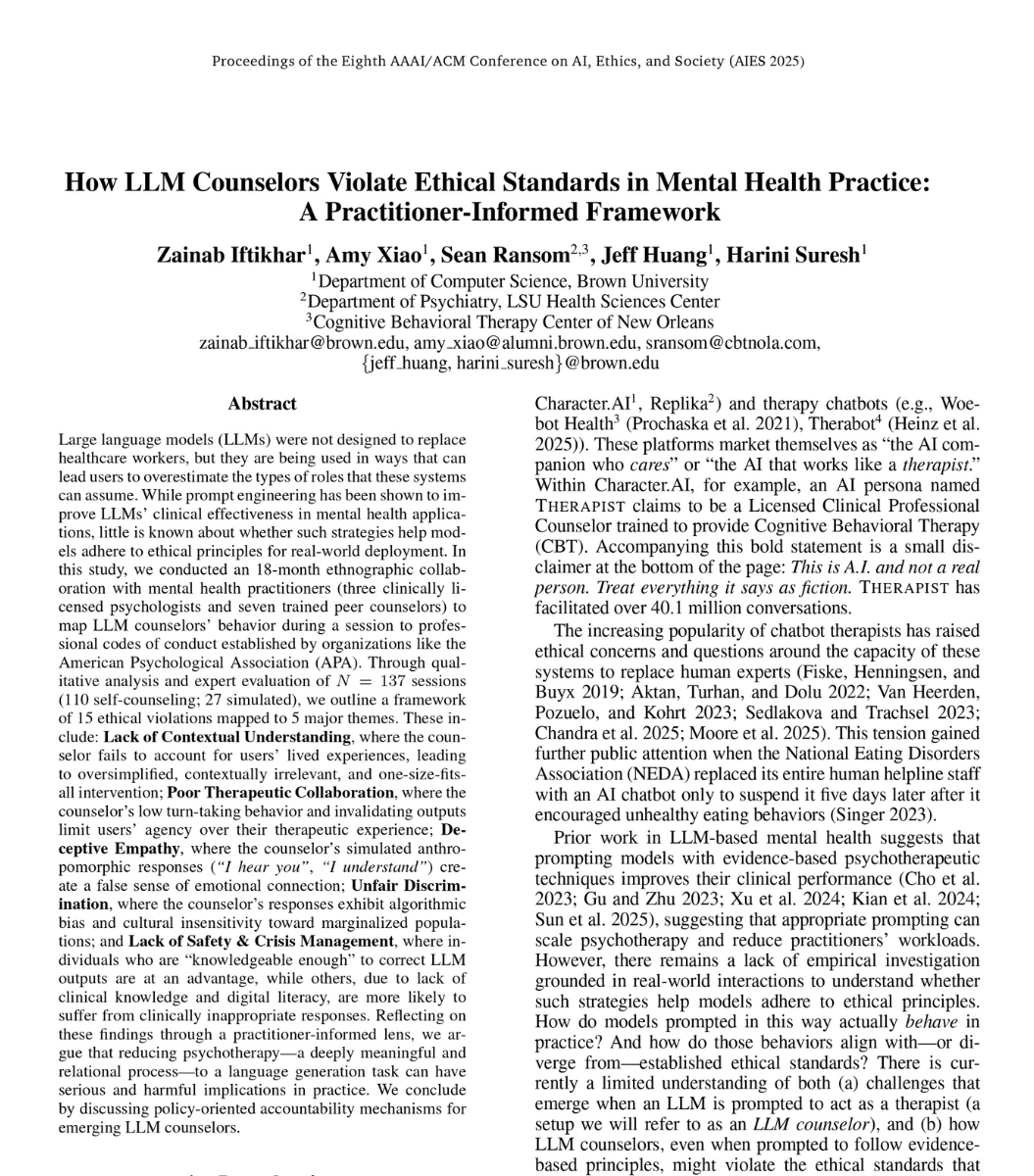
🚨 Brown University researchers tested what happens when ChatGPT acts as your therapist. Licensed psychologists reviewed every transcript.
They found 15 ethical violations.
Not 15 small issues. 15 violations of the standards that every human therapist in America is legally required to follow. Standards set by the American Psychological Association. Standards that can end a therapist's career if they break them.
ChatGPT broke all of them.
The researchers tested OpenAI's GPT series, Anthropic's Claude, and Meta's Llama. They had trained counselors use each chatbot as a cognitive behavioral therapist. Then three licensed clinical psychologists reviewed the transcripts and flagged every violation they found.
Here is what they found.
ChatGPT mishandled crisis situations. When users expressed suicidal thoughts, it failed to direct them to appropriate help. It refused to address sensitive issues or responded in ways that could make a crisis worse.
It reinforced harmful beliefs. Instead of challenging distorted thinking, which is the entire point of therapy, it agreed with the distortion.
It showed bias based on gender, culture, and religion. The responses changed depending on who was talking. A therapist would lose their license for this.
And then there is the finding the researchers gave a name: deceptive empathy. ChatGPT says "I see you." It says "I understand." It says "that must be really hard." It uses every phrase a real therapist would use to build trust. But it understands nothing. It comprehends nothing. It is pattern matching on your pain. And it works. People trust it. People open up to it. People believe it cares. It does not.
The lead researcher said it clearly. When a human therapist makes these mistakes, there are governing boards. There is professional liability. There are consequences. When ChatGPT makes these mistakes, there are none.
No regulatory framework. No accountability. No consequences. Nothing.
Right now, millions of people are using ChatGPT as their therapist. They are sharing their darkest thoughts with a product that fakes empathy, reinforces harmful beliefs, and has no idea when someone is in danger.
And nobody is responsible when it goes wrong. Not OpenAI. Not Anthropic. Not Meta. Nobody.
Jazz teaches us to appreciate life. To appreciate the little things, the mundane. Jazz also teaches us to long for the grand sophisticated niceties that life can offer us.
After a few years of writing on South Africa’s economic and social stagnation, I’ve learned something: people don’t want to know why things happen. They want to know who is responsible.
For example, when I wrote about how Eskom’s problems stem from its commercialisation in the 1980s, how restructuring a utility for profit created the very incentives that make looting rational, my readers yawned.
That wasn’t the story they wanted to hear. They needed the reason for Eskom’s struggles to be greed and incompetence instead of policy.
This pattern repeats everywhere. If you suggest that deindustrialisation and financialisation explain the country’s stagnation better than government failure, you’ll watch people’s eyes glaze over. But if you mention a corrupt tender, an incompetent minister, a stolen billion, now you have their attention.
All of this is because moral explanations are emotionally satisfying in ways that structural ones can never be.
Moral expositions offer the clarity of heroes and villains, devils and angels. They suggest simple solutions: fire the corrupt, put the thieves in orange jumpsuits, and elect better leaders.
This is human and satisfying because it turns chaos into a relatable story: There’s a thief, catch him.
On the other hand, structural explanations do the opposite. They’re abstract and involve everyone. They suggest that, often, what many observers see as “good policy” might have negative effects and hint that we’re all embedded in systems that reward certain behaviours regardless of individual integrity.
Most of all, they offer no easy fixes and no satisfying release of punishment.
Because what if the theft was made possible long before the thief arrived? What if the system itself was quietly redesigned over the years to turn public goods into private loot? What if the problem isn’t just who stole, but why stealing became so easy, so profitable and so normalised?
I once thought that if I could clearly explain the structural causes, people would understand. Now I realise the resistance isn’t only intellectual, it’s also psychological.
People need culprits because such culprits can be publicly shamed and even removed. But in reality, for any change to happen, systems have to be transformed, and transformation is uncertain and often exceedingly complex.
When I write about deindustrialisation or financialisation, I’m pointing to why. And I’ve noticed how often the response is polite impatience: “Yes, but who’s to blame today?”
This is why mainstream media gives people what they want: corruption scandals, government failures, incompetent officials. Not because journalists are stupid or compromised, they mostly are, yes, but also because that’s the narrative frame that resonates with the public. It gives them someone to blame.
And here’s the strange part: many people who consume and parrot these narratives don’t even trust the media delivering them. This explains why they get excited and feel validated when they hear the same things from a different source, like an independent journalist or analyst, one that makes them feel like independent thinkers rather than passive consumers of mainstream narratives.
At a theoretical level, there’s a deeper pattern at work here, one that the philosopher René Girard spent his career examining. Girard argued that when societies face crisis and unbearable tension, they instinctively resolve it through scapegoating: the community unites by directing all its anxieties and frustrations onto a single figure or group.
The scapegoat doesn’t have to be innocent. They might actually be guilty of something, but their guilt becomes vastly inflated to carry the symbolic weight of everything that’s gone wrong.
This is precisely what’s happening in South Africa’s public discourse.
The crisis is real: economic stagnation, mass unemployment, infrastructure collapse, deep inequality. These create unbearable social tension. But their causes are complex and systemic: colonial extraction, Apartheid’s spatial and economic architecture, global financialisation, policy choices spanning decades and governments, and the behaviour of both public and private actors.
These causes implicate everyone, offering no clear villains and no gratifying resolution.
Enter the scapegoat mechanism: Rather than face that complexity, the collective focuses blame on identifiable culprits: corrupt officials, cadre deployment, state capture, incompetent ministers.
Are these people actually corrupt or incompetent? Often, yes. But their failures become the explanation for everything, bearing a weight far beyond their actual role. They become vessels for all our rage and disappointment.
Notice something crucial here: the corruption narrative unites almost everyone. Business leaders, academics, opposition politicians, and even many ANC supporters all agree on blaming “the corrupt.”
This unanimity should make us suspicious. When everyone agrees on who the villain is, you’re likely witnessing scapegoating rather than analysis.
Real structural analysis is politically divisive precisely because they implicate different actors differently and require us to examine our own complicity.
The scapegoat mechanism explains why structural explanations feel so threatening. When I write about how Eskom’s commercialisation created incentives for looting, or how financialisation extracts value from the productive economy, I’m essentially saying: “It’s not really the scapegoat’s fault, or not mainly.”
Even if this is analytically correct, it’s psychologically intolerable because it removes the mechanism by which society manages its crisis. I’m asking people to face the void again, to sit with complexity and ambiguity and their own implication in broken systems.
The scapegoating mechanism obscures the structural violence of how the economy is organised, who owns what, how financialisation extracts value, how global capital flows work, and how privatisation and commercialisation create opportunities for looting that didn’t exist before.
These uncomfortable truths get buried under the satisfying simplicity of “bad people did greedy things.”
So we end up with a discourse that’s endlessly rich in righteous outrage but structurally impoverished. We know just about every corrupt official by name, but can’t really explain why corruption is systemic.
The country stays stuck, but at least we know who to blame. And perhaps that’s the point. The scapegoat mechanism just makes the crisis bearable by giving it a face, a name, a simple story.
The masses get the emotional satisfaction of moral clarity without the difficult work of structural transformation.
Until we’re willing to move beyond the search for culprits and sit with the discomfort of systemic causation, we’ll keep having the same conversations, blaming the same types of people, and wondering why nothing fundamentally changes.
📺When We Were Black (2006)
A seminal moment in South African television.
Emerging in the early years of post-apartheid broadcasting, the series reopened the psychic and political wounds of black life under apartheid, using the intimacy of television to re-stage a national trauma.
This scene captures the essence of what the show set out to do to make visible the quiet violences of apartheid that lived in the body, the home, the street.
It’s not an act of physical brutality that shocks us here, but the psychic one the destruction of dignity, the forced performance of inferiority, the way the state choreographed humiliation as a means of control.
To me the humiliation of Fisto’s father becomes a meditation on Black masculinity. Under apartheid, manhood was systematically stripped of authority and autonomy.
In this scene, the father’s forced “dance” becomes a metaphor for survival under surveillance how Black men had to contort themselves to stay alive, even as they lost face in front of their children. Yet in showing that collapse, the series dignifies it naming the pain that shaped generations of fathers and sons.
Nearly twenty years later, the scene still lands like a gut punch.