44 years ago this month, my dad passed away.
This is the only picture I have with him.
My mum once told me that shortly before he died, he turned to her with a tear in his eye and said: “Sometimes I get so scared I won’t see my little boy grow up.”
At the time, she told him not to be silly. Nothing was going to happen to him.
A few days later he had a huge heart attack in the middle of the night.
I was 3 years old. He never did see me a grow up.
I think about him every day.
If you love someone, don’t presume you can tell them tomorrow. Today is all we have.
The first time you think you have missed something, when something 'already had its move', has gone too far, is too extended, too high, or too low, it is often only phase one of a much larger move.
Major trends rarely make people capitulate immediately. They unfold in waves.
First, the person who avoided the move feels smart.
Then, as the trend keeps going without them, that confidence turns into doubt.
Doubt becomes frustration.
Frustration becomes disgust.
Disgust becomes pain.
And eventually, after enough repeated confirmation, they capitulate and join the trend near the top.
"There is nothing so disturbing to one's well-being and judgment as to see a friend get rich."
– Charles Kindleberger
That rhythm is very painful but holds a core truth, when a big trend forms, when a wide array of people make money in a field or when you feel yourself pushing against an idea simply because you aren't in it...
There usually is time to join at first or there will be another opportunity.
Being able to let go of ego and join the trend despite the emotional conflict yields very big results. This is especially true for the big trends, the big themes that encapsulate years of growth. (Will this be way bigger/smaller in xyz years?)
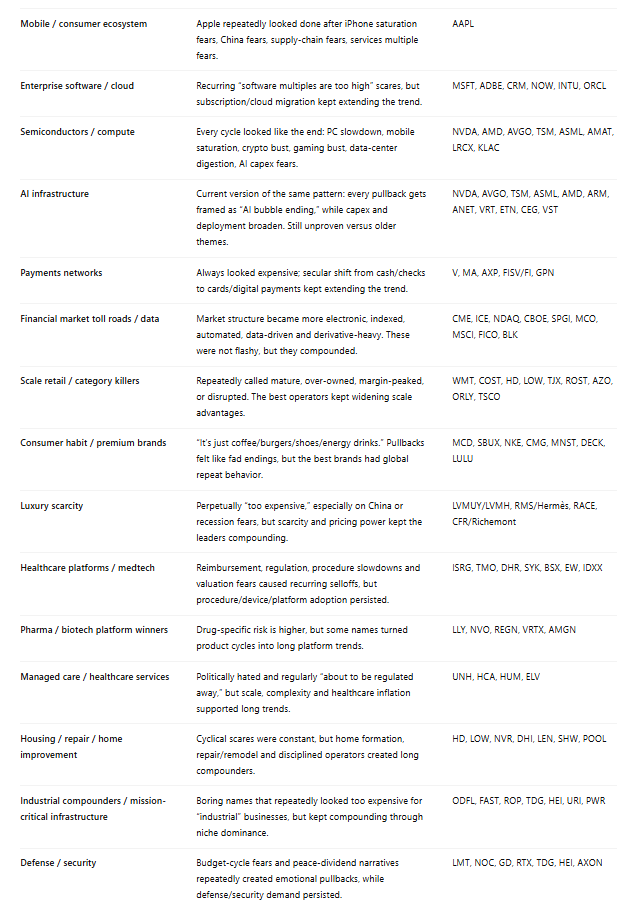
A few examples to illustrate the point, which logically will have survivorship bias and include failures along the way. On average though, the point stands.
Overall the theme remains moat, brand power, switching costs, economies of scale, network effects.. All within real multi-year growth backwinds.
People often want the new thing while the new thing is often in one of its first phases.
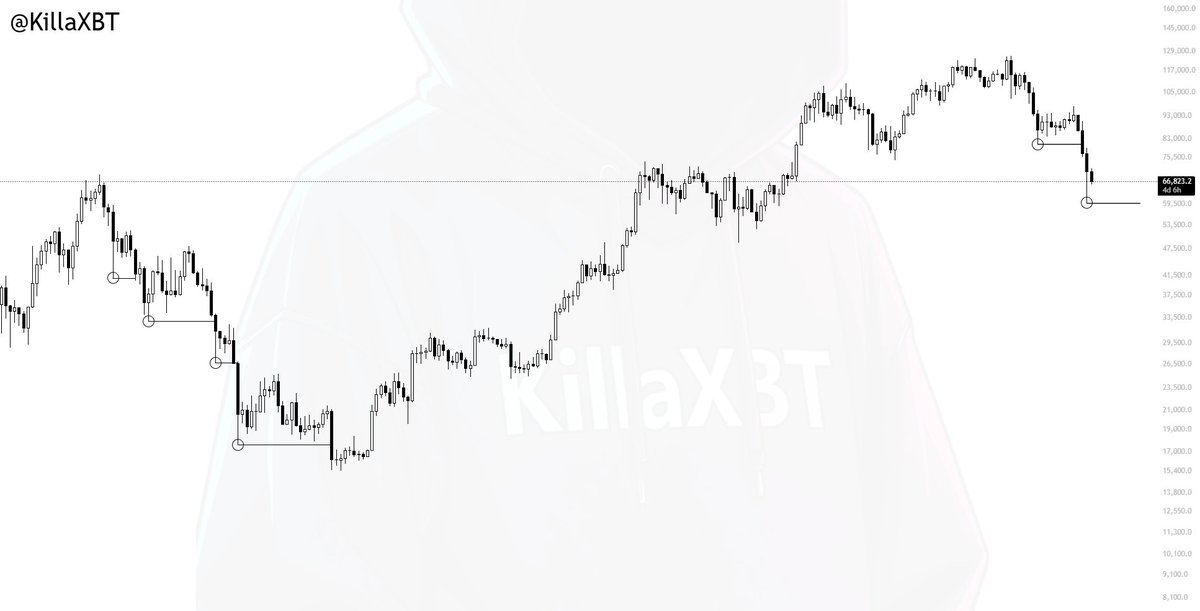
Important Observation: $BTC
Notice how every time we print a capitulation wick, price often takes weeks, sometimes even months to revisit that low.
This isn’t just technical. It’s largely psychological.
By this stage, most participants who were long have already been wiped out. Liquidity dries up. The market becomes thinner and easier to move. As mentioned before, this type of movement is heavily algorithm driven and rooted in psychology.
Right now, most people are:
Waiting for a sweep of the capitulation wick low.
Waiting for a retest to enter shorts.
After a move like this, fear dominates. Participants are still emotionally anchored to the previous drop, hesitant, defensive, and expecting further downside. That collective paranoia is exactly what creates the next setup.
After a capitulation wick, we often see:
A strong recovery
A pullback designed to trap bottom shorters
Then a push to sweep the external range highs
In this case, the external range highs sit around 71K, with the mid range liquidity pocket between 64–66K.
When fear is elevated and positioning is defensive, the path of most frustration is usually up, at least before any larger structural decision is made.
Trend still matters. But so does understanding where the crowd is leaning. 🤟
Explore 150 pages of trades executed by the mentor @theMMXMtrader Learn from the best In the game and elevate your trading game
https://t.co/G9ce24zQZq…
(This thread is long enough, but I will expand on a number of points here in the coming days)
You have to shake the sidelined mentality.
You cannot be frozen out by these markets.
If you are, you're trying to position far larger than your account can handle.
Because there's too much opportunity for there to be any other reason.
1. The Leverage and "trying to make it" debate
In your attempts to try and make life-changing money you're destroying your ability to make any money.
Most of you are not skilled enough to be able to operate with leverage and trading the markets on the LTF trying to secure additional value or knife-catching entries.
Many traders in this space would rewind the clock to remove leverage trading from their toolkit and instead stick to spot trading.
You can of course do whatever you like, and this won't be for all of you, however, the psychological side that comes with leverage is a hard beast to control.
Many of you will waste a cycle trying to move in on leverage to generate outsized returns against your portfolio size. Many of you will have already been chopped up after this significant market correction when you would have been safer and more relaxed, and potentially already more profitable by simply buying some spot.
When the market is bullish, you don't need a lot of leverage, you need discipline, patience and the ability to craft positions over time.
Stop believing that you do. Sure, I appreciate it's harder for market selection and opportunity with smaller portfolios, but unless you start stacking wins, you're just playing lotto with the markets.
2. The Current Climate
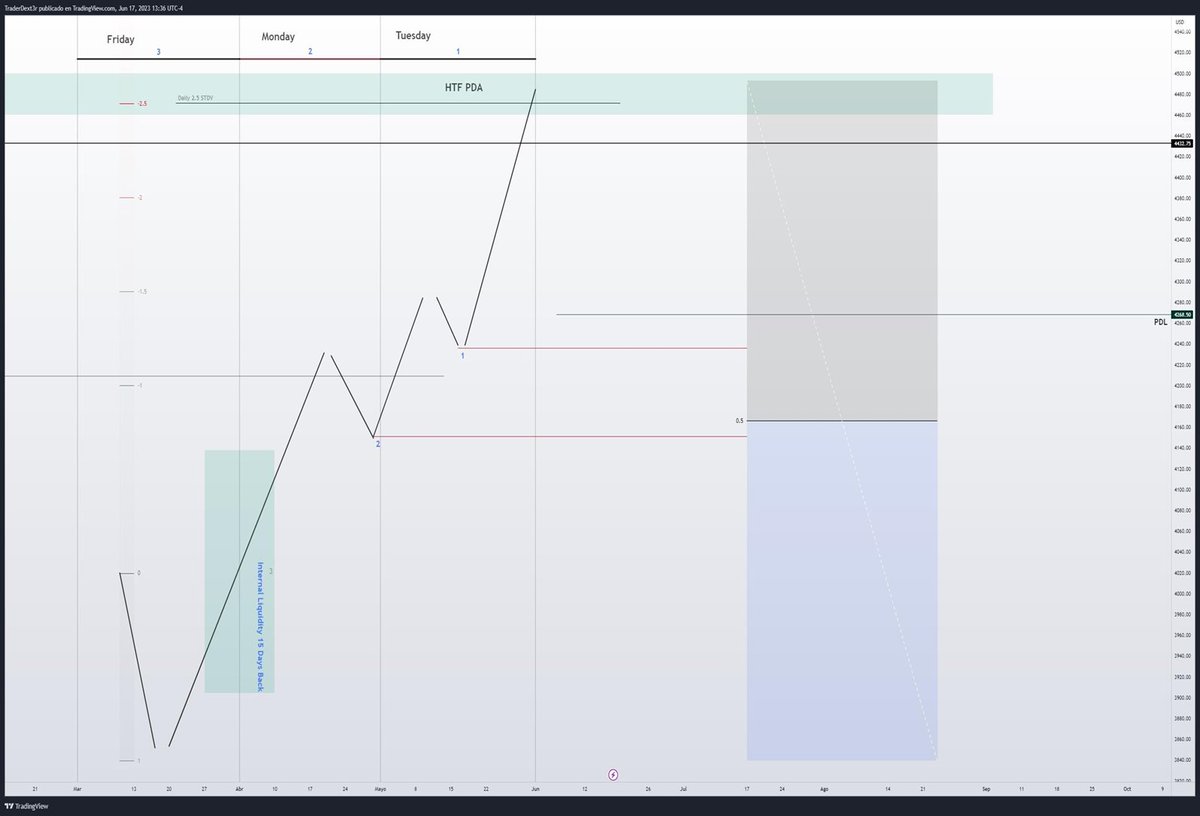
Many markets are currently in the process of reclaiming the significant HTF breakdown levels. These reclaims are very often independent signals in themselves for positioning.
Don't let your worries about "oh man price is already up a lot" get in the way of sensible positioning to the strongest markets.
We're at a point where all targets are now fresh highs for the year. So there's plenty of juice left (if the markets continue their ascent, God willing.)
I mention it all the time, but it's the biggest breakthrough you'll have as a trader, the ability to understand positioning and how important the process of establishing positions over time is.
This isn't about risk totals either, you should absolutely push hard during these environments (I'll cover that in a separate thread) this is about the process to actually establish that risk.
Don't spend time sidelined, don't spend time thinking you're running out of time, don't spend time chucking money away using high leverage in an attempt to "make it" before the cycle ends.
Many of the things you believe are simply your fears being vocalised and confirmed by your mind.
The market is still bullish.
You have time.
You need to change your actions to not be sidelined.
You need to appreciate risk and using it to your benefit to maintain and build.
During the correction I spoke about the work that you do during this period sets you up for a relaxed summer.
Bring on summer.
It's in these moments, where the market is feeling heavy that your mind will be racing into what lies in store.
The Defensive mindset:
You're overleveraged.
You haven't taken profit on higher price point entries.
You'd rather leave the positions untouched because "what if."
You've added too aggressively to spot positions.
You'll be nervous, worried about the potential for downside, unsure how deep it will be and your positions are under threat.
The outcome here is you're likely to lose money, potentially panic close spot positions and usually freeze up during more aggressive selling as you're just hoping it stops.
Your focus becomes watching red candles thinking "oh shit oh shit they all said we were going higher!"
Your unrealised PnL plummets and your impulses close your positions down.
The Attacking mindset:
You're aware a larger sell off may be brewing in the market.
You've cleared some risk on leveraged positions, especially from very recent entries.
You know that even if you're wrong there's still opportunity if the market doesn't sell off aggressively to reposition long.
You are psychologically prepared that your unrealised PnL may take a hit and your portfolio won't be at the same level it was 24 hours ago but this is all short-term.
You have ammunition ready to strengthen your positions and holdings if the market gives a sell off.
You welcome a sell off as opportunity.
You are prepared, anticipatory and can action opportunity the market provides.
Be attacking. Make the necessary changes to ensure sell offs don't leave you panicking and freezing up.
Switch the mindset to realise opportunity and the ability to secure some great entries and additions to your bags.
Understand the psychological aspect to a sell off, not just the visual one.
A very important concept to learn and comprehend.
ATTACK THE MARKET.
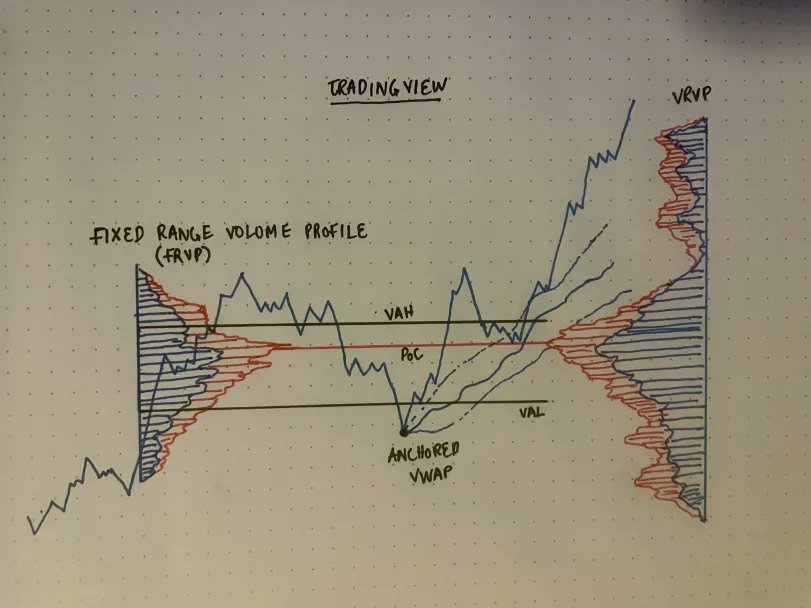
"Bro, what are those indicators and labels on your chart?
What is VAH, VAL, HVN, LVN, Naked PoC, FRVP, VRVP, VWAP & Anchored VWAPs?
&
How do I use them?"
I'm glad you asked.
A Comprehensive Breakdown of Simple Volume Tools I use on @tradingview