Atlassian's revenue: $1.79 billion last quarter
Atlassian's move: fire the engineer who built their infrastructure
his move: post a 38-minute breakdown of every system he built, free for anyone to copy
what he revealed:
> Envoy proxy instead of enterprise load balancers
> sidecar architecture for auth, logging, rate limits
> DynamoDB + SQS for async provisioning
> Packer + SaltStack for automated VM deployments at scale
Atlassian charges per employee across 350,000 customers
this guy just handed you the enterprise playbook for free
save this
OpenTUI Keymap is a host agnostic key/cmd engine for DOM like apps.
It allows extreme customisation of a generic core, from key stroke syntax parsing to to command resolution and dispatch behaviour. It composes layers of bindings and commands into a single adaptive dispatch model.
Demo link in the replies.
There are many such systems, most of which stop at the key binding part. Apps often are expected to implement their own command layer on top of these. This disconnects the bindings from the actual command registry.
Looking for a proper solution usable in OpenCode I couldn't find anything that fulfilled the need of being extremely extensible to allow plugins to fully control key mapping and command behaviour. I wanted it to always be able to know exactly which keys and commands are reachable at any point in time, no matter from where and how the mappings are manipulated.
The main driver was enabling a which-key like plugin and vim like bindings in a mostly declarative way. While any other plugin could extend the keymap even further with a custom config syntax for key strokes for example. So addons for it are mostly composable and it comes with a variety of addons providing common behaviour.
It can also power other discovery features directly from live state. Help views, command palettes and graph/debug UIs can all ask the engine what is active, reachable, shadowed, pending, or dispatchable instead of rebuilding that knowledge separately.
The core is intentionally very much generic: hosts adapt focus, hierarchy, input events, and lifecycle, while addons extend parsing, tokens, sequence patterns, command metadata, resolvers, interceptors, and event matching. The result is a keymap that plugins can compose with rather than work around.
This could all be built directly into OpenCode and just be app specific. Working on OpenTUI though I want applications to have an out-of-the-box solution to build keyboard-first apps easily. Well, at least agents can.
It is extremely over-engineered. And I love it.
I hope some of you will too.
4 of the most confusing terms in AI, defined:
Model: a blob of parameters, written during training. Does next-token prediction and nothing else. Stateless.
Harness: everything around the model that turns it into an agent: tools, system prompt, context window management, etc.
Environment: the world the agent acts on. Anything outside the harness that the agent perceives and acts on via tools.
Agent: a model, harnessed, in an environment.
---
Opus is a model.
Claude Code and Claude Web are different agents, because their harnesses differ - even though the models are the same.
The file system is an environment. MCP servers add tools to the environment.
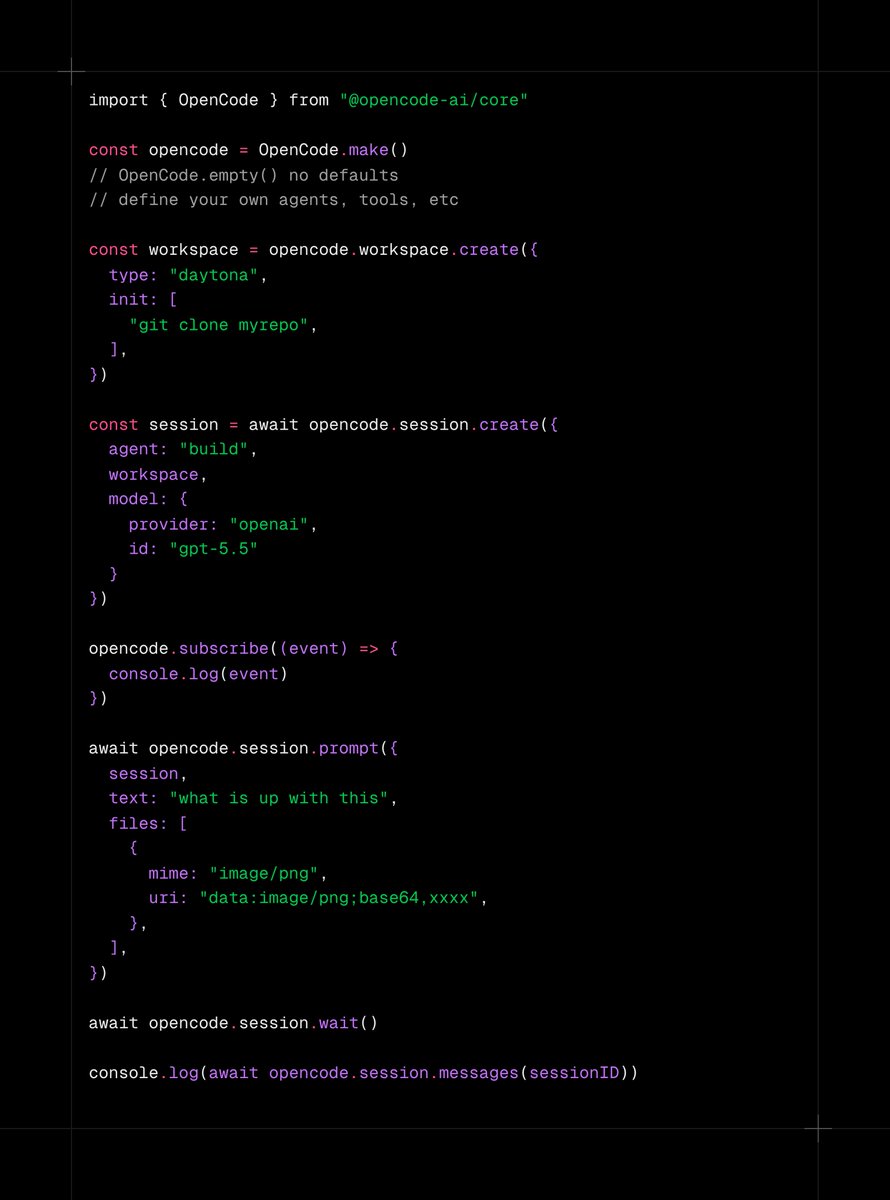
we're making OpenCode more embeddable in 2.0
you can even use the workspaces feature to run distributed sessions
data replication is handled for you so you don't have to think about the fact that it's running remotely
your server can even go down and it'll resync when it's up
We've re-built Conductor from scratch to make it twice as fast.
Creating tabs, switching workspaces, and rendering files are all 50% faster, memory usage is lower, and the app is 150 MB smaller.
Introducing Conductor Allegro!
I'm starting to think that DDD might be the answer to all of my problems
- Model not doing what you want? Shared language
- Can't navigate a massive codebase? Bounded contexts with global mapping
- Don't know why a decision was made? ADR's
It's just so freaking elegant
My interaction design manual is now open for registration with 3 new chapters.
With 23 chapters and 23 downloadable React components on an interactive platform, Devouring Details includes everything I know about not just interactions, but design.
Available for 2 weeks.