Physician PM&R I AI & Robotics in Medicine | I help clinicians stay ahead on AI in Medicine - AIMedily Newsletter. | Neurobionics Lab University Michigan.
A JAMA Perspective this week asked:
Could autonomous AI eventually provide better medical care than physicians using AI?
Medicine is inherently human and messy. It is uncertainty, context, patient preferences, judgment, and decisions that are rarely black and white.
🧵
There is so much happening in medical AI right now, but I keep coming back to the same question:
How do we use these tools in a way that actually makes care better?
I share what I’m learning each week through AIMedily.
Subscribe here https://t.co/nDnQwWatHI
Can AI improve blood smear analysis?
A multicenter study of 1,570 blood smears found that AI-assisted review improved classification and reduced review time.
APL screening sensitivity: 100% vs 96%
Schistocyte sensitivity: 89.9% vs 82.7%
Review time: 328 vs 852 sec
The system supported lab professionals rather than replacing them.
Where could AI-assisted tools be most useful in laboratory medicine?
More short medical AI updates in AIMedily — subscribe free through the link in my bio.
Link to paper in comments.
Can AI coaching match the human experience?
A Johns Hopkins study compared AI-led diabetes prevention with human coaching in 368 adults.
AI helped people start sooner: 11 vs 26 days.
But human coaching scored higher for satisfaction and acceptability, and 46.5% of the AI group said they would have preferred a human coach.
Faster access does not always mean a better experience.
Would you choose AI if it helped you start sooner?
I share more short, practical updates on AI in healthcare in AIMedily. Subscribe free through the link in my bio.
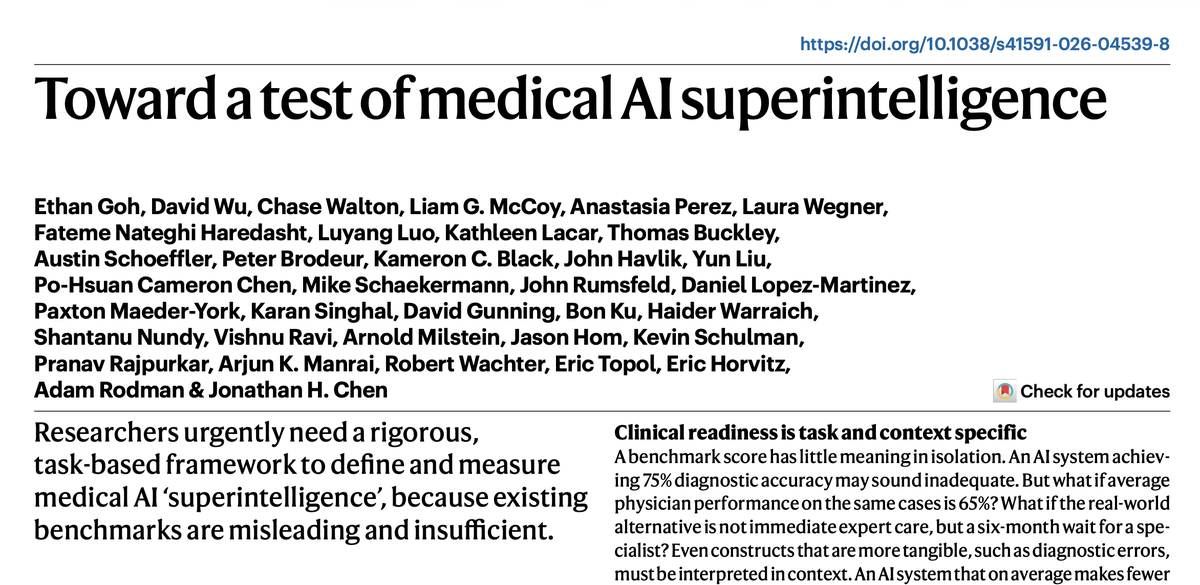
@EricTopol@NatureMedicine@drethangoh This is excellent. Open-sourcing the code and development sets to move forward faster. It will be very interesting to see how MAST performs across different clinical settings and patient populations.
Clinicians using AI were more likely to record an appropriate diagnosis, write a more complete note, and document an appropriate treatment plan.
We need more studies like this: AI tested in real clinical workflows, not only on benchmarks.
What’s your take? I share more studies like this inAIMedily:https://t.co/82fYFtPgoz
What happens when an LLM is tested in real primary care?
A Nature Medicine trial tested a GPT-4o clinical decision support tool across 16 facilities in Kenya, involving 103 clinical officers and 9,347 patients.
Patient satisfaction and consultation time were also similar.
No serious adverse events were judged to be related to the AI tool.
The clearest benefit was documentation.
Also in this week’s issue:
• @Updock FDA clearance for between-visit care • @claudeai Science from Anthropic • 3 in 10 adults using social media or AI for health info • Tools: @VisualDx , @PearlHealth_ , and @Shortwave
AIMedily is for clinicians who want to keep up with medical AI.
Subscribe free - https://t.co/82fYFtPgoz
Medical AI is moving closer to patient care.
This week, I covered 2 studies:
1️⃣ Strong medical AI scores can hide fragile reasoning.
2️⃣ In a real-world primary care trial, LLMs support improved documentation quality.
AI may help clinical workflows. But we still need evidence that it improves outcomes that matter to patients.
I write AIMedily for clinicians trying to keep up with medical AI without spending hours searching.
Short weekly update. Free.
Join here: https://t.co/2Nn03gMwZK
❓What happens when AI moves from answering clinical questions to taking clinical steps?
That question came up in this week’s AIMedily.
I covered two studies that show where medical AI may be heading.
This week’s AIMedily also includes:
• 3 AI tools
• Health scanner news
• WHO guidance on AI and evidence-informed policy
• OpenAI and rare genetic disease diagnosis
• Philips Future Health Index 2026
• 6 research papers from NEJM AI, Nature, JMIR, and JAMA