I share Engineering, Management & Tech Ops experience •
CTO x3 • Indie maker x2 •
Built a fintech from 0 - €500M ADTV •
Scaled a marketing platform to 9M MAU
Do you go on engineering adventures & expeditions?
“Shiny object syndrome” can cause engineers to skew solutions towards the less optimal.
This is how to stay at the bleeding edge, but in a realistic and measured way: →
CTO Logic is booting up ...
I write about how to operate professionally at the intersection of software engineering, tech management, leadership, and business.
https://t.co/ZNHsqzALJu
@GergelyOrosz Misalignment of goals vs. incentives is likely a significant cause of this debacle, as well as having a weak and inept board.
Maybe the non-profit aspect was intended to reduce the attack surface for regulators.
C-suite people: Your CTO is probably lying to you.
OK, she's not actually lying, but she does need to represent the truth in a way you can handle.
Otherwise it would be too difficult for you to trust the development process.
https://t.co/WhITTttBmA
#CTO#CEO#founders
.@agazdecki
Is @microacquire friendly to foreign acquirers who don’t want to end up owning a US corporation?
Do you have a standard solution for this?
E.g. transfer ownership of the *product* and related intellectual property, rather than sell the *company* that owns it?
Corollary:
What will engineers tend to choose?
A. Write something from scratch on a clean slate.
B. Refactor/extend something that exists.
If you make it too easy to decide to create a new service, you will end up with lots more of them than necessary!
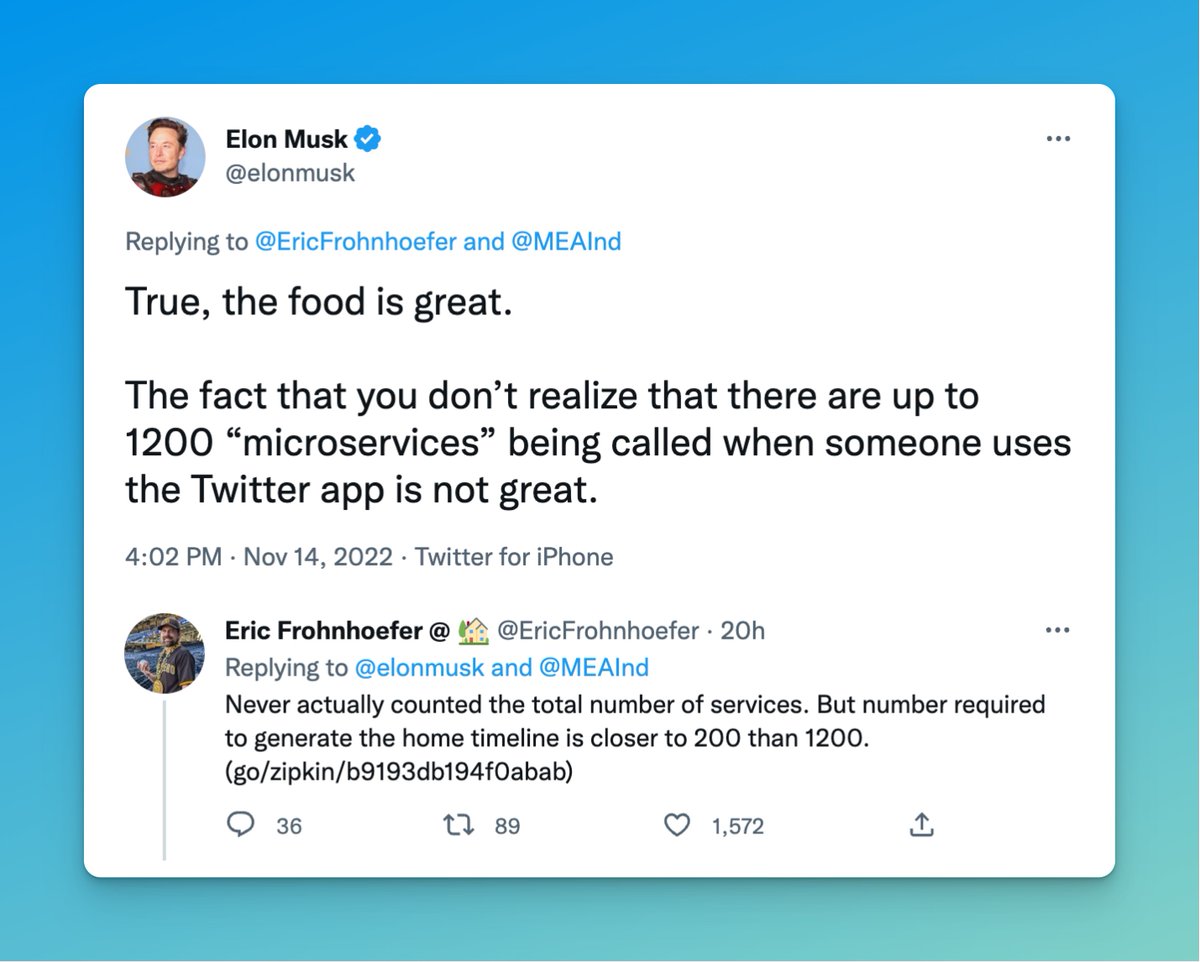
1200 microservices just to render the Twitter timeline. Or is it "just" 200?
Microservices are a double-edged sword.
Like everything else in engineering, they are a trade-off.
If anyone can decide on a whim to create a new microservice, you’re doing it wrong.
Creating a new service must be a carefully considered decision.
The more trivial the functionality, the more it should be combined into a related pre-existing service.
Done right, you end up with “macroservices,” which each handle a complete functional or business domain.
Welcome to the Popular Front for the Revival of Monoliths!
Personally, I think we need to popularise what you might call "macroservices" rather than complete monoliths.
@GergelyOrosz My view, which has got me fired only once:
You (the CEO) are paying me (an executive) to have the courage to tell you when you're wrong, and to figure out what's really wrong and fix it.
You have a duty to insulate your department from such behaviour: https://t.co/doqaFMrQWa
Do not be a "yes-man"
An important function of an executive is to act as a buffer against:
🙊 Uncertainty - some industries are on a roller-coaster.
🙈 Whims - the CEO or owner with ADD is always zig-zagging.
👎 Distractions - other things that don’t move the needle.
@GergelyOrosz Working with people from different cultures, I learned that I had to eliminate nuances, figures of speech and metaphors and be much more direct.
I also say "Hello" and ask my question on the same line. It's more respectful of the other person's time and attention.