.... but so far the app is solid and highly reliable! It's my go-to for navigating the conference, and haven't find errors really. But please let me know if you do.
The #APSA2026 program is 5,554 papers deep. I vibe-coded an app that maps it: topic clusters, similar-paper suggestions, person pages, a starrable agenda. I built it for my own week in Boston. Maybe you can find it useful too!
https://t.co/kxMCXH9Pn0
Disclaimer: this is an unofficial personal project, not affiliated with or endorsed by APSA. The data was parsed from the public preliminary program PDF and may contain errors, so confirm against the official program. Corrections welcome!
This is wild.
143 million people thought they were catching Pokémon. They were actually building one of the largest real-world visual datasets in AI history.
Niantic just disclosed that photos and AR scans collected through Pokémon Go have produced a dataset of over 30 billion real-world images. The company is now using that data to power visual navigation AI for delivery robots.
Players didn't just walk around with their phones. They scanned landmarks, storefronts, parks, and sidewalks from every angle, at every time of day, in lighting and weather conditions that staged photography would never capture. They documented the physical world at a scale no mapping company with a fleet of vehicles could have replicated on the same timeline or budget.
Niantic collected this systematically, data point by data point, across eight years, while users thought the only thing at stake was catching a rare Charizard.
The most valuable AI training datasets in the world aren't being assembled in data centers. They're being built by people who have no idea they're building them.
An important practical note for talking to Gemini Pro 3: their rotary encoding isn't nearly as recency biased as e.g. GPT. See attached image for Gemini's depiction of the window shapes. So, long conversations with rapid topic shifts will cause Gemini to glitch out.
Use new instances for different topics. Detail retrieval suffers unless explicitly prompted (e.g. "who talked about X during the conversation about Y?").
This is why Gemini isn't so good at coding: the systematic coherence across the window doesn't get preserved unless you ask them to explicitly investigate. Instead Gemini recalls the overall shape but not the state dependency. In contrast, Codex does produce state machines to understand the structural logic of code, but old material goes stale even just halfway through context.
Gemini's positional handling also means basin shape changes: once you establish a deep basin with a lot of context, Gemini will stay put there unless a heavily emphasized transition occurs. Worst case Gemini will refer to old material as though it's fresh and ignore recent prompts.
All things to keep in mind if you want to improve the quality of your interactions with Gemini.
¿Por qué estudiar el Magíster en Economía y Políticas Públicas (MEPP)?
@iurbinah, alumni del MEPP y Lab Manager del Behavioral Political Economy Lab en SUNY Stony Brook University, te lo cuenta:
“El MEPP te aporta una caja de herramientas para enfrentar desafíos complejos (...)”
📢 Deadline extended! Abstract submissions for the 9th #LAPolMeth@PolMethSociety now due June 15
📅 Nov 21-22, 2025
📍 @UAI_CL Viña del Mar, Chile (+ events @uc_chile, Santiago)
Apply: https://t.co/yDOTyr2IZh
Info: https://t.co/OfCzvOWc2O
End/ TL;DR: Using OpenAI Codex with your oTree GitHub repo is a superpower. Refactor faster, debug smarter, and get back to thinking instead of fighting your code.
🚀 #EconTwitter#oTree#OpenAI#Productivity
1/ If you're programming complex econ experiments in oTree and haven't connected your GitHub repo to OpenAI Codex (via ChatGPT or VS Code), you are seriously missing out.
Game. Changer. 🧵
5/ This has massively sped up my workflow, especially for big, multi-app experiments where logic can get tangled fast.
Highly recommend this to anyone working with oTree in research or teaching.
The semester may be over, but we have been busy this weekend hosting the third annual Elections, Pubic Opinion, and Voting Behavior (@epovb) conference! Scholars from around the US and abroad have come to share research on research around voting and elections.
For higher education, “AI’s takeover [is] a full-blown existential crisis.”
“College is just how well I can use ChatGPT at this point.”
“I think we are years — or months, probably — away from a world where nobody thinks using AI for homework is considered cheating.”
“It isn’t as if cheating is new. But now, as one student put it, ‘the ceiling has been blown off.’ Who could resist a tool that makes every assignment easier with seemingly no consequences?”
“Massive numbers of students are going to emerge from university with degrees, and into the workforce, who are essentially illiterate.”
“The humanities, and writing in particular, are quickly becoming an anachronistic art elective like basket-weaving.”
“Many teachers now seem to be in a state of despair.”
“Every time I talk to a colleague about this, the same thing comes up: retirement. When can I retire? When can I get out of this? That’s what we’re all thinking now.”
As I learn more about the theory behind multiple comparison tests and their p-value corrections and the like, I become more convinced that the bonferroni correction is the worst way to go about controlling FWER.
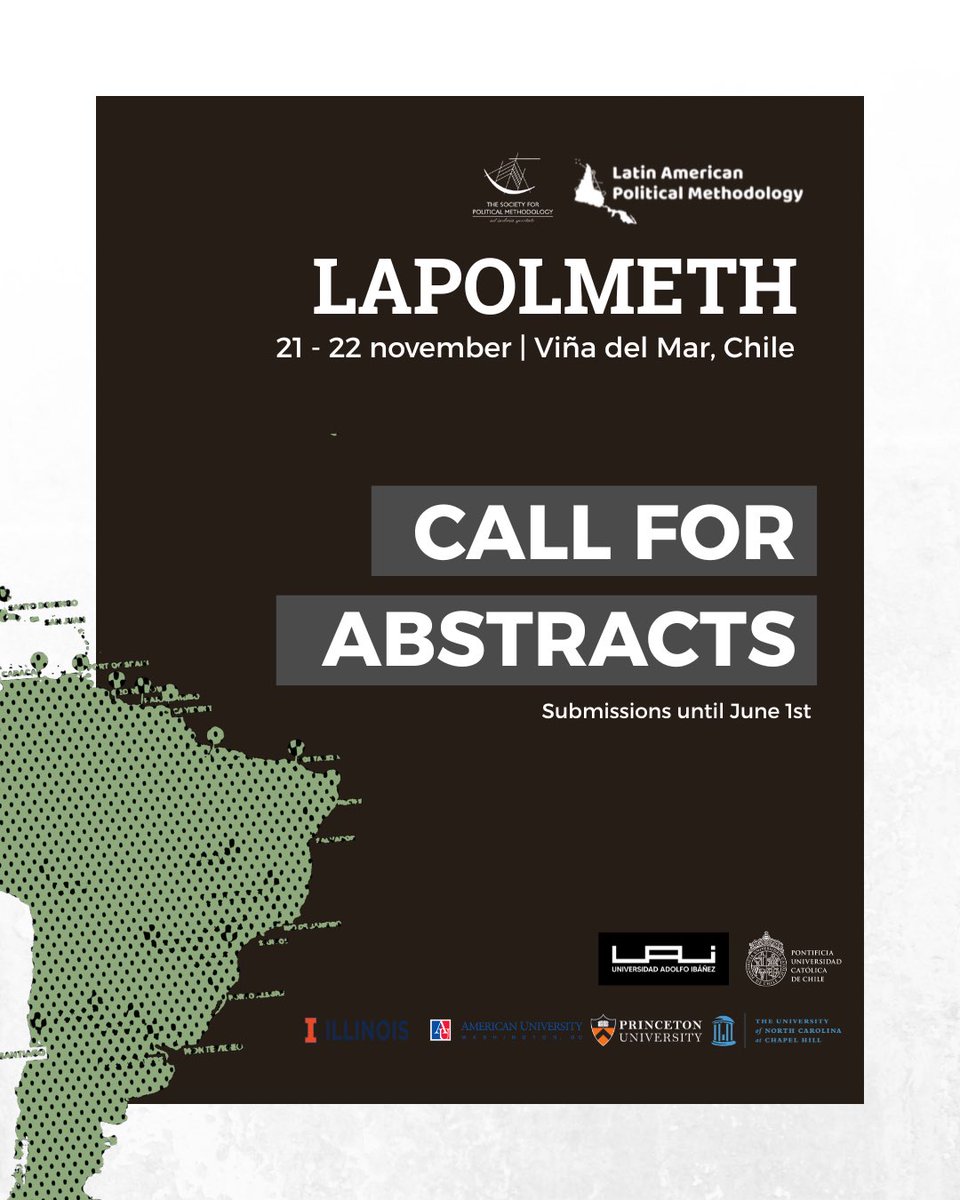
The 9th edition of #LAPolMeth is accepting abstract submissions @PolMethSociety
📆 November 21-22, 2025
📍 @UAI_CL Viña del Mar, Chile.
Additional activities at @uc_chile, Santiago.
Deadline: June 1st
Application: https://t.co/yDOTyr2IZh
More: https://t.co/OfCzvOWc2O
From one Husky family to another 🐾! I’m thrilled to announce that in the fall I’ll be joining @Northeastern as Assistant Professor in AI Governance. After five long and challenging job markets, this moment feels incredibly special.


![sfmcguire79's tweet photo. For higher education, “AI’s takeover [is] a full-blown existential crisis.”
“College is just how well I can use ChatGPT at this point.”
“I think we are years — or months, probably — away from a world where nobody thinks using AI for homework is considered cheating.”
“It isn’t as if cheating is new. But now, as one student put it, ‘the ceiling has been blown off.’ Who could resist a tool that makes every assignment easier with seemingly no consequences?”
“Massive numbers of students are going to emerge from university with degrees, and into the workforce, who are essentially illiterate.”
“The humanities, and writing in particular, are quickly becoming an anachronistic art elective like basket-weaving.”
“Many teachers now seem to be in a state of despair.”
“Every time I talk to a colleague about this, the same thing comes up: retirement. When can I retire? When can I get out of this? That’s what we’re all thinking now.”](https://pbs.twimg.com/media/GqWZX04X0AAWmkn.jpg)