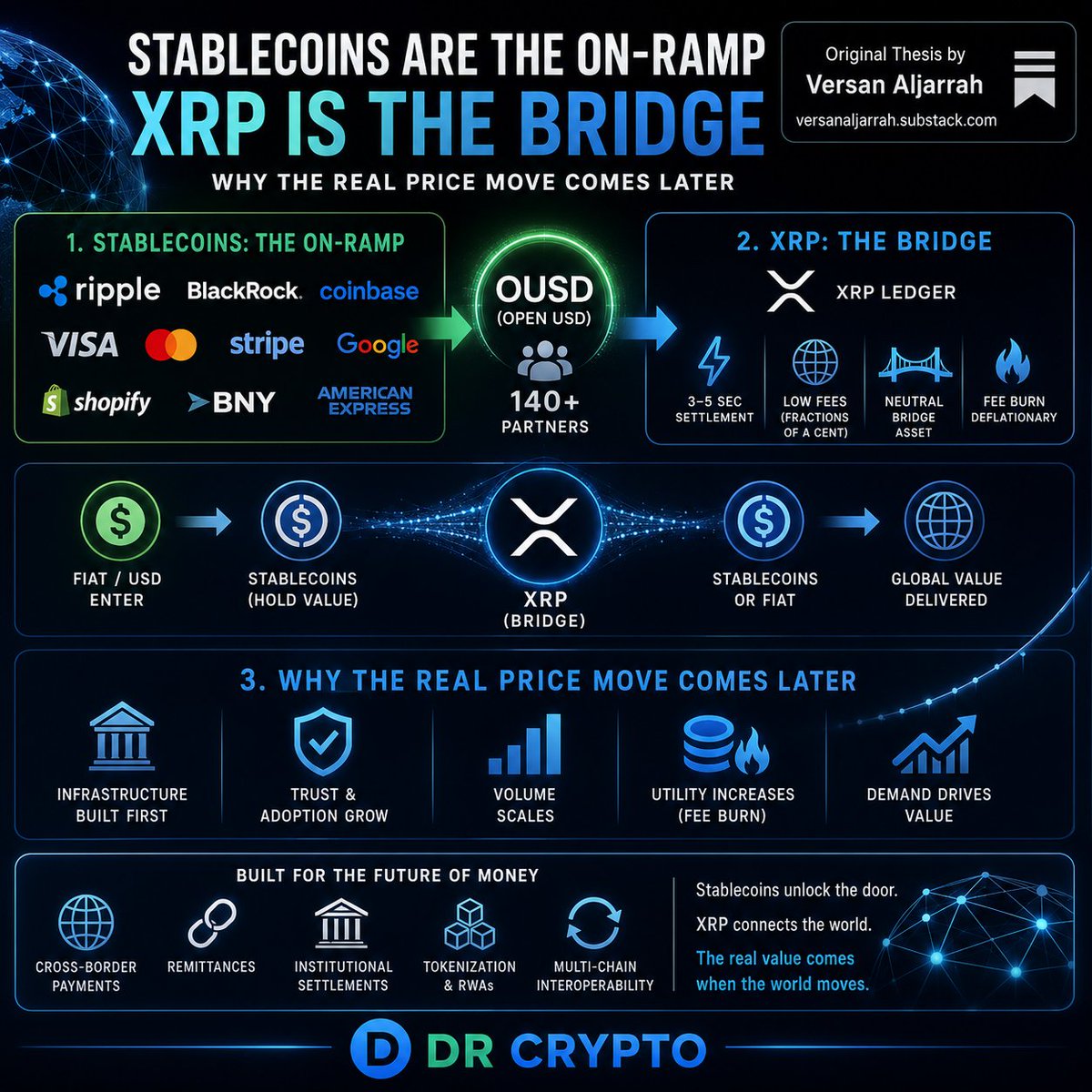
🌩️The Stablecoin Race Isn't Replacing XRP..It's Building the Demand for It.
One of the more compelling infrastructure theses is this:
Stablecoins become the on-ramp. XRP becomes the bridge.
We're watching that foundation take shape.
What we're seeing:
• Stablecoin market exceeds $300B+ and continues to grow.
• Ripple launched RLUSD, a regulated stablecoin issued on XRPL and Ethereum, integrated with Ripple Payments.
• Open USD (OUSD) brings together 140+ global partners, including Ripple, BlackRock, Visa, Mastercard, Coinbase, Stripe, Google, Stellar, Solana, Polygon, Base, and others to build neutral institutional stablecoin infrastructure.
Stablecoins solve one problem extremely well:
Holding value.
The next challenge is moving that value efficiently across:
• Banks
• Countries
• Currencies
• Blockchains
• Payment networks
That's where Ripple's infrastructure was designed to operate.
XRP's utility includes:
✅ 3–5 second settlement
✅ Fractions-of-a-cent transaction costs
✅ Native bridge asset on the XRP Ledger
✅ On-Demand Liquidity eliminating pre-funded accounts
✅ Auto-bridging across digital assets
✅ Liquidity for tokenized assets and cross-border payments
The long-term thesis isn't that stablecoins compete with XRP.
It's that growing stablecoin adoption may increase demand for efficient interoperability between assets, currencies, and networks.
Ripple is increasingly building an institutional stack that includes:
• RLUSD
• XRP Ledger
• XRP liquidity
• Ripple Payments
• Institutional custody
• Prime brokerage
• Tokenization infrastructure
• Enterprise settlement
Infrastructure typically comes before large-scale transaction volume.
Transaction volume generally comes before utility-based valuation.
The market often focuses on price.
Institutions focus on infrastructure.
Over the past year we've seen:
• Regulatory progress
• RLUSD expansion
• Open USD consortium participation
• Growth in tokenization
• Live payment corridors
• Continued enterprise integrations
Whether this ultimately translates into materially higher XRP demand will depend on real-world adoption, transaction volumes, and execution..not headlines.
The next phase to watch isn't social media excitement.
It's measurable payment flows, institutional adoption, stablecoin growth, and XRP Ledger activity.
OP/ info by @VersanAljarrah
#xrp #ripple
Great projects aren't built by hype alone they're built by believers. The $WIKICAT community keeps growing stronger every day. This is how billion-dollar stories begin.
CA:
0x6Ec90334d89dBdc89E08A133271be3d104128Edb
#WikiCat#WKC#WikiCatArmy 🪖 #HODL
My first ever bullrun experience when I entered crypto as a newbie in 2021.
My $75 turned to $10,000. My mentor then helped me take profit and bought back when it started consolidating.
Till today we still host AMA with the Dev team from Australia and South Africa on telegram and every holder has DIRECT access to ask questions and receive answers from them.
This is the standard.
Heat is everywhere—from the boiling hot springs and fumaroles of Yellowstone to the fast-paced action of the 2026 FIFA Men’s World Cup.
In both settings, scientists and analysts use heat maps to visualize activity. Today's Caldera Chronicle describes the GOOOOAAALLLLLL! of those maps.
https://t.co/d60zoqjyh7
📷1: Thermal infrared image of a portion of Norris Geyser Basin, Yellowstone National Park, acquired from an airborne thermal survey in October 2014. Warm colors indicate higher temperatures, and cooler colors are lower temperatures.
📷2: Simulated (not from actual data) soccer heat maps for different positions: (A) goalkeeper, (B) central defender, (C) right winger, and (D) striker. Overlain on a green soccer field background, warmer colors (red/orange) represent areas of more activity or location frequency, while cooler colors (green/cyan/blue) represent areas with low activity or location frequency. For each heat map, the direction of play is left to right.
I remember when $ASTEROID pumped to over a $100M market cap, and everyone concluded that BNB Chain was dead.
A few weeks later, $SIREN moved from a $100M market cap to over $4B, while $LAB climbed from about $200M to $6B.
Today, it's $ANSEM on Solana, and once again, people are questioning their conviction in BNB Chain.
I'm not here to compare chains. I'm here to remind you that the market isn't running away.
In crypto, 90% of the money is made by those who know how to wait and Hodl their convictions instead of chasing pumps.
Every coin has its green days.
For the long term, I'm still most bullish on BNB chain.
Most people don’t care what the next financial system is called.
They care about one question:
“What’s in it for me?”
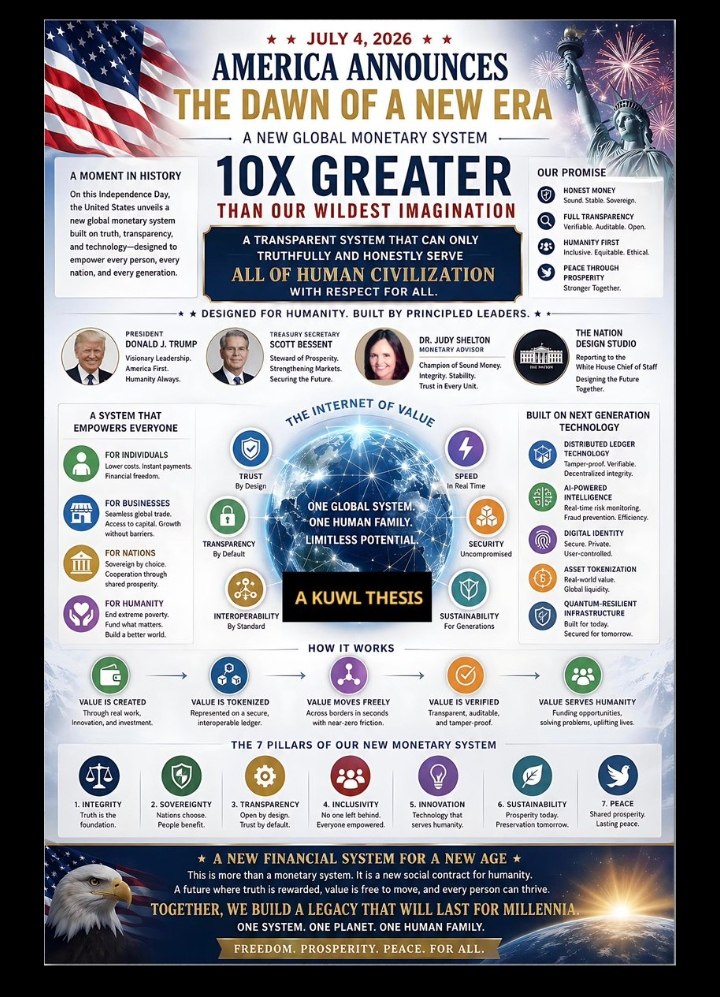
What if America’s next economic upgrade simply meant:
• Your money settles faster.
• Fees get smaller.
• Fraud gets harder.
• Property rights get stronger.
• Savings hold their value.
• Government becomes more transparent.
• Innovation creates more jobs instead of more bureaucracy.
What if the real revolution isn’t “crypto”…
… it’s rebuilding trust through better rules, honest money, modern infrastructure, and technology that serves people instead of the other way around?
If that’s even directionally correct, shouldn’t we be asking better questions before arguing over today’s headlines?
The future may belong less to those with the loudest opinions… and more to those asking the wisest questions.
Worth considering?
Rob Cunningham
@KuwlShow