#vct2022 What are you thinking when you look up at the sky full of stars? Infinite space🙌🏻✨
There are never too much SiGe thermoelectrics in outer space!
So, let us present our #vct2022poster "Thermoelectric properties of p-type SiGe/MnTe composites"
EU-P.16
📣 It’s time! Registration for #RSCPoster 2022 is now open! Take part in March 2022 to share your research, drive discussion and develop ideas into your next published paper. Join in: https://t.co/fU5qLWJZSh
Hello everyone! Glad to present my #VCT2021poster on the mechanochemical synthesis of p-type skutterudites. This year #VCT2021 organizers allowed one to prepare a video poster, so please check out my video about our research below.
I love creating posters very much, but this year I was lucky enough to give an oral talk at #VCT2021. My colleagues have prepared some stunning posters that I want to share with you. The first poster from @Sasha_Khanina. It is so amazing!
#VCT2021
I'm glad to present my first #VCT2021Poster on a scalable mechanochemical synthesis of Ba-doped BiCuSeO oxyselenides. I am new to thermoelectrics, so in this poster, I showed the main results that I managed to achieve during almost a year of working at @energy_misis.
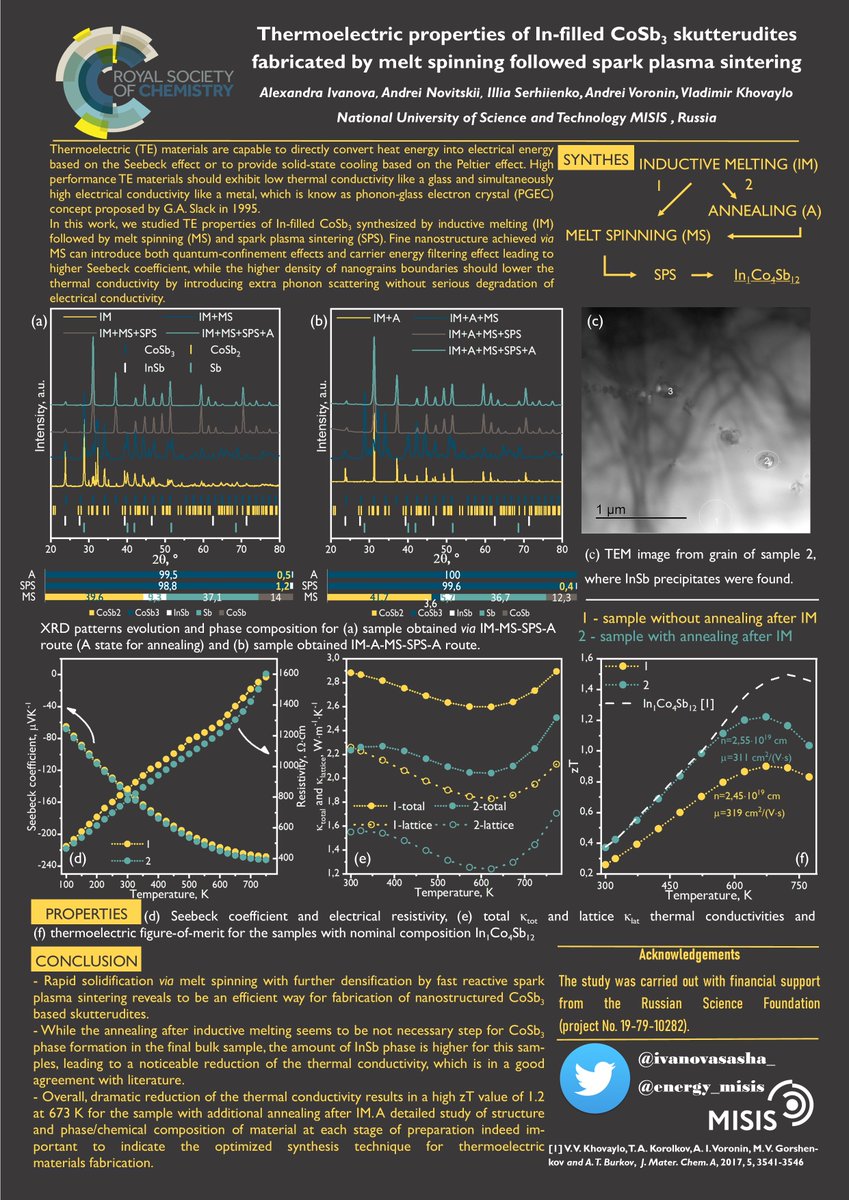
@pereklund77 2/2 The right unit for the resistivity values (fig. d) is µOhm*cm, not Ohm*cm as shown. Sorry about this and thank you for pointing this out.
@pereklund77 1/2 Generally, the electronic contribution to thermal conductivity in skutterudites lies in the range of 20 – 40% of the total thermal conductivity, which is also the case for our work. However, I made a mistake in the poster.
@DrummerBoy2112 3/4 Thus, for sample 1 InSb was found only at the grain boundaries, while for sample 2 it was found at the grain boundaries and at the SKD grain itself, leading to ~20% reduction of the thermal conductivity.
@DrummerBoy2112 4/4 Overall, we believed that such an approach (a combination of inductive melting / annealing / melt spinning) may be used for other types of filled SKD, where nanoprecipitates formation is important for the zT enhancement.
@DrummerBoy2112 3/4 Thus, for sample 1 InSb was found only at the grain boundaries, while for sample 2 it was found at the grain boundaries and at the SKD grain itself, leading to ~20% reduction of the thermal conductivity.
@DrummerBoy2112 2/4 However, during this work, using a combination of different approaches it was revealed, that the formation of the InSb secondary phase (which is important for the thermal conductivity reduction) is affected by the way we prepared the samples.
@DrummerBoy2112 1/4 Thank you for such a nice question!
The initial aim of this study was to develop and optimize (reduce all unnecessary steps) a simple, fast and scalable fabrication technique of skutterudites (SKD).
@DmitriyKarpen11 2/2 These should result in increase of mid/long wavelength phonon scattering and thus reduce the lattice contribution to the thermal conductivity.
@DmitriyKarpen11 1/2 Thanks for the question. Figure of merit enhancement was mainly achieved via decreasing the thermal conductivity. In the In-doped samples, the InSb phase was presented as nanoprecipitates at the boundaries as well as in the body of the grain.