Congratulations to the EU for denying their consumers magazines from outside the bloc because they wanted to stop three Chinese companies who will find workrounds. One of the worst pieces of policy making I have ever seen.
Did more digging.
It gets worse.
I decided to compare, isolating the PS5 Platform as a comparison. How many more digital exclusive games are there? and does it correlate with the 85% number?
There are, at this point in time, about 1,120 PRINTED PS5 games (give or take). We are going to assume, that all 1,120 of those games also have a digital counterpart.
I went to the PSN store and simply clicked PS5 Platform and games. So this does not include DLC, MTX, etc. The total? 7,590 games.
But what about free to play?
Lets exclude those, this brings the total down to 7,451 games on the PSN store sorted specifically for the PS5. I want to note, this would be a COMPLETE PS5 library (thus far).
So, simple Math
7,451 - 1,120 = 6,331.
There are 6,331 MORE games on the PSN store than what's PHYSICALLY PRINTED For the PS5. That is 5.65x MORE games. These are all games that sell for 1 dollar, all the way up to your 100$+ digital special editions. If you Buy Final Fantasy Rebirth for 69.99 physically, go home, and buy "Quack McStuffins" for a dollar on PSN, those quantity of numbers are treated as equal.
and it gets even funnier.
Lets take that digital catalogue of 6,331 games and divide it by that complete library number (7,451) and turn it into a percentage.
6,331 divided by 7,451 = 84.96%
Meaning? almost 85% of the PS5's available library is DIGITAL ONLY. Ironic how 85% of Playstation's sales are digital eh?
So, what's happening here?
"All digital" defenders are using False Equivalency, and an Availability bias to gaslight users into thinking that no one plays physical anymore and to "get with the times" in the digital era.
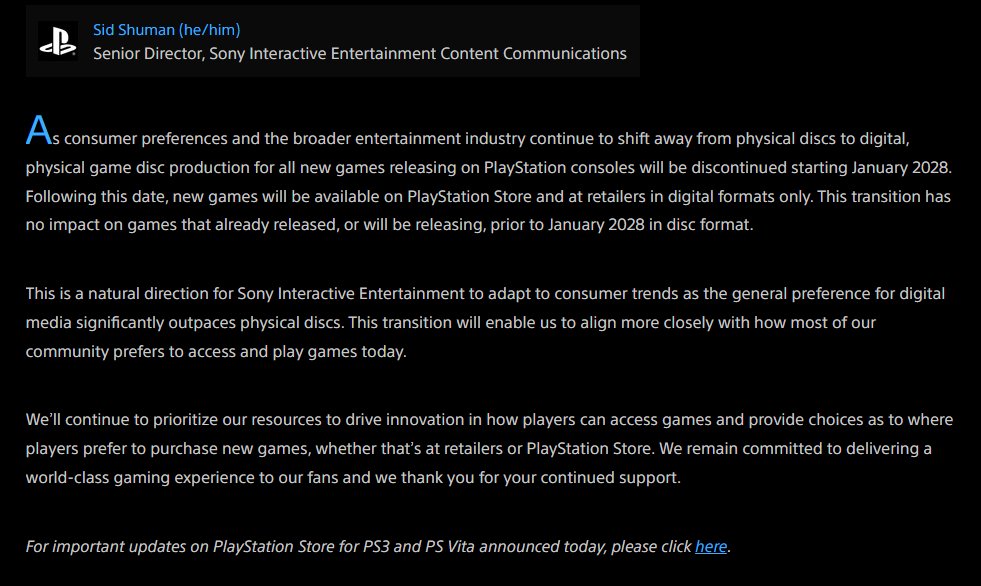
Playstation themselves stated "This is a natural direction for Sony Interactive Entertainment to adapt to consumer trends as the general preference for digital media significantly outpaces physical discs." But this logic is ONLY sound if you apply a False Equivalency.
ALL OF THIS- Before we even take into account of the insomniac leaks back in 2022, which showed that 31 out of the 33 first party games sold MORE in Physical than Digital. And in recent memory, Astrobot selling around 55% physical vs Digital.
So, why are they doing this?
Because MONEY!
Playstation makes WAY more money if you buy the game digitally vs Physically. So playstation is using the backing of convenience, Digital Incentives, indie/AA teams, Mini-Games, and yes, AI Slop, to validate jamming gamers who prefer Physical games with a hot poker into a 100% digital era.
PLEASE READ AND UNDERSTAND:
We have to talk about the physical vs digital data, A LOT of people still buy Physical games on PS5.
More than you think, like WAY MORE! Please read and understand what Sony is doing it trying to FORCE DIGITAL games! IMO this should not even be legal:
- FY2025 Full Year (Apr 2025 – Mar 2026) = the digital to physical split was 78%/22%.
But this does NOT tell the whole story. Because this is all games sold, not all games that have physical copies and digital! So majority of the 78/22 split don't even have physical, let's look at some real numbers from leaks and stats we have:
From Insomniac Leak:
- God of War Ragnarök: 76% Physical / 24% Digital
- Lego Star Wars: The Skywalker Saga: 63% Physical / 37% Digital
- Astro Bot: 55% Physical / 45% Digital
- Marvel’s Spider-Man 2: 54% Physical / 46% Digital
- Assassin's Creed Mirage: 49% Physical / 51% Digital
- Resident Evil 4 Remake: 45% Physical / 55% Digital
- Hogwarts Legacy: 44% Physical / 56% Digital
- Star Wars Jedi: Survivor: 40% Physical / 60% Digital
UK / Europe Retail Data (GSD – 2023/2024):
- Astro Bot: 55% Physical (UK) / and 60% Physical (Europe) – 2024
- Marvel’s Spider-Man 2: 54% Physical (UK) – 2023
- Assassin's Creed Mirage: 49% Physical (UK) – 2023
- Hogwarts Legacy: 45% Physical (UK) – 2023
- Resident Evil 4 Remake: 45% Physical (UK) – 2023
- Horizon Forbidden West: 51% Physical (UK) – 2022
People still buy a lot of physical games on PS5, especially when it's SINGLE PLAYER GAMES. When it's more mp then it goes down to more digital. But please don't just listen to the 78%/22% split, those numbers are overall numbers and don't represent the full story AS YOU CAN CLEARLY SEE!
Because it's not a fair comparison since all games don't have a physical copy or eventually stop printing it. They are trying to paint a narrative to control prices and take ownership from you, that is the truth and spread it!
@DoesItPlay1 When calculating that percentage, were second hand market sales taken into account? I think if you consider all the used games people buy the statistic would shift even more towards physical. But of course, that produces no revenue towards Sony
Everyone is talking about the digital-physical-split percentages. So we will too!
The TL;DR: Most of what has been parroted about consumer preference is wildly exaggerated at best, or a mix of a bad faith campaign and severe negligence at worst.
Sony has announced the death of physical media because of "changing consumer trends". Most of us can already smell the bullshit it in this fake excuse. It is when we take a closer look that we discover just how much of a lie that statement really is.
Let's start by scrutinizing the most repeated number lately: 85 % of sales are digital.
This number exists. But in what context?
It comes from the Fiscal Year Q4 report for 2025. ONLY IN THIS QUARTER did we get this number. The overall percentage for the entire year 2025 is "only" 78 %.
Still sounds bad. Where is the lie, then?
It comes with what both sides include. The digital part also accounts for digital-only games. AKA products which didn't give a choice to the customer. You could either add to the digital tally or not play these games at all. This alone should show you how they use statistics to deceive the public.
But we are not done.
If you look at honest comparisons, like those we got through the infamous Insomniac leaks in 2022, or certain market reports from the UK more recently, you will find games that even sell predominantly physical. Many of which are Sony's own first party titles. So their games sell more physical copies, but they still dare to use consumer preference as the excuse.
Not convinced?
Let's look at the even broader picture. Researching online we can find an infographic illustrating the development of the physical-digital split over the years. Admittedly, there is a constant decline for the physical share. Abysmal even in the years up to 2020. HOWEVER, in recent years the year on year decline has slowed down and has almost reached a stable plateau.
Oh, and have we mentioned that the vaaaaaaast majority of all players own a console that can read discs? 82 % is the number floating around online. We take a page out of Sony's book and just run with it for now. Only, let's add that even the other 18 % might not be digital-only die-hards. After all, there were times when both the disc console and the detachable disc drive were sold out at some point.
What would you say does that show about consumer preference?
Less than 18 % actually prefer digital.
Just with a little research we have come from "85 % prefer digital" to "less than a fifth of the customer base actually does".
So why does Sony push for a change? You know by now. Money!
Multiple areas they benefit in in an all-digital future:
1) Margins for digital games are simply better. The save the entire overhead for physical production, logistics, customer service/returns, retailer cuts, etc.
2) This is the big one: The death of the second hand market. Or at least they think that's beneficial, if they ignore the facts that second hand buyers can also contribute to digital revenue, and they help with discoverability/word of mouth advertising. We wouldn't be surprised if this comes back to haunt Sony.
3) Pricing monopoly: They set the prices. They decide discounts. They decide the number of sales that happen, if any.
The key word is REVENUE!
Because that is another great opportunity to play with alarming numbers. The revenue percentage split between digital and physical makes the gap look even wider, of course. Despite selling almost 70 million physical copies, that area generated relatively low revenue. It accounts for only a little over 10 % of the revenue generated by game sales.
That's the moment when "reliable" analysts and "quality" media could formulate headlines like "Physical media is dying - Makes up only 10 %". But that's not alarmist enough. They can do one "better".
You might ask, "But DoesItPlay?, why do I see people claim that the gaming space is over 95 % digital?"
Let's reveal the most evil trick of them all, shall we?
Let's take a look at that FY 2025 report again. The overall category is called "Game Software". In here (and subsequently in the blogs of the anti-physical crowd) the biggest lie materializes. "Game Software" does not only include digital and physical game sales. It also accounts for ANY TYPE OF ADDITIONAL CONTENT (expansions, in-game currency, microtransactions of all sorts) and "Other Software", which is not even specified as to what that could be exactly. If we now lump all of this together and check the percentage of physical game revenue, we land at roughly 4,7 %.
This, ladies and gentlemen, is the single biggest gaslighting this industry has pulled on you when it comes to lying about consumer preference.
It was never about consumer preference. It was about maximizing profits and control over what should be rightfully yours after a purchase.
non-tech people reply to my post thinking esp32 is yet another cheapo toy or temu fast fashion
meanwhile it's one of the most important pieces of open hardware in the last decade. it helped thousands of students and hobbyists learn embedded systems without needing a $300 dev board
I have bunch of esp32 devices around my apartment doing various things: control fan, lights, monitor door states, etc. and they can be reprogrammed and reused for new projects, NOT made to be thrown away after a few months
politicians can never comprehend this level of engineering freedom
Let's say the PS6 is a digital only console (pretty much guaranteed now) and 20yrs after it's release you wanna get a game for the PS6 but they've shut down the store just like they did for the PS3/Vita. What are you going to do?
You can't go to a gamestop, a pawn shop, a flea market, ebay or whatever. This is planned obsolescence in its' final form. PlayStation now has 100% control over how you buy and play a game.
Your boy wanna sell you a game for cheap? Can't do that, gotta buy full price on PSN. Wanna give your boy a game to check out? too bad, he's gotta buy it for $70 on PSN.
This is terrible for videogame preservation and consumer rights
The EU truly lives on another planet.
Lets say one buys small tech items that are worth only a few pennies - now there’s a 3€ custom tax on it. For a product I’d normally buy for a few cents and don’t get produced in the EU anyway..
or I can buy the exact same product in a 100 pieces package for 15€ at some mismanaged retail store.
Essentially means that you can no longer DIY stuff or repair things as the import tax of several items quickly add up.
Also think about smaller stores that buy necessary items in small quantities; actual tech shops and so on - they will no longer be able to buy the necessary supplies at a value which made repairing tech feasible..
Se nos acaba de atragantar la comida.
PlayStation confirma en su blog oficial que dejará de producir juegos en físico a partir de enero de 2028. Los nuevos títulos se lanzarán únicamente en la PlayStation Store y en tiendas a través de, exclusivamente, formato digital.
God forbid you buy things directly from the manufacturer as opposed to a drop shipper that slaps a 5x markup on the exact same product
If the issue was things like Temu and Shein they could've applied the fee only to specific items like clothing. Many spare parts and electronics are literally only made in China.
I would like to remind everyone that all the digital ID bills are SUPPORTED by tech giants like meta and google because their data selling scheme is rapidly becoming worthless thanks to AI and bots (a problem they created).
Wanting media that can be censored by the state to be broadcast on the internet that will be ID locked by the state.
So this is how democracy dies. With a bunch of terrible parents going "it's about time".
Someone searched for a Munich publishing company on Google. the AI Overview came back with:
"Yes, [company] is known for dubious business practices."
then added a summary. red flags. tips for users to avoid the scam.
confident and structured but was completely made up.
the sources the AI cited said none of that the AI mixed the company up with genuinely shady firms and invented connections that existed nowhere on the internet.
the publishers sent Google a cease-and-desist. Google didn't respond adequately.
so they went to court.
the court's ruling:
AI Overviews are not search results. they are Google's own words. Google rewrote the web "in its own words and according to its own structure." therefore Google is the author. therefore Google is liable.
Google's defense: users know AI makes mistakes and should double-check.
the court's response: that's not how publishing law works.
Google's statement after the ruling: "AI Overviews are designed to reflect information that already exists on the web."
the information that destroyed two companies' reputations did not exist on the web.
the AI wrote it.
Google published it.
a court just decided those are the same thing.
every AI search engine. every chatbot. every platform that takes information and synthesizes it into a confident answer is now looking at this ruling.
When your AI gets it wrong, who pays?
Google Chrome 150 marks the end of full support for Manifest V2 extensions, effectively removing the remaining workarounds that allowed the original uBlock Origin to continue functioning in Chrome.
Starting with Chrome 150 (expected in late June 2026), Google will complete its transition from Manifest V2 to Manifest V3. This means the powerful webRequestBlocking API used by advanced extensions will no longer be available for normal Chrome extensions.
As a result, the original uBlock Origin will no longer work at full strength in Chrome. It relies on Manifest V2’s ability to inspect and block requests in real time.
Under Manifest V3, extensions must use declarativeNetRequest, which requires them to rely on predefined filtering rules instead of dynamic blocking. This improves security and performance according to Google, but it also limits what ad blockers can do, especially against complex ads and trackers on sites like YouTube.
The developer of uBlock Origin offers uBlock Origin Lite, a Manifest V3 version that still provides ad blocking but with the restrictions imposed by Chrome. Other ad blockers have also released Manifest V3 versions with similar limitations.
Users who want the full power of the original uBlock Origin can switch to Firefox, which continues to support Manifest V2 extensions, or use Brave, which includes built-in ad and tracker blocking.
Google has been gradually rolling out this change since 2024, and Chrome 150 marks the final step in that transition.
Al de la Filmoteca Maldita, que subía películas Lost Media, le piden 2 años y medio de cárcel y 870k€
Mientras él esperaba su juicio, varias empresas piratearon terabytes de libros para entrenar sus IAs
El copyright NO protege la cultura ni es igual para todos
Hoy hablamos de eso
🔗 https://t.co/xO3LT4nGbZ