Author of the No Bullshit Guide textbook series. Founder at @minireference. Strong humanist bias. Using Python for good. Wrestling with stats code every day!
@justinskycak ... once you're up there, you can take many "lateral" paths to see nearby views (both known and unknown), and each new (often redundant) path you learn among the different places (math results) is a new "aha moment" experience.
More connections → less things to remember. (2/2)
@justinskycak The way I see it, math knowledge is like a mountain, and having good prereqs structure (scaffolding) as a steady climb path that trains your legs as you go up the hill to reach new heights. You're right, it will feel easy (obvious) to get to the new places, however, ... (1/2)
@mathladyhazel And similarly for potential energies:
U_g(r) = G*m_1*m_2/r and U_e(r) = k*q_1*q_2/r
(where potential energies are defined negative of work done as U = -W = -∫F⋅ds calculated from x=infinity to x=r)
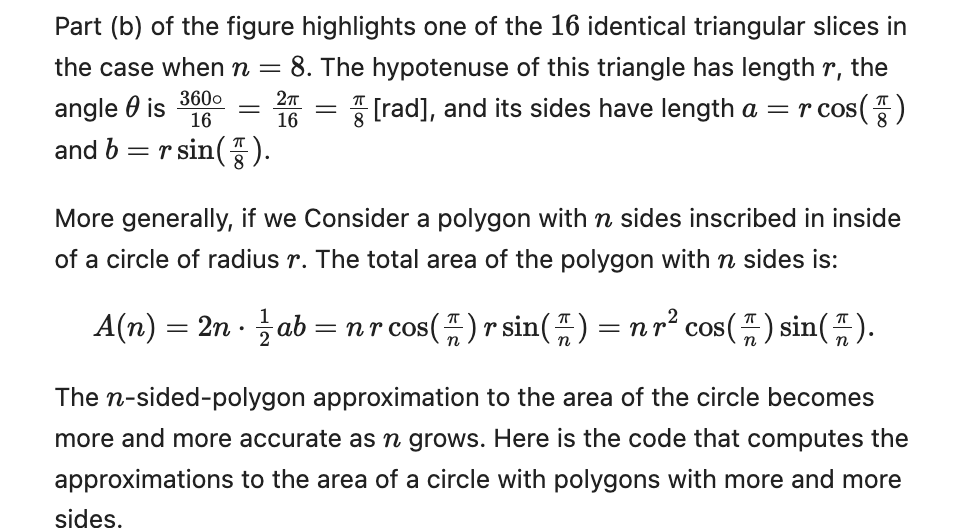
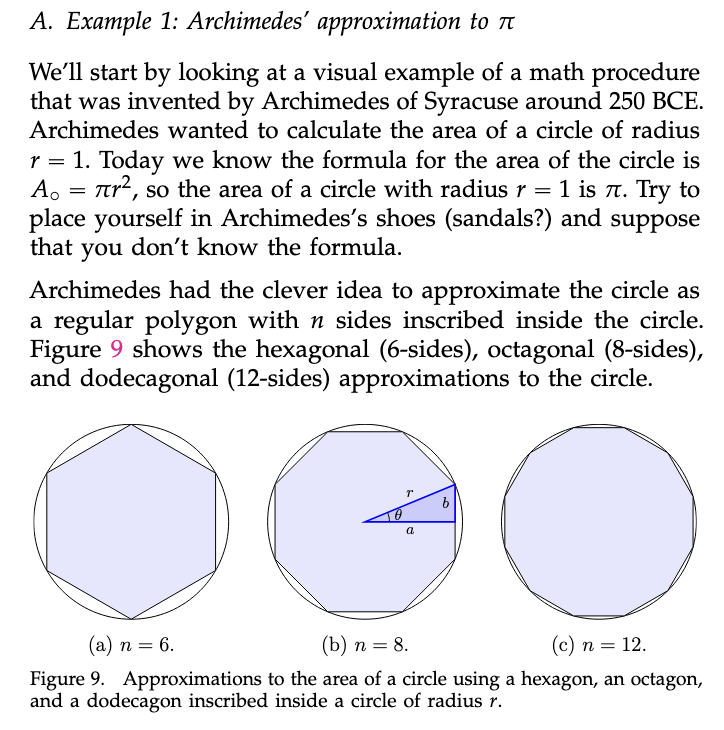
Archimedes' approximation to π from 250 BCE:
Split the area of a circle into triangles, calculate the area of the triangles, and add them.
It probably took Archimedes days to compute all the triangle areas; we can do it more easily in Python today ;) #calculus#PiDay#Python
Fresh off the press:
Free tutorial: Calculus explained in 25 pages
Printable PDF: https://t.co/jaX3CiPmJj [2MB, 25pp]
Video trailer: https://t.co/dwGAeosphC
Blog post with more info: https://t.co/Bul3OVhKUr
I was feeling optimistic this morning I could use "shortcut" to generate a dataset with certain characteristics for educational purposes (examples of Seaborn visualizations).
I feel totally discouraged now; going to think about the problem using my own neural netweok after lunch.
The thing I find most frustrating about genAI is that, when it fails to one-shot a solution, it doesn't leave you with any partial progress. You waste hours on the tweak-and-wait loop with 0 result. In contrast, if you worked on it, you'd have a partial solution to improve on.
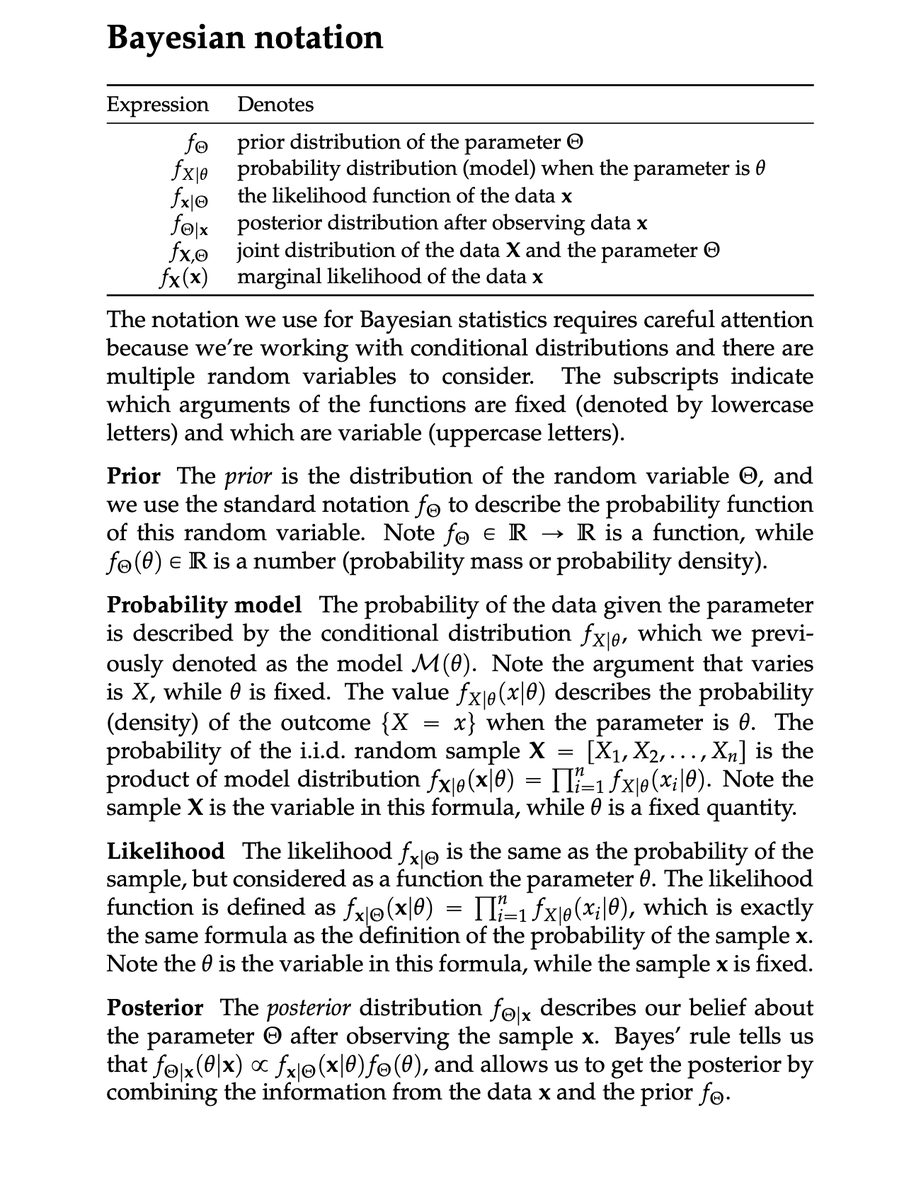
Update: I ended using the notation L_x(θ) for the likelihood: https://t.co/jQjLc3I2eW
This is more standard, better mnemonic (L--> likelihood) and visually distinct from a probability distribution so makes the whole "doesn't integrate to one" easier to understand.
I spend an exorbitant amount of time choosing the notation for each section to ensure consistency and precision. I used to think this was wasted time, but now I realize this effort is essential for the clarity of explanations...
Cleanliness of notation is next to Godliness?
@emilesilvis The softcover and hardcover versions have the same content, but the hardcover is nicer. It's also more expensive though, so I leave that choice up to you.
@emilesilvis Print is definitely better because you can flip back and forth between the different parts.
Also, with purchase of a print copy, you get a free PDF copy with matching page numbers so you can switch between print and screen as you wish, cf. https://t.co/s1LUz2ePgy
@desirivanova Yeah, I'm getting that a lot lately.
Usually on the second or third question (after earlier part clearly having access to the web).
I also get the suggestion: you can paste URLs here and I will check them for you, and I'm like, "yo, you provided the URLs above—check them!"
@foolstechdev Nice! I'll be glad if my book helps you with understanding 3D stuff (and 4D in homogeneous coordinates!).
I was recently doing some edits in that section to add this link to a book that seems cool (its out of print, so the authors made it free online):
https://t.co/coGsdpU8Jt
Here are direct links to the PDF preview that include the introductions from each chapter:
https://t.co/Qcn34EvUo2 [223pp, 9MB]
https://t.co/QFxuMLL0fB [191pp, 16MB]
See also the concept maps:
https://t.co/QKSsRbsGdk
After seven years in the works, the No Bullshit Guide to Statistics eBook is finally done! See the announcement blog post here: https://t.co/Ug94oAj2zi
People say teaching both frequentist and Bayesian #statistics in parallel can't be done, but I say ¿Por qué no los dos?
@__mharrison__ To generate sampling distributions empirically, e.g. here is the sampling distribution of the mean for samples of size n=30 from the uniform random variable
ubars30 = [np.mean(rvU.rvs(30)) for j in range(10000)]
@muperpaseum Thanks for the kind words. Yes, I hope to work on more translations over time. So far I only have a French translation, which was a lot of work but good experience, cf. https://t.co/DFdRFKnnH3
Так, i український переклад зрештою !