@centrifuge, the pioneer in RWA tokenization, is exploring a possible restructuring that would turn its CFG token into equity in a Cayman Islands company. It's one of the community's hottest discussion topics this year, with 100+ replies a few days before the voting begins.
@RobinhoodCrypto 8. Having tokens on blockchain rails strikes me as tempting for building on top. All the early-stage obstacles - rebalancing, batch execution looks realistically solveable by a wallet or de-fi application. @TheIndexFi is good example, someone is already moving in this direction.
@RobinhoodCrypto 7. Traditional index funds regularly rebalance to track their strategies. Trading 212 pies allows us to do this with one action, though it's still manual. There's not rebalance functionality in the wallet yet.
@RobinhoodCrypto 6. Robinhood path was a bit longer. Deposited EURC, swapped into USDG, to avoid extra hoops on individual trades as I noticed the stock LPs are against USDG. Paid $2.02 here. Then did 10 individual trades with 1/10 of the remaining value, ~$0.19 swap fee on each. Network fee - 0.
@RobinhoodCrypto 5. Trading 212 'pie' feature allowed us to invest directly in EUR an equal amount of the sum into the 10 underlying stocks. This costs 0.30 EUR trading fee, and it happened in one go. An efficiency hard to beat.
@RobinhoodCrypto 4. Stocks brings dividends, we got $0.02 AAPL on 13-th. Tokenized counterparts are debt securities against the RHJ issuer. Dividends exist, but silently, by scaling the balance value (ERC-8056). Still now widely adopted and most wallets (including Robinhood's own) show balanceOf.
@RobinhoodCrypto 3. Tokenized stocks tend to price a bit higher on average (1-1.5%). This continues to be valid about a month after the chain was launched due to the hype around the new tokenized asset. The price effect on our overall performance is negligible.
@RobinhoodCrypto 2. NYSE FANG+ took a bit of downturn during the experiment, so I suffered a bit of unrealized loss on both portfolios: -0.56% for off-chain, -2.02% for on-chain index. Why is that?
@RobinhoodCrypto 1. The setup was quite simple, as the index is too. I also needed a benchmark platform for traditional stocks, so I used @Trading212. Each platform received 200 EUR of funds, invested at the same time on August 4-th in the 10 stocks composing the index.
@gnosispay cashback program is supposed to end on September 30th. No extensions are proposed and a B2B shift for V2 was already announced. Today they added funds for ~5 weeks in their distribution contract. A part of me still hopes it's not over.
@BrianInCrypto@Uniswap > Retail participants should not be making markets.
If retail participants are feeling like losers, they are free not to participate. Obviously they still want to be in.
@cinesiusss A few past hardware wallet issues compel me to say no. But more importantly, it's a personal preference. For some, $5k buys a good time in the Maldives, for others it's a lifetime of savings.
@RobinhoodApp I've dreamed about it for a while, but waited for the perfect moment. Preparation was mandatory, as it was my first time. Registration, KYC, SEPA transfers... Then it happened, so fast. We separated long ago, because the company underwent a merger. But I will never forget it.
Ethereum's Trillion Dollar Security initiative tracks frontend dependency sandboxing as a risk control under its infrastructure dimension, with LavaMoat mentioned as active solution.
Excited to see it showcased in practice.
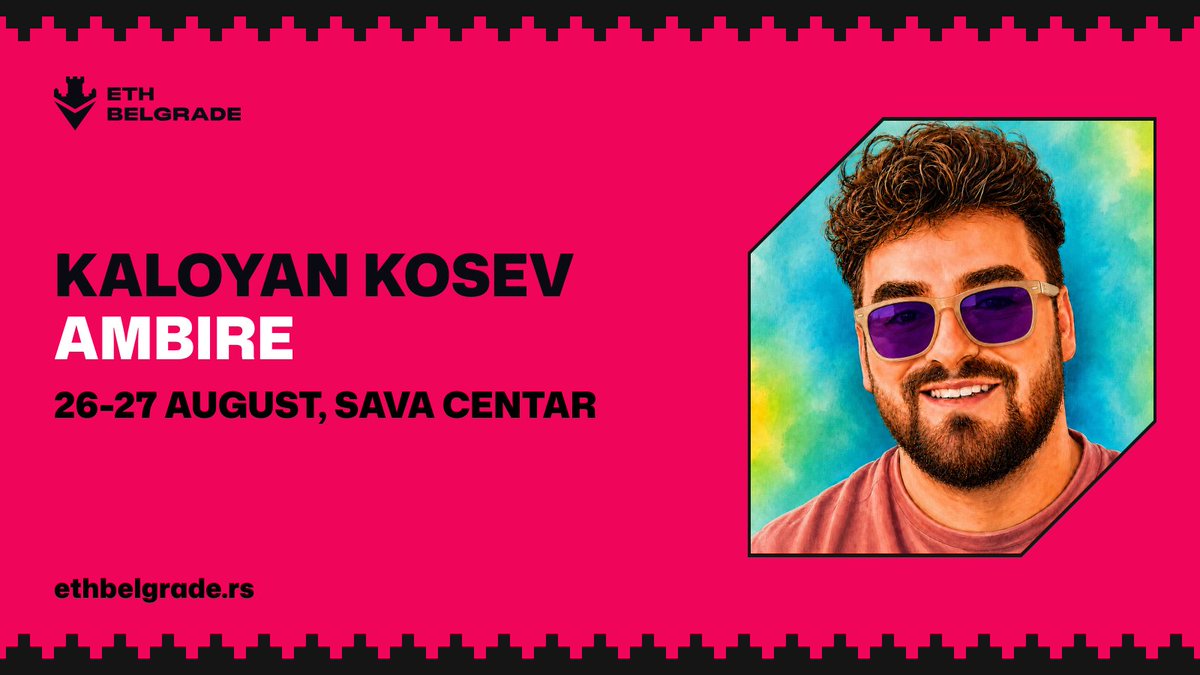
NEW SPEAKER ANNOUNCEMENT 🔐
@0xSuperKalo, Tech Lead at @ambire, is joining ETH Belgrade.
With 15 years of experience as a JavaScript engineer, Kaloyan was part of the team that secured Ambire’s browser extension against the risks introduced by compromised npm dependencies.
He’ll explain how LavaMoat and Secure ECMAScript can isolate third-party packages and limit what they are allowed to access.
See how this works inside a real browser extension at ETH Belgrade.