@borislavItskovv It's tricky doing an exact estimate as Uniswap fee switch is tailored across protocol versions and pools. Still, total protocol fees as measured by @tokenterminal is a good enough indicator for the peak inflow.
~100 ETH -> ~4800 ETH in daily Ethereum fees (base + priority).
That's the Binance hack's side effect: everyone scrambling to trade at once.
For a Lido staker that meant a daily APR jump from ~2.2% to ~15%.
@goran_stoyanov "The art of taxation consists in so plucking the goose as to obtain the largest possible amount of feathers with the smallest possible amount of hissing."
Well, now they found a way to decrease the hissing by making you pay for it 🙈
Introducing Ambire Ice: The hardware wallet built for @safe.
Private
Fully open-source
Quantum ready
Perfect clear signing
Ambire’s extension and mobile app, now with a dedicated hardware device.
Pre-order yours: https://t.co/RZfZezQNHd
@BleapApp serious answer
- CASPs in EU report everything under DAC8
- stablecoins have issuers
- to buy something meaningful you still eventually convert to fiat
but it's nice to at least start with "why"
imagine being hacked and the attacker is leaving readme.md files all over your system that cause your ai to constantly give cyber refusals so you can't even use ai to defend yourself lmao
@l2beat #5
1. Look for matching values in PrivacyPoolComplex transfer history (to eliminate protocol fee noise).
2. See 9.37 withdrawal to investigated address (Sep 20)
3. No 9.37 deposit found, but 12.49506 (Sep 19) and 3.12506 widhdrawal (Sep 22) that are likely linked.
We have a special treat for you at L̵2̵PrivacyBEAT today: an amazing treasure hunt to unleash your inner @zachxbt! 🔍
This was originally part of an internal workshop, but now we’re opening it up to you! All details here: https://t.co/FmovWEGQ1m or in the thread below.
@l2beat@0xprivacypools with low activity are susceptible to amount correlation.
Matching amounts are often not a real proof, but are enough for an address to be 'flagged' for further investigation.
One should be cautious with withdrawing remainders from a privacy protocol 💡
@l2beat #1: funds sourced from l2beet.gwei, -> the surprise website would be https://t.co/6Yyz5iyG7d. #1 was funded by https://t.co/RCEWQpzmOG, so it was enough to do a lookup in their public transaction explorer by receiver address and get to the sender tx on arbitrum.
We have a special treat for you at L̵2̵PrivacyBEAT today: an amazing treasure hunt to unleash your inner @zachxbt! 🔍
This was originally part of an internal workshop, but now we’re opening it up to you! All details here: https://t.co/FmovWEGQ1m or in the thread below.
Long-time CarbonDeFi user via Alienbase. Got a bit frustrated when frontend stopped showing my positions, but didn't panic. My withdrawal was always one contract call away.
That's the case for tools like this: strategies not actively managed, should live on-chain.
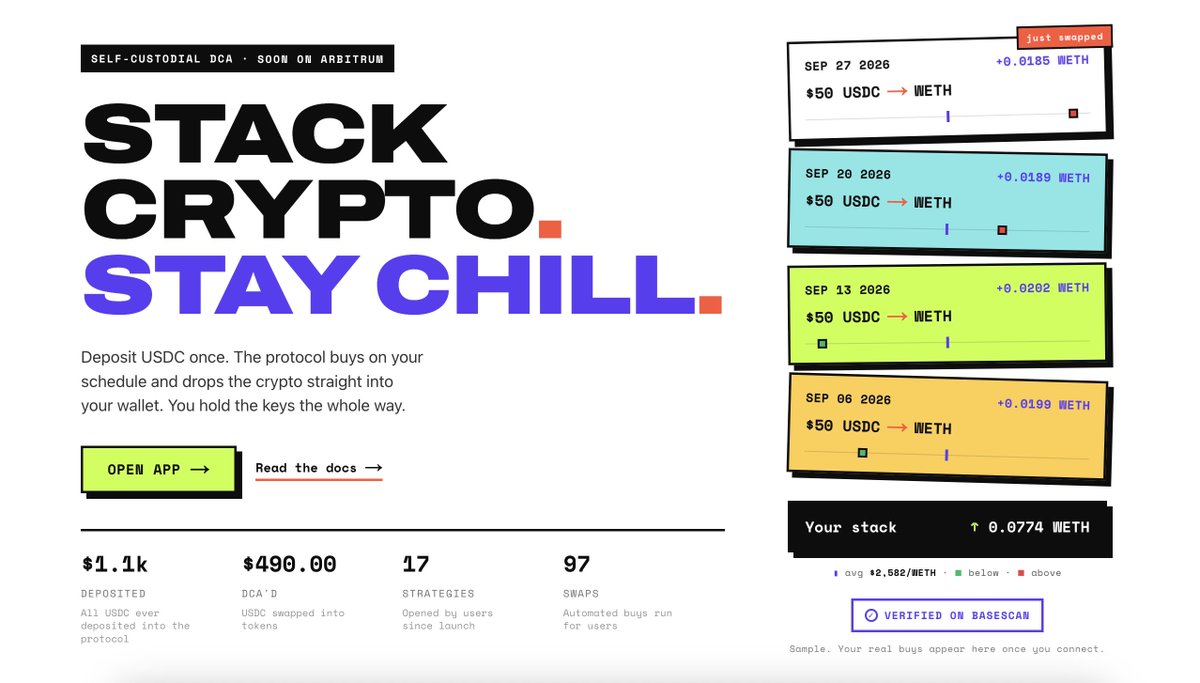
DCA Onchain is live.
A self-custodial way to automate recurring crypto buys.
Set your strategy.
Fund your own smart contract.
The protocol executes the buys on schedule.
Your crypto goes straight to your wallet.
Try it https://t.co/cs05bX7uIW
Railgun privacy achieved internally in @ambire, thanks to #Kohaku SDK / @ethereumfndn.
For the demo, we have 2 public and 2 private ZK accounts: RailgunA and RailgunB.
0:00 - Shielding ETH from public RailgunA to its derived private ZK account.
1:00 - Sending privately between the two ZK accounts.
2:30 - Unshielding from RailgunA's private ZK account to public RailgunB, with no onchain traceability.
Shield txn: https://t.co/sOnlC0K8R2
Unshield txn: https://t.co/p0X22sDzbA
Our end goal is built-in privacy in Ambire. With the Kohaku SDK evolving, we're continuing to expand the integration and explore what's possible with Privacy Pools @0xprivacypools.
The path is long, but the direction is clear 🛡️
Last post in my quantum series: "when quantum hits, every wallet is cracked and there's nothing we can do" Not true 💪
Every "quantum will kill crypto" take skips the obvious: we already have quantum-safe signatures. NIST standardized them in 2024 (ML-DSA, SPHINCS+). The math to replace ECDSA is done.
What's left is swapping it in. On Ethereum that's easy or hard depending on your account:
▶️ Smart account: checks signatures in code, so it can adopt a post-quantum scheme on its own - same address, no fork.
▶️ EOA (a normal address): locked to ECDSA, can't be upgraded without changing the protocol.
But EOA with EIP-7702 (the standard that lets them delegate to smart-account code) - is the way to bring existing EOAs along!
But it's only a potential path today, not an escape hatch yet. That's because you can't remove the original private key! As long as that ECDSA key can still sign, a quantum attacker who recovers it still owns the account, whatever you delegate to.
@ambire is not post-quantum today, and neither is anyone. But account abstraction is what makes the eventual switch a quiet, same-address upgrade with no user action.
Series done. I'm sharing the earliest post below 👇
I appreciate the effort of established products to explore new niches, but Spotify throwing "Japansese walking workout" videos at me on the home page is too much. There's enough places in the internet to watch random shit, for free.
Serve your audience and keep focus.
@centrifuge, the pioneer in RWA tokenization, is exploring a possible restructuring that would turn its CFG token into equity in a Cayman Islands company. It's one of the community's hottest discussion topics this year, with 100+ replies a few days before the voting begins.