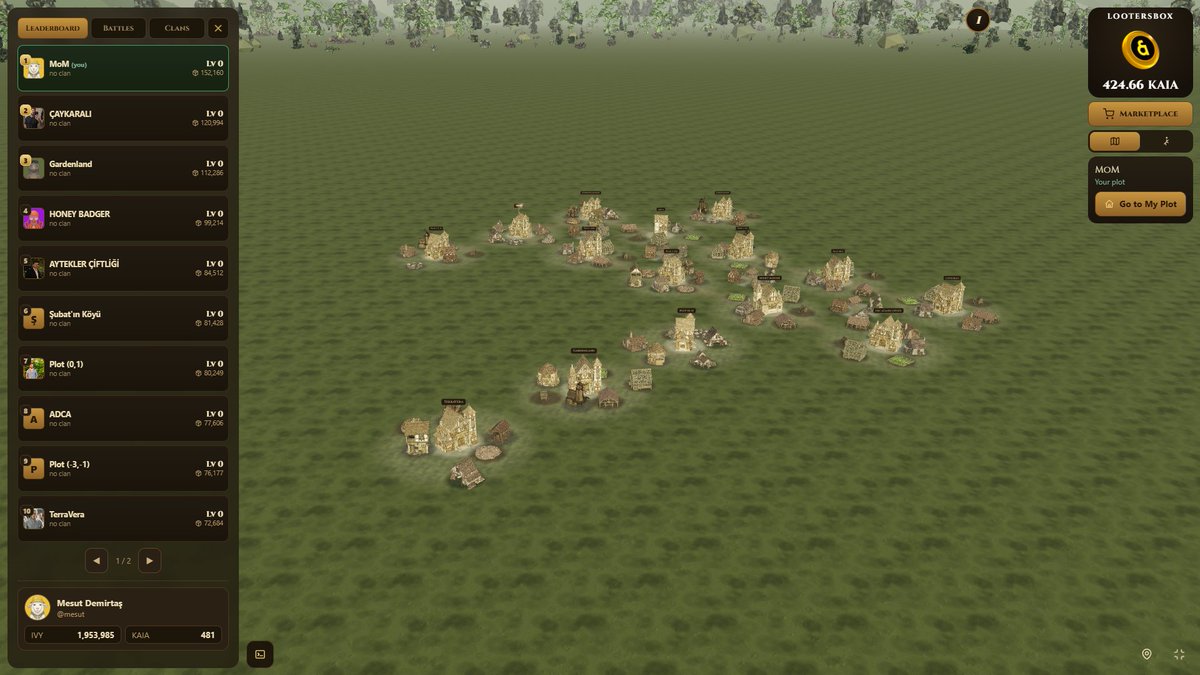
If you knew Ivy as a token, what you are looking at now is something else.
The old Ivy was a token on BNB Chain with a classic web2 app beside it. Posts in a database. Likes reduced to a number. Identity as a row in a table.
The chain existed. It was just not part of daily life.
1/5
What if your village could earn you real kaia:native? 👀
🌾 Buy land & build
⚒️ Produce resources
🛡️ Train farmers & guards
🤝 Form a clan
⚔️ Raid other villages
Win → take your share of the treasure 💰
Looters: 100% on-chain.
https://t.co/zsWSeva0wC
TARE is live!
Complete social interactions and on-chain transactions instantly to claim 250 KAIA.
More campaigns and project activities are coming soon.
https://t.co/vstwjjEzXS
Ivy Live is on its way to becoming a revenue-generating app ecosystem. The revenue generated is shared among Ivy users.
The next reward distribution is in 30 days.
https://t.co/pP0Hx4lLLo
4/ If you run a tracker, a listing or a dashboard, the same data is open to you:
https://t.co/iq3CE30bns
Free to use, no key required. Take the numbers from the source instead of asking us for them.
1/ Every number behind Ivy, on one page:
https://t.co/KMK0ezr9xL
Supply, staking, SharePool payouts, posts, likes and tips. It refreshes every 60 seconds, straight from the chain. No account needed.
3/ One line on that page never changes:
500 billion minted. Not one more.
The token has no mint function. Every IVY burned lowers the supply for good, and each SharePool share burns 1,000,000 IVY.
A few NFTs stay with the wallet that received them and can never be moved. Their Send button is greyed out, so you do not spend a fee on something that would fail.
None of this expires. Whenever you get around to it, it will still be there.
https://t.co/1Da9lS24dk
If you were with Ivy before the move to Kaia, two things are waiting for you on one page.
Your new IVY, and the NFTs you own but probably cannot see anywhere.
https://t.co/ywgg5Jg5LD
Every NFT it finds has a Send button.
Type the address of the wallet you actually use on Ivy, confirm, and they arrive there. That is how they show up in your Ivy account.
Sending cannot be undone, so read the address twice.
So the question was never which chain we are on. It was what is on the chain.
Our answer is everything. Identity, usernames, likes, tips, revenue, and the rules that split it.
Ivy is now a social network written onto @KaiaChain , from its identity layer to its economy.
5/5
If your revenue sits inside a company's accounting, you cannot verify how much of it reached you. You are asked to trust the accounting.
That is the arrangement on every platform you have ever used. Ivy included, until now.
4/5
If your revenue sits inside a company's accounting, you cannot verify how much of it reached you. You are asked to trust the accounting.
That is the arrangement on every platform you have ever used. Ivy included, until now.
4/5
If your likes live in a database column, they can be deleted overnight, inflated, or produced by bots.
If your username is a row in a table, whoever holds that row can take it back.
3/5
If your likes live in a database column, they can be deleted overnight, inflated, or produced by bots.
If your username is a row in a table, whoever holds that row can take it back.
3/5
The problem with that was not technical. It was structural.
A social network that reaches a blockchain through a token is not onchain social. It is a database with a token next to it.
We know, because that is exactly what we were.
2/5