Ronald Reagan has a message for MAGA as Trump escalates the trade war with Canada:
“We should beware of the demagogues who are willing to declare a trade war against our friends, weakening our economy, our national security, and the entire free world, all while cynically waving the American flag.”
This might not make me popular but I remain continuously impressed by Carney: to me, one of the few (if not the only) genuine statesman in the West.
It genuinely takes incredible balls and statesmanship - especially for Canada, arguably the western country that's most dependent on the US - to walk away from the table and match Trump's tariffs China-style.
Europe, with far less dependence on the US and considerably more resources than Canada, just pathetically caved and signed on Trump's humiliating terms when in the same situation.
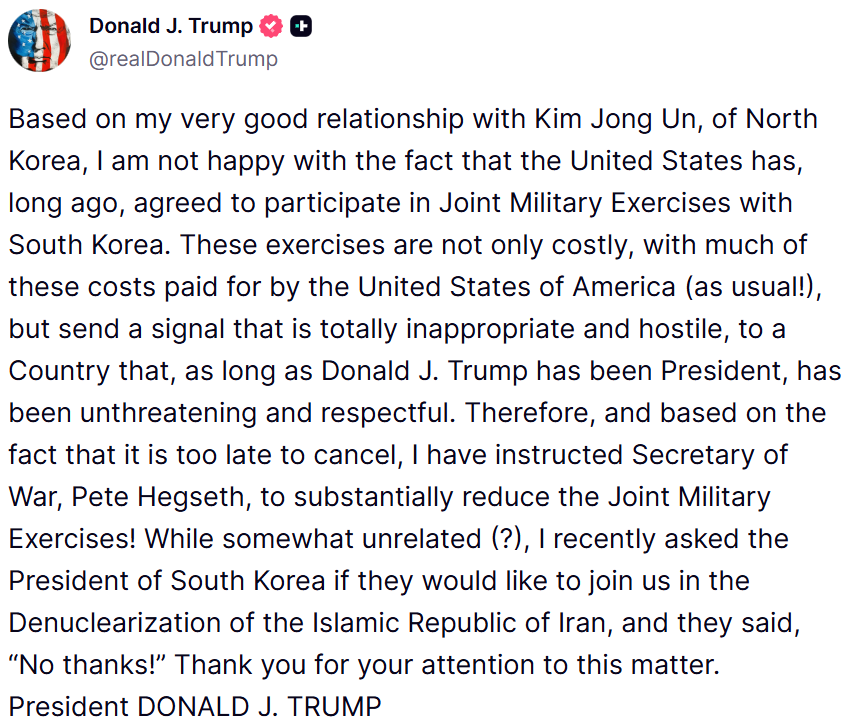
~35,000 Americans died to help create South Korea, and it remains home to several key US military bases. they have historically been a very good ally
meanwhile, North Korea is sending its soldiers to fight on behalf of Russia in Ukraine against US/NATO interests
this statement, endorsing one of the most significant destabilizing forces in the region, will have a chilling effect across all of our allies in Asia (Japan, Taiwan, Philippines, etc.)
as i've said for months now, you are watching the speedrun destruction of the US empire happen live as a result of a war of choice where we chose not to build any multi-lateral justification or coalition beyond Israel
it's so over
It makes me laugh when the same leftists who implemented rent controls in Berlin now blame landlords for the severe apartments shortage.
Rent controls quickly halved the number of available apartments.
Perfect example of leftists not understanding even basic laws of economics.
Software Disruption Analysis: Industry is More Resilient than Feared
I studied a cohort of ~100 public software companies from 2022-1H26, and analyzed them for evidence of being AI winners, losers, or resilient. Full list in last tweet.
High level takeaways:
- 3 years in, there is not broad evidence of AI disruption in software. ARR growth growth remains healthy and stable, growing mid-teens in 1H26.
- It is clear which categories of spend are being categorized for growth, maintained, or being de-prioritized.
- A cohort of AI winners is growing faster than AI Ad Tech ($GOOG $META $AMZN $APP), but slower than hyperscalers and labs.
- The vast majority of public software companies are demonstrating resilience to AI.
- The money is to be made buying (or shorting) stocks that are put into the wrong category: believed losers that are actually resilient, or resilient companies that become winners, or shorting winners that are ultimately challenged, etc.
this is important to understand
very simple explanation from bezos on why EPS and EBITDA are bullshit + FCF and ROIC are what matter.
EPS and EBITDA ignore capital intensity. hypothetically, you could spend $10B on capex, at a negative ROIC, and have EPS/EBITDA quadruple.
the stock will go down in this circumstance 100% of the time fwiw, the market understands value creation
this is why you see M&A that is "EPS accretive" and the stock goes down 25%, because the mkt sees value destruction
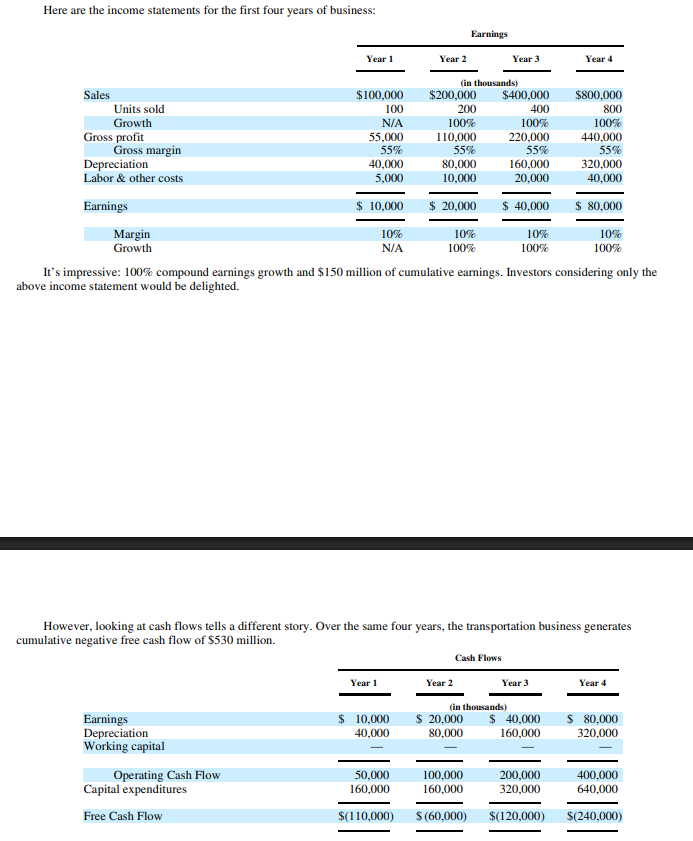
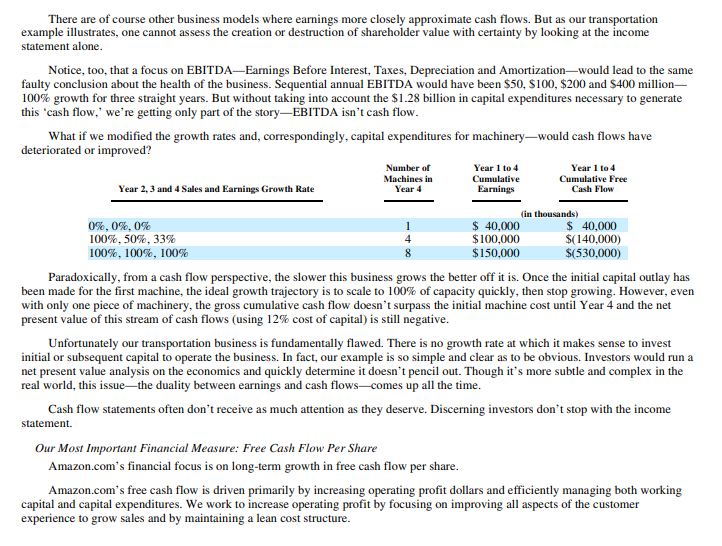
Bezos: "There are of course other business models where earnings more closely approximate cash flows. But as our transportation example illustrates, one cannot assess the creation or destruction of shareholder value with certainty by looking at the income statement alone.
Notice, too, that a focus on EBITDA—Earnings Before Interest, Taxes, Depreciation and Amortization—would lead to the same faulty conclusion about the health of the business. Sequential annual EBITDA would have been $50, $100, $200 and $400 million— 100% growth for three straight years. But without taking into account the $1.28 billion in capital expenditures necessary to generate this ‘cash flow,’ we’re getting only part of the story—EBITDA isn’t cash flow."
the letter is here, its short, 3-4 pages
https://t.co/IaAtp6sS0q
but again, pull up a bunch of LLMs, and sit there asking questions until everything written there is crystal clear
this is very very basic shit that 99.9% of twtr doesn't understand, but where u will get dinged from any intvw immediately
basically, what do P/E and EV/EBITDA get wrong, what are their flaws, what is the IS' tie to the CF statement, why is FCF what matters, what is ROIC, how is equity value created, why is every stock a DCF
this is like, bare bones fundamental equity analysis, where u simply dont understand what drives stock prices if u dont have this mastered.
so get it nailed down 🔨
John’s right. It reminds me of the story of Buffett going to see the farm implement dealer. Buffett asked him how his year went. The owner said great. Buffett then asked him what he did with the profits. The owner pulled back the curtain in his office and said it’s all out there on the lot (referring to the tractors and equipment). Buffett wanted money to invest for him. No dice for Buffet. The answer was that it was a business that had no excess cash above what was required to grow the business.
Moral of the story: That wasn’t the best kind of business. As Buffett said at the 2025 BRK meeting, the best businesses are the ones that need no capital.
Further, if the ROIC is consistently 10-15%, you can’t pay more than 1.5x-2.5x the invested capital for that type of business. Don’t have to check my notes on this one. It trades nowhere near that range of capital multiples. The unknown future always haunts us all!
$AMZN Jassy: "We've long believed AWS could become a few hundred billion dollars revenue business and now believe it will be at least double that and very possibly be $1 trillion annual revenue business for us in time with very appealing accompanying free cash flow and return on invested capital."
@BenBajarin True, but what about the quality of the earnings? Profits are in theory receivables, not cash. Also look at Broadcom for example. Do you think that frontier labs are able to fulfil their obligations? Think that makes the market uncertain, look at Oracle CDS.
Trump is so fucking dumb that when he heard that semiconductors use "transistors," he thought they said "transgenders."
That's how fucking stupid our President is.
The issue with using ROIC as a North Star for your investing process is that it is a trailing output. Buying companies with high ROICs tends to/tended to work because during constant global paradigms there is a persistence to excess return generation at the industry level.
The issue is that during a paradigm shift, the trailing metrics become useless.
What matters are competitive advantages.
Barriers to entry. Switching costs. Network effects. Cornered resources. The power you hold within your ecosystem.
ROIC will never stop mattering, but the backwards looking accounting metric is borderline useless in an environment like the current one.
The dominant tech trend of the 2010s was scaled platform companies vertically integrating from app, to software, to middleware, to hardware, to semis.
Scale + Software-hardware co-design provided both better performance and better cost than merchant systems, leading to platforms squeezing most of the value out of the ecosystem while still delivering tons of value to customers (and killing competitors forced to pay merchant premiums).
We saw this at $META $GOOG $AMZN $MSFT $AAPL and it created the Mag7 dynamic.
The bottlenecks around AI infrastructure (more demand than supply) has shifted power from platforms back to components in a manner that hasn’t been seen since the 1990s. The market is wrestling with the question: is this a permanent shift?
There is mounting evidence that this is not a permanent shift. And I suspect platform companies will repeat the 2010s playbook of using software-hardware co-design to commoditize merchant providers throughout the stack and deliver superior value to customers at lower cost. We are seeing this with Trainium and TPU ASICs (3 programs), $META MTIA and CXL/memory optimizations, $AAPL expanding their ASIC program with $AVGO, OpenAIs Jalapeño inference chip, Anthropic reducing Neoclouds to a Colo layer with $WULF deal this week, and I suspect Anthropic and OpenAI will only become more vertically integrated each year.
To convey the point - $GOOG is forecast to spend more on Capex in 2027 than the entire semiconductor industry had in revenues a decade ago (chart below). They will be relentlessly optimizing that spend for eternity. They alone can support basically an entire 2016-semis sized economy to optimize the stack. Thats how they have 3 different XPU ASICs ramping, plus CXL, plus CPUs, and much more. Not all will work - not all needs to.
This doesn’t mean $NVDA is a short. I think $NVDA is becoming a sortof platform company with a vertically integrated complete rack and software solution, lots of co design with the server and DC supply chain, with some 3P models, and its own OS models. There will be continued need for general purpose AI infrastructure, ASICs won’t do everything. METAs Neocloud optionality exists only because they have GPUs.
But beyond $NVDA, $AVGO, $TSM, which are basically platform companies with unique and valuable IP, I expect most of the rest of the AI bottlenecks in memory, power, and storage, to re-commodotize over time.
A bet on bottleneck stocks at this stage of the AI buildout is explicitly a bet that extreme shortage conditions remain intact to ~2030+ (to get your money back + a high beta cost of equity before conditions normalize). That might happen! But it’s a much higher hurdle than exists for the platform companies.
There are scenarios where supply-demand come into balance and $MSFT $AMZN $GOOG $META $NVDA $TSM $AVGO $AAPL (and yes Anthropic OpenAI), could still be great investments. Those are plays on the underlying AI inference S-curves more than extreme availability shortage conditions persisting. This is proven out by the fact that they mostly haven’t increased margins significantly this cycle. They benefit more from token unit growth than from extracting panic shortage prices from customers.
I guess I’m forecasting we eventually have a Mag10 market if demand curves for tokens persist, but platforms are able to get supply chains to catch up to demand.