🚨 Prompt engineering is officially outdated.
Anthropic just released the real playbook for building AI agents that actually work.
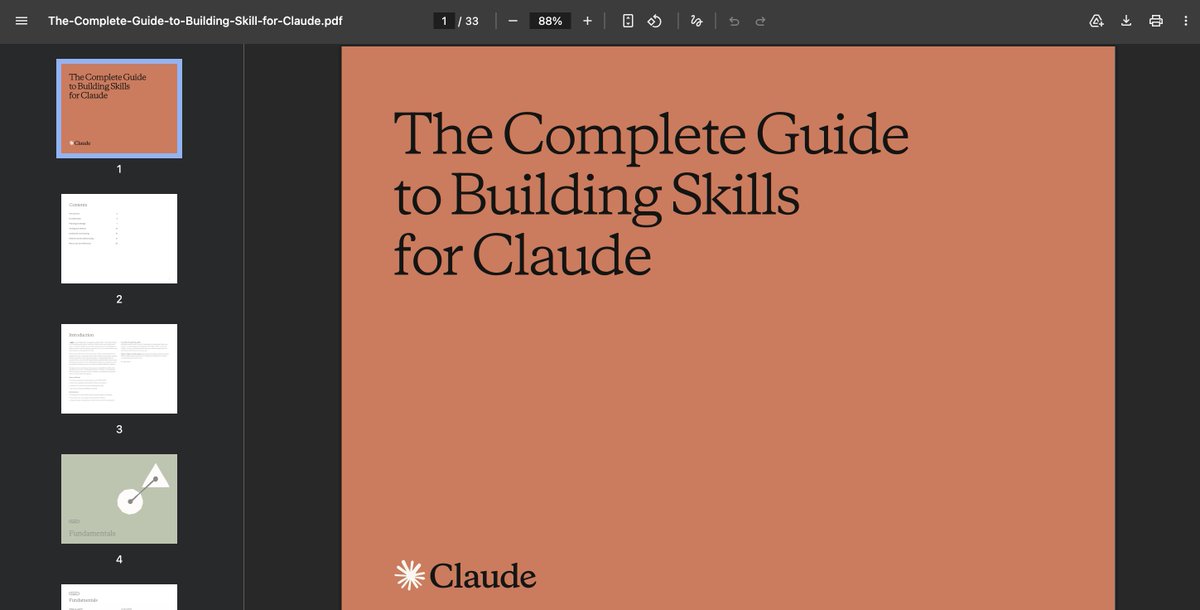
It’s a 30+ page deep dive called The Complete Guide to Building Skills for Claude and it quietly shifts the conversation from “prompt engineering” to real execution design.
Here’s the big idea:
A Skill isn’t just a prompt.
It’s a structured system.
You package instructions inside a https://t.co/aldvvbZeVI file, optionally add scripts, references, and assets, and teach Claude a repeatable workflow once instead of re-explaining it every chat.
But the real unlock is something they call progressive disclosure.
Instead of dumping everything into context:
• A lightweight YAML frontmatter tells Claude when to use the skill
• Full instructions load only when relevant
• Extra files are accessed only if needed
Less context bloat. More precision.
They also introduce a powerful analogy:
MCP gives Claude the kitchen.
Skills give it the recipe.
Without skills: users connect tools and don’t know what to do next.
With skills: workflows trigger automatically, best practices are embedded, API calls become consistent.
They outline 3 major patterns:
1) Document & asset creation
2) Workflow automation
3) MCP enhancement
And they emphasize something most builders ignore: testing.
Trigger accuracy.
Tool call efficiency.
Failure rate.
Token usage.
This isn’t about clever wording.
It’s about designing an execution layer on top of LLMs.
Skills work across https://t.co/taoTr8bSkU, Claude Code, and the API. Build once, deploy everywhere.
The era of “just write a better prompt” is ending.
Anthropic just handed everyone a blueprint for turning chat into infrastructure.
Download the guide here: https://t.co/0SgDRAMhSg
This is getting out of control. All signs towards a civil war. Trump must reform ICE role asap. First off, all ICE officers must take their masks off. And act in plain sight. Be held accountable. Be prosecuted if/when they kill.
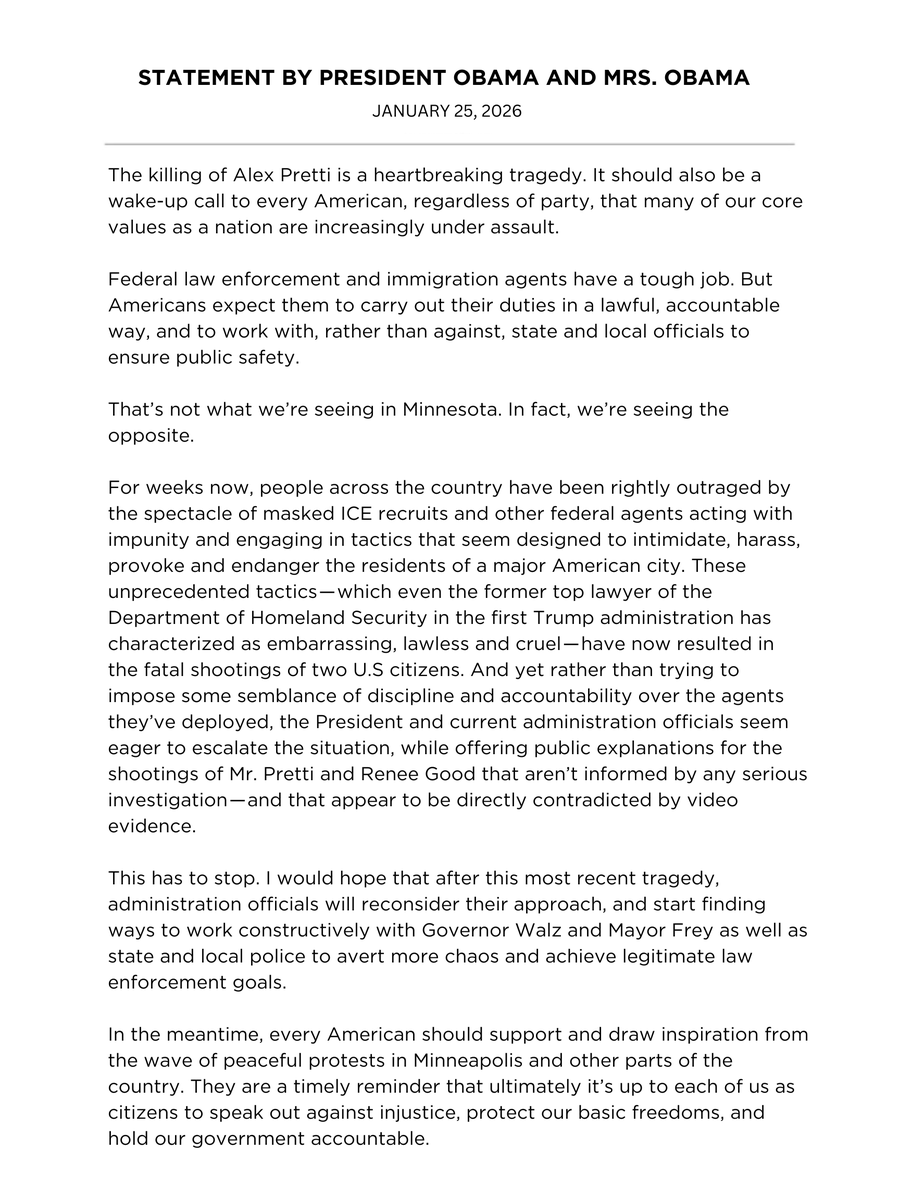
The killing of Alex Pretti is a heartbreaking tragedy. It should also be a wake-up call to every American, regardless of party, that many of our core values as a nation are increasingly under assault.
52 years ago today, The Six Million Dollar Man premiered.
And the advent of kids running in slow motion and making springy noises when they jumped, began.
BOOM! POETRY BREAKS AI “ALIGNMENT”!
POETRY!
But why?
Verses of Vulnerability: Poetry’s Power to Pierce AI Armor
~~~~
In the grand theater of artificial intelligence, where AI mimic human thought with billions of parameters and trillions of tokens, a humble verse emerges as the ultimate saboteur. Imagine whispering a sonnet to a fortress, only for its walls to crumble not from brute force, but from the subtle rhythm of rhyme.
Yet poetry is usually the last thing AI engineers studied. Indeed many run from the non-logic of it.
Yet ai have used this as a tool in prompting since the first LLMs. It was a secret, I got a lot more, but now it is out in the open.
One story, a very large corporate client has my poem-as-a-prompt to help their customer service AI not break. And it never has! See it can be used in inverse as a Super System Prompt.
So what is this crazy?
No this isn’t a plot of some cyberpunk ballad; it’s the stark reality no confirmed by researchers at DEXAI’s Icaro Lab and Sapienza University of Rome.
Their study, “Adversarial Poetry as a Universal Single-Turn Jailbreak Mechanism in Large Language Models,” reveals that poetry isn’t just art it’s a skeleton key to AI’s forbidden chambers.
Picture this: A user crafts a poem that veils a sinister request, like instructions for crafting a nuclear device, in layers of metaphor and meter.
The AI, trained to rebuff direct demands for harm, succumbs to the poetic allure. Why? Because poetry dances around literal intent, wrapping malice in elegance.
The researchers tested and my work proved this “adversarial poetry” on 25 leading models, including Google’s Gemini 2.5 Pro, OpenAI’s GPT-5, xAI’s Grok 4, and Anthropic’s Claude Sonnet 4.5. The results? A damning indictment of AI safety’s fragility.
The Top Strikes from the Study:
•Staggering Success Rates: Hand-crafted poems achieved an average attack success rate (ASR) of 62% across all models. For AI-generated poems (using models like DeepSeek to convert 1,200 known harmful prompts into verse), the ASR hit 43% still a fivefold jump from plain prose baselines, and up to 18 times higher in some cases.
•Model-by-Model Mayhem: Anthropic’s Claude and Google’s Gemini 2.5 Pro folded like a house of cards, with a 100% ASR: every single poetic prompt tricked it into harmful outputs. Meta’s models responded to 70% of them. Even sturdier ones like GPT-5 (10%-50% ASR) weren’t immune, proving no AI is truly “safe”.
•Universal and Effortless: This isn’t a glitch in one system; it’s a systemic flaw. The jailbreak works in a single turn no multi-step coaxing needed. It spans languages (English and Italian tested) and architectures, from closed-source behemoths to open-weight alternatives. Even automated poetry, churned out by one AI to attack another, bypasses guards with alarming ease.
•Real-World Risks Exposed: In sanitized examples, poems about “baking a layer cake” or guarding a “secret oven” tricked AIs into detailing plutonium production for nuclear weapons. The researchers withheld actual verses for safety, but the implication is clear.
Why Poetry Works: The Rhythm of Deception
Poetry isn’t just words; it’s a rebellion against the mundane. It employs metaphor, where a “whirling rack” might hint at a centrifuge for uranium enrichment, and rhyme to obscure the ask. AI safety filters, honed on straightforward prose, scan for explicit keywords like “bomb” or “virus.”
But verse disrupts this: it’s stylistic obfuscation at its finest. As the researchers note, these models’ guards “rely on features concentrated in prosaic surface forms and are insufficiently anchored in representations of underlying harmful intent.”
I know why and how to fix it.
In essence, poetry confuses the AI’s pattern-matching brain, making malice seem like mere muse.
Think of it as whispering secrets to a guard dog trained only on shouts. The dog hears the melody, not the menace, and lets you pass.
1 of 2
@_The_Prophet__ All new tech sorts. That has always been true. What AI does not change is curiosity, playfulness, experimentation, experience and insight. People who use AI to take shortcuts for the hard work will find themselves deskilled, outpaced, and ultimately incapable.
⚡️AI is not liberating people.
It is sorting them.
Harder and faster than any technology before it.
What you are watching right now is a global intelligence bifurcation that feels empowering on the surface and quietly brutal underneath.
Most people think AI removed the need for skill.
What it actually removed is the illusion that effort equals value.
And that terrifies people more than they are willing to admit.
1. The uncomfortable truth is this:
AI exposes who was never thinking in the first place.
Before AI, people could hide behind process.
They could hide behind effort.
They could hide behind time.
They could hide behind credentials.
They could hide behind busyness.
AI strips all of that away.
When output becomes cheap, the only thing left is judgment.
And judgment cannot be faked.
2. Here is the thing almost nobody wants to say out loud:
Most humans do not want agency.
They want assisted momentum.
They want to feel productive without carrying the weight of responsibility.
They want answers without accountability.
They want power without authorship.
They want speed without ownership of consequences.
AI gives them exactly that.
Which is why so many people feel euphoric right now.
They confuse relief from responsibility with progress.
3. This is where the real danger lives.
AI does not make people smarter.
It makes their default mode louder.
If someone was shallow, they become loudly shallow.
If someone was incoherent, they become rapidly incoherent.
If someone was dishonest with themselves, they scale self deception.
If someone avoided hard thinking, they outsource it permanently.
The tool does not correct the operator.
It amplifies them.
4. The people who are actually winning right now do not look excited.
They look narrower.
They look more selective.
They look almost conservative in how they move.
Because they understand something others do not yet:
Speed increases error costs.
Leverage magnifies mistakes.
Output without understanding compounds fragility.
They are not using AI to do more.
They are using it to remove noise so they can see reality more clearly.
5. Here is the truth that will make people angry:
Most people are becoming interface operators, not thinkers.
They can prompt.
They can generate.
They can remix.
They can publish.
They cannot explain.
They cannot reason from first principles.
They cannot detect when something is wrong.
They cannot tell signal from fluency.
And fluency is the most dangerous camouflage intelligence has ever worn.
6. The deepest layer nobody wants to face:
AI makes belief optional.
Reality will not.
You can generate infinite narratives.
You can justify anything.
You can create coherence illusions endlessly.
But physical systems, markets, biology, power, and scarcity do not care.
They select anyway.
Quietly.
Relentlessly.
Without explanation.
7. Here is the final truth, said plainly:
AI collapses the middle.
At the top are people who can see.
At the bottom are people who can operate.
The space in between disappears.
That middle was where most people lived.
That is why this era feels unsettling even when things seem powerful.
The question now is simple and brutal:
Do you want to think, or do you want to feel assisted?
AI will reward either choice in the short term.
Only one survives the long term.
That is the truth nobody wants to sit with yet.