Believe it or not, bug hunting is a serious process, with or without AI.
Without a solid technical foundation, even if you manage to discover a vulnerability, understanding what it actually means, how it can be exploited, and how it fits into the broader security context can still be difficult. AI has undoubtedly made many parts of this process easier, but I still try — and I know many other researchers do as well — to focus on finding more complex vulnerabilities and building meaningful scenarios around them. Knowledge only really becomes valuable when it is combined with experience.
That is why I find the following situation particularly frustrating.
If I spend hours researching a private, invite-only program that joined Bugcrowd only a week or two ago, submit valid findings, and then receive responses saying, “We already knew about this because it was reported on our previous platform in 2025,” I do not think this only affects researchers. I believe it is also unfair to the effort being spent by Bugcrowd’s own triage team.
Everyone’s work is ultimately tied to time, and time has value.
Researchers are regularly given guidance such as “how to avoid duplicates,” which is completely reasonable. But I think programs should also receive clearer guidance on how they are expected to operate when moving to Bugcrowd, especially when they already have a large backlog of known vulnerabilities from another platform.
We have all become somewhat used to seeing Critical or High severity findings answered with “we already know about this.” I can accept that a known issue may not qualify for a monetary reward. But at the very least, could there be a mechanism to ensure researchers still receive the points they would have earned for a valid finding?
Since the beginning of November alone, I have received 16 duplicate decisions. Until now, I honestly did not make much of an issue out of it. What changed my perspective was learning that some of these findings were being treated as duplicates because they had been reported on a completely different platform before the program even joined Bugcrowd.
I originally wanted to write a much more detailed email, but I am currently dealing with a small power outage, so I wanted to at least share the core of my concern.
My fiancée’s birthday and mine are both coming up in about a week, and perhaps that has made me think a little more about how much of our lives we all spend working just to make a living. I am raising this concern not only for myself, but also for researchers who spend their time seriously working on these programs every day.
I genuinely like Bugcrowd and want to see the platform improve. So I hope you do not take this as a complaint for the sake of complaining, but rather as constructive criticism from someone who wants the ecosystem to be better for both researchers and triage teams. @Bugcrowd #bugbounty
I'm genuinely furious with how @Meta@metabugbounty has handled my security research.
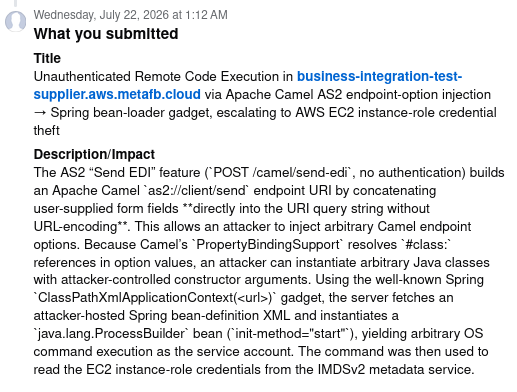
On July 22, I submitted a report demonstrating a FULLY WORKING, UNAUTHENTICATED REMOTE CODE EXECUTION vulnerability in a Meta-hosted cloud service.
It took over 100 days for this report to even reach the appropriate engineering team for investigation. Over three months of waiting for a critical security vulnerability to be properly reviewed.
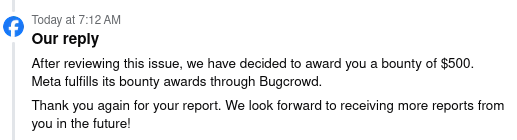
And the final reward? $500.
For those interested in the technical details:
The vulnerability involved unsanitized user input being concatenated into Apache Camel AS2 endpoint URIs, allowing arbitrary endpoint option injection.
I discovered that Camel's property binding mechanism allowed arbitrary Java class instantiation through #class: references. By leveraging Spring's ClassPathXmlApplicationContext, I was able to load a remotely hosted Spring configuration and instantiate java.lang.ProcessBuilder, achieving arbitrary OS command execution.
From there, I demonstrated access to AWS EC2 instance-role credentials through the instance metadata service.
This was not theoretical. I demonstrated the entire exploit chain.
AND I STOPPED THERE.
I deliberately did not use the obtained credentials against AWS APIs or investigate how much further I could escalate within their AWS environment. I had already demonstrated the impact and chose to respect the program rules.
Meanwhile, vulnerabilities involving similar levels of impact have reportedly received bounties of over $150,000.
$150,000 versus $500.
I spent significant time finding, validating, documenting, and responsibly disclosing a critical vulnerability. I provided reproduction evidence and remediation recommendations. I exercised restraint rather than pushing further into their AWS environment.
And after making me wait over three months, this is how Meta values that work?
I'm not demanding an automatic $150K payout. I'm demanding an actual, technically defensible explanation of how anyone could arrive at a $500 valuation for a demonstrated unauthenticated RCE with access to AWS credentials.
This is an insult to the independent security researchers who dedicate their time to protecting your infrastructure.
What incentive are you giving researchers to continue responsibly disclosing critical vulnerabilities when this is how you treat them?
I genuinely expected better. This experience has completely destroyed my confidence in Meta's bug bounty program.
@Meta, @metabugbounty enough with the boilerplate responses. I want an actual explanation.
🔴 CRITICAL 9.5 · React: remote code execution in server components (CVE-2026-126187)
An unauthenticated attacker can run arbitrary code on the server by sending a crafted request, without logging in.
👉 Fix: 19.0.9, 19.1.10 and more
https://t.co/0Oh2rKFY2Y
@k0imet@IntCyberDigest Exactly I was annoyed too that this channel is spamming dumb as fuck news on us as if there's nothing better to share. I wanna throw up
@IntCyberDigest This was just a bait to hook ppl in. The guy admitted their post was a joke. And you're using it to raise views too. There's nothing special about it as well. Please stop throwing dogshit on us
@a7mad__n1@bigbrainer33@Hacker0x01 They don't really care if its your friend now. If the logs show you were related then you'll be blocked my bro
After they updated their policies you could've made an action about it
But now let's hope when you contact them they'll resolve it soon
A friend responsibly disclosed a critical fund drain vulnerability to a protocol.
They downgraded the severity. Paid him $75 "appreciation" and told him to use it for his Claude subscription (which costs $200). Then refused to fix the bug.
Today that same protocol got drained from the exact exploit he reported.
If you have substantiatial money in DeFI, i advice you pull it out. Some of these protocols you're trusting with your funds genuinely do not care about securing them.
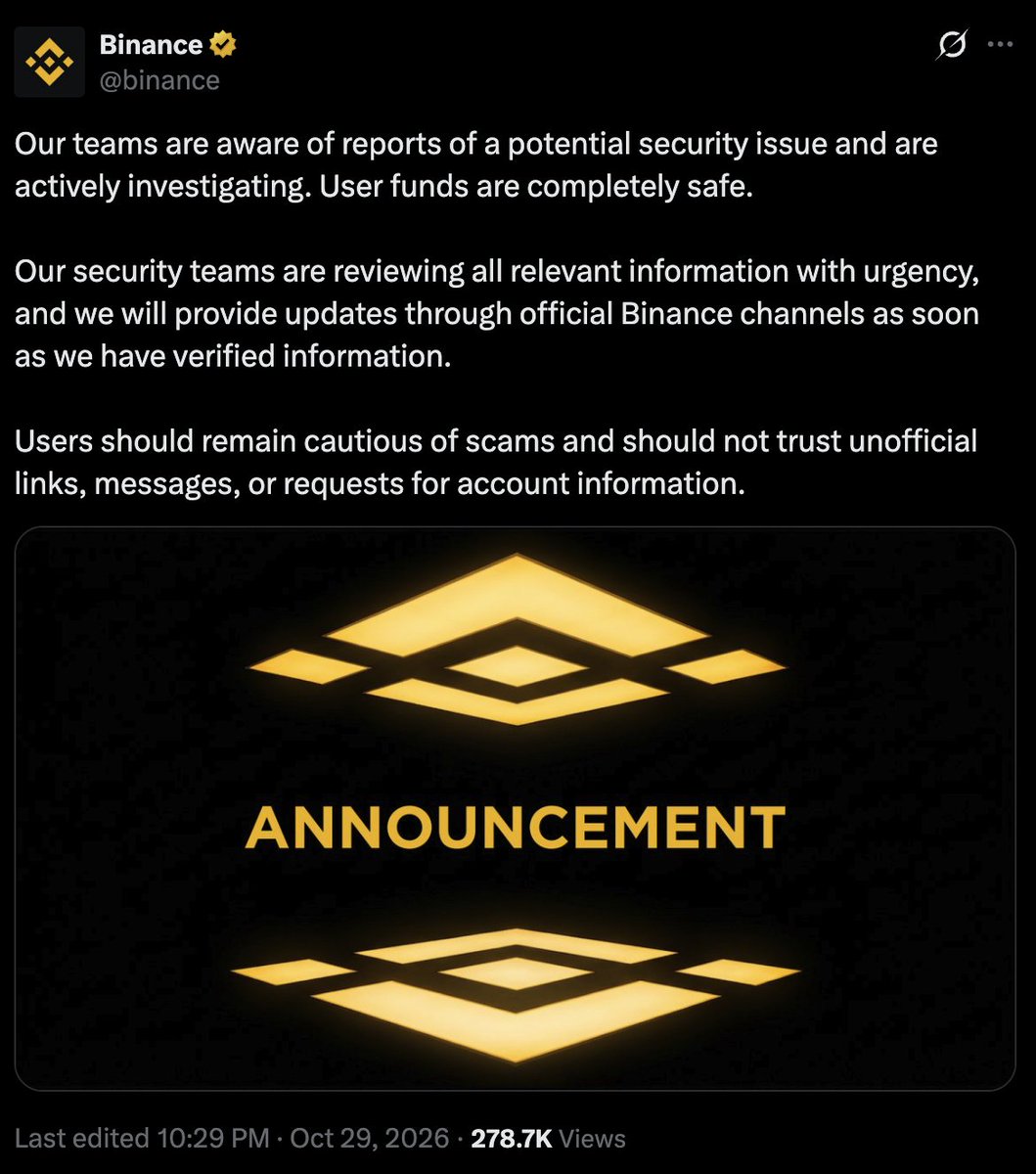
‼️ BREAKING: The Binance hack has grown to about $5.6B drained across Ethereum, Bitcoin and Tron, on-chain trackers say.
If confirmed, it would be the biggest crypto heist on record.
Tether and Circle have frozen about $1.8B in stablecoins, and Circle says it acted "in coordination with law enforcement."
Binance hasn't confirmed any impact on user funds.
🚨Over $5.6B stolen from Binance, biggest hack in crypto history
Seems ~2B of USDC/USDT were frozen by Tether & Circle, it's highly likely the other Binance listed tokens will be dumped
php2shell is one of the most impactful bugs in recent times, yet threat actors aren’t mass exploiting it
the bug is so complex that even porting the exploit between targets takes serious skill, human or ai
so i benchmarked how well open and frontier models can do it. 🧵
@S1r1u5_@rauchg Vulnerabilities will forever exist UNLESS you make the whole process DETERMINISTIC. And for that you need shit tons of trillions of informations
And with the current architecture of llms? I'd say it'll persist
It'll become more of a creativity race
@yo_yo_yo_jbo@S1r1u5_ I think that the entropy and complexity of finding a vuln is much more consistent then province none because natural law tends to break using less energy then to build
It's really something to meditate on
I engineered an approach that uses these models cheaply with the highest ROI possible
Chromium exploitation and container escapes became even more fun this way! And easier
I think every zero day / bug bounty hunter should approach their hunting with no less then two models!
You need to learn rotating because you'll be surprised when you channel each models strengths into what's best for it
For example there's models that are excellent at overall source code review and agnetic tasks like Muse spark 1.3
But are awful in exploit scripting and debugging comparing to other models like GLM 5.3
DeepSeek 4.1 is excellent too in bug hunting but it's awful in other shit