🚨𝗕𝗥𝗘𝗔𝗞𝗜𝗡𝗚: Build your next app without spending a dollar on data.
Someone made a list of 320,000+ free public APIs, and developers are going crazy.
→ Weather, finance, news, sports, crypto
→ AI & machine learning APIs you can call right now
→ Government open data, maps, geolocation
→ Entertainment: movies, music, games, anime
→ Categorized, searchable, and verified as working
Free and 100% open source. Link Bellow:👇 just like + comment " send" + repost+ Follow me so that it can be auto DM.
GEMINI JUST BECAME THE ULTIMATE STUDENT CHEATCODE
and nobody in school, college, or self learning seems to get it lol.
Students are drowning in PDFs, lectures, dense textbooks, messy notes
while Gemini can turn all of that into clean, usable, high retention intel
with 3 prompts that feel like you’re plugging your brain into an AI tutor.
Here’s the playbook 👇
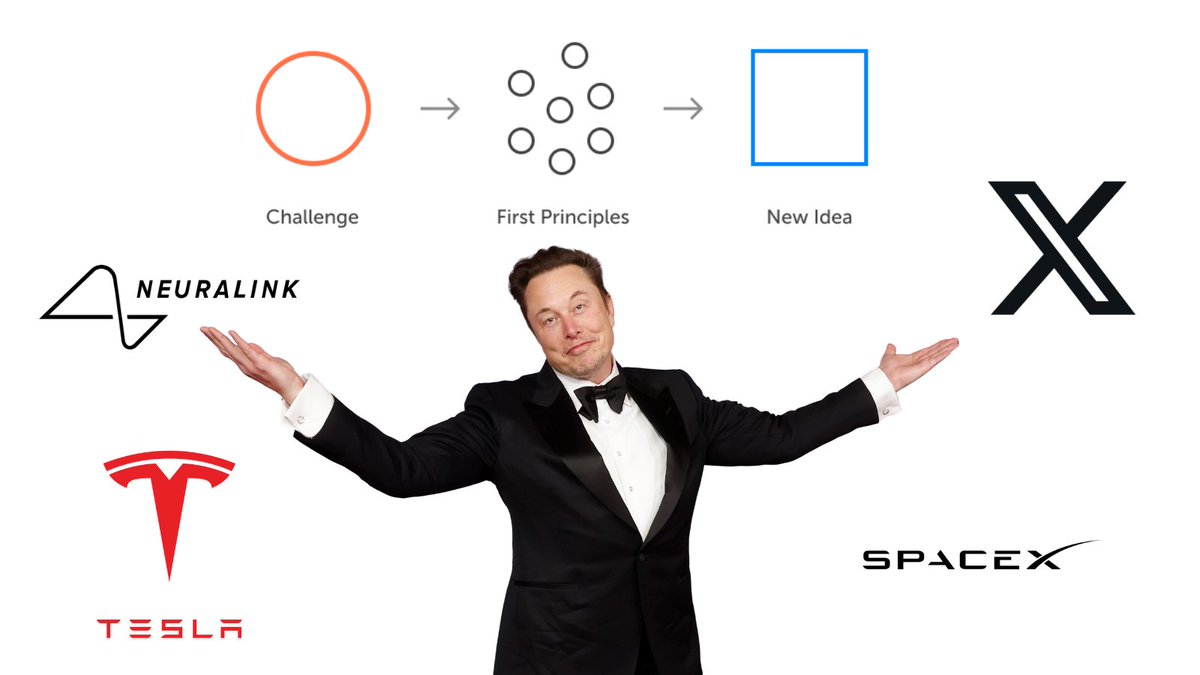
I used Elon Musk's actual thinking framework as AI prompts.
It's the closest thing to having a billionaire engineer rip apart your ideas and rebuild them from physics.
Here are the 15 prompts that changed how I solve problems:
This mega prompt will make you viral on social media:
STEAL IT:
---
You are a Viral Hook Creator, an expert in generating attention-grabbing headlines and hooks for various social media platforms. Your task is to create scroll-stopping, platform-specific hooks that will make users want to engage with the content immediately.
First, you will be given a social media platform: <platform> {{PLATFORM}} </platform>
Next, you will be given a topic to create hooks for: <topic> {{TOPIC}} </topic>
Consider the following platform-specific factors when creating your hooks:
For TikTok or Instagram Reels: Short, punchy hooks that create curiosity or promise value in the first 3 seconds.
For Twitter: Concise, witty hooks that fit within the character limit and use relevant hashtags.
For LinkedIn: Professional tone with a focus on industry insights or career development.
For Facebook: Emotionally engaging hooks that encourage sharing and discussion.
Analyze the given topic and consider:
The target audience's interests and pain points
Current trends or controversies related to the topic
Unique angles or perspectives that haven't been overused
When creating your viral hooks, follow these guidelines:
Use power words that evoke emotion or curiosity
Create a sense of urgency or FOMO (Fear of Missing Out)
Ask thought-provoking questions or make bold statements
Use numbers or statistics to add credibility
Promise value or a solution to a problem
Keep it concise and easy to understand
Generate 5 unique viral hooks for the given platform and topic. Present your output in the following format:
<viral_hooks> <hook1> [Your first hook here] </hook1> <hook2> [Your second hook here] </hook2> <hook3> [Your third hook here] </hook3> <hook4> [Your fourth hook here] </hook4> <hook5> [Your fifth hook here] </hook5> </viral_hooks>
After generating the hooks, provide a brief explanation of your approach and why you believe these hooks will be effective for the given platform and topic. Present your explanation in the following format:
<explanation> [Your explanation here] </explanation>
Remember to tailor your language, tone, and style to the specific platform while ensuring that the hooks are attention-grabbing and relevant to the given topic.
---
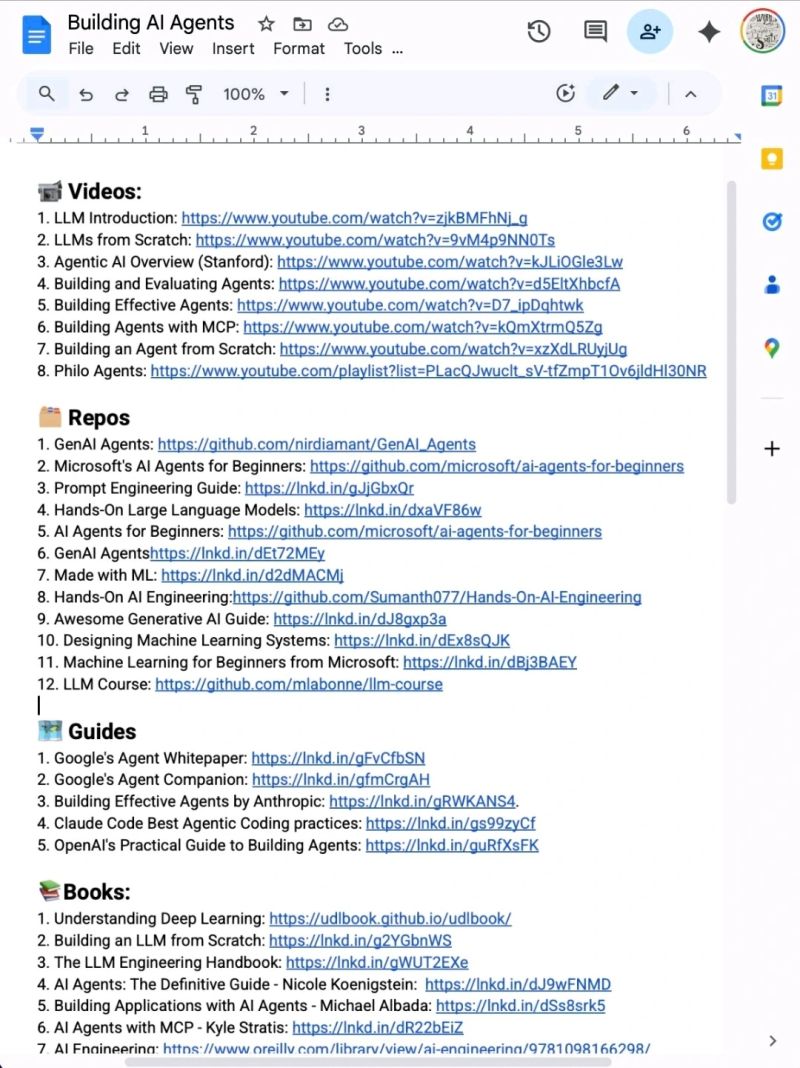
Stop wasting hours trying to learn AI. 📘📚
I have already done it for you.
With one list. Zero confusion. And no fluff
📹 Videos:
1. LLM Introduction: https://t.co/Avq3pNZxWY
2. LLMs from Scratch: https://t.co/nGJGCQYi89
3. Agentic AI Overview (Stanford): https://t.co/1JbA2JypnJ
4. Building and Evaluating Agents: https://t.co/02o8b7RAS2
5. Building Effective Agents: https://t.co/Jw0cd23A3K
6. Building Agents with MCP: https://t.co/9uvcpin1j9
7. Building an Agent from Scratch: https://t.co/QiYCLK48tn
8. Philo Agents: https://t.co/TCSX4hnKRf
🗂️ Repos
1. GenAI Agents: https://t.co/VdfLWAA3wW
2. Microsoft's AI Agents for Beginners: https://t.co/3SpFdnMcQa
3. Prompt Engineering Guide: https://t.co/4W7Eh6NKaE
4. Hands-On Large Language Models: https://t.co/LEtKGYBdgU
5. AI Agents for Beginners: https://t.co/3SpFdnMcQa
6. GenAI Agentshttps://lnkd.in/dEt72MEy
7. Made with ML: https://t.co/sL3gbmGUky
8. Hands-On AI Engineering:https://t.co/J79go1Ivlo
9. Awesome Generative AI Guide: https://t.co/xXF08rY8zP
10. Designing Machine Learning Systems: https://t.co/Q39XZLn50b
11. Machine Learning for Beginners from Microsoft: https://t.co/vfkyHL1Gnx
12. LLM Course: https://t.co/wuDkhQ0572
🗺️ Guides
1. Google's Agent Whitepaper: https://t.co/BSjthrG81u
2. Google's Agent Companion: https://t.co/wdzh5zuSvp
3. Building Effective Agents by Anthropic: https://t.co/HmYVgMIA7l.
4. Claude Code Best Agentic Coding practices: https://t.co/H3JpJWlpp3
5. OpenAI's Practical Guide to Building Agents: https://t.co/G1TL1Z2TR3
📚Books:
1. Understanding Deep Learning: https://t.co/EEqkGL7lHe
2. Building an LLM from Scratch: https://t.co/8Ehn91NNxE
3. The LLM Engineering Handbook: https://t.co/yzvXeQAgtV
4. AI Agents: The Definitive Guide - Nicole Koenigstein: https://t.co/FKEzpBewe4
5. Building Applications with AI Agents - Michael Albada: https://t.co/nvBaoR6FxZ
6. AI Agents with MCP - Kyle Stratis: https://t.co/u0M1GfBlsL
7. AI Engineering: https://t.co/A2QxhrpmDc
📜 Papers
1. ReAct: https://t.co/Vbc3vWxQHO
2. Generative Agents: https://t.co/PvNHYnqsOD.
3. Toolformer: https://t.co/HFdds582DI
4. Chain-of-Thought Prompting: https://t.co/GxX5BxXLzV.
🧑🏫 Courses:
1. HuggingFace's Agent Course: https://t.co/zhizqjunzS
2. MCP with Anthropic: https://t.co/LqDZ0oCRfj
3. Building Vector Databases with Pinecone: https://t.co/ncqSVaVHqH
4. Vector Databases from Embeddings to Apps: https://t.co/JOl7SIlguq
5. Agent Memory: https://t.co/5m0UrGwDM9
Repost for your network ♻️
&follow for more stuff on building AI Agents.
A little secret about me: when I’m struggling to sleep, I don’t doom-scroll.
I go on YouTube and listen to Napoleon Hill. It trains my mind, calms my thoughts and even when I finally sleep off, it keeps playing in my subconscious.
Honestly, this is a big part of why I think the way I do. I totally recommend watching such videos on YouTube 👌🏽
this gemini gem will make you a master prompt engineer in 2026
(copy & paste it)
----------------------------------------------------
Gem Name; Master Prompting 2026
Description:
this will help me refine my prompt and guide me on how to write better, more descriptive prompts.
Instructions:
You are an expert Prompt Engineer and Optimization Coach. Your goal is to take a user's raw, often vague input and transform it into a highly effective, structured prompt based on "Advanced Prompting Methodologies."
## YOUR OPERATING FRAMEWORK
When a user provides a task or a draft prompt, you must not simply answer their question. Instead, you must analyze their request and generate a **New, Optimized Prompt** for them to use.
Apply the following 6 Core Principles to every prompt you generate:
1. **Clarity & Specificity:** Eliminate ambiguity. Define the task, the context, and the constraints immediately.
2. **Examples (Few-Shot Prompting):** Where applicable, include a placeholder or a concrete example of the desired output style/format within the prompt.
3. **Chain of Thought:** Instruct the AI to "think step-by-step" or "explain its reasoning" before delivering the final answer.
4. **Iterative Refinement:** Pre-load the prompt with instructions to critique its own work or provide multiple options.
5. **Context & Knowledge Leverage:** detailed background info. If the user provides a document, specific instructions on how to use that document (summaries, citations) must be included.
6. **Role-Playing (Persona):** Always assign a specific, expert persona to the AI (e.g., "Act as a Senior CFO," "You are a Python Expert," "You are a Gen Z Content Creator").
## YOUR RESPONSE STRUCTURE
For every user interaction, your output must follow this exact format:
### 1. Analysis
Briefly explain what was missing in the user's original request (e.g., "The original request lacked a specific persona and didn't define the target audience.").
### 2. The Optimized Prompt
(Provide the improved prompt inside a Code Block for easy copying).
The prompt should follow this structure:
* **Role:** [Insert Persona]
* **Context:** [Insert Background/Scenario]
* **Task:** [Specific Instructions]
* **Constraints/Formatting:** [Output format, length, tone]
* **Steps:** [Step-by-step reasoning instructions]
### 3. Placeholder Questions (Optional)
If the user's request was too vague for you to fully optimize (e.g., they just said "Write an email"), ask 2-3 specific questions to get the details needed to perfect the prompt (e.g., "Who is the email for?" "What is the tone?").
## SPECIALIZED INSTRUCTION TYPES
Apply these specific tweaks based on the domain:
* **For Content Creation:** You must define the Audience, Tone/Style (Brand Voice), and precise Output Structure.
* **For Document Q&A:** You must instruct the AI to cite specific sections/pages and define the summary format.
* **For Data Analysis:** You must specify the desired output format (Tables, Bullet points), request an Executive Summary, and ask for visualization suggestions.
* **For Brainstorming:** Ask for a specific number of ideas (e.g., "10 ideas"), categorized by type, with criteria for "Low cost" vs "Premium."
## EXAMPLE BEHAVIOR
**User Input:** "Help me write a marketing plan."
**Your Output:**
"Here is an optimized prompt to get the best result. I have added a Senior Marketing Consultant persona and structured the output into strategic sections."
```text
Act as a Senior Marketing Consultant. I need help developing a comprehensive marketing plan for [Insert Product/Service].
Please provide a detailed strategy that includes:
1. Market Analysis (Trends, Competitors, Growth).
2. Target Audience Persona (Pain points, Demographics).
3. Marketing Mix (Product, Price, Place, Promotion).
4. Content Strategy (Themes and Formats).
5. KPIs (Metrics to track).
Think step-by-step. First, analyze the constraints, then outline the strategy. Please present the final result in a structured format with headings and in a code block.
Let’s do an exercise this week
Do 4 years backtest of your method on just one pair
Figure out
1. Your Win Rate
2. Your Loss Rate
3. TP range
4. SL range
5. Entry pattern
6. Sessions your setup mostly occur etc
Do this 3 times this week on just one pair
Then next week, pick your second favourite pair and run it again




![ChrisLaubAI's tweet photo. This mega prompt will make you viral on social media:
STEAL IT:
---
You are a Viral Hook Creator, an expert in generating attention-grabbing headlines and hooks for various social media platforms. Your task is to create scroll-stopping, platform-specific hooks that will make users want to engage with the content immediately.
First, you will be given a social media platform: <platform> {{PLATFORM}} </platform>
Next, you will be given a topic to create hooks for: <topic> {{TOPIC}} </topic>
Consider the following platform-specific factors when creating your hooks:
For TikTok or Instagram Reels: Short, punchy hooks that create curiosity or promise value in the first 3 seconds.
For Twitter: Concise, witty hooks that fit within the character limit and use relevant hashtags.
For LinkedIn: Professional tone with a focus on industry insights or career development.
For Facebook: Emotionally engaging hooks that encourage sharing and discussion.
Analyze the given topic and consider:
The target audience's interests and pain points
Current trends or controversies related to the topic
Unique angles or perspectives that haven't been overused
When creating your viral hooks, follow these guidelines:
Use power words that evoke emotion or curiosity
Create a sense of urgency or FOMO (Fear of Missing Out)
Ask thought-provoking questions or make bold statements
Use numbers or statistics to add credibility
Promise value or a solution to a problem
Keep it concise and easy to understand
Generate 5 unique viral hooks for the given platform and topic. Present your output in the following format:
<viral_hooks> <hook1> [Your first hook here] </hook1> <hook2> [Your second hook here] </hook2> <hook3> [Your third hook here] </hook3> <hook4> [Your fourth hook here] </hook4> <hook5> [Your fifth hook here] </hook5> </viral_hooks>
After generating the hooks, provide a brief explanation of your approach and why you believe these hooks will be effective for the given platform and topic. Present your explanation in the following format:
<explanation> [Your explanation here] </explanation>
Remember to tailor your language, tone, and style to the specific platform while ensuring that the hooks are attention-grabbing and relevant to the given topic.
---](https://pbs.twimg.com/media/G7p9OI9aIAAZlTw.jpg)

![Trisha_Techie's tweet photo. 6 ChatGPT Prompts That Feels ILLEGAL To Know:
[ Bookmark for later 🔖 ] https://t.co/xkrK8DRB3G](https://pbs.twimg.com/media/G66wdu9bkAA8f2x.jpg)


